Summary
- Zayo prints four route-mile totals and four fiber-mile totals across the ten documents I read on 21 November 2026. Exactly one sentence puts a fiber figure and a route figure together under one scope and one date: the 1 May 2026 release, at 32 million fiber miles and 224,000 route miles across North America.
- Divided under the definition Zayo published in its 2019 annual filing, that pair gives about 142.9 strands per route mile. The division is mine, not Zayo's. The same fiber total against a shorter 210K trench gives about 152.4 — which is how an average moves when not one strand changes.
- A strand count for a named route appears in the record twice, both from 2017: 432 fibers available on an 825-mile New York–Chicago route, and a Chicago metro build of 20 segments carrying 280 strands, up to 26 per segment. Nothing published since states strands on any named route or segment.
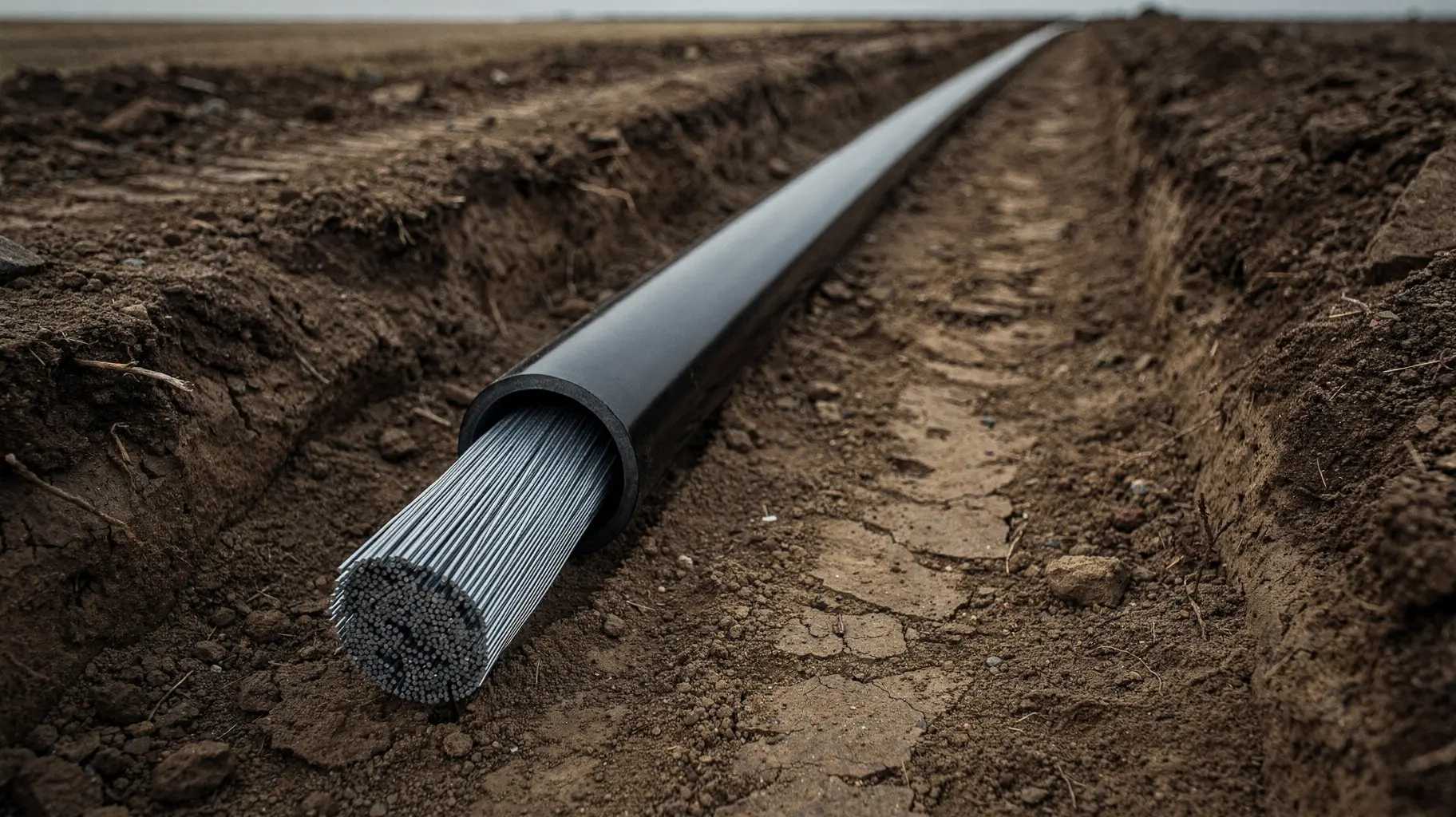
A fiber network is two objects stacked on each other. There is the trench, a line on the ground that is one mile long if it is one mile long, whatever is buried in it. Then there is the glass: a cable inside that trench holding some number of strands, each of which can carry light.
Zayo has told readers how to count both, once. In the glossary of its annual report for the fiscal year ended 30 June 2019, filed with the US Securities and Exchange Commission, the company wrote: "Fiber miles—The number of route miles in a network multiplied by the number of fiber strands within each cable on that network. For example, if a ten-mile network segment has a 144 count fiber installed, it would represent 10x144 or 1,440 fiber miles." The same glossary treats route miles as the actual number of non-overlapping miles the network traverses, and keeps the two units apart on purpose. One counts ground. The other counts ground multiplied by glass. That definition is the most useful sentence in the entire pile of documents I read, and it was published seven years ago (Form 10-K, fiscal year ended 30 June 2019).
No page I read in November 2026 restates it.
Four trenches, four numbers
Zayo does not print one route-mile total. It prints four, at four paces.
The homepage, which carries no date, sets "More than 230,000 route miles worldwide*" beside "34M fiber miles worldwide*" (zayo.com). Both figures carry an asterisk. In two separate retrievals of that page text, no footnote appeared explaining what it stands for. That is a bounded observation about two readings, not a claim about the page.
The network page also carries no date, and it does something the homepage does not: it prints a second fiber total in a different scope. "34M fiber miles worldwide*" for the globe, "32M fiber miles" for North America without an asterisk, "More than 230,000 route miles worldwide*", and "11+ unique fiber routes in North America" (Our Network).
The What's New page puts the same 32 million fiber miles beside a smaller trench: "32M fiber miles" and "210K route miles" for the North American network, in a stat block with no date on it (What's New).
The Backbone for AI page restates the pair in capitals and adds a third scope inside itself — not the operating network but the work in progress: "32M Fiber Miles in North America", "224,000 Total Route Miles in North America", and projects underway spanning over 15,000 route miles and approximately 20 million fiber miles (Backbone for AI).
Then there is the dark fiber product page, which quotes a number that composes with nothing: "We offer 19M+ miles of fiber and 11 unique long haul routes across North America." No route-mile total is attached to that 19 million, so nobody can divide it. The page says Zayo has "dense and deep fiber counts" and leaves it there (Dark Fiber).
The one place the pair closes
On 1 May 2026, announcing the close of its purchase of Crown Castle's fiber business, Zayo put both units in one sentence with one perimeter and one date: "The Zayo network spans 32 million fiber miles and 224,000 route miles across North America and connects more than 400 markets globally" (release, 1 May 2026).
Read that sentence twice, because it is doing something none of the undated pages do. It fixes the scope — North America — and it fixes the day. Everything else in this article has to be assembled from printings that carry neither.
The same release states what the acquisition added: "approximately 90,000 route miles and 40,000 on-net enterprise locations", and that the combined network "now spans 224,000 route miles across North America". It gives no fiber-mile figure for the acquired business at all.
Ten days short of six months later, on 15 October 2026, the newsroom index carries a summary line reading "Today, Zayo’s network spans 32 million fiber miles and 224,000 route miles…" (newsroom index). The line is truncated on the index and I did not open the release behind it, so its scope sentence is not something I can quote.
142.9, and whose number it is
Take the one sentence that composes and divide it. 32,000,000 ÷ 224,000 = 142.857. About 142.9 strands per route mile across North America on 1 May 2026.
That is my arithmetic on Zayo's printed figures, performed under a definition Zayo published in 2019 and has not restated since. Whether the 2019 definition still governs the 2026 numbers is an assumption, and it is the load-bearing one in this piece; I state it here because every ratio below rests on it.
What the number is: the average amount of glass behind each mile of trench, if you flatten a continent into one cable. What it is not: the strand count of any route, any segment, or any deal.
The same glass, a shorter trench
The What's New page prints the identical 32 million fiber miles against 210,000 route miles. Divide that: 32,000,000 ÷ 210,000 = 152.38, about 152.4.
Here is what should stop a reader cold. The fiber-mile figure did not change between the 210K printing and the 224,000 printing. The route-mile figure moved by 14,000. Either the two figures carry different dates or different perimeters, or one of them is stale, or the fiber total is simply not recomputed when the trench count changes. Both figures cannot be current, complete and measured on one perimeter at once, and no document I read reconciles them. That is my deduction from the printed record, offered with its alternatives, and it alleges nothing about intent.
The qualifier survives the division
The worldwide pair cannot be divided cleanly, and the article will not pretend otherwise. Thirty-four million fiber miles over "more than 230,000" route miles gives a value below 147.8 strands per route mile, because the denominator is a floor. A ceiling, not a figure. Anyone who quotes 147.8 as an exact result has thrown away the word "more".
The pair that carries an audited date
The 2019 filing reports 133,000 route miles and 13.0 million fiber miles as of 30 June 2019 — the only pair in the reviewed set that one document publishes with one as-of date. Divide it under its own glossary: 13,000,000 ÷ 133,000 = 97.74, about 97.7 strands per route mile (Form 10-K).
Subtract the acquisition from the current total and the arithmetic lands close: 224,000 minus approximately 90,000 gives approximately 134,000 route miles before the acquired contribution, against 133,000 in the 2019 filing. That resemblance is a coincidence of arithmetic. No document says the two describe the same network on the same perimeter, and nothing here should be read as continuity.
So the average has moved from about 97.7 to about 142.9 under the same definition, on a trench count that barely moved. Either the glass per mile rose by roughly half, or the counting changed, or the definition quietly stopped applying. The record does not say which.
The strands Zayo has actually printed
Two documents name strand counts on specific pieces of ground, and both are nine years old.
On 27 November 2017, announcing the Spread Networks acquisition, Zayo described "a 825-mile, high-fiber count long haul route connecting New York and Chicago" and wrote: "Of the 432 fibers available on the route, less than 25 percent are utilized today". The release also records overpull rights and additional conduit (2017 release). Four hundred and thirty-two fibers on 825 miles is roughly 0.52 fibers per route mile — the average of a single route, and about 275 times below the network figure above. Both numbers are correct. They answer different questions.
On 21 February 2017, Zayo announced a Chicago metro dark fiber build for a cloud customer: "The project will connect six data center locations with 20 diverse segments totaling 280 strands across all segments, with up to 26 strands per segment" (2017 release). Twenty segments, 280 strands, up to 26 on any one of them — the only per-segment distribution in the entire reviewed set.
That is where the trail ends. Across all ten documents, no page states how many strands the network carries per route mile, no page publishes a segment table joining route miles to fiber miles, and no page published after 2017 states a strand count for any named route or segment.
The practical consequence is blunt. A buyer sizing a route between two cities needs the number that appears in the 2017 releases and nowhere else: strands available on this segment, at this count, today. The published pair gives a continental average and a 2019 definition, and neither one helps write that clause.
What the arithmetic cannot do
A network that carries dense metro rings and lean long-haul spans has a per-route strand count nowhere near its own average, in either direction. The average is a real number about a real asset and it describes no part of it. It is not a capacity figure, not a lit-capacity figure, and not an available-strand figure.
What these six numbers are not
- 142.9, 152.4, 97.7 and the ceiling below 147.8 are my divisions of Zayo's printed figures. No page I read prints a strands-per-route-mile number.
- The fiber-mile definition is quoted from a 2019 filing. No 2026 document restates it, and nothing here asserts that it governs the 2026 figures — I assume it at the first ratio and say so.
- Each figure appears inside its own document's scope and date. I do not choose among 210K, 224,000 and more than 230,000, and I do not claim that one supersedes another.
- The 15 October 2026 release is known to me only through a truncated index line. Its body was not read and its scope is not asserted.
- The 2017 strand counts are printed as 2017 facts. Nothing here claims current availability on any route.
- The fixed 32 million fiber miles beside a moving trench count is my deduction, offered with three possible readings. No inflation, no double counting, no misstatement and no intent is alleged anywhere in this article.
Member Briefing
Read the full trend briefing
Members read the full briefing with the source notes behind every finding.
Strategic Circle
A daily briefing in your language, built from changes we have verified.
Join for USD 20/monthCancel anytime.
Members also get the full research library, a daily briefing on the networks they follow and the private forum.