
Summary
- XYZ.COM LLC is publicly identified as the operator or sponsoring organisation for .xyz and the sampled .audio, .auto, .autos, .baby, .beauty, .boats and .car top-level domains.
- Public delegation, agreement, policy, WHOIS, RDAP and abuse-contact records establish capability and accountability boundaries, but they do not establish repeated product reliability or attributable customer outcomes.
- The sampled records show a registry service provider in technical-contact and RDAP fields, making change control, evidence access, escalation and recovery shared operating concerns.
- Portfolio scale can reduce repeated work through common systems, yet it also increases correlated-failure risk and requires per-TLD supervision, integration, maintenance and exception handling.
A registry portfolio is an operating system, not a list of domain endings
XYZ.COM LLC is publicly associated with a portfolio of generic top-level domains, including .xyz and the sampled .audio, .auto, .autos, .baby, .beauty, .boats and .car namespaces. That portfolio looks simple when reduced to a commercial list. From an operator's perspective, however, each namespace is a persistent public system with contractual, technical and policy surfaces that have to agree. Delegation records must point to working name servers. Registration data services must answer through WHOIS or RDAP. Registrars need predictable provisioning behavior. DNSSEC policy must align with signing and key-management practice.
Abuse reports need an intake route and a decision path. Changes have to be coordinated across the registry operator, its registry service provider, registrars, ICANN and other dependencies.
The public record supports a careful analysis of that work, but not a performance verdict. IANA identifies the sponsoring organisation and exposes delegation fields. ICANN identifies the registry operator and links the applicable agreements. The registry website presents public policy, WHOIS, privacy, terms and abuse-contact surfaces. Those records establish Capability and responsibility boundaries. They do not establish measured product reliability, response time, availability, security effectiveness or a customer outcome.
This distinction matters because a registry can expose all expected interfaces while still requiring substantial supervision, integration, maintenance and exception handling. A buyer, registrar or governance team therefore should not ask only whether a control exists. It should ask who runs it, how failure is detected, what evidence is retained, how an exception is escalated, and how recovery works when multiple organisations share the path.
The exact company boundary
The current BTW directory object names XYZ.COM LLC, and the IANA .xyz record identifies the same legal entity as the sponsoring organisation.[1][8] The ICANN .xyz registry page also names XYZ.COM LLC as operator and dates the agreement to December 2013.[9] That is the defensible company boundary for this article.
The boundary is narrower than the public brand. The registry website uses .xyz and XYZ branding, while the IANA record lists a separate technical contact at CentralNic and an RDAP endpoint on a CentralNic domain.[2][8] The correct reading is not that the brand, the legal entity and every technical component are interchangeable. It is that XYZ.COM LLC holds the operator role visible in the delegation and agreement records while a named registry service provider appears in technical contact and data-service fields.
That distinction prevents two common errors. First, a public operator record does not prove that XYZ.COM LLC directly builds or operates every DNS, EPP, RDAP, WHOIS, data escrow or monitoring component. Second, a provider relationship does not transfer the operator's public accountability to the provider. Contract ownership, policy choices, escalation decisions and evidence review can remain with the operator even when technical execution is supplied elsewhere. The architecture visible from public records is therefore an accountability map, not a private systems diagram.
Capability, product reliability and customer outcome are three different claims
Capability is the easiest claim to support. The public pages show a WHOIS search surface, a registry-policy index, a privacy policy, terms, abuse contact information, IANA delegation records and ICANN agreement records.[2][4][5][6][7][8][9] The sampled portfolio records also expose nameserver, WHOIS, RDAP, technical-contact and operator fields.[10][11][12][13][14][15][16] These are observable interfaces and governance artifacts.
Product reliability is a different claim. It asks whether those interfaces operate correctly and consistently under ordinary load, deployment changes, dependency incidents and hostile traffic. A page that lists an RDAP endpoint does not show its latency, correctness, capacity, failover behavior or historical availability. A DNSSEC policy link does not show whether keys were rolled without incident. An abuse contact does not show triage quality or time to resolution. None of the reviewed material supplies a repeated measurement series that would justify a broad reliability conclusion.
A customer outcome is narrower still. It would require attributable evidence that a registrar, registrant or other stakeholder achieved a production result because of this operator's controls. Examples might include fewer failed provisioning transactions, faster recovery, lower abuse exposure or reduced manual review. The public records reviewed here do not provide that causal evidence. Consequently, this article treats the portfolio as a set of documented operator responsibilities and dependency boundaries. It does not turn existence into reliability, or reliability assumptions into a business result.
What the .xyz delegation actually establishes
IANA's .xyz delegation record supplies a useful minimum set of facts. It names XYZ.COM LLC as sponsoring organisation, gives administrative and technical contacts, lists authoritative name servers, and identifies WHOIS and RDAP service addresses.[8] It also records dates for registration and later updates. Those fields establish that .xyz is delegated and that public contact and service endpoints were recorded at the time of the page capture.
They do not expose the private topology behind those endpoints. The record does not say how many serving sites exist, how traffic is distributed, how capacity is forecast, how configuration is promoted, how a failed node is isolated or how monitoring is staffed. It also does not demonstrate that the named services answered correctly over a meaningful interval. A delegation record is authoritative inventory, not an availability report.
That difference defines the operator's continuing work. Someone must reconcile the public record against the actual service. Someone must detect an unintended nameserver, stale address, certificate problem, RDAP routing error or contact change. Someone must decide whether a discrepancy is a harmless publication lag or a production incident. If a registry service provider performs the technical change, XYZ.COM LLC still needs a review and escalation path because its legal operator identity remains visible to ICANN, IANA, registrars and the public.
Portfolio scale multiplies control surfaces
The sampled IANA pages for .audio, .auto, .autos, .baby, .beauty, .boats and .car each identify XYZ.COM LLC as sponsoring organisation and show technical contact, nameserver, WHOIS and RDAP fields.[10][11][12][13][14][15][16] Each sampled page also records a transfer to XYZ.COM LLC. The corresponding ICANN pages identify the operator and provide agreement records for those namespaces.[17][18][19][20][21][22][23]
This sample does not prove that every portfolio namespace has identical configuration or performance. It does show why portfolio operation is more than maintaining one shared service. Even when common infrastructure is reused, each top-level domain remains a separately delegated and contracted object. Its dates, amendments, policy details, reserved-name decisions, contacts and change history can diverge. A global change may therefore have a portfolio-wide technical implementation but a namespace-specific approval and evidence trail.
The operational challenge is configuration convergence without governance blindness. Shared automation can reduce repeated manual work, but an error in a common template can spread across many namespaces. Namespace-specific exceptions can preserve contractual accuracy, but too many exceptions make the shared system difficult to reason about. The operator needs both: common controls with explicit, reviewable variation. Public records show the objects that must be kept aligned; they do not show how effectively XYZ.COM LLC performs that alignment.
The registry service provider boundary
The IANA records in the sample list CentralNic in the technical-contact field and use CentralNic-hosted RDAP addresses.[8][10][11][12][13][14][15][16] That is meaningful evidence of a provider dependency. It is not evidence that all registry functions are outsourced, nor does it disclose commercial terms, private architecture or internal division of labor.
Operationally, the provider boundary creates at least four interfaces. There is a technical interface for DNS and registration-data services. There is a change interface for planned releases, configuration updates and emergency work. There is an evidence interface for logs, incident chronology and control attestations. There is a governance interface for deciding which organisation owns a policy exception, registrar dispute or public notice. Each interface needs named ownership and an escalation clock.
Provider dependence can improve capability by supplying specialised infrastructure and staff. It can also create coordination cost. When the public operator observes an anomaly, it may not possess every underlying signal. When the provider sees a technical symptom, it may not own the policy decision. Effective operation therefore depends on shared runbooks, access to evidence, agreed severity definitions, rehearsed communication and a route for executive escalation. The public pages establish that a provider appears in the chain. They do not establish the quality of that chain or whether it has succeeded during a real failure.
DNS delegation is a continuing reconciliation task
Authoritative DNS is the first public dependency visible in every sampled IANA record.[8][10][11][12][13][14][15][16] The records list name servers and addresses. That makes delegation inspectable, but it does not make it self-maintaining. Addresses change, infrastructure is replaced, routing policies evolve, and emergency mitigations can leave stale values behind.
The operator's work begins with change control. A proposed delegation change should be checked against the intended serving system, dependency ownership and rollback plan. It continues with observation: the registry needs to know whether all listed servers answer authoritatively, whether data converges, whether responses are consistent and whether failure is isolated or systemic. It ends with evidence: approvals, before-and-after states, provider confirmations and incident chronology should remain available for later review.
The important reliability boundary is that a correct public listing is a snapshot. It does not prove persistent reachability or response correctness. Likewise, a live answer at one moment does not prove geographic resilience, capacity under attack or clean failover. A responsible assessment therefore treats delegation records as necessary evidence of configuration and identity, not sufficient evidence of service quality.
DNSSEC adds key lifecycle work
The registry-policy page exposes a DNSSEC policy entry.[5] That is evidence that DNSSEC is part of the public policy surface. It does not reveal the private key-management architecture, ceremony, hardware custody, signing cadence, emergency rollover design or record of past transitions.
DNSSEC converts some DNS integrity questions into lifecycle questions. Keys must be generated and protected. DS information and signing keys must remain consistent across trust boundaries. Rollovers must be sequenced so that old and new material overlap correctly. Monitoring must detect signature expiry, publication gaps, validation failure and unexpected key state. Recovery procedures must cover both technical error and compromised material.
Portfolio operation makes those tasks harder because common tooling can affect multiple namespaces while each namespace still has an independent delegation and contract context. Supervision should therefore distinguish shared-system alarms from TLD-specific anomalies. Maintenance should include scheduled rollover preparation, inventory reconciliation and access review. Exception handling should define who can pause a change, who approves an emergency sequence and how the operator and provider communicate under time pressure.
Nothing in the public material supports a claim about XYZ.COM LLC's DNSSEC reliability or incident history. The evidence supports only the narrower conclusion that DNSSEC appears in the public policy surface and belongs in any serious operating assessment.
RDAP and WHOIS are data services, not static labels
The .xyz delegation lists both a WHOIS server and an RDAP endpoint, and the other sampled delegations expose the same categories of fields.[8][10][11][12][13][14][15][16] The registry website also provides a public WHOIS search page.[7] These observations establish data-access capability.
Operating those services requires more than keeping a port open. Responses must map correctly to registry data, respect disclosure policy, handle internationalised and malformed input, remain consistent with provisioning state and change when policy or protocol requirements evolve. A service can be reachable but still return stale, incomplete or inconsistent information. A web form can load while its backend path is degraded. For that reason, availability checks and data-quality checks should be separate.
The provider boundary matters here because the public RDAP address points to provider infrastructure. XYZ.COM LLC, as named operator, still needs a way to evaluate exceptions: disagreement between WHOIS and RDAP, a missing object, a privacy-related complaint, a registrar update that has not propagated, or a query pattern that resembles abuse. Maintenance includes schema changes, policy interpretation, client compatibility and capacity planning. Recovery includes data reconciliation after a failed deployment or dependency outage.
The public record does not disclose how these processes are implemented, so no reliability or customer outcome should be inferred.
EPP and registrar integration remain hidden but essential
Registrars need a provisioning path to create, renew, transfer, update and delete domain objects. In modern generic top-level domains that path ordinarily involves EPP, but the public pages reviewed here do not disclose XYZ.COM LLC's private EPP topology, command limits, extension set, deployment design or registrar support process. This absence is itself an important evidence boundary.
The operator still has predictable integration responsibilities. A command must be authenticated and authorised. Object state transitions must follow policy. Responses must be deterministic enough for registrar systems to handle. Billing, premium-name rules, reserved names and launch restrictions can alter an otherwise standard transaction. A registry service provider may execute the protocol, while the operator owns commercial or policy decisions that shape the result.
Reliability assessment should therefore separate protocol reachability from transaction correctness. A successful TCP connection is not a successful registration. A syntactically valid EPP response is not proof that the requested state reached every downstream service. Supervision needs synthetic transactions, reconciliation against authoritative data and clear handling for partial failures. Integration cost falls on both sides: the registry maintains behavior and notice discipline; registrars maintain client compatibility and operational support.
The reviewed sources support the existence of operator and registrar-facing responsibilities, but they do not support claims about transaction volume, error rate or registrar satisfaction.
Abuse controls begin with intake, not outcomes
The registry home and related pages present a route to contact the XYZ Anti-Abuse Team.[2][3][4][5][6][7] The ICANN agreement pages establish that each sampled namespace is operated under a registry agreement.[9][17][18][19][20][21][22][23] Together, these sources support the existence of a public abuse-contact surface and a contracted governance context.
They do not show how a report is validated, prioritised, correlated or resolved. An abuse mailbox can receive incomplete, malicious or duplicative reports. Evidence may identify content hosted elsewhere while the domain record is the only object under registry control. A registrar may hold the customer relationship. Law enforcement, security researchers, brand owners and ordinary users may apply different urgency and evidentiary standards. Automated signals can help triage but can also create false positives.
The real operator work lies between intake and action. Staff or trusted systems must validate the domain, preserve the report, identify the responsible party, apply policy, request missing evidence, record the decision, communicate with a registrar or provider and review any appeal. Emergency suspension may reduce one risk while creating another if attribution is wrong. A public contact therefore evidences Capability, not effectiveness. The reviewed record provides no measured abuse reduction, response-time distribution or customer outcome.
Policy publication does not prove policy enforcement
The registry site exposes a registry-policy index and a DNSSEC policy link.[5] Its terms state that posted policies and guidelines can form part of the website-use framework and that terms may change.[6] ICANN's agreement pages provide the contractual layer for each sampled namespace.[9][17][18][19][20][21][22][23]
Publication is necessary because registrars and other stakeholders need to know the rule set. Enforcement is a separate operational system. A policy has to be translated into validations, review queues, notices, permissions and exception paths. A changed rule has to reach documentation, software, registrar communications and support staff at a coordinated time. A legacy object may require treatment different from a new registration. A legal demand may conflict with the ordinary path.
For an assessor, the key question is traceability: can the operator connect a public rule to the control that applies it, the evidence that the control ran, the exception that altered it and the approval for that exception? The public pages do not answer that question. They show the published boundary but not the internal control design or its success rate. It would therefore be inaccurate to infer effective enforcement merely because a document exists.
Privacy obligations create another operating plane
The privacy page describes categories of personal information, cookies, service providers, marketing contact, user choices, security limitations and rights for certain residents.[4] It states that the policy may change and gives a contact route. These are public commitments for the website and related interactions, not a complete description of registry data processing.
Even at that narrower level, the commitments create maintenance work. Forms, analytics, cookies, retention practice and third-party services can change. The public text must remain aligned with actual collection and disclosure. Access and deletion requests need identity verification and a defensible response path. Security incidents can require communication across legal, technical and service teams.
Registry data adds further complexity, but the reviewed page does not specify every registry-data flow. The correct conclusion is limited: XYZ.COM LLC publishes a detailed privacy notice for the site, and that notice identifies responsibilities and limitations. It does not prove complete compliance, security effectiveness or a successful user outcome. A due-diligence review would need current data maps, retention evidence, processor terms, request records and incident procedures before drawing a stronger conclusion.
Public terms define limits as well as promises
The terms page says information is provided without guarantees of accuracy, timeliness or completeness, describes user responsibility, and notes that third-party sites are outside the site's control.[6] It also says terms can change. Those statements are useful because they prevent marketing pages from being treated as operational warranties.
For a technology buyer or registrar, this is a reminder to separate informational content from contracted service obligations. A public description may explain a namespace or link to a policy, while the registry agreement, registrar agreement or other binding instrument governs actual service duties. An operator must maintain that document hierarchy and avoid contradictions among pages, contracts and implemented behavior.
The terms also reveal an exception-handling cost: when public information is wrong or stale, users may still act on it even if a disclaimer exists. Support teams need a correction path. Product and legal teams need ownership for updates. Changes should be reviewed for downstream effects on policies and registrar communications. The source establishes these public limitations; it does not establish how frequently corrections occur or how effective the update process is.
Shared systems create correlated failure risk
The sampled delegations share a visible pattern: XYZ.COM LLC appears as sponsoring organisation, CentralNic appears as technical contact, and common forms of DNS, WHOIS and RDAP fields are present.[8][10][11][12][13][14][15][16] The agreement pages likewise show a repeated operator relationship across the sample.[9][17][18][19][20][21][22][23]
This pattern suggests that some services or operating practices may be shared, but it does not prove a specific private architecture. The safe operational inference is about risk shape. If multiple TLDs depend on a common provider, common control plane or common change method, a defect can affect more than one namespace. A shared system can reduce cost and improve consistency; it can also turn a bad template, credential problem, software defect or routing incident into correlated failure.
Controls should therefore evaluate blast radius before a change, phase high-risk work, preserve per-TLD evidence and maintain a rollback strategy that does not assume every namespace failed identically. Monitoring should support both portfolio and individual views. Incident communication should say which namespaces and interfaces are affected rather than treating the portfolio as one undifferentiated service. None of these practices is proven by the public record. They are the supervision requirements implied by a multi-namespace operating boundary.
Namespace variation resists perfect standardisation
The sampled IANA pages record different registration dates and transfer histories for .audio, .auto, .autos, .baby, .beauty, .boats and .car.[10][11][12][13][14][15][16] The corresponding ICANN pages are separate agreement records.[17][18][19][20][21][22][23] That separateness matters even when the technical backend is shared.
Each namespace can carry distinct amendment history, reserved-name decisions, launch obligations, pricing logic, policy language or stakeholder expectations. A common implementation must therefore accept controlled variation. Hard-coding every exception into a shared service can make change dangerous. Handling every namespace manually can make consistency impossible. The practical design goal is explicit configuration with reviewable defaults, versioned exceptions and tests that exercise both.
This is also a maintenance problem. An exception that was valid at transfer may become obsolete. A global policy change may not apply identically to a legacy contract. A registrar may support one extension but not another. The operator needs an inventory of variation and a process to retire it. Public agreement and delegation pages identify where variation can exist, but they do not expose the internal configuration or prove that it is current.
Supervision cost is permanent
Registry operation is not a set-and-forget workload. Supervision must span DNS answers, delegation consistency, RDAP and WHOIS reachability, data quality, provisioning, abuse queues, policy exceptions, provider changes and contractual notices. A monitor can detect a symptom, but someone still has to decide whether it is meaningful and what action is safe.
The sampled public records create multiple sources of truth: IANA delegation fields, ICANN agreement records, registry website content and provider-operated endpoints.[2][5][7][8][9][10][11][12][13][14][15][16][17][18][19][20][21][22][23] Differences among them can be legitimate timing effects or signs of error. Supervision therefore includes reconciliation, not just uptime checks.
Cost appears in staffing, access, observability, on-call coverage, provider coordination, evidence retention and review time. It also appears in false alarms and low-frequency edge cases that require senior judgment. Outsourcing a technical component can move part of the execution cost, but it does not eliminate operator oversight. The sources do not disclose XYZ.COM LLC's staffing or cost structure, so no numerical claim is justified. The defensible conclusion is that the public accountability surface requires continuous supervision regardless of who runs each component.
Integration cost sits between organisations
The operator, registry service provider, registrars and ICANN each control a different part of the service. Integration cost arises whenever state or intent crosses those boundaries. Registrar commands need predictable results. Provider changes need operator approval and evidence. ICANN notices may require technical and policy implementation. Public WHOIS, RDAP and DNS state must reflect authoritative registry data.
The most expensive defects are often semantic rather than transport-level. A request can arrive successfully but be interpreted under the wrong policy. A change can deploy but omit one namespace. An RDAP response can be syntactically valid but stale. An abuse report can reach the mailbox but lose a critical attachment or ownership handoff. These cases require shared identifiers, timestamps, status definitions and escalation procedures.
Integration maintenance also includes compatibility. Protocol versions, security requirements, registrar clients and data formats evolve. A provider upgrade may be technically sound while exposing a registrar assumption. The public record establishes the parties and interfaces, not the quality of their integration. A buyer should ask for change notices, compatibility practice, reconciliation evidence and incident handoff rules before assuming that a visible endpoint means a low-friction workflow.
Maintenance cost accumulates across the portfolio
Maintenance includes routine patching and capacity work, but a registry portfolio adds policy, contract and evidence maintenance. Contacts and addresses change. Public links move. Agreements receive amendments. DNS and registration-data services evolve. Privacy and website terms may require revision. A common operational template can reduce repetition, yet every namespace still needs a valid delegated and contracted state.
The IANA pages show that records are updated over time, while the ICANN pages expose amendments and notices.[8][9][10][11][12][13][14][15][16][17][18][19][20][21][22][23] These are signs of living systems, not immutable launch artifacts. Maintenance therefore needs ownership, schedule and verification.
Deferred maintenance creates hidden coupling. An outdated contact can delay escalation. An undocumented exception can break a later migration. A stale public policy can conflict with implemented behavior. An unreviewed provider change can widen blast radius. The reviewed sources do not show XYZ.COM LLC's maintenance backlog or control quality. They do show enough moving surfaces to reject any assumption that backend outsourcing eliminates maintenance work.
Exception handling is where ownership becomes visible
Normal paths can be automated: a valid domain command, an ordinary RDAP query, a planned delegation update. Exceptions expose the real operating model. Examples include a disputed abuse report, a reserved-name request, a registrar state mismatch, an unexpected DNS change, a privacy request involving several systems, a provider outage or an emergency security action.
An exception needs a case owner, authority boundary, evidence standard, decision record and communication plan. The registry operator may own the policy decision while the provider owns execution. A registrar may need to correct customer data. ICANN may need a notice or approval. Delay and ambiguity grow when those roles are not explicit.
The public pages provide contact and agreement surfaces but do not disclose queue depth, escalation performance or exception outcomes.[2][4][5][6][7][9][17][18][19][20][21][22][23] Accordingly, they support analysis of responsibility, not a claim of effective response. A due-diligence request should focus on representative exception classes, evidence retention and post-incident learning, not only on a list of automated controls.
Failure modes that deserve explicit planning
The first failure mode is configuration divergence: IANA, the serving system and internal intent do not agree. The second is shared-provider failure, where a common dependency affects several namespaces. The third is partial publication, where a change reaches DNS but not RDAP, WHOIS or registrar-facing state. The fourth is data inconsistency, where a reachable service returns an outdated or conflicting object.
The fifth is credential or key failure. Compromised access, an expired certificate or a DNSSEC rollover mistake can turn a routine lifecycle event into an integrity or availability incident. The sixth is abuse-process failure: reports are lost, misclassified, delayed or actioned without sufficient evidence. The seventh is policy drift, where public documents, contracts and software encode different rules. The eighth is communication failure among the operator, provider, registrar and governance bodies.
The ninth is recovery failure. A rollback may restore one interface while leaving another inconsistent. The tenth is evidence failure: the service recovers, but the parties cannot reconstruct what happened or demonstrate which controls ran. None of these failures is reported here as an XYZ.COM incident. They are plausible operating risks derived from the public dependency and responsibility map. The reviewed material does not provide failure frequency, severity history or proof that any specific control prevented them.
Recovery must restore consistency, not just reachability
A registry recovery is complete only when authoritative state is consistent across the affected surfaces. Restoring DNS answers is not enough if registrar transactions are stale. Reopening EPP is not enough if RDAP still reflects pre-incident data. Reverting a website page is not enough if the underlying policy implementation changed. Recovery criteria should therefore be object- and interface-specific.
Provider coordination is central. If the technical provider restores a service, the operator still needs evidence that the correct namespace data and policy state were restored. Registrars may need notice, replay guidance or reconciliation. Abuse and privacy queues may need review for events missed during the disruption. A post-recovery period should watch for delayed or duplicate work.
The public records do not describe XYZ.COM LLC's recovery plan, restoration time or past performance. They only identify the services, parties and contracts that a plan would need to cover. Any stronger claim would be speculation. A buyer should request recovery objectives, dependency maps, rehearsal evidence, rollback ownership and reconciliation steps rather than relying on a delegation page as proof of resilience.
Migration and provider change carry lock-in
The sampled records show a named technical provider across several delegations.[8][10][11][12][13][14][15][16] Even without private contract details, that pattern makes migration a relevant risk. Registry services hold specialised state, protocol behavior, DNS configuration, signing material, data-service logic, registrar integrations and operational history. Moving them requires more than copying a database.
Lock-in can be technical, operational and evidentiary. Technical lock-in comes from provider-specific extensions, tooling or data models. Operational lock-in comes from staff familiarity, monitoring and established escalation. Evidentiary lock-in comes from logs and historical context that may not transfer cleanly. Contractual rights to data and transition assistance therefore matter as much as a nominal export feature.
A safe migration would need inventory, data validation, registrar coordination, phased DNS and service changes, parallel checks, rollback criteria and preserved incident evidence. Each namespace may require separate governance steps. The public records do not show an intended migration or dissatisfaction with the current provider. They simply reveal a dependency boundary that deserves explicit exit planning.
What a registrar or enterprise evaluator should request
The first request should be an exact responsibility matrix for XYZ.COM LLC and its registry service provider across DNS, DNSSEC, EPP, RDAP, WHOIS, data handling, abuse and incident communication. The second should be evidence of current reconciliation between public delegation, authoritative service and registry data. The third should be change-management practice: notice periods, phased release, rollback and per-TLD exception handling.
The fourth should be reliability evidence that is narrower than marketing. Useful material includes defined service indicators, incident summaries, synthetic transaction design and data-quality checks. The fifth should be abuse and privacy case governance, including evidence standards, escalation, appeal and retention. The sixth should be recovery and provider-exit planning.
These requests preserve the distinction among Capability, product reliability and customer outcome. Public records can establish the first. Repeated measurements and incident evidence are needed for the second. Attributable stakeholder results are needed for the third. Without all three, an evaluator should state what is known and what remains unproven.
Image context and its limit
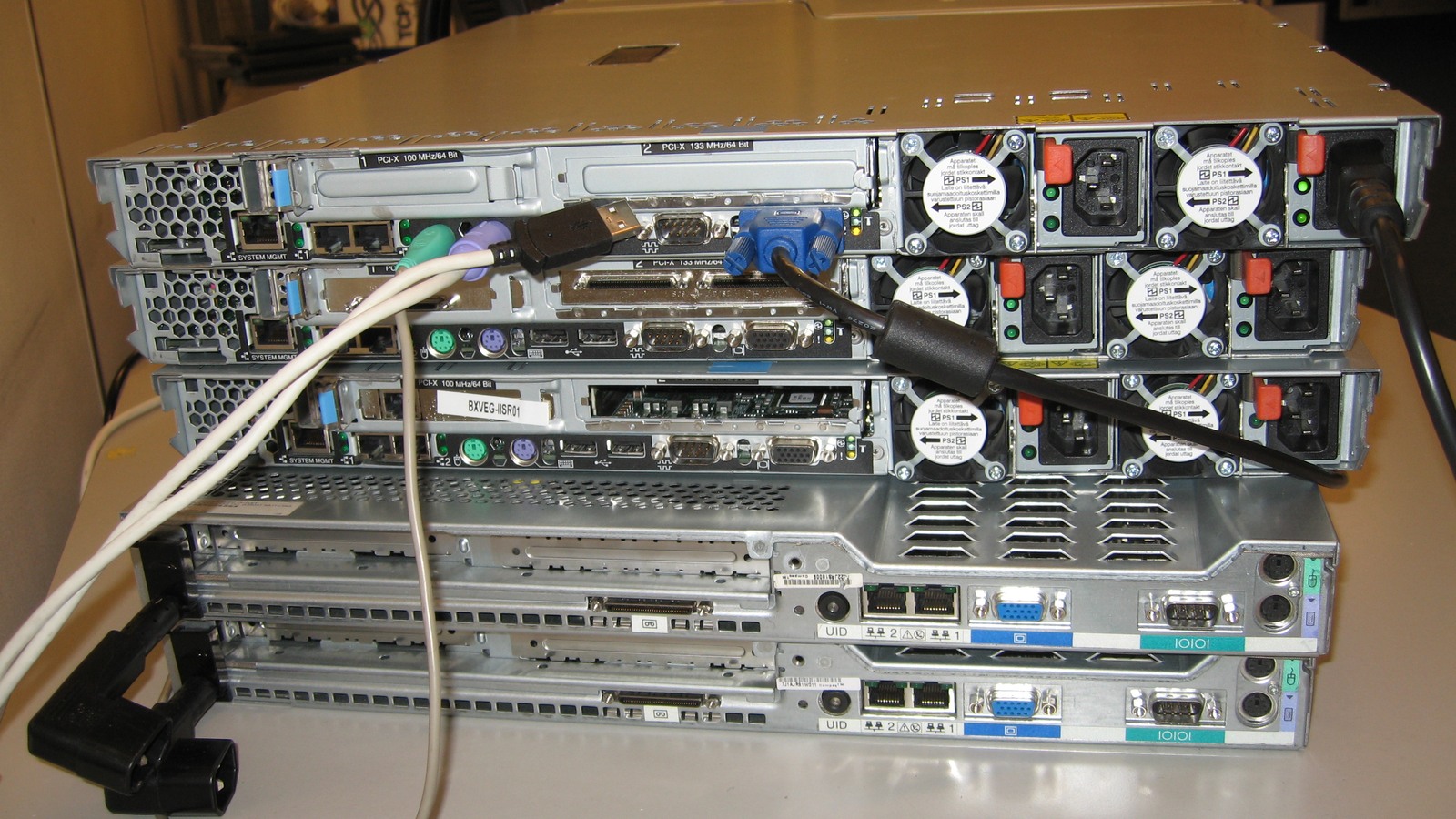
The featured photograph shows the backs of generic servers, ports, power supplies and connected cables. It was photographed by Jemimus and has been cropped and resized under CC BY 2.0. The image provides network-operations context only.
It does not depict XYZ.COM LLC, CentralNic, a registrar, a registrant, a customer environment, a TLD production site or a registry deployment. It does not prove capacity, redundancy, uptime, security effectiveness or any customer outcome. The hardware labels visible in the scene are incidental maintenance markings, not evidence about the company covered here.
This boundary is important because infrastructure imagery can easily imply more than a public record supports. The article's factual basis is the directory object, registry pages, IANA delegations and ICANN agreement records, not the photographed equipment.
Sources
[1] https://btw.media/en/directory/xyz-com-llc
[2] https://nic.xyz/
[4] https://nic.xyz/privacy-policy
[5] https://nic.xyz/registry-policies
[6] https://nic.xyz/terms-of-use
[8] https://www.iana.org/domains/root/db/xyz.html
[9] https://www.icann.org/en/registry-agreements/details/xyz
[10] https://www.iana.org/domains/root/db/audio.html
[11] https://www.iana.org/domains/root/db/auto.html
[12] https://www.iana.org/domains/root/db/autos.html
[13] https://www.iana.org/domains/root/db/baby.html
[14] https://www.iana.org/domains/root/db/beauty.html
[15] https://www.iana.org/domains/root/db/boats.html
[16] https://www.iana.org/domains/root/db/car.html
[17] https://www.icann.org/en/registry-agreements/details/audio
[18] https://www.icann.org/en/registry-agreements/details/auto
[19] https://www.icann.org/en/registry-agreements/details/autos
[20] https://www.icann.org/en/registry-agreements/details/baby
[21] https://www.icann.org/en/registry-agreements/details/beauty
[22] https://www.icann.org/en/registry-agreements/details/boats
[23] https://www.icann.org/en/registry-agreements/details/car
Verdict
XYZ.COM LLC's public record supports a clear Capability claim: it is the named operator or sponsoring organisation for the sampled namespaces, and the surrounding ecosystem exposes DNS delegation, registration-data, policy, WHOIS, contract and abuse-contact surfaces. The same record also exposes a provider boundary and a portfolio of separately delegated, separately contracted objects.
That evidence does not establish product reliability or a customer outcome. It says nothing conclusive about uptime, transaction correctness, abuse reduction, recovery speed, registrar satisfaction or business value. Those claims require measurements and attributable results that are not present in the reviewed sources.
The strongest operating conclusion is therefore about work. Shared infrastructure does not remove supervision. Public interfaces do not remove integration. A mature portfolio does not remove maintenance. Automation does not remove exception handling. Provider expertise does not remove the operator's need for evidence, escalation and recovery ownership. For XYZ.COM LLC, as for any multi-TLD registry operator, the quality question is not whether the expected controls can be named. It is whether responsibility stays coherent when a control changes, disagrees with another system or fails under pressure.
Member Briefing
Deeper Profile Context
Sign in with the right membership level to unlock the full briefing and source notes.
Only for Strategic Circle
Strategic Circle
Open to all readers. Unlock profile briefings after joining and signing in.
Join Strategic CircleOnly for Leadership Alliance
Leadership Alliance
For qualified IP-asset owners and management; sign in to unlock alliance briefings.
Join Leadership Alliance