
Summary
- WiscNet said at 6.58pm Central on September 14 that splicing had begun in two areas after roadwork-related fibre damage, with restoration estimated for 10pm.
- The notices cover connections for Ashwaubenon School District and Village of Ashwaubenon. They do not establish a network-wide outage or disclose either site's backup arrangements.
The repair has become more specific; its outcome has not. WiscNet's September 14 updates for two Ashwaubenon connections moved from an investigation of damaged fibre to splicing in two work areas. At 6.58pm Central, the network gave a current restoration estimate of 10pm. That was a target for the work, not a report that service had returned.
The distinction matters to a site deciding how long to maintain a temporary operating arrangement. It also exposes a purchasing question that a description of a redundant network backbone cannot answer on its own: what remains available when the physical connection to a particular site is affected?
From roadwork damage to a splicing operation
The separate notices for Ashwaubenon School District and Village of Ashwaubenon both say an outage was observed from 9.40am Central on September 14. The notices themselves were opened shortly after 10.17am and 10.18am. Those publication times should not be substituted for the stated onset.
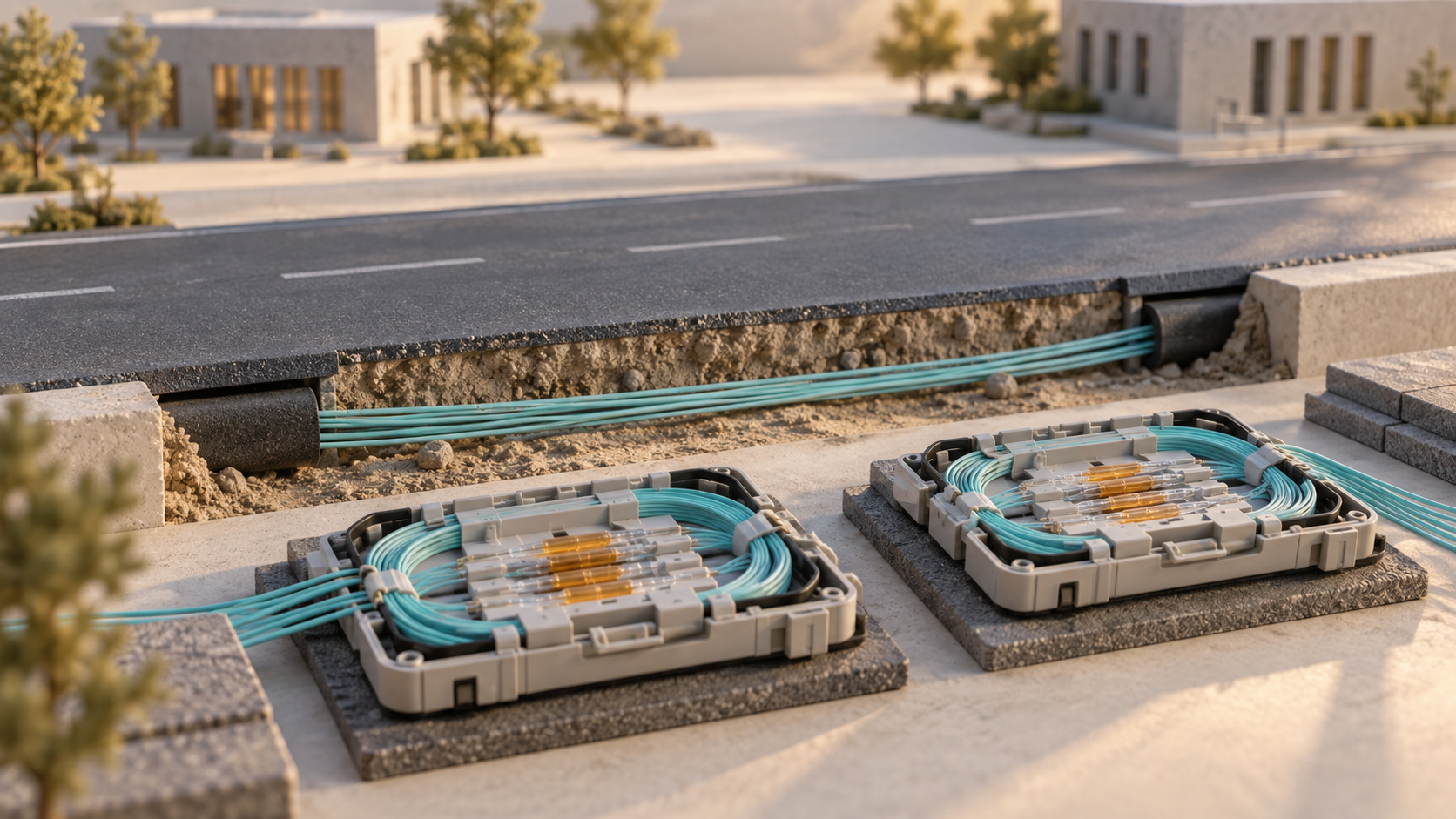
Late in the morning, WiscNet described investigating a fibre cut between DePere and Appleton, Wisconsin. At about 1.14pm it reported extensive fibre damage due to roadwork. Afternoon updates said the scale of the restoration work would take it into the evening. The 6.58pm updates added that splicing had started and needed to be completed in two areas.
Two work areas are not proof of two independent cuts, and two customer notices are not evidence of two unrelated fibre incidents. The network did not identify a construction contractor or publish a finding on liability. Nor do the notices quantify damage, lost activity or the cost of repair.
At the reporting cutoff—7.43pm Central on September 14, equivalent to 00.43 UTC on September 15—both incident records still showed an identified issue, without a resolution timestamp. The 10pm estimate must be read in that snapshot. It is neither confirmed restoration nor a promise that the connection is still unavailable whenever this article is read.
Three different meanings of resilience
WiscNet's service catalogue describes network access with unmeasured usage, a redundant backbone and a fixed annual fee. It separately offers Connect +1 for multiple connections between a member site and the backbone, and a BGP multihome option for members using WiscNet and other providers at the same time.
Those descriptions address different parts of the service. Backbone redundancy concerns the network behind the site connection. Additional connections can support reliability or capacity. Using another provider adds an operational relationship. None of those labels, without further evidence, establishes that the paths into a particular building avoid the same physical exposure.
This is a question for procurement, not a diagnosis of the Ashwaubenon configuration. The notices do not say whether either site had extra connections, a second provider or a tested failover arrangement. They therefore do not support a claim that a backup failed, or that no backup existed. They also do not establish that the school district's or village's entire operations stopped.
An annual, unmetered access price makes the usage bill more predictable. It does not, by itself, specify the time needed to repair outside plant or the continuity of every end-to-end connection. The catalogue gives variable annual pricing, not the actual price or contractual commitments of these affected services.
A narrower, useful market signal
The new information is progress in a physical repair and a more explicit estimated timescale. The broader buying implication is to ask where resilience is actually delivered: inside the backbone, across the access segment, through a second provider or within the institution's own temporary arrangements.
Other incidents on the same status page are not evidence that this damage spread across the network. Likewise, an older Ashwaubenon alarm record referring to an intentional takedown should not be merged into a continuous outage beginning in August. The September 14 notices describe their own observed event. Keeping those boundaries intact is more useful than turning a local repair into an unsupported system-wide narrative.
Member Briefing
Deeper Profile Context
Sign in with the right membership level to unlock the full briefing and source notes.
Only for Strategic Circle
Strategic Circle
Open to all readers. Unlock profile briefings after joining and signing in.
Join Strategic CircleOnly for Leadership Alliance
Leadership Alliance
For qualified IP-asset owners and management; sign in to unlock alliance briefings.
Join Leadership Alliance