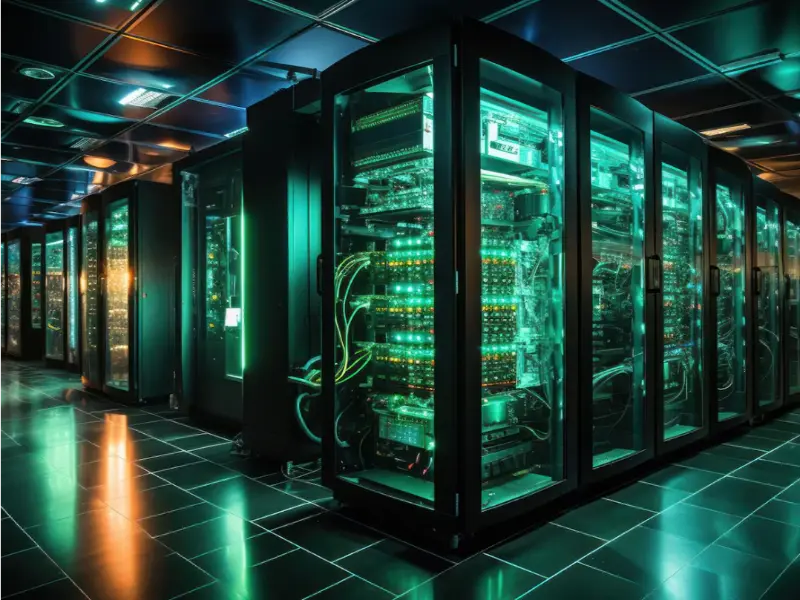
- Supercomputers are designed to advance scientific research, engineering simulations, and healthcare analytics through their immense data processing and storage capabilities.
- The evolution of supercomputers towards cloud-based systems aims to make them more compact, cost-effective, and versatile, serving national strategic purposes and commercial applications.
- With a primary purpose in vital areas like defence, aerospace, meteorology, and healthcare, supercomputers play a crucial role in driving innovation and societal development through their advanced computing capabilities.
Supercomputers are computers capable of processing vast amounts of data and performing high-speed calculations that regular personal computers cannot handle. In terms of components, they share a basic structure with ordinary computers, but they differ significantly in performance and scale. The main characteristics of supercomputers include two aspects: immense data storage capacity and extremely fast data processing speed, enabling them to perform tasks in various fields that are beyond the capabilities of ordinary people or regular computers.
Introduction to supercomputers
A supercomputer is a type of computer that has higher processing speed, larger storage capacity, and more advanced functionality compared to mainframe computers. It typically refers to electronic computers capable of processing over 50 million instructions per second and storing data exceeding one million bytes. Supercomputers have processing capabilities several orders of magnitude faster than personal computers, making them indispensable in areas like intensive calculations and massive data processing.
The key features of supercomputers are their high speed and large capacity, supported by a range of external and peripheral devices and sophisticated software systems. Depending on the type of processor used, supercomputers can be classified into two categories: those with specialised processors and those using standard-compatible processors. The former efficiently handles specific types of problems, while the latter offers versatility and wider applicability across various domains.
Specialised supercomputers are common in fields like astrophysics and cryptography, where tailored processing capabilities are essential. Many supercomputers, however, are non-specialised systems serving diverse sectors such as the military, healthcare, meteorology, finance, energy, environmental sciences, and manufacturing. They play critical roles in complex simulations, data analysis, and decision-making processes across these domains.
Also read: Why is data centre security important?
Purpose of supercomputers
The main purpose of supercomputers is to advance scientific research across fields like physics, chemistry, and biology by simulating complex phenomena and aiding in discoveries. They also play a crucial role in climate modelling, weather prediction, and understanding climate change impacts.
In engineering, supercomputers are used for tasks like computational fluid dynamics (CFD) simulations and structural analysis, enhancing product development and competitiveness in industries such as aerospace and manufacturing. They also support security and defence efforts through cryptography, intelligence analysis, and military simulations, contributing to national security.
Moreover, supercomputers impact healthcare by enabling medical research, genomic analysis, and drug discovery. They improve patient outcomes and healthcare decision-making processes. Overall, supercomputers are indispensable tools driving innovation and progress in scientific research, engineering, security, and healthcare domains.
Also read: Advantages of data centre as a service (DCaaS) for your business
Prospect of supercomputers
In the future, supercomputers are likely to evolve into a form of shared server cloud computing, leveraging their strong computational speed and ability to process large volumes of data. On the other hand, the architecture and component methods of supercomputers themselves may undergo significant changes, especially in terms of size reduction, lightweight operation, and cost minimisation. In the future, they will not only serve as a national strategic asset but also venture into the commercial sector, further stimulating their development.
As a vital manifestation of national informatisation, supercomputers will first and foremost play a crucial role in areas such as defence technology, industrialisation, and aerospace satellites. Additionally, they will demonstrate their advantages in fields like meteorology, physics, and exploration. With their powerful data processing and high-speed computing capabilities, future supercomputers will be essential tools in the era of big data. They will also become more prevalent in our daily lives, making significant contributions to our societal development.