
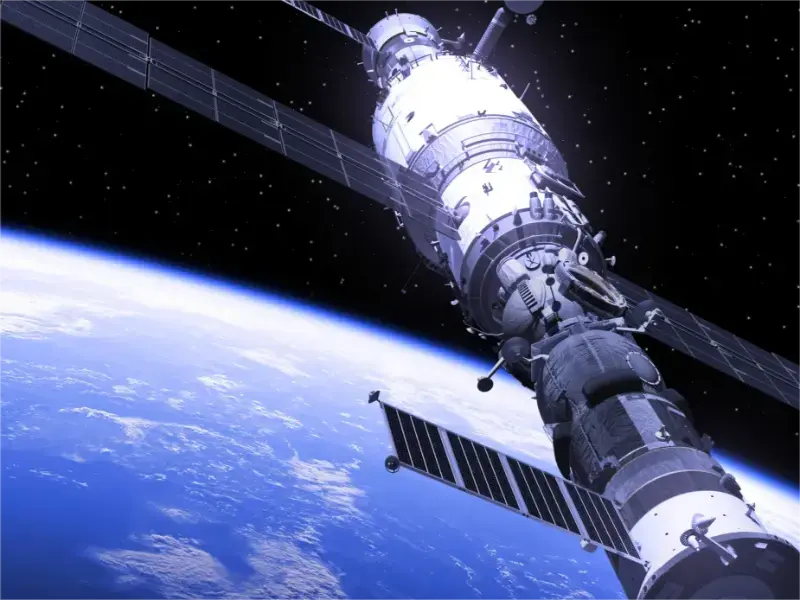
An explainer of satellite systems, ground infrastructure, and the connectivity services they enable across communications and related applications.
- A satellite is a self-contained communications system with the ability to receive signals from Earth and to retransmit those signals back, consisting of two components, a communications satellite and an Earth station connected via that satellite.
- Satellite technology has the advantages of wide coverage, large communication capacity, good transmission quality and convenient and rapid networking.
- The main drawbacks of satellite technology are the transmission delay, as well as the existence of a communication blind zone, and also the effects of sunrise interruptions, eclipses and rain failure phenomena.
Satellite technology is the use of satellite airwaves for communication between Earth stations. With its many advantages, such as wide coverage, large communication capacity, good transmission quality, convenience and rapid network formation, is considered to be an important means indispensable for the establishment of global personal communication.
How to achieve satellite communication
A satellite is a self-contained communications system with the ability to receive signals from Earth and to retransmit those signals back with the use of a transponder—an integrated receiver and transmitter of radio signals.
A satellite communication system consists of two components, a communications satellite and an Earth station connected via that satellite. Geostationary communications satellites, also known as synchronous satellites, are the most commonly used stars in the current global satellite communications system, and their period of operation is exactly equal to the rotation period of the Earth (24 hours), so the two are kept in synchronous operation.
Therefore, as long as three communication satellites are placed at equal intervals in the geostationary orbit, their antenna beams can cover the entire Earth (except for the polar regions), realising communication on a global scale, because the maximum coverage of a geostationary satellite’s antenna beams is greater than one-third of the total surface area of the Earth.
The three satellites of the International Telecommunications Satellite System (INTELSAT) currently in use are located over the Atlantic, Pacific and Indian Oceans.
Also read: Google Pixel 9 could gain satellite SOS feature
Pros and cons of satellite technology
Compared with other means of communication, satellite communication technology has many advantages:
First, the airwave coverage area is large, the communication distance is long, and the users in the coverage area can realise multi-access connections through communication satellites to realise multi-access communication and instant communication.
Secondly, the transmission band is wide and the communication capacity is large. Satellite communication has a wide frequency range, which can provide hundreds, thousands or even tens of thousands of voice paths between two points, and provide medium and high-speed data channels of more than one hundred megabits per second at most.
Thirdly, the communication is stable and of high quality. Most of the satellite links are in the cosmic space above the atmosphere, belonging to the constant reference channel, with small transmission loss, and are not affected by various natural environments and human factors between the two points of communication.
Also read: Thaicom’s spacetech revolution: Empowering industry through LEO satellites
The main disadvantage of satellite transmission is the transmission delay, also known as the “delay effect”. For example, when making a satellite phone call can not be immediately heard back, a question and answer in the process of radio waves to nearly 160,000 kilometres back and forth, taking 0.6 seconds.
At the same time, satellite communication technology also exists in the communication blind zone, that is, the region near the Earth’s poles cannot effectively utilise satellite technology. Moreover, although satellite technology is capable of maintaining normal communications in the event of a magnetic or nuclear explosion, there are interruptions of sunspots, eclipses and rain failures.
Signal Brief
- Signal: What is satellite technology?
- Region: Global
- Market Class: Global Cloud Services Trends
Market Context
- The article provides foundational context for understanding satellite connectivity and its relationship to communications infrastructure.
- Operational relevance: Medium
- Time Horizon: Next quarter
What To Watch
- Satellites and payloads
- Ground stations
- Radio spectrum and network links
Member Briefing
Deeper Trend Context
Sign in with the right membership level to unlock the full briefing and source notes.
Only for Strategic Circle
Strategic Circle
Open to all readers. Unlock trend briefings after joining and signing in.
Join Strategic CircleOnly for Leadership Alliance
Leadership Alliance
For operators, investors, and policy teams that need relationship evidence, failure paths, and source notes. Sign in to unlock.
Join Leadership AllianceSnapshot
Category
Global Cloud Services TrendsSatellite technology uses spacecraft, radio systems, ground infrastructure, and network links to deliver communications, positioning, sensing, or other services.
Region
GlobalPrimary Domain
TechnologyImpact
MediumThe article provides foundational context for understanding satellite connectivity and its relationship to communications infrastructure.
Confidence
Good confidence (72%)Confidence score guide
Several public sources