
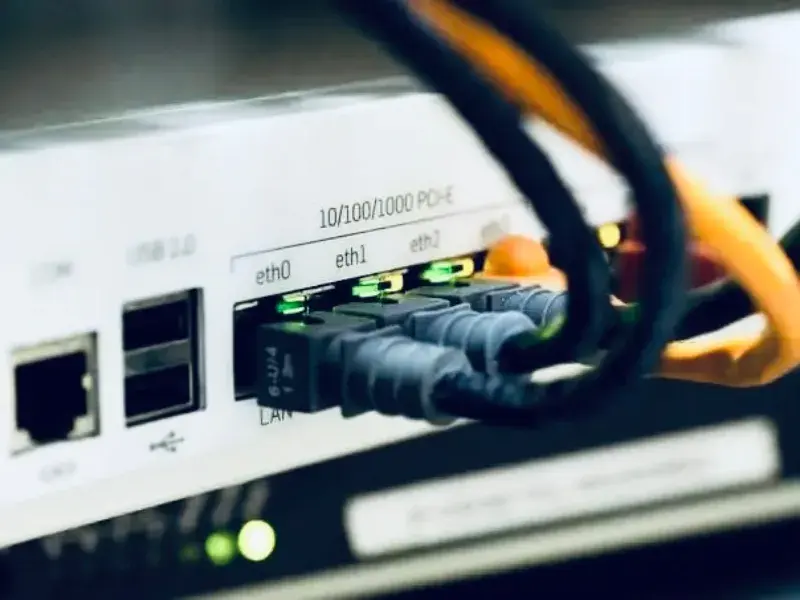
- A port in networking is a virtual checkpoint that directs incoming and outgoing data traffic to the correct program or service on a device.
- Network ports are a major factor in network security and cybersecurity in general.
Ports are a fundamental aspect of connectivity and data transfer. But what is a port? It isn’t just a physical connection, but also a logical connection that programs use to exchange information. In the most basic sense, a port is a start and endpoint of communication.
What is a port
A port, also known as a network connection, serves as a channel through which different computer devices and applications communicate. A port in networking is a virtual checkpoint that directs incoming and outgoing data traffic to the correct program or service on a device.
Imagine the internet like a large apartment building with many tenants. When a delivery arrives, it goes to a specific apartment number, not just the building address. Ports act like apartment numbers, ensuring that data reaches the right application on a device. We identify ports with unique numbers ranging from 0 to 65535. They work alongside IP addresses, which pinpoint a specific device on the network.
Network connections differentiate between various programs or services running on a device. The range from 0 to 1023 is reserved for well-known ports. The range from 1024 to 65535 is used for dynamic ports. These network connections are also sometimes referred to as private or ephemeral ports.
These connections bring efficiency to data traffic. They allow multiple programs on a single device to communicate simultaneously without data collisions. This results in a smooth and organised flow of information.
Also read: ABS-CBN’s Sky Cable Corp partners with Converge ICT for network enhancement
Also read: How IPTP Networks overcame Red Sea cable crisis with terrestrial solutions
Issues with ports in computer networking
The biggest challenge with virtual ports is network security. With the advent of cyber threats, the security of ports has become a significant concern. Open, unsecured network connections are a gateway for malicious actors. They plant port scanning and DoS attacks to exploit these weaknesses.
Fortunately, there are a number of practices and tools available to improve port security. Firewalls act as gatekeepers to software that manages unused ports. Regular scans can also help identify vulnerabilities before the worst happens.
Physical ports, on the other hand, may stop functioning due to a couple of reasons. Here are some common causes of network connection failure.
1. Power surges: Devices directly connected to electric mains are vulnerable to power surges, sometimes damaging the ports.
2. Water damage: Exposure to water or moisture leads to malfunctioning ports.
3. Internal failures: Issues with the port hardware itself, such as component failures, can cause ports to stop working.
4. Damage from cable pins: Inserting cables too forcefully can damage the pins inside a port.
When a port fails, a simple visual inspection of the hardware might not reveal the cause of the problem. It’s also important to note that if one port fails on a multiport device, the others should continue functioning normally. Each network connection operates independently.
How do network ports affect cybersecurity
Network ports are a major factor in network security and cybersecurity in general. Firewalls take the port number into consideration when determining whether to allow or block communication. They are configured to only allow communication to the specific ports needed for a service and block other unneeded ports so they cannot be exploited.
When a company wants to have a website, email and secure file transfer service on the internet. Its firewall would allow inbound connections to ports 80 and 443 for web traffic, port 25 for inbound email and port 22 for Secure Shell FTP (SFTP). It forwards these ports to the specific servers for each type of service. The firewall will block all other ports.
So, if an employee incorrectly tries to use FTP on port 21 instead of SFTP, it will be blocked. Or, for instance, if an attacker tries to connect to port 3389 for Windows Remote Desktop to gain control of a server, the firewall will block the connection.