
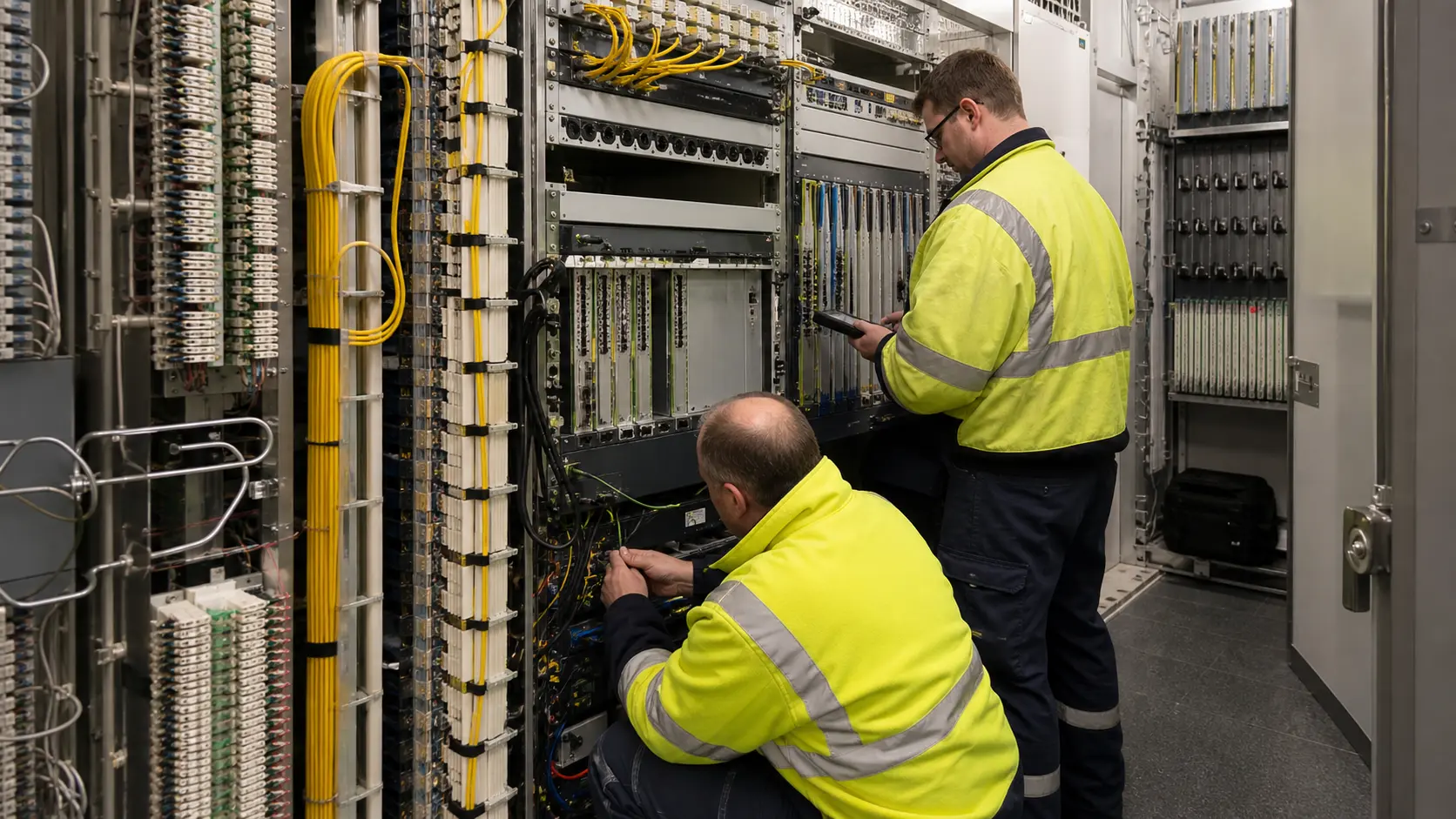
Summary
- VolgoGazTelecom is a real Samara communications operator with a long corporate life, communications licences, local phone-number capacity, a RIPE-recognised autonomous system and a visible IPv4 footprint. The harder question is not whether the company exists, but whether its local network economics can stand on recurring service revenue rather than a narrow set of industrial and public-sector contracts.
- The strongest operating evidence is AS41465, a small IPv4-only network whose public routing records show VolgoGazTelecom originating a limited set of prefixes, using Rostelecom and TransTeleCom as visible upstreams, and carrying no visible downstream transit base. That topology makes the company an access and local-service operator, not a wholesale backbone.
- Public pricing signals put its retail broadband reference point near the same low-ruble band as larger Samara competitors. A 100 Mbps residential plan advertised by a market aggregator at 500 rubles per month is economically useful only when customer density, low churn and cheap access to buildings keep support and maintenance costs contained.
- The probable concentration risk sits around industrial and municipal work. Procurement mirrors and business registries repeatedly connect VolgoGazTelecom with local telephony, internet access, security systems, fire-alarm maintenance and the Samara gas-company ecosystem, including references to SVGK and Volgopromgaz. The evidence supports a probable anchor, but not a fully quantified current dependence.
- The investment judgement is therefore conditional. VolgoGazTelecom becomes more defensible if it can prove multi-customer recurring contracts, disciplined capex, stable upstream terms and enough local reliability premium to resist national carriers. It weakens if the 2025 revenue improvement came mainly from non-repeatable project work, related-party demand or delayed maintenance.
Start with one paid circuit
The cleanest way to read VolgoGazTelecom is to begin with a single paid circuit in Samara, not with the company name. A small operator sells a household connection, an office internet line, a telephone service, a video or alarm circuit, or a managed link for a local institutional customer. The monthly receipt is simple. The retained contribution is not. Before the operator keeps anything for profit, that circuit must carry its share of upstream IP capacity, access-network depreciation, building entry costs, customer support, billing, field labour, spares, licence compliance, office overhead and bad-debt risk.
If the circuit belongs to a residential customer paying a low broadband tariff, the operator needs density and low fault rates. If it belongs to an industrial or public-sector account, the operator can charge for reliability and response, but it also inherits stricter service expectations and concentration risk.
That is the economic question behind VolgoGazTelecom. The company is not a new entrant trying to buy attention with a venture-funded fibre build. Public corporate profiles place the business in Samara, registered in 1996, with fixed-line communications as its main activity. Routing data shows an autonomous system registered in 2006. Local directories list telephone, internet, television, call-centre and weak-current network services. Procurement mirrors show local connections, long-distance telephone services, internet access, alarm systems and related installation or maintenance work.
This is the profile of an operator that grew around local embeddedness: rights, technicians, customers who know whom to call, and a footprint that probably matters more street by street than nationally.
The difficulty is that embeddedness is not the same as scale. A national carrier can spread network operations, billing systems, customer acquisition and upstream purchasing across millions of lines. A small regional operator must recover similar categories of cost from a much smaller base. Every underused switch, fibre span, router, cable-TV headend element or van matters. Every large customer negotiation matters. A single contract can make annual growth look attractive, while a single churn event can expose too much fixed cost.
VolgoGazTelecom's public evidence therefore has to be read less like a normal corporate profile and more like a margin stack: what is recurring, what is concentrated, what is technical advantage, and what is merely legacy presence?
The margin stack starts with price. A third-party Samara tariff page lists a VolgoGazTelecom "Basic" internet offer at 100 Mbps for 500 rubles per month. Other aggregators put national and larger regional competitors in the same rough band: Rostelecom offers Samara home internet packages around 475 to 550 rubles in promotional listings; MTS and Dom.ru show bundled or higher-speed offers that can begin around 400 to 625 rubles depending on promotion, bundle and technology. Those are not high prices.
A small operator can make them work only if the cost to serve is unusually low, if the customer is attached to other services, or if the listed tariff is a lead-in while business accounts and managed services carry the margin.
That shifts attention to the second circuit: a local enterprise or industrial account. Public procurement mirrors and contractor databases show VolgoGazTelecom selling local phone calls, intra-zone and long-distance calling, internet access and alarm-system work. One construction-procurement mirror identifies SVGK as the main customer for a subset of tenders and references maintenance of fire-alarm and evacuation-warning systems at SVGK facilities. Another business profile says the company has won dozens of procurements across a broader set of buyers.
Interfax reports that the Volgopromgaz holding had a 29.91 percent interest in VolgoGazTelecom in the context of the Samara gas-company ecosystem. Those signals do not prove the current revenue split. They do justify treating an industrial or gas-related anchor as a central risk to test.
The key question is not whether anchor demand is bad. For a local telecom company, a stable industrial customer can be the difference between scattered household churn and a bankable base load. A gas-network operator, utility group, university, municipal service or building portfolio can value uptime, telephone continuity, alarm links and fast technician response more than a pure retail subscriber does. The problem appears when the anchor dictates price, payment timing or capex priorities, or when the operator's network is built around the anchor's locations rather than a broader commercial market.
If VolgoGazTelecom's 2025 improvement reflects repeatable monthly service revenue across many customers, the company has a base. If it reflects one or two project bursts, the next renewal cycle will be harsher than the revenue line suggests.
The company is small, real and locally old
The identity boundary is relatively clear at the surface. Public Russian business profiles identify the legal entity as the limited liability company behind the Russian name Volgogaztelecom, with INN 6314011847 and OGRN 1026300897226. They place it at Frunze Street 70 in Samara and describe its main activity as communications on wired technology. Several profiles name Nikolai Yuryevich Proshchalykin as general director from 2024. The company is old by Russian small-business standards: 1996 registration appears consistently across RBC, T-Bank, B2B.House, Saby and other public contractor mirrors.
That age matters. A 1996 communications company has had time to acquire telephone numbering, premises access, customer billing habits, local ducts or cable routes, and trust with building managers. It has also had time to accumulate obligations. Legacy telephone service brings regulated expectations, numbering administration, old equipment and customers who may no longer be the growth segment. Cable television and fixed telephony can keep a customer relationship alive, but neither automatically produces the economics of a modern fibre operator.
For a company of this size, age is a source of defensibility only if the old base has been converted into current recurring connectivity and managed-services revenue.
The public accounts give a mixed but useful financial outline. RBC reports 2024 revenue of 68.78 million rubles, cost of sales of 70.992 million rubles and a net loss of 2.545 million rubles. Several 2026-updated contractor and bank profiles report 2025 revenue around 109.6 million rubles and net profit around 6.73 million rubles, with headcount around 30 people. Read mechanically, that is a sharp rebound: roughly 59 percent revenue growth from 2024 to 2025 and a swing from loss to profit. Read economically, it raises a question.
A small local operator rarely grows recurring access revenue by that much in one year without a new contract set, a project cycle, a reporting reclassification, price increases, unusually successful sales, or a one-off catch-up.
The headcount signal reinforces that caution. Public profiles disagree on employee numbers: RBC lists 42 employees for one period, while several 2025 profiles show 30. A 30-person communications company can run a meaningful local footprint, but it cannot absorb unlimited field work, complex construction and high-touch enterprise support without trade-offs. The same staff pool must support sales, billing, engineering, installation, fault repair, phone service, network operations and administrative compliance. That makes customer density and service mix decisive.
A small team can be profitable when most circuits are predictable, geographically compact and billed monthly. It becomes stretched when revenue depends on labour-heavy installation or alarm projects that must be won again and again.
The ownership picture is less settled than the registration data. Current contractor profiles tend to show Proshchalykin as the sole founder or owner. Interfax and OpenWeb, drawing on the Volgopromgaz context, refer to Volgopromgaz as owning a 29.91 percent interest in VolgoGazTelecom. The likely explanation is timing, indirect ownership, reporting lag or conflicting public-source updates, but the contradiction should not be ignored. Ownership matters because it affects customer concentration and incentive alignment.
If a related industrial holding remains materially connected, VolgoGazTelecom may have protected demand but weaker arm's-length pricing. If the business is now effectively owner-managed and independent, then any gas-group revenue is a customer-concentration issue rather than a group-captive issue. The public record does not settle that boundary cleanly.
The operational boundary is also wider than pure internet access. VolgoGazTelecom appears in directories for internet provision, telephone service, cable television, call-centre functions, weak-current networks, security systems and fire-alarm installation or maintenance. It holds or is reported to hold active communications licences and an emergency/fire-safety systems licence. It is listed in an SRO registry for design or construction-related work with a first responsibility level, and the SRO records refer to contract obligations capped at 25 million rubles for that tier.
This points to a hybrid operator: part access provider, part telephony company, part local systems integrator. That breadth can diversify revenue. It can also blur the quality of earnings, because a million rubles of recurring broadband revenue and a million rubles of alarm-system work have different renewal and margin profiles.
The network evidence says access operator, not backbone
The strongest technical evidence is AS41465. RIPE membership records list Limited Liability Company VolgoGazTelecom at Frunze 70 in Samara, with the vgt.ru domain and contact channels. BGP tools identify AS41465 as VGT_RU, registered through RIPE on August 25, 2006. Several routing observatories agree on the shape: a small IPv4 footprint, no visible IPv6 prefixes, a limited set of originated routes and upstream visibility through Rostelecom and TransTeleCom. CIDR Report, BGP.Tools, IPinfo and IPIP all show the same broad topology. That is direct network-resource evidence, not marketing language.
The footprint is small in global terms. Public BGP views show the operator originating a block around 89.19.192.0/20 and a set of more-specific /24 routes, plus routes associated with Samara State Technical University in some views. Depending on the source and counting method, the total visible IPv4 address count is reported around the low thousands: 4,352, 4,608 or more when overlapping aggregate and more-specific routes are counted differently. The difference itself is instructive. The company is not a national backbone with abundant address space.
It is a local ASN with enough IPv4 to support residential, business and institutional customers, but not enough to rely on address scarcity alone as a strategic asset.
No public routing source found visible IPv6 origination for AS41465. That matters less as an immediate revenue issue in a local Russian access market than it would for a cloud provider, but it is still a renewal signal. IPv4-only operation can be practical for a small ISP, especially where customer equipment, content demand and upstream arrangements remain IPv4-heavy. Over time it can increase dependency on NAT, address management and legacy engineering. It also suggests that VolgoGazTelecom's current economics are probably about maintaining a compact access network rather than selling future-facing, developer-grade connectivity.
The upstream pattern is more important. Rostelecom and TransTeleCom appear repeatedly as visible upstreams. Both are large carriers with national reach and stronger purchasing power. For VolgoGazTelecom, using them as upstreams is normal; a regional ISP should buy transit or upstream connectivity from carriers with backbone networks. The risk is price and bargaining power. If customer ARPU is low and upstream costs rise, retained contribution compresses quickly. If one upstream has a fault or contractual pressure, the second path helps, but only if the redundancy is engineered and paid for properly.
Public BGP adjacency does not prove contract quality, committed capacity, burst pricing or repair SLA.
The absence of visible downstreams also frames the business. A network with downstream customers can earn transit margin and occupy a higher rung in the routing value chain. VolgoGazTelecom's public record instead looks like an eyeball and local-access network: customers consume connectivity, and the company hands traffic to larger carriers. IPinfo explicitly classifies the activity pattern as consumer ISP-like, with a day-night rhythm and no downstreams. That supports the view that the operator's economics depend on access-line density, not wholesale traffic resale.
The Samara State Technical University prefixes are worth a separate note. Some BGP/IP data sources show 194.190.143.0/24 and 194.226.136.0/24 connected to AS41465 views, while IPinfo's detailed page for 194.190.143.0/24 identifies Samara State Technical University as the network in RIPE WHOIS. That does not mean VolgoGazTelecom owns the university's network. It means the public routing picture intersects with local institutional connectivity.
For the economic argument, the point is narrower: VolgoGazTelecom is visible in Samara institutional routing evidence, which is consistent with a local operator serving or touching institutional demand. It is not evidence of broad regional scale.
The revenue base has three different shapes
VolgoGazTelecom's revenue should be divided into three buckets before making a judgement. The first is household and small-business access: internet, phone and possibly television billed monthly. The second is enterprise and public-sector communications: local telephone capacity, internet access, managed circuits and support. The third is project or systems work: alarm, fire-safety, weak-current, building networks, maintenance and installation. Public sources show all three. The company's resilience depends on the mix.
The household-access bucket is visible but probably not the only story. Third-party provider sites list VolgoGazTelecom in Samara with office and support contacts. One tariff aggregator lists a "Basic" 100 Mbps internet plan at 500 rubles per month. Local directories describe internet, cable television and phone service. Phone-number data sites report more than 20,000 numbers assigned or associated with the operator in Samara Oblast. Those facts show a consumer/local-service surface. They do not reveal the active subscriber count, churn, average revenue, collection rate or building coverage.
A back-of-the-envelope test shows why the unknowns matter. At 500 rubles per month, one residential broadband subscriber contributes 6,000 rubles per year before VAT treatment, upstream capacity, customer support, equipment, billing and field repair. Ten thousand such customers would imply 60 million rubles of annual gross receipts; five thousand would imply 30 million.
The public 2025 revenue figure around 109.6 million rubles therefore could not be explained by a small base of low-priced households alone unless there are many thousands of active lines, higher business tariffs, bundled services, installation revenue, public contracts, systems work, or all of these. The company may well have a mixed model; the public evidence does not allow a clean subscriber-derived revenue bridge.
The enterprise and public-sector communications bucket looks economically important. B2B.House reports procurement wins involving local connections, intra-zone and long-distance calls, internet access and other telecom services. T-Bank's contractor page lists government-contract style items such as internet access and telephone connections, while Saby reports a much larger number of tenders and identifies SVGK as a main customer. These records indicate that VolgoGazTelecom can sell beyond retail households. That is positive because business and institutional customers can pay for reliability, legacy phone integration and local support.
It is negative if the same customer group dominates purchasing volume.
The systems bucket is the most ambiguous. SRO and licence records show the company can work on design, construction or fire-safety systems within defined responsibility limits. Procurement mirrors reference fire-alarm and security-system maintenance. Local directories list weak-current networks and security systems. This is adjacent to telecom because buildings need cabling, alarms, call points, monitoring, video and support. It can strengthen customer relationships: the same technician who knows a building's cable routes can maintain its alarm network and internet connection. But project work is lumpy.
It requires labour, parts, compliance and warranty exposure. It can inflate revenue without building durable monthly recurring revenue.
The 2025 financial swing should be read through those buckets. A move from 68.78 million rubles of 2024 revenue and a 2.545 million ruble loss to roughly 109.6 million rubles of 2025 revenue and 6.73 million rubles of profit looks strong. But the quality of that improvement depends on what changed. If higher-margin managed services and recurring enterprise contracts replaced low-margin maintenance, the company improved structurally. If a few installation projects, catch-up billings or related-party contracts lifted one year, the improvement is less durable. Public filings do not break down the answer. That is the central evidence gap.
The probable anchor is a strength until it sets the ceiling
The probable anchor customer is not hard to locate conceptually. Public sources repeatedly connect VolgoGazTelecom with the Samara gas and industrial ecosystem. Interfax, writing about Volgopromgaz, lists VolgoGazTelecom among companies linked to that holding at a 29.91 percent stake. Saby says SVGK is the main customer. A contractor mirror identifies SVGK as the biggest customer for the subset of work it tracks. Procurement descriptions include maintenance of fire-alarm and warning systems at SVGK facilities and work at a Poxvistnevogorgaz branch.
Other source material places VolgoGazTelecom in a neighbourhood of gas, utility and construction organisations rather than as a purely retail broadband brand.
This is not enough to assert that SVGK or Volgopromgaz is the current majority revenue source. It is enough to make concentration the first diligence item. An industrial anchor can be economically rational for both sides. A gas-distribution company needs office telephony, site links, alarm circuits, dispatch support, video or security systems and local technicians who can get to a facility. A small telecom operator with a shared local history can supply that bundle better than a national retail provider selling generic broadband. The customer gets accountability; the operator gets predictable work and a reference base.
The risk is that the same logic can trap the operator. If the anchor is related or historically tied, pricing may not reflect arm's-length value. If the anchor faces political, regulatory or ownership pressure, telecom spending may be renegotiated as part of a wider conflict. Interfax's report on the Samara gas-company environment describes government criticism and law-enforcement referral around gas assets connected to the same wider business ecosystem, with SVGK disputing the criticisms. VolgoGazTelecom is not itself accused in that report.
The relevance is exposure: if a local operator's important customers sit inside a politically scrutinised industrial group, revenue durability depends on more than ordinary service quality.
The concentration question also affects capex. A local operator may build routes to serve its strongest customer first, then try to sell along the path. That is efficient if the route passes dense buildings or public institutions. It is dangerous if routes terminate at specialised facilities with few alternative buyers. Fibre to a gas office, dispatch facility or industrial site can be valuable, but the resale market for that path may be thin. Equipment bought for alarm integration or site-specific telephony may be harder to redeploy than standard broadband access electronics.
VolgoGazTelecom's SRO and fire-safety profile makes the anchor model more plausible. A company that combines telecom access with weak-current and alarm systems is useful to industrial and municipal customers that want one local contractor for physical-site communications. That is a differentiated capability relative to pure internet resellers. It also means the company competes not just with ISPs but with electrical contractors, security-system firms and facilities-maintenance providers. The contract conversation becomes: who can answer the phone, send the technician, know the building and keep the compliance documents in order?
The best outcome is a portfolio of anchors rather than one anchor. A university, municipal agencies, housing complexes, small businesses, gas facilities and retail subscribers together can support a compact network. A single industrial group cannot. The public evidence shows multiple services and some broad procurement activity, but it does not show enough customer-level detail to prove diversification. Until that evidence appears, the company should be valued as an operator with possible anchor protection and possible anchor dependence, not as a broadly diversified Samara broadband platform.
Pricing is not generous enough to hide execution errors
Samara broadband pricing is unforgiving. Large operators advertise entry-level and bundled plans in the same band as VolgoGazTelecom's visible retail offer. Rostelecom listings show 100 Mbps home-internet packages around 475 to 550 rubles per month, often with bundles or promotions. MTS listings show 100 Mbps home internet or bundles at promotional rates around 400 to 550 rubles. Dom.ru listings in Samara show 100 to 300 Mbps packages around 625 rubles in promotional formats. Aggregator pages show still more local substitutes.
These prices move and promotional details vary, but the conclusion is stable: a small operator cannot rely on premium mass-market pricing.
That makes the retained contribution per circuit the real battle. Upstream connectivity is not the only cost. The operator must pay people who answer support calls, travel to customer premises, pull cable, replace routers, fix storms or power-related faults, maintain legacy telephony equipment, manage billing disputes and comply with communications rules. The costs do not fall neatly with every lost subscriber. A technician's salary, office rent, service vehicle and core router are fixed or semi-fixed over a range of customer counts. When the subscriber base is dense, those fixed costs are spread.
When the base is thin, a low advertised price destroys margin.
The business can still work if VolgoGazTelecom is not trying to beat national carriers on commodity broadband. A local operator can win buildings where it already has wiring, customers who still value local phone service, businesses that need faster on-site support, and institutional accounts that bundle communications with security or fire-alarm maintenance. It can sell static addressing, local telephony, managed LAN work and circuit monitoring. It can serve customers who dislike remote call centres. These are not glamorous advantages, but in a local access market they can produce a margin if churn is low.
The operational evidence partly supports that model. Local directories list several phones, office hours, card and bank payment options, and a mix of internet, phone, cable television and security-system categories. A print-services supplier displays a testimonial attributed to VolgoGazTelecom's then-director about printing payment bills for telephony and internet. That is a small but telling sign: the company has or had a conventional subscriber-billing operation, not just one-off engineering projects. The question is whether the bill base is still large and current enough to finance network renewal.
The danger is maintenance deferral. A small operator can show accounting profit for a period by postponing equipment upgrades, running old plant longer, limiting IPv6 adoption, stretching field labour or relying on customer inertia. That strategy works until a cable cut, power event, customer churn wave or upstream renegotiation arrives. Public BGP evidence shows no IPv6 and a compact network; public labour signals show a small staff and some job-market visibility for technical roles. None of that proves underinvestment. It does mean the operator has little room for repeated mistakes.
The unit-economics test therefore has to be practical. How many active monthly access lines exist? What is blended ARPU across residential, business and institutional services? What share of revenue is monthly recurring rather than project or installation? What is gross margin after upstream transit, access costs and field labour? How many tickets per hundred lines per month? How many truck rolls per new connection and per fault? What percentage of customers buy two or more services? Without those numbers, the public revenue line is an outcome, not a model.
Cost and capital sit in the field, not only in routers
In a network this size, the cost base is physical. Public routing data identifies the ASN and upstream topology, but the economics are shaped by ducts, risers, poles, basements, apartments, offices, fire panels, cable routes, customer equipment and the technician's drive time across Samara. A carrier can buy internet transit; it cannot buy local familiarity instantly. That is why VolgoGazTelecom's old address, SRO record and multi-service directories matter. They suggest a local field operation with relationships to buildings and institutions.
Field labour is a double-edged asset. It gives the company a service promise that national carriers sometimes struggle to match in small segments: a local person can inspect, repair and explain. It also makes scaling expensive. If revenue growth requires more custom work, the company needs more technicians, vehicles, tools, certifications, supervision and safety procedures. If revenue growth comes from existing buildings with little incremental field work, margins expand. The same 10 million rubles of new revenue can be excellent or weak depending on how many truck rolls it takes.
The fire-safety and weak-current side raises the labour intensity. Maintenance of alarm and warning systems is not passive bandwidth resale. It requires compliance, documentation, qualified staff and site visits. The SRO first-level responsibility cap and the active fire-safety licence give VolgoGazTelecom a credible right to sell such services, but they also signal why an industrial customer would hire it: not just for internet, but for a bundle of communications infrastructure inside physical facilities. That bundle can be sticky. It can also soak up working capital when projects involve materials, delayed payment or warranty obligations.
Capital renewal is the quieter issue. A company that has operated since the 1990s has likely replaced parts of its network several times, but public sources do not show the age of fibre, copper, switches, optical line terminals, cable-TV equipment, battery backup or core routers. The 2024 loss and 2025 profit do not answer whether depreciation reflects economic reality. If maintenance capex is low because the network is mature and compact, the business is stronger. If it is low because upgrades are postponed, the profit is overstated.
The IPv4 footprint is another capital constraint. A low-thousands address base can support a local ISP with NAT and careful allocation, especially where many residential customers do not need public addresses. It can become a bottleneck for business customers that want public IPv4, hosting, cameras, VPNs or static services. A larger operator can absorb scarcity across a broader pool. A small operator may need to charge for static IP service, use carrier-grade NAT, or acquire addresses at market prices. No public source disclosed VolgoGazTelecom's address utilisation or customer-addressing policy.
Upstream costs also remain opaque. Public BGP records identify visible upstreams, but not contract prices, commits, burst charges, transport to handoff points, port speeds, backup paths or service credits. For a small operator, the difference between cheap, sufficient upstream and expensive, underutilised redundancy can determine profit. If traffic grows faster than revenue because customers stream more video on flat-rate plans, the operator must either upgrade capacity or let quality decline. The customer sees "slow internet"; the income statement sees gross margin pressure.
Competition comes from carriers, substitutes and convenience
VolgoGazTelecom faces at least three competitive layers. The first is national and large regional fixed broadband: Rostelecom, MTS, Dom.ru, TTK, MegaFon-related offers and other Samara providers. They can bundle mobile, television, streaming, routers and promotions. They have stronger brands, deeper procurement teams and larger network operations. Their offers can be cheaper on promotion and faster on headline speed. A small operator should not want a direct advertising fight with them.
The second layer is building-level availability. Broadband competition in a city is not only who exists in Samara; it is who is wired into a particular building, office or facility. If VolgoGazTelecom already serves a building, its marginal connection cost may be low. If a national carrier has exclusive or better entry, VolgoGazTelecom may be uneconomic. Public aggregator pages cannot resolve that address-level map. They can only show that substitutes exist and that the customer has alternatives in many parts of the city.
The third layer is service bundling. VolgoGazTelecom's potential edge is not "faster internet" in the abstract. It is local accountability across telephone, internet, cable television, weak-current networks, fire alarm, video or building systems. A customer who wants a single contractor for office communications may prefer that bundle even if a national carrier offers cheaper home broadband. A residential customer watching price and speed probably will not. The company must therefore avoid confusing the two markets.
Commodity household access should fill network utilisation; enterprise and facility services should pay for the complexity.
Mobile broadband is another substitute, especially for households and small offices that do not need guaranteed latency. Russia's large mobile operators can bundle mobile data and home internet, making churn easier for price-sensitive customers. Wireless is less suitable for alarm circuits, building-wide cabling, fixed telephony replacement or enterprise sites that need predictable uptime. That again pushes VolgoGazTelecom toward local reliability and managed services rather than pure broadband speed.
The unofficial signals are mixed. 2GIS-style local listings show positive ratings in some search snippets, while other review sites show very thin or negative feedback. One negative review complains about workload and pay; T-Bank shows one low customer feedback item. These are not statistically robust. They are useful only as weak signals that the company's public consumer reputation is not a strong enough moat to carry the thesis. A small local operator with a strong service reputation usually leaves more visible customer advocacy.
The absence of broad public praise does not condemn the company, but it lowers confidence in a retail-led growth story.
The company's website visibility is also not a strong sales signal. Public monitors and directory pages associate vgt.ru with the business, and historical snippets show service notices and payment instructions, but some site-checking pages reported weak or unavailable web status at recent crawls. That does not prove service deterioration; many small Russian operators rely on phone, office and existing customer channels more than polished websites. It does mean public web presence should not be mistaken for active demand generation.
Regulation and geopolitics raise the floor under compliance costs
Russian communications operators operate under a demanding regulatory environment. VolgoGazTelecom's public licence footprint is therefore not decorative. Communications licences, numbering resources, local telephony obligations and lawful-intercept or network-control requirements create a compliance floor that does not scale down neatly for small operators. The company must remain registered, licensed and administratively competent even if its customer base is local. That favours experienced incumbents over casual entrants, but it also consumes management time.
The fixed-telephony history matters here. Historical tariff orders and provider-news archives show VolgoGazTelecom changing local telephone tariffs in the 2000s under Federal Tariff Service orders. That era is not the current broadband market, but it explains why the company has legacy public-service characteristics. It was not born as an app-era reseller. It came through the regulated local telephone and ADSL environment, where numbering, tariffs and service categories mattered. Those rights can still support business telephony and local trust. They can also leave old customers and low-margin obligations.
Geopolitics is indirect but real. Russian operators face equipment supply constraints, currency volatility, software and hardware substitution pressures, and vendor-service uncertainty. A small operator cannot bargain for imported network equipment like a national carrier. If routers, optical modules, cable equipment, fire-alarm components or customer-premises devices become more expensive or harder to source, replacement cycles lengthen. That risk is difficult to quantify from public sources, but it is structurally higher for small operators with limited capital access.
The Samara industrial context adds a local political layer. Interfax reported official criticism and legal referrals involving gas-distribution assets connected to the wider Volgopromgaz/SVGK environment, with the companies disputing parts of the criticism. VolgoGazTelecom is adjacent in the public record, not the subject of those accusations. Still, an operator whose probable anchor demand sits near politically sensitive infrastructure should be analysed with that exposure in mind.
A change in control, procurement policy, asset lease structure or municipal relationship could affect telecom and security-system contracts even if VolgoGazTelecom performs well technically.
Procurement dependence also changes risk. Public-sector or quasi-public customers can be reliable payers, but they may require tendering, documentation, price discipline and periodic rebidding. Contractor mirrors disagree on the exact number of tenders and wins, which limits precision. The direction is clear: procurement is part of the business. That means renewal quality matters. A recurring private subscriber renews by not churning; a procurement customer may renew only after a formal process in which a lower bidder or national carrier can challenge.
What would change the judgement
The positive case is specific. VolgoGazTelecom has old local rights, real network resources, visible upstream redundancy, active reported licences, local phone-number capacity, a compact Samara presence and a service mix that can be valuable to businesses and institutions. Its reported 2025 revenue and profit improved sharply after a weak 2024. If management can prove that the improvement came from recurring communications contracts and that no single customer dominates cash flow, the company could be a durable small operator. It would not need to become a national carrier.
It would need to be the locally trusted operator for buildings and organisations that value repair speed, telephone continuity and integrated site communications.
The negative case is also specific. The visible retail tariff is low. The network is small and IPv4-only. Public evidence does not show downstream transit or broad wholesale leverage. Procurement and industrial links suggest possible concentration. Systems work can be labour-intensive and lumpy. Public ownership signals conflict. The website and review signals do not show a powerful retail brand. If 2025 profit was driven by a narrow set of project wins or related-party demand, the company's economic resilience is weaker than the headline rebound suggests.
The next facts that would change the judgement are straightforward. First, active subscriber counts by category: residential internet, business internet, telephone, TV, managed service and alarm/security contracts. Second, revenue split between monthly recurring services and project or installation work. Third, the top-five customer share and whether SVGK, Volgopromgaz-related entities or public bodies account for a material percentage. Fourth, gross margin after upstream capacity and direct field labour. Fifth, capex over the last three years and planned replacement spending.
Sixth, upstream contract terms with Rostelecom and TransTeleCom, including redundancy and capacity commitments. Seventh, address-level coverage and churn against Rostelecom, MTS, Dom.ru and other Samara competitors. Eighth, ownership history and current beneficial influence.
Until those facts are available, the right conclusion is disciplined rather than dramatic. VolgoGazTelecom appears to be a small, real, locally embedded operator with a plausible business in Samara and a credible technical footprint for its size. It does not appear to have the routing scale, brand evidence or retail pricing power of a broad growth platform. Its opportunity is to make reliability pay in places where national carriers are too generic and pure contractors are too narrow. Its risk is that the same local embeddedness hides dependence on one industrial cluster or a small set of procurement renewals.
The company therefore should be monitored as a contribution story. One paid circuit must leave enough after upstream, labour and equipment. One building must support more than one service. One anchor must lead to adjacent customers rather than substitute for them. One year of revenue growth must translate into renewal capital and not merely a better accounting period. If those tests are passed, VolgoGazTelecom can remain economically relevant without becoming large. If they fail, the company will look less like a regional ISP with defensible local economics and more like a small services contractor carrying a network on the side.
Sources
- https://www.ripe.net/membership/member-support/list-of-members/ru/vgt/
- https://apps.db.ripe.net/db-web-ui/lookup?source=ripe&key=AS41465&type=aut-num
- https://stat.ripe.net/data/as-overview/data.json?resource=AS41465
- https://stat.ripe.net/data/announced-prefixes/data.json?resource=AS41465
- https://stat.ripe.net/data/routing-status/data.json?resource=AS41465
- https://bgp.tools/as/41465
- https://www.cidr-report.org/cgi-bin/as-report?as=AS41465&view=6447
- https://radar.cloudflare.com/as41465/
- https://ipinfo.io/AS41465
- https://www.ip2location.com/as41465
- https://whois.ipip.net/AS41465
- https://www.bigdatacloud.com/asn-lookup/AS41465
- https://ipgeolocation.io/browse/asn/AS41465
- https://www.iplocate.io/AS41465
- https://2ip.ru/as/41465/
- https://www.ipaddress.com/ipdb/ipv4-public/89.19.206.0/24/
- https://whois.ipip.net/cidr/89.19.194.0/24
- https://ipinfo.io/AS41465/194.190.143.0/24
- https://companies.rbc.ru/id/1026300897226-ooo-volgogaztelekom/
- https://www.tbank.ru/business/contractor/legal/1026300897226/
- https://b2b.house/company/OOO-VGT_2a139b01-aac1-48f8-9ab1-3c5fc71b0e79/
- https://vsem-podryad.ru/company/2a139b01-aac1-48f8-9ab1-3c5fc71b0e79/
- https://saby.ru/profile/6314011847-631701001
- https://otc.ru/organization/all/1026300897226/
- https://indicator.bifit.ru/ui/report/6314011847
- https://check.tochka.com/company/1026300897226/
- https://spark-interfax.ru/samarskaya-oblast-samara/ooo-vgt-inn-6314011847-ogrn-1026300897226-9b0bc61bc69848bd88fcf6011c724545
- https://www.klerk.ru/tool/ocompany/1026300897226/
- https://xn----etbbhpfd3axw8i.xn--p1ai/companies/6314011847
- https://registry.npgap.ru/view?Auditplan_sort=state&Sanction_sort=info&id=77
- https://registry.npgap.ru/view?Auditplan_sort=comment&Sanction_sort=info&id=77
- https://www.reestr-sro.ru/samara/sro-v-proektirovanii/sro-id-281/members/?page=4
- https://samaratrud.ru/employer/detail/?companyId=3542da9c-f997-11e8-adb0-000c2973da2c
- https://htmlweb.ru/geo/oper.php?id=3519
- https://www.interfax-russia.ru/volga/news/eks-glava-pravleniya-svgk-ivan-avetisyan-stal-rukovoditelem-uk-samarskogo-holdinga-volgopromgaz
- https://www.openweb.ru/6314019525-ooo-ukh-volgopromgaz
- https://provayder.net/samara/providers/volgogaztelekom/
- https://provayder.net/samara/tarifs/bazovyy-383/
- https://101internet.ru/samara/providers/volgogaztelecom
- https://samara.cataloxy.ru/firms/www.vgt.ru.htm
- https://www.orgpage.ru/samara/volgogaztelekom-ooo-1999219.html
- https://samara.spravmer.ru/volgogaztelekom-samara/
- https://mirstat.ru/samara/internet_service_provider.html
- https://www.providernet.ru/news.php?year=2007
- https://volgadoc.ru/printcenter/invoice/
- https://provayder.net/samara/providers/rostelekom/
- https://provider-dom.ru/samara/
- https://samara.mtsru.ru/internet
- https://samara.provodnoi.ru/providers-rating/
Member Briefing
Deeper Profile Context
Sign in with the right membership level to unlock the full briefing and source notes.
Only for Strategic Circle
Strategic Circle
Open to all readers. Unlock profile briefings after joining and signing in.
Join Strategic CircleOnly for Leadership Alliance
Leadership Alliance
For qualified IP-asset owners and management; sign in to unlock alliance briefings.
Join Leadership Alliance