
Summary
- USGS supplied hourly streamflow data from more than 2,600 sites on the web in 1996. During February's Washington and Oregon floods, it served more than 11,900 graphs to more than 4,800 users outside the agency.
- After Hurricane Fran disrupted North Carolina's telephone and power services, the local USGS computers stopped providing normal web access. River-level data were rerouted through other remote networks.
The people trying to follow North Carolina's flooding online had acquired a thoroughly modern problem. The river was changing, and the website carrying its measurements was unavailable. Hurricane Fran had interfered with the computers as well as the landscape they described.
Fran passed through the state on 5–6 September 1996. Widespread telephone and power failures disrupted the North Carolina USGS computer system. The agency's 1997 account says web users were temporarily unable to monitor the severe flooding. Staff rerouted river-stage data to other remote networks and made them available online. The public's new window on the river needed a way around the local outage.
There was already a substantial audience for that window. In February 1996, during flooding in Washington and Oregon, USGS served more than 11,900 hydrographs—graphs showing how river conditions changed over time—to more than 4,800 non-USGS users. Agencies used the information to manage reservoir releases and assess floods. By September, the national service was delivering more than 48,000 real-time discharge graphs in a month.
This was a marked change in the experience of obtaining water information. In a 2020 retrospective, USGS's Joe Nielsen described the earlier public routine: paper reports or direct requests, predominantly daily statistics, usually available a year or more after collection and checking. The first version of the web system, called rt_www, began with a handful of Montana sites and a few days of recent flow measurements. A small group at Montana Water Science Center had given readers something timely to open for themselves.
Operational partners already received data through satellites and modems. The web brought a much wider public into the distribution chain. The contemporary fact sheet dates public web provision to 1995; by 1996 it offered hourly streamflow data from more than 2,600 sites. Readers could fetch a graph without asking a member of staff to retrieve it. Historical daily records also went online, reducing requests previously handled manually.
Behind the convenient graph, the river still required human attention. Water level, called stage, could be transmitted by instruments. Calculating discharge—the volume passing a point over time—required a relationship between that level and the river's flow. The relationship changed as the channel changed. Measurements and interpretation kept it useful. In the system described in 1997, the calculation passed through USGS computers before reaching users.
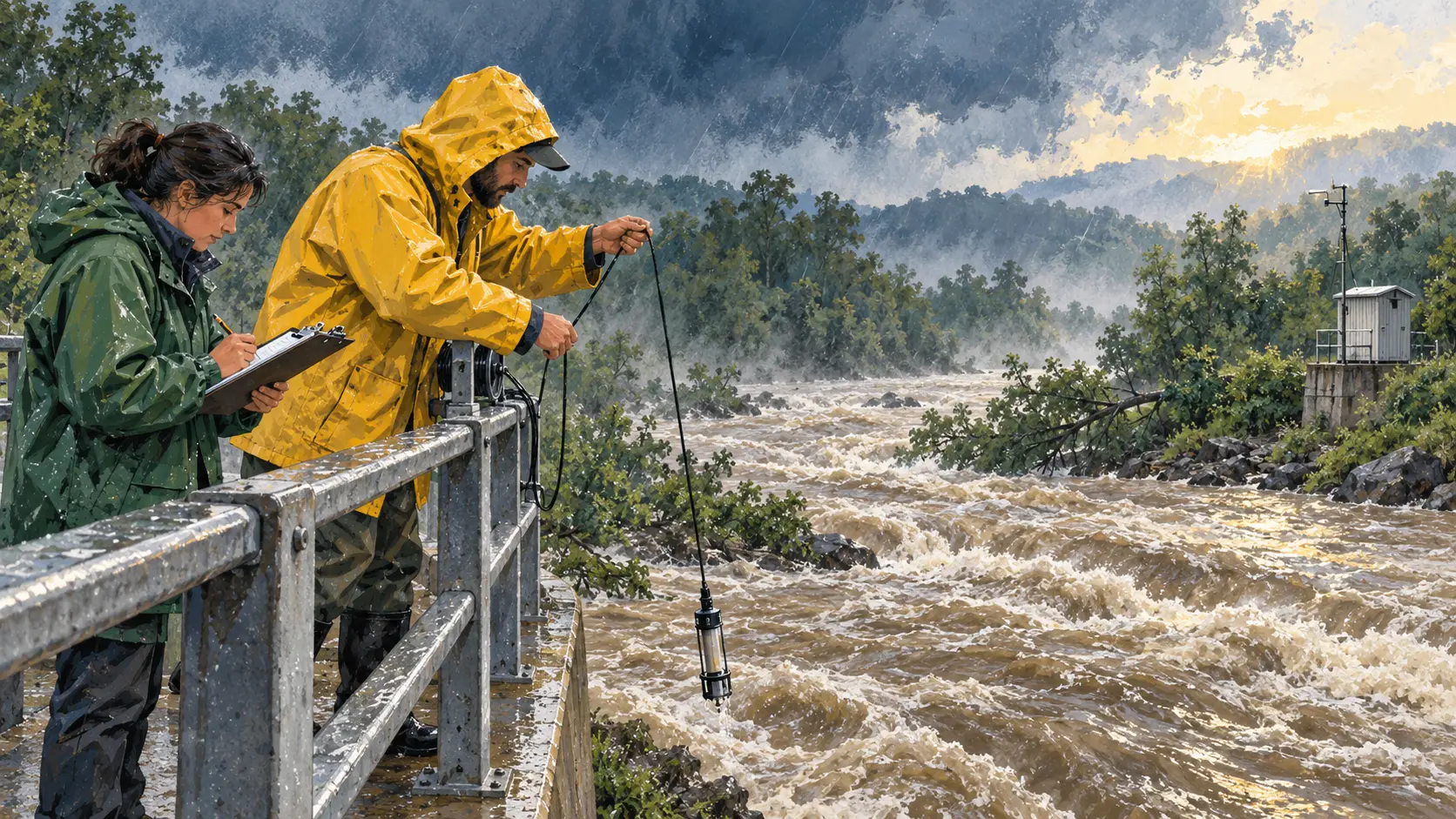
The work outside those computers continued during Fran. A Virginia update dated 8 September reported scientists and field teams measuring high water and collecting water-quality samples in four river basins. An earlier update described access problems caused by fallen trees, washed-out roads and local flash flooding. A browser made the results easier to obtain; gathering them still involved getting to the river.
Even the expansion of online access had a physical limit. The 1997 fact sheet reported that the observing network had fallen to about 7,000 stations in 1996, 185 fewer than the previous year. More people could consult data while fewer places were being measured. Decisions by the agencies paying for individual stations affected readers well beyond those agencies: National Weather Service used nearly 4,000 stations operated for other cooperators.
The web had made river information a service people could use while events unfolded. Fran then put the delivery arrangements into the story. Keeping that service useful meant maintaining observations, calculations and a route to the reader—even when the office providing it shared the weather outside. The river had acquired a webpage. It had declined to acquire office hours.
Member Briefing
Deeper Profile Context
Sign in with the right membership level to unlock the full briefing and source notes.
Only for Strategic Circle
Strategic Circle
Open to all readers. Unlock profile briefings after joining and signing in.
Join Strategic CircleOnly for Leadership Alliance
Leadership Alliance
For qualified IP-asset owners and management; sign in to unlock alliance briefings.
Join Leadership Alliance