Summary
- The UK proposes advance notification and security review for fibre-optic sensing on subsea cables, including deployments able to detect activity in UK waters even when the cable does not land in Britain.
- The same framework would require data protection and allow government to request sensing data for national security. The paper leaves the detailed rules to later regulations.
The cable has become a sensor
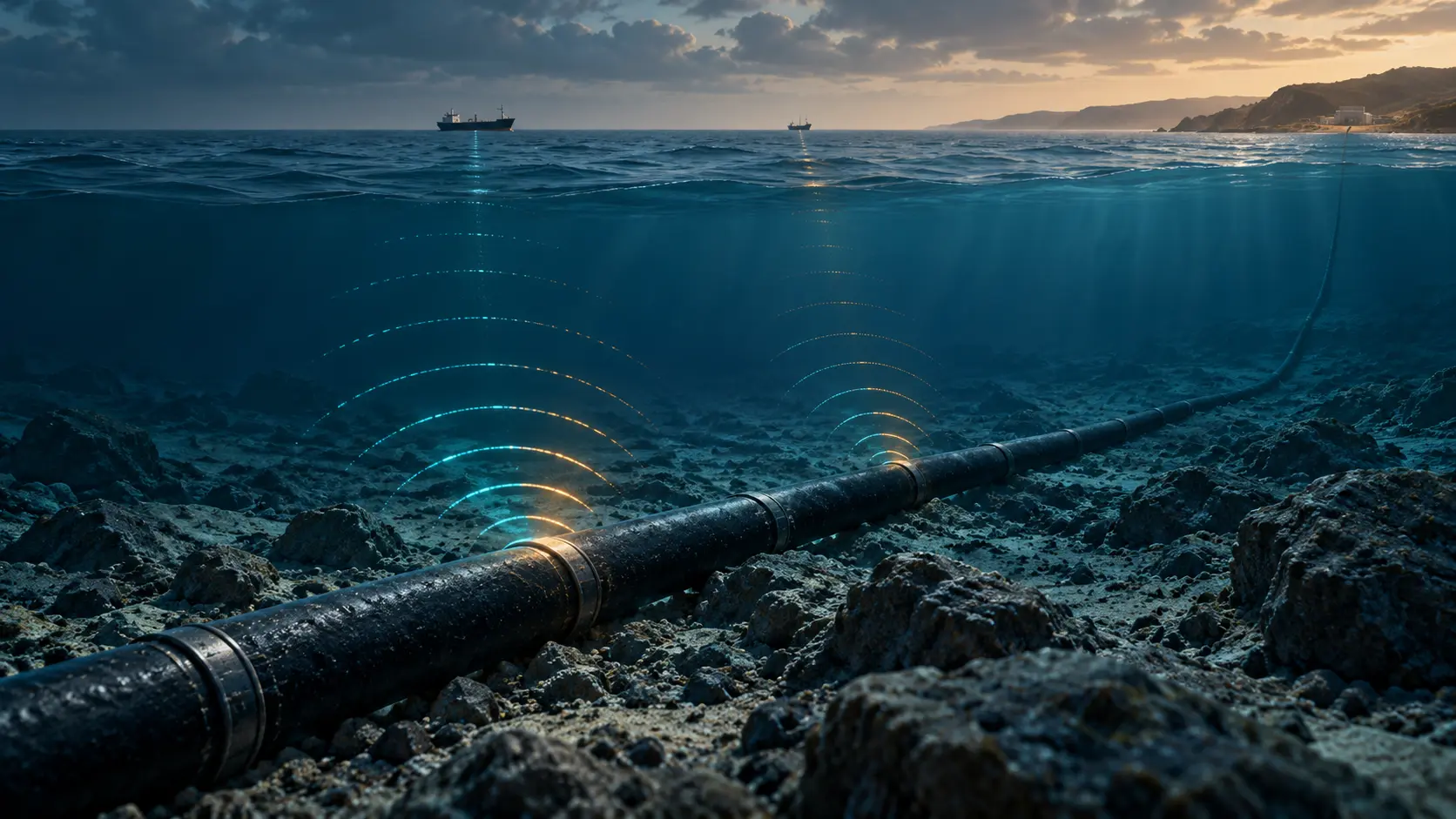
A subsea cable can now do more than carry traffic. Fibre-optic sensing uses the cable’s optical fibres to register vibration, sound, temperature and movement around the route. The UK Government’s 22 October White Paper names Distributed Acoustic Sensing, Distributed Temperature Sensing, optical interferometry and state-of-polarisation sensing. These systems can help locate faults, detect anchor drag and seabed disturbance, and support seismic or marine research. The same readings can reveal vessel activity and patterns around defence assets.
That dual use is the policy problem. The proposal treats sensor deployment as a security decision before it becomes an operational tool. The entity controlling the fibre would notify government about a system’s owner, operator and supplier, other parties with data access, intended use, technical capability, data format, sampling and retention, and location. A permanent deployment on existing infrastructure would normally be reported at least six months in advance. An urgent fault investigation could use a provisional notice, followed by at least 72 hours’ activation notice.
The government proposes a review period of up to six months for permanent deployments on existing infrastructure. It could ask for more information, inspect premises, and in an exceptional imminent-threat case stop deployment temporarily while review continues. After review, it could impose conditions on configuration or operating procedures; a full prohibition is proposed only where conditions cannot manage the risk. Those conditions could be revisited after a supplier change, a major technology upgrade or a new security risk.
The framework’s most consequential line concerns the data itself. Baseline requirements would cover security of the sensing system and its output, and require responsible entities to provide sensing data to government when requested in the interests of national security. The paper’s question 60 asks respondents directly whether that duty should exist. It also proposes rules on encryption, storage and access locations, vetted personnel, access logs and mechanisms for sharing data in the form and frequency requested. The detailed technical duties would sit in secondary regulations and codes of practice.
The map is also wider than a landing station. The proposal would cover sensing on a cable that passes through UK waters without connecting to Britain if it can detect activity within the UK’s territorial sea, exclusive economic zone or continental shelf. Its reach follows what a sensor can observe, not simply where the cable touches shore. The stated consultation proposals are not enacted powers. The paper identifies no current data request, named deployment, imposed condition or prohibition.
For cable owners, this turns sensing from a technical add-on into a regulated service with a security file, notice clock and continuing data obligations. The central choice is now visible in the consultation: the fibre may listen for safer repairs and better science, while the state wants a route to inspect the listener and obtain its output. The final rules will decide how narrowly that route is drawn.
Sources: UK Government White Paper; official consultation page.
Member Briefing
Deeper Profile Context
Sign in with the right membership level to unlock the full briefing and source notes.
Only for Strategic Circle
Strategic Circle
Open to all readers. Unlock profile briefings after joining and signing in.
Join Strategic CircleOnly for Leadership Alliance
Leadership Alliance
For qualified IP-asset owners and management; sign in to unlock alliance briefings.
Join Leadership Alliance