Summary
- Carrier diversity is commercially useful, but it is not proof that two circuits avoid the same fibre, conduit, bridge, building entrance, power feed or repair bottleneck.
- A buyer should pay a resilience premium only against a versioned failure-domain schedule, explicit unknowns and a test that demonstrates what survives one physical event.
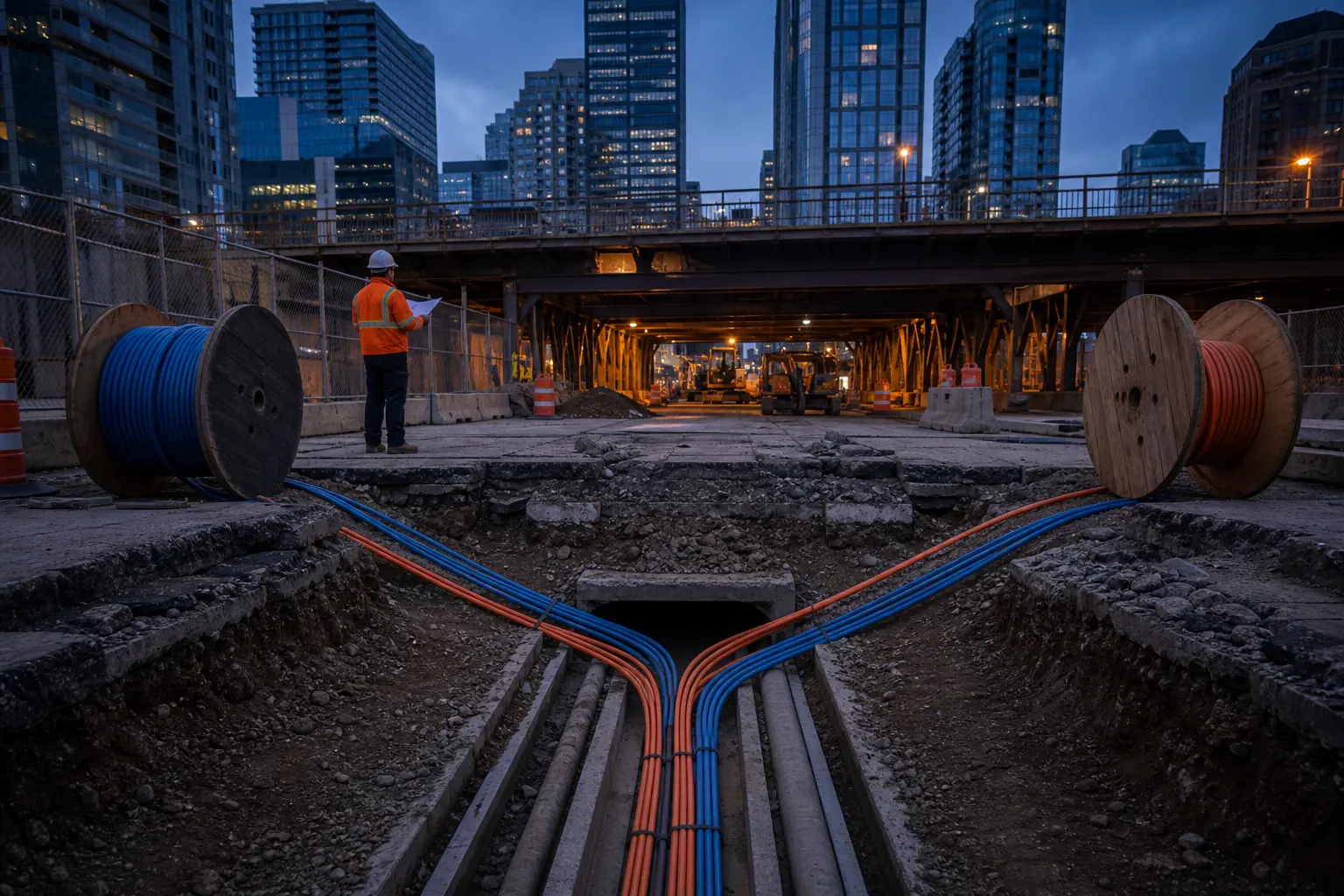
Picture the failure report after an excavator opens the wrong section of road. Circuit A is down. Circuit B is down. The suppliers are different and the service identifiers have nothing in common, yet both local loops entered the district through the same duct bank. The enterprise bought two contracts and one physical outcome.
This is not an argument against managed diversity. It is an argument for naming the thing being bought. GTT says it provides an unnamed Fortune 500 consumer-products company with dual dedicated-internet circuits, diverse carriers and broadband backup across more than 100 sites. At critical warehouses, the design includes tertiary lines. GTT also says its carrier-agnostic model can select multiple providers and physical paths across different points of presence. Those are materially better design choices than a single unprotected access line.
But the same GTT case study does not publish route drawings, conduit records, building entrances, shared power, maintenance contractors or the result of a common-mode outage exercise. Its customer is unnamed. The reported reduction in downtime and more than $2.2 million in annual network-cost savings are useful company claims, not an independent certification of physical separation. A serious buyer should preserve that distinction rather than turn a vendor case study into a fact the vendor did not claim to prove.
Reach is not separation
GTT operates one of the world's large IP backbones. Its current public material says AS3257 reaches more than 400 points of presence, 140,000 customer locations and over 170 countries; another current GTT network page gives a figure above 450 PoPs. The company markets diverse and redundant paths and can combine wired access with 5G or low-earth-orbit satellite. Scale improves the menu of possible routes. It does not, by itself, describe the ducts serving a particular factory, hospital, office or data centre.
The Portland example shows why ownership has to be traced across the chain. In 2023 GTT announced a new PoP using Ziply Fiber, with initial 400G capacity, access to 11 data centres and the Hillsboro subsea cable landing station. Ziply described its regional infrastructure as dual and redundant. That is evidence of an access partnership and more regional options. It still does not reveal whether two customer circuits share a bridge, conduit, entrance, power source or repair crew between the premises and the backbone.
A logical service map is therefore not a physical failure map. Border Gateway Protocol can select a different next hop while the two paths remain inside the same trench. Two wavelengths can use different transmission equipment while occupying one fibre. Two access carriers can buy capacity from the same underlying infrastructure owner. Even routes that separate across a metro area can reconverge at a bridge, rail crossing, landing station, meet-me room or building riser.
The FCC's useful distinction
The Federal Communications Commission made the distinction unusually clear in its 2013 911 reliability order. Logical diversity can mean different transmission equipment while the circuits still share a fibre or conduit. Physical diversity means sufficient route separation that one power failure, equipment failure or cable cut does not disable both. The order also cited the practice of periodically auditing whether the physical and logical diversity called for by the design still exists.
In June 2026, the FCC stated a technology-neutral benchmark in even plainer terms: physically diverse routes should not share physical segments such as fibre, conduits or structures where one failure could break both paths. These texts concern 911 reliability; they do not govern every GTT enterprise contract. Their value here is analytical. They define a test that marketing words such as “dual”, “redundant” and “diverse” often leave unresolved.
Buy evidence at the boundary
The economic problem is information asymmetry. GTT can see its backbone and orchestration layer. An access carrier knows its local plant. A duct owner, landlord or transport authority knows a different segment. A repair contractor may know which supposedly separate assets enter the same queue after a storm or road strike. The enterprise carries the interruption loss without necessarily receiving the combined route record.
That asymmetry turns a resilience premium into an option whose exercise conditions are hidden. The second circuit creates value only if its expected avoided loss exceeds its recurring charge, site equipment, testing cost and remaining common-mode exposure. A cheaper logical second path may still be rational. What is not rational is paying a physical-diversity price for a logical-diversity product.
Every critical A-to-B service should therefore carry a versioned failure-domain schedule. It should name the carrier and circuit identities, on-net and off-net segments, hand-off owners, known shared conduits and structures, building entries, meet-me rooms, risers, power feeds, termination equipment and common repair dependencies. It should also show the evidence date, undisclosed sections, confidence level, last single-failure test and contractual remedy when the supplied route violates the agreed separation.
Unknown is an acceptable entry. Empty is not. If a supplier cannot disclose a sensitive route, it can still attest against defined common points, allow an independent auditor to inspect the evidence, or offer a contract remedy tied to a diversity breach. If none of those is possible, the buyer should price the circuit as unverified rather than pretend uncertainty is resilience.
Medium diversity can be more valuable than a third fibre with the same civil exposure. GTT's portfolio includes 5G and LEO satellite access alongside wired services. Wireless and satellite introduce their own dependencies—power, spectrum, weather, terminal placement and provider control—but they can avoid the particular trench or bridge that defeats two fixed lines. The correct comparison is not fibre versus wireless in the abstract. It is one failure-domain portfolio against another.
The board-level conclusion is simple: line-item plurality is not an operating outcome. Accept the resilience claim only when a defined single physical event leaves the required business service running, and preserve the evidence that makes that statement true.
Sources
Member Briefing
Deeper Profile Context
Sign in with the right membership level to unlock the full briefing and source notes.
Only for Strategic Circle
Strategic Circle
Open to all readers. Unlock profile briefings after joining and signing in.
Join Strategic CircleOnly for Leadership Alliance
Leadership Alliance
For qualified IP-asset owners and management; sign in to unlock alliance briefings.
Join Leadership Alliance