
Summary
- What it says: True Internet Data Center, Myanmar is not primarily a cloud growth story. It is a reliability business operating in a country where reliability itself is scarce.
- Main topic: Cloud service dependency; Data centre investment
- Context: Infrastructure / Company research / Myanmar
A reliability business in a market that prices failure
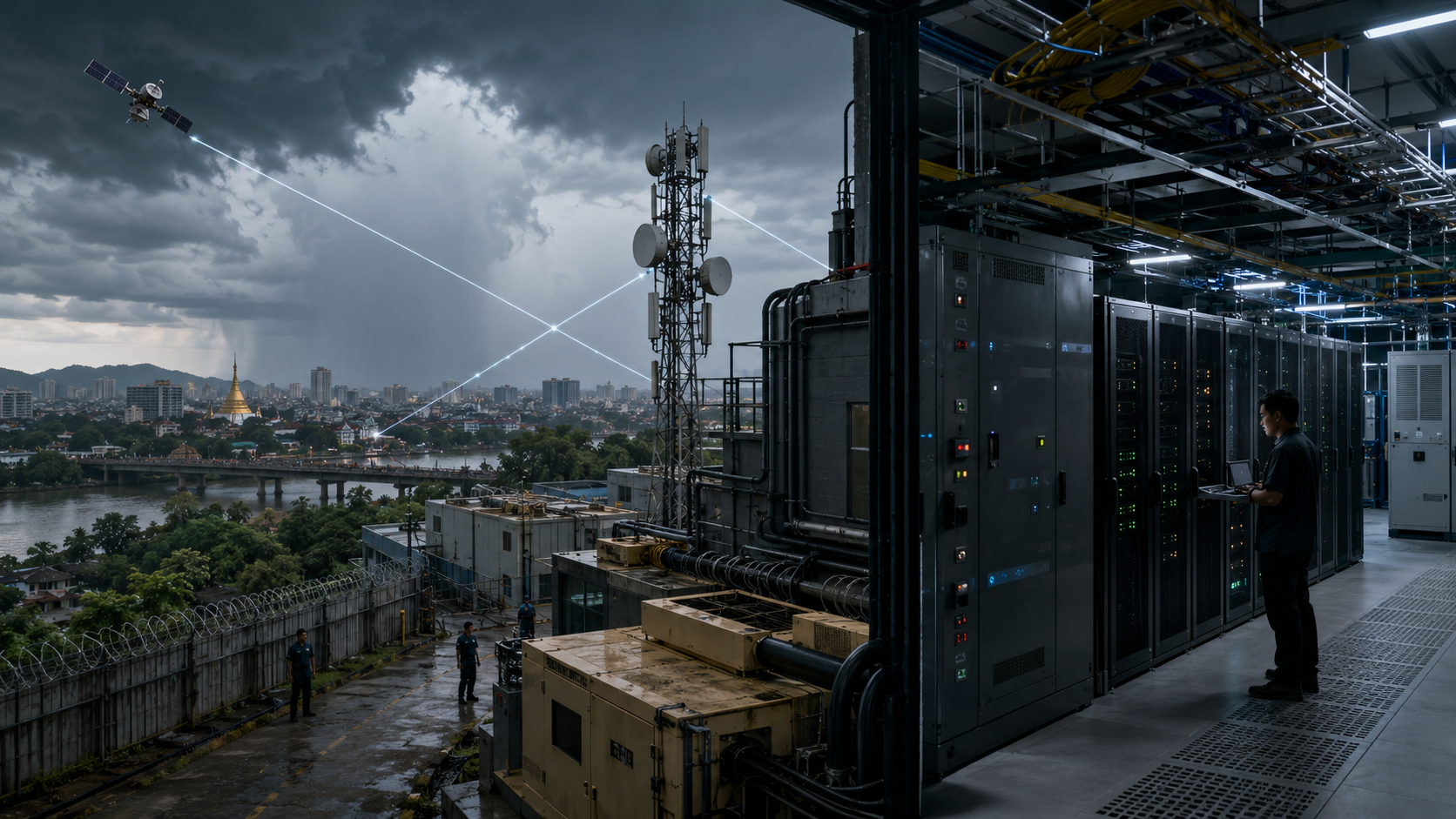
True Internet Data Center, Myanmar is not primarily a cloud growth story. It is a reliability business operating in a country where reliability itself is scarce. The company's strategic value does not come from being a miniature version of Thailand's hyperscale data center boom.
It stems from a narrower, more fragile, and more commercially revealing position: a licensed data center and managed services provider in Yangon, located in MICT Park, connected to the True IDC Thailand ecosystem, visible in Myanmar's telecommunications license registries, APNIC-derived network resource records, and peering databases, and positioned around colocation, managed services, connectivity, and continuity for businesses that cannot safely run critical systems from ordinary offices.
The public record confirms a modest but real operational identity. The official True IDC Myanmar page states that the Myanmar data center was established in 2015 in MICT Park, Yangon, and showcases "Colocation and Managed Services" as the two key services aimed at medium and large enterprises and government agencies. The same page lists colocation, rack space, power, cooling, backup power, monitoring, redundant power, fire protection, carrier-grade equipment, access control, managed servers, network and internet connectivity, hardware as a service, backup service, equipment installation, and remote support. It also advertises a 99.95% SLA. The regulator's record is more solid than the marketing page: the Myanmar Posts and Telecommunications Department lists True IDC (Myanmar) Co., Ltd. at Building 17, Ground Floor, MICT Park, Hlaing Universities Campus, with an Application Services license issued on March 28, 2016 and expiring March 27, 2031 for ISP, cloud, and value-added services. (trueidc.com)
This evidence should discipline the analysis. True IDC Myanmar is a real licensed company with a physical and network identity. It is not, on the public evidence, a large hyperscale platform. The parent group's Thai data center story now includes AI infrastructure, hyperscale capacity, Microsoft's Thailand cloud region, and a Global Infrastructure Partners/BlackRock partnership targeting over a billion dollars of data center capital over three to five years. But the Myanmar service offering is visibly narrower: on True IDC's own site, Thailand has a long menu of data center connectivity, including cloud interconnection products such as Google Cloud Interconnect, Huawei Cloud Hosted Connection, Alibaba Cloud Express Connect, and AWS Direct Connect, while Myanmar is only listed under "Colocation & Managed Services." (trueidc.com)
This distinction constitutes the article's core commercial assertion. True IDC Myanmar's value is not in selling cheap compute, bulk cloud consumption, or prestige infrastructure. Its value lies in converting unreliable inputs into usable uptime. Myanmar makes a data center a private substitute for failing public infrastructure. A customer that buys a rack in Yangon is buying more than floor space. It is buying power resilience, cooling, generator management, network proximity, staff availability, physical security, remote support, regulatory authorization, and a degree of continuity when ordinary business conditions are unstable.
The World Bank's Myanmar Economic Monitor of June 2026 provides the macroeconomic reason for this product's existence. It reports that 64% of firms experience power outages, the median outage duration is four hours, and 47% of firms own or share a generator. It also reports that unreliable power increases costs, reduces productivity, and makes operations harder to plan. The same report shows that enterprise digital adoption in Myanmar remains shallow: only 22% of firms use social media for business communication, 9% use basic email, 1% claim to have a dedicated business domain name, and about 7% maintain a website. (MIMU)
This means the addressable market is narrow but not negligible. Most businesses do not need serious colocation because they are not yet digitally advanced enough. But the ones that do—banks, financial institutions, telecom operators, content platforms, government agencies, logistics firms, large retailers, multinational subsidiaries, industrial groups, and IT service providers—face a high cost of failure. True IDC Myanmar's business model is to place itself between those customers and Myanmar's unreliable infrastructure, and then charge a premium to absorb that operational volatility.
Who the company really is
The company is best described as a Myanmar operating unit under the True IDC brand, backed by Thai operational know-how and linked to a wider CP/True digital infrastructure ecosystem, but locally licensed and locally exposed. The Thai Business Association of Myanmar directory lists "True IDC Myanmar Co. Ltd." at Ground Floor, Building 17, MICT Park, Hlaing Township, Yangon, and describes the business as providing data center colocation, cloud services, managed services, and "all-in-one" hardware/software support. This directory is not an ownership document, but it matters because it shows how the company presents itself within Thai-linked business networks in Myanmar: not as a pure wholesale facility, but as a practical IT infrastructure provider for businesses needing bundled support. (Tbam1997)
True IDC's 2020 article about Myanmar describes the facility as the first Thai-invested commercial data center in Myanmar, situated in MICT Park, a tech hub housing software and ICT firms. It also calls the facility carrier-neutral, states that it provides an internet exchange service, and claims it serves local and international customers through colocation, managed services, and ICT solutions. The same article reports, through an executive quote, that foreign investors made up as much as 80% of users while local companies accounted for 20%. That figure should not be treated as an audited customer split; it is a company statement. But it supports the commercial reading that the initial sales target was not the average Myanmar SME. It was foreign and high-end enterprise demand. (trueidc.com)
A 2015 Mizzima report based on the company's launch announcement gives the original business thesis. True IDC presented the Myanmar data center as a way for companies to reduce investment in servers, software, and maintenance, to expand faster, improve security, boost efficiency, and avoid building in-house IT infrastructure. This launch narrative was promotional, but its economic logic remains valid: when a market lacks mature infrastructure, a data center operator sells an outsourced shortcut to resilience. (ENG.MIZZIMA.COM)
The mistake would be to read this as a standard company profile. The important question is not whether the company has a tidy brochure. It does. The important question is what scarce asset it controls. In Myanmar, the scarce asset is not just the building. It is the combination of the license, the location, the operational know-how, the interconnection position, and the ability to procure and maintain reliability inputs under stress.
What it sells: uptime as a bundled risk transfer
A normal colocation provider sells racks, power, cooling, interconnects, access control, and remote hands. True IDC Myanmar sells that, but the economics are harder because every input is less reliable. Power is not just a utility bill; it is a production risk. Cooling is not just a facility cost; it is a condition for availability. Remote support is not just a convenience; it replaces scarce technical labor and unpredictable physical access. Backup power is not a feature; it is the core of the product.
The company's public service offering is revealing. The Myanmar page lists colocation space, facility management, managed servers, network and internet connectivity, hardware as a service, backup service, equipment installation, remote hands, and special reports. A job posting for a "Solution & Cloud Consulting Engineer" from True IDC Myanmar adds another layer: the role involved cloud solution architecture, pre-sales support, proofs of concept, tender/RFQ/TOR responses, statements of work, and techno-commercial proposals. This means the Myanmar business was not confined to passive rack rental. It had, at least publicly, a commercial engineering motion around enterprise solutions and managed projects. (trueidc.com)
The margin model is a gap. The customer has an avoided-cost curve: avoidance of interruptions, avoidance of generator ownership, avoidance of IT staff, avoidance of cooling failures, avoidance of office-server risk, avoidance of security exposure, avoidance of maintenance outages, and avoidance of capex. True IDC Myanmar has a production-cost curve: power, diesel, UPS systems, batteries, cooling, staff, spare parts, imported hardware, connectivity, compliance, rent, insurance, and parent-company overhead. The company makes money if the contractual monthly price exceeds the operator's cost of producing availability.
It loses margin when the cost of private reliability rises faster than customers' willingness or ability to pay.
That gap is fragile. If fuel prices rise, if batteries and switchgear become hard to import, if the kyat weakens against the currencies used to buy equipment, if customers pay slowly, if SLA credits become real, or if staff attrition climbs, the operator's cost curve moves up. If customers are multinationals, banks, or large regulated enterprises, they may still pay. If customers are local SMEs, they may fall back to cheaper self-provision or offshore hosting. This is why Myanmar can simultaneously raise the value of a data center and shrink the market's ability to buy one.
The SLA language of 99.95% must also be read commercially, not cosmetically. In annual arithmetic, 99.95% availability implies about 4.38 hours of downtime per year. In a stable market, that would be compared against the facility's tier design, redundant utility feeds, generator redundancy, maintenance discipline, and service-credit conditions. In Myanmar, it integrates additional variables: fuel availability, generator runtime, import logistics, network volatility, security conditions, route diversity, staff availability, and regulatory continuity. True IDC's own documents are not perfectly uniform—the main Myanmar page advertises 99.95%, while the 2020 article refers to SLA needs "up to 99.90%." That gap is not fatal, but it reinforces the need to see SLA as a commercial promise whose enforceability depends on contractual conditions not visible in the public record. (trueidc.com)
The scarce asset: authorization, location, and interconnection
True IDC Myanmar does not hold an exclusive license. The PTD list shows 264 communications service licenses as of May 1, 2026, including 48 application services licenses. True IDC Myanmar's license therefore counts as authorization, not as a monopoly. It legally supports the ability to sell ISP, cloud, and value-added services, but does not prevent others from competing.
The most valuable bundle is authorization plus location. The physical location is Building 17 in MICT Park, Hlaing, Yangon. The regulator, True IDC's official page, APNIC-derived records, PeeringDB, and TBAM all point to that same address. The network location is visible via AS134137 and APNIC-derived address records. Ipregistry's APNIC mirror lists 103.55.0.0/24 as TIDC-MM, describes it as "True Internet Data Center - Myanmar," assigns the country code MM, gives the MICT Park address, and shows the route origin as AS134137. It also shows a Thai maintainer link and a "True Internet Data Center Administrator" role at True Tower in Bangkok. (Ipregistry)
This proves two things and does not prove a third. It proves that the Myanmar operation has a real Internet number resource footprint. It proves the Thai operational link. It does not prove scale. A /24 represents 256 IPv4 addresses. A data center company can serve customers through private circuits, customer-owned prefixes, upstream allocations, and non-public network arrangements, so the public IP block does not cap the business. But it does cap the claim that can be made from public data. There is no visible evidence here of a large public hosting network or a major carrier-scale route footprint.
PeeringDB reinforces that conclusion. The network entry for AS134137 lists True Internet Data Center, Myanmar, ASN 134137, two IPv4 prefixes, one IPv6 prefix, traffic levels of 1–5 Gbps, a mostly inbound traffic ratio, and an open peering policy. PeeringDB is self-reported, so it is useful as a market signal rather than as audited telemetry. Nonetheless, the figures indicate a modest network presence, not a dominant internet operator. (PeeringDB)
The facility record is more interesting strategically. PeeringDB lists "True IDC, Yangon, Myanmar" at Building 17, Ground Floor, MICT Park, Hlaing, Yangon, with a local exchange. The exchange is MMIX Yangon, Myanmar Internet Exchange, shown with 45 networks on the facility page. The same facility page lists networks including Campana MYTHIC, Kaopu Cloud HK, MUI Technology, My Mandalay, and VDC Net. A Peering Asia 6.0 slide deck lists the MMIX Yangon point of presence at True IDC, MICT Park, Yangon, with 29 connected ASNs, 140 Gbps peak traffic, BIRD route servers, and RPKI route origin validation. (PeeringDB)
This is the facility's strongest strategic signal. True IDC Myanmar's own public network footprint appears modest, but the building's role as an exchange site raises its economic relevance. A rack in a facility that sits at the edge of domestic peering has a different value than a rack in an isolated server room. For content, payments, enterprise applications, and domestic platforms, local peering can reduce latency, cut transit dependence, and improve control. The scarce asset is not just "space in Yangon." It is space in a Yangon facility that has regulatory authorization, local exchange proximity, and a Thailand-linked operational process.
The economics of connectivity: why local hosting can matter, and why it might not be enough
The economics of hosting in Myanmar has long been constrained by the gap between local demand and local interconnection. An older but useful article from Internet in Myanmar, first published in 2018 and explicitly flagged by the editor as potentially out of date, captured the original problem well: "colocation is nothing without connectivity." It noted that Myanmar traffic could route through Singapore because the dominant networks were not peered locally, and estimated that local exchange could reduce a 90ms round-trip to about 1–2ms. The same article named Burst Myanmar, NTT Myanmar, Myint & Associates, GTMH Telecom, KBZ Gateway, and True Datacenter as relevant market names, described True's Myanmar capability at the time as limited to colocation, flagged a quick commercial response, and gave an old reference price for a full rack of $2,000–$2,500 per month based on collected quotes. (Internet in Myanmar)
That article is market chatter, not current price evidence. But it shifts the commercial reading. It says the market never rewarded facility claims alone. It rewarded connectivity, responsiveness, and the ability to solve operational bottlenecks. The same article ranked GTMH ahead of True IDC in 2018 because GTMH had stronger connectivity and infrastructure service provider attributes. That is not a current competitive ranking. It is evidence of the erosion path: a data center in Myanmar can be undercut by a provider with better network reach even if the facility brand is weaker. (Internet in Myanmar)
True IDC's 2020 article attempted to address that weakness by highlighting carrier neutrality and internet exchange service. The facility's PeeringDB and Peering Asia evidence confirms that this was not empty language: MMIX Yangon is indeed associated with the True IDC MICT Park site. But it remains important to separate the facility's exchange relevance from True IDC's own traffic scale. The exchange can create network externalities around the building; it does not mean True IDC controls the traffic or captures all of its economics.
The local vs. offshore decision remains a trade-off. Hosting in Singapore or Thailand offers deeper cloud ecosystems, greater provider depth, more mature compliance standards, and lower physical infrastructure risk. It also creates dependency on latency, foreign exchange, jurisdiction, and international routes. Hosting in Yangon improves local latency, physical accessibility, and domestic interconnection, but exposes the customer to Myanmar power risk, regulatory risk, shutdown risk, and local legal requirements.
True IDC Myanmar's strategic value exists precisely in that gap: customers who need a local presence but cannot absorb local operational volatility themselves.
Power: the hidden production function
Power is the main cost center and the main product. A data center sells reliable power in a structured form. It buys unreliable grid power, supplements it with UPS, generators, batteries, and fuel, and turns that into a contractual uptime promise. In Myanmar, that transformation is expensive.
World Bank firm-level data shows that outages are normal, long, and costly. Reuters reported in November 2025 that Myanmar's operational power capacity had fallen to 2015 levels by 2024, that Western sanctions and foreign exchange shortages were hitting the electricity grid, and that cheap Chinese panels were supporting solar adoption. The same report said that electricity supply had deteriorated since the 2021 coup and civil war, exposing millions to chronic blackouts, while sanctions restricted access to technical support, spare parts, and expertise for infrastructure maintenance. (MIMU)
This matters for True IDC Myanmar in both directions. Bad power increases demand for colocation because office server rooms become unreliable. But bad power also increases the delivery cost for the operator. If grid supply is intermittent, the facility must run backup systems more often. Generator usage increases maintenance, fuel storage requirements, failure risk, and cash costs. UPS systems and batteries wear under cycling. Cooling becomes harder when input power is unstable. If spare parts require foreign exchange or import approvals, the risk of outage rises even before a failure occurs.
The solar trend is a partial competitor, not a full substitute. Reuters reported that solar panel imports from China more than doubled in the nine months to September 2025 to about $100 million, that home solar installations reached around 300,000 in 2025, and that a home solar system with battery and inverter could be acquired for under $1,000, compared to about $7,000 for a small diesel generator plus $50–$100 per week in fuel. For many shops, clinics, water kiosks, and small businesses, solar-plus-battery is a rational alternative to the pain of office-level outages. (Reuters)
But a data center is not a shop with lights and point-of-sale equipment. It needs 24/7 power quality, cooling, redundancy, switching, monitoring, and maintenance. Solar adoption can erode the bottom of the demand—the small customer who only needed a few powered machines during outages—but it does not eliminate demand from banks, large firms, regulated enterprises, or content providers. If anything, the spread of solar confirms the underlying problem: customers are paying privately for reliability because the public system cannot deliver it.
The operator's margin therefore depends on contract design. A strong contract passes through fuel and power escalation, sets prices in foreign or hard-currency linked terms, limits SLA exposure, and separately charges for remote hands, interconnects, managed service, and exceptional consumption. A weak contract locks revenue in kyat while fuel, batteries, equipment, and vendor support are dollar-, baht-, or yuan-denominated. The public record does not disclose True IDC Myanmar's contract currency, power pass-through model, or SLA credit exposure. Without that, profitability cannot be inferred from the existence of demand.
The Thai connection: credibility, but not a blank check
The Thai link is a real asset. True IDC Myanmar benefits from the credibility of True IDC Thailand's operating history, processes, vendor relationships, customer references, and regional sales channel. The official Myanmar page explicitly states that the Myanmar business operates based on more than 21 years of experience from True IDC Thailand, and the 2020 article says that Thai standards and Regional Command Center monitoring were applied to Myanmar operations. Uptime Institute's customer case study on True IDC notes that the group serves customers in Thailand and Myanmar across banking, retail, manufacturing, government, OTT, and content service provider sectors. (trueidc.com)
This matters commercially because professional customers buy trust, not just racks. A bank or foreign subsidiary choosing a data center provider in Myanmar will value the Thai operational process, the group's reputation, the procurement access, and the sense that the operator is not a thin local shell. The TBAM listing also suggests a Thai business network sales channel, which is important for companies entering Myanmar from Thailand and needing a provider that can bridge regional governance expectations with local operating conditions. (Tbam1997)
But the parentage plays both ways. In Thailand, True IDC is now part of a much larger digital infrastructure story. GIP, a BlackRock subsidiary, announced a strategic partnership with CP Group and True IDC in May 2025 to accelerate Thailand's digital infrastructure, support AI and cloud computing, and deploy more than a billion dollars of data center capital over three to five years. Microsoft's 2025 announcement indicated that True IDC would serve as one of the key data center partners supporting Microsoft's cloud region in Thailand. These facts support the parent's credibility and operational ambition. They do not prove new investment in Myanmar. (global-infra.com)
In fact, they may imply the opposite. Global infrastructure capital normally dislikes opaque political risk, sanctions exposure, currency controls, uncertain customer concentration, and non-transparent regulatory requirements. A Thai hyperscale platform backed by institutional capital may ring-fence Myanmar rather than double down. The parent group may strengthen Myanmar through processes and procurement, but it may also cap Myanmar capital expenditure if group governance, sanctions screening, or investor optics become binding constraints.
That is the correct reading: True IDC Myanmar has the parent's credibility, but not necessarily the parent's balance-sheet appetite. The Myanmar asset is more likely a strategic option and continuity node than a priority growth engine.
Political risk as an operating cost
Political risk in Myanmar is not background noise. It is part of the data center's production function. A licensed provider of internet, cloud, and value-added services operates under a regime where connectivity can be restricted, monitored, or constrained.
Freedom House rates Myanmar "Not Free" in Freedom on the Net 2025 with a score of 9/100. Its report states that Myanmar remains one of the world's worst environments for internet freedom, with localized shutdowns, military control over key service providers, blocking of Signal and VPN access, surveillance and censorship technology in telecom and internet companies, and a January 2025 cybersecurity law imposing broad censorship mandates, VPN restrictions, and local data retention requirements. (Freedom House)
The Myanmar Internet Project's 2025 yearly report, based on independent and ethnic media, local Telegram channels, monitoring organizations, junta-affiliated media, and local verification where possible, documented 105 internet shutdown incidents across 73 townships in 14 states and regions in 2025. It also reported shutdowns in five Yangon townships and categorized the shutdown types into mobile restrictions, internet connectivity cuts, and total internet/mobile blackouts. This source is civil-society monitoring, not regulator data, but it is commercially relevant because customers price shutdown risk even when a shutdown does not touch their own facility. (Myanmar Internet)
Carnegie's 2026 analysis is more structural. It argues that after the 2021 coup, Myanmar's junta compelled telecom operators and ISPs to implement controls including surveillance and interception technology, user data access, and SIM registration enforcement, contributing to the exits of Telenor and Ooredoo and institutionalizing digital repression through network infrastructure. This does not prove misconduct by True IDC Myanmar. It proves the operating environment faced by any licensed infrastructure provider adjacent to the internet. (Carnegie Endowment for International Peace)
The commercial effect is direct. Some customers will pay more for local continuity because they need low latency, local access, and local operations. Other customers will avoid local hosting because local jurisdiction increases exposure to data requests, retention requirements, censorship orders, or reputational risk. The same regulation can create demand and destroy demand. A local data requirement could benefit local data centers in the short term. A broad data retention or platform-control obligation may cause foreign firms to move sensitive systems offshore. For True IDC Myanmar, regulation is not simply a compliance cost.
It shapes the customer pool.
Sanctions and cross-border enforcement add another layer. The OFAC Burma sanctions framework includes prohibitions related to financial services for the benefit of Myanma Oil and Gas Enterprise, while UK/EU/Canadian sanctions have targeted the Myanmar military's access to equipment, funds, jet fuel, and associated suppliers. These measures are not sanctions on True IDC Myanmar and must not be portrayed as such. Their relevance is indirect: sanctions raise the screening burden on counterparties, complicate currency and procurement flows, and increase the risk premium for any exposure to Myanmar infrastructure. (ofac.treasury.gov)
Thailand's February 2025 decision to cut electricity, internet, and fuel to five Myanmar border zones shows how infrastructure itself can become a coercion tool. That action targeted scam centers along the Thai-Myanmar border, not True IDC's Yangon facility. But it demonstrates a regional fact: power and connectivity flows can become policy instruments when security concerns dominate. Reuters reported that the Provincial Electricity Authority of Thailand cut 20.37 MW of supply to the affected border areas, including Tachileik, Myawaddy, and Phaya Thonsu. (Reuters)
Who depends on True IDC Myanmar
The public record does not identify a clear customer list. This is a major evidentiary gap. True IDC's own page targets medium to large enterprises and government agencies. Its 2020 article names education, banking, and financial institutions as sectors addressed by its ICT solutions and says foreign investors showed strong interest. Uptime Institute's group-level customer case study says True IDC serves banking, retail, manufacturing, government, OTT, and content providers in Thailand and Myanmar. None of this proves named Myanmar customers, contract sizes, or customer concentration. (trueidc.com)
The visible dependence is more network-topological than customer-specific. If MMIX Yangon is present at the True IDC facility, then networks using that exchange depend to some degree on the physical and operational continuity of that site. PeeringDB lists six networks in the facility and 45 networks on the MMIX Yangon exchange entry at that facility. Peering Asia lists the MMIX Yangon PoP at True IDC with 29 connected ASNs and 140 Gbps peak traffic. These figures should not be converted into True IDC revenue, but they indicate that the facility sits inside Myanmar's interconnection map. (PeeringDB)
For enterprise customers, the dependence is likely operational rather than public. A bank may host backup infrastructure. A foreign company may host local application servers. A government agency may host workloads or buy managed services. A content provider may use local peering or local cache proximity. A local IT company may colocate equipment and resell services. The absence of named references means none of these can be asserted as specific True IDC Myanmar relationships. But the service offering, job posts, license scope, and facility role make them plausible customer categories.
This opacity matters economically. In a mature data center underwriting, customer concentration is decisive. A bank, telecom, or government anchor client can change the valuation. The absence of anchor clients can, too. The public evidence does not disclose rack utilization, contract tenors, renewal rates, hard-currency revenue share, power density, churn, customer credit quality, or SLA history. Therefore, the company's strategic value can be analyzed; its enterprise value cannot be responsibly estimated.
Competition: how the position can be eroded
True IDC Myanmar faces four forms of competition.
First is direct local competition. Internet in Myanmar's old practice survey named Burst Myanmar, NTT Myanmar, Myint & Associates, GTMH Telecom, KBZ Gateway, and True Datacenter. Facility directories also show nearby sites such as Myint & Associates Vantage Tower, Telenor Myanmar Yangon, Burst Myanmar, and Campana CLS around Yangon. These directories are secondary sources, and some capacity data is restricted or incomplete. But they support the baseline point: True IDC Myanmar is not alone. (Internet in Myanmar)
The second competitor is connectivity-led colocation. If a rival has better upstream diversity, better domestic routes, stronger international gateway relations, better peering with the dominant networks, or stronger cloud resale capability, it can erode True IDC's position even if its facility brand is weaker. In fragile markets, customers buy the full availability chain. A shiny rack on a weak network loses to a simpler rack on a stronger network.
The third competitor is offshore hosting. Singapore and Thailand can offer deeper cloud ecosystems, better infrastructure, more provider choice, and lower facility risk. True IDC's own Thai parent platform, now attached to Microsoft and GIP/BlackRock narratives, may itself become a preferred offshore option for Myanmar-linked customers who can tolerate latency and do not need local jurisdiction. That is an internal tension: the stronger the Thai platform becomes, the more it may attract workloads that would otherwise have needed Myanmar colocation.
The fourth competitor is self-provision. Solar, batteries, small generators, and office IT outsourcing let some firms avoid colocation. This is particularly relevant for low-density, non-critical workloads. Self-provision will not replace enterprise-grade data centers, but it can take away the marginal customers who might otherwise pay full rack and managed-service prices.
There is also a fifth erosion path: regulation. If Myanmar forces sensitive data to stay local, local data centers gain bargaining power. If Myanmar extends censorship, retention, inspection, or shutdown obligations, local hosting becomes less attractive for foreign and compliance-sensitive clients. Regulation can create a moat and poison it at the same time.
The economic model as a balance sheet
On the asset side, True IDC Myanmar has a license through 2031, a known site in Yangon, a Thai operational link, a recognized regional brand, visible network resources through APNIC, a PeeringDB network identity, local exchange proximity, and a service offering that bundles colocation, managed services, and connectivity. It also has a commercial narrative pointed at foreign investors and large organizations.
On the revenue side, probable streams are recurring rack and power fees, managed services, network and internet connectivity, backup services, remote support, installation work, hardware/software resale, cloud consulting, and possibly ICT project revenue. The job-post evidence and the TBAM directory support a broader managed-service/project model rather than pure wholesale colocation. (Tbam1997)
On the liability side, it has grid risk, fuel risk, UPS and battery replacement risk, cooling risk, import and foreign-exchange risk, staff retention risk, route-dependency risk, political compliance risk, customer payment risk, and parent-group capital-allocation risk. These liabilities are not footnotes. They are the cost of goods sold.
The central strategic value is an option value. If Myanmar stabilizes, True IDC Myanmar becomes a pre-positioned, licensed infrastructure node with Thai backing and exchange proximity. If enterprise digital adoption deepens, the demand curve shifts outward. If local peering becomes more important, the MICT Park position improves. If foreign businesses return, the Thai link becomes valuable. If data localization pressure rises, local capacity becomes scarcer.
The downside is equally clear. If the grid worsens, if fuel and spare parts become harder to get, if sanctions risk rises, if foreign businesses leave, if customers shift workloads to Thailand or Singapore, if local shutdowns become more frequent, or if group governance ring-fences Myanmar, the asset becomes costly to maintain relative to revenue. In that case, True IDC Myanmar is not a growth platform. It is a defensive continuity outpost.
What the public record still cannot answer
The public record cannot answer the most important investor questions. It does not disclose ownership percentages, audited financials, revenue, EBITDA, rack count, utilized racks, available IT load, generator configuration, UPS redundancy, fuel storage, PUE, power density limits, insurance coverage, Myanmar-specific facility certification status, customer names, contract tenors, SLA credit history, hard-currency revenue share, government exposure, related-party arrangements, lease terms, or detailed upstream contracts.
It also cannot show whether the company's availability claim has been tested under Myanmar's worst operating conditions. The marketing pages list redundancy and monitoring. The regulatory records prove authorization. The APNIC and PeeringDB records prove network identity and interconnection context. None of them prove realized availability, profitable utilization, or resilience under sustained power stress.
This is not a reason to dismiss the company. It is a reason to avoid overvaluation. The right commercial view is specific: True IDC Myanmar is a genuine licensed reliability node with strategic relevance inside Yangon's data center and peering ecosystem, but the public evidence does not permit treating it as a large independent growth platform. Its value is likely concentrated in high-need enterprise continuity, local interconnection, Thai-linked customer trust, and the option value of a future stabilized Myanmar.
Evidence record
Source name: Official True IDC Myanmar page. URL:https://www.trueidc.com/en/myanmar. Source type: official company website. What it supports: established 2015 in MICT Park, Yangon; colocation and managed services; 99.95% SLA language; redundant power, cooling, monitoring, security, backup power, network connectivity, managed servers, backup service, and remote support. What it does not prove: revenue, realized uptime, actual utilization, customer names, exact power capacity, or audited facility certification. Why it matters economically: it defines the product as managed reliability and infrastructure, not as a hyperscale cloud region. (trueidc.com)
Source name: Myanmar Posts and Telecommunications Department license list, updated May 1, 2026. URL:https://www.ptd.gov.mm/Uploads/License/Attach/52026/320151252026_Website%20New%20%20Licence.pdf. Source type: regulator PDF. What it supports: True IDC (Myanmar) Co., Ltd holds an Application Services license from March 28, 2016 to March 27, 2031 for ISP, cloud, and value-added services at Building 17, MICT Park. What it does not prove: exclusivity, compliance record, operational quality, revenue, or ownership. Why it matters economically: the license is an authorization asset, but not a monopoly.
Source name: Ipregistry/APNIC derived record for 103.55.0.0/24 and AS134137. URL:https://ipregistry.co/AS134137/103.55.0.0/24. Source type: RIR/WHOIS mirror. What it supports: TIDC-MM address space, description "True Internet Data Center - Myanmar", Myanmar country designation, MICT Park address, route origin AS134137, and Thai maintainer link. What it does not prove: traffic volume, private circuits, customer routes, or quality of service. Why it matters economically: it proves a real network resource footprint and a Thai operational link, while showing a small public IP footprint. (Ipregistry)
Source name: PeeringDB network entry for AS134137. URL:https://www.peeringdb.com/net/16010. Source type: self-reported peering database. What it supports: organization name True Internet Data Center, Myanmar; ASN 134137; traffic levels 1–5 Gbps; open peering policy; two IPv4 prefixes and one IPv6 prefix listed. What it does not prove: audited traffic, live BGP truth, customer base, or profitability. Why it matters economically: it positions True IDC Myanmar as a small interconnection entity rather than a dominant carrier. (PeeringDB)
Source name: PeeringDB facility entry, True IDC Yangon. URL:https://www.peeringdb.com/fac/5031. Source type: facility and interconnection directory. What it supports: Building 17, Ground Floor, MICT Park, Hlaing, Yangon; MMIX Yangon present as local exchange; networks listed in the facility. What it does not prove: power capacity, rack count, uptime, carrier contracts, or exchange revenue capture. Why it matters economically: the facility's exchange proximity may be more valuable than True IDC's own visible network scale. (PeeringDB)
Source name: Peering Asia 6.0 MMIX slide deck. URL:https://papers.peeringasia.org/pa60/peeringasia60-peering-personal-full-list.pdf. Source type: industry conference PDF. What it supports: MMIX Yangon PoP at True IDC, MICT Park, Yangon; 29 connected ASNs; 140 Gbps peak traffic; BIRD route servers and RPKI route origin validation. What it does not prove: True IDC revenue, customer occupancy, or traffic share. Why it matters economically: it supports the idea that the facility is part of Myanmar's local peering infrastructure.
Source name: True IDC Myanmar 2020 article. URL:https://www.trueidc.com/en/news-detail/84/TrueIDC-Myanmar. Source type: company article. What it supports: carrier-neutral positioning, internet exchange service, colocation/managed/ICT services, foreign-investor targeting, sector focus on education, banking, and financial institutions, and narrative of Thai standards. What it does not prove: audited customer split, specific named clients, current market share, or realized SLA. Why it matters economically: it shows the intended customer and revenue model. (trueidc.com)
Source name: Mizzima 2015 launch report. URL:https://mizzima.com/business-domestic/true-idc-launches-data-centre-myanmar. Source type: local press based on company launch statement. What it supports: launch timing, original value proposition, colocation and managed-services thesis, and claims of reducing server, software, and maintenance investment. What it does not prove: current operations, revenue, customer retention, or commercial success. Why it matters economically: it records the original demand thesis: outsource infrastructure to reduce cost and risk. (ENG.MIZZIMA.COM)
Source name: Thai Business Association of Myanmar directory. URL:https://www.tbam1997.com/directory-search-detail/?registerId=a70e7811-82f6-4e87-91c5-9d22d030e38f. Source type: chamber of commerce directory. What it supports: local address and business description covering colocation, cloud, managed services, and hardware/software support. What it does not prove: legal ownership, revenue, facility quality, or current customer contracts. Why it matters economically: it shows the Thai business network channel and "all-in-one service" positioning. (Tbam1997)
Source name: Internet in Myanmar, "Datacenters and Cloud Providers in Myanmar". URL:https://www.internetinmyanmar.com/articles/datacenter-cloud-myanmar/. Source type: informal practical article and market chatter, first published 2018. What it supports: early competitive set, connectivity as the key business issue, old reference price for a full rack of $2,000–$2,500/month, and market perception that True's capability was limited to colocation at the time. What it does not prove: current pricing, current ranking, or current provider capacity. Why it matters economically: it shows how operators and buyers likely valued the market: connectivity and responsiveness mattered more than brand claims. (Internet in Myanmar)
Source name: World Bank Myanmar Economic Monitor, June 2026. URL:https://themimu.info/sites/themimu.info/files/documents/Report_Myanmar_Economic_Monitor_-_Shock_Amid_Fragility_WB_Jun2026.pdf. Source type: multilateral economic report. What it supports: power outages affecting 64% of firms, median duration four hours, 47% generator ownership/sharing, shallow digital adoption, and weak enterprise digital infrastructure. What it does not prove: True IDC-specific demand, customer willingness to pay, or profitability. Why it matters economically: it defines both the reliability demand driver and the narrowness of the digital customer base. (MIMU)
Source name: Reuters, "War-torn Myanmar embraces solar to tackle power crisis". URL:https://www.reuters.com/sustainability/climate-energy/war-torn-myanmar-embraces-solar-tackle-power-crisis-2025-11-14/. Source type: news report with energy market evidence. What it supports: power capacity deterioration, sanctions/forex/spare-parts pressures, solar import growth, home solar adoption, and diesel-to-solar substitution economics. What it does not prove: True IDC's own power sourcing, backup configuration, or energy cost. Why it matters economically: power is both the product sold and the main cost risk. (Reuters)
Source name: Freedom House, Freedom on the Net 2025: Myanmar. URL:https://freedomhouse.org/country/myanmar/freedom-net/2025. Source type: digital rights and internet freedom report. What it supports: "Not Free" score of 9/100, shutdowns, provider control, censorship, surveillance concerns, and cybersecurity law risk. What it does not prove: misconduct by True IDC Myanmar. Why it matters economically: regulatory and shutdown risk affects local hosting demand, customer compliance burden, and foreign customer risk appetite. (Freedom House)
Source name: Myanmar Internet Project, 2025 Yearly Report on Digital Repression in Myanmar. URL:https://www.myanmarinternet.info/post/yearly_report_2025-1. Source type: civil-society monitoring report. What it supports: 105 internet shutdown incidents across 73 townships in 2025, including disruptions in Yangon townships, and the methodology behind the monitoring. What it does not prove: regulator-confirmed shutdown totals or facility-specific impact. Why it matters economically: internet shutdown risk changes the value of local hosting and redundancy design. (Myanmar Internet)
Source name: Global Infrastructure Partners announcement on CP Group and True IDC. URL:https://www.global-infra.com/news/global-infrastructure-partners-gip-partners-with-cp-group-and-true-idc-to-accelerate-thailands-digital-infrastructure-growth/. Source type: investor/company announcement. What it supports: parent-level Thai data center expansion, GIP/BlackRock involvement, ASEAN growth language, and over $1 billion targeted capital deployment. What it does not prove: Myanmar capex, Myanmar strategic priority, or Yangon facility support. Why it matters economically: it boosts parent credibility but also highlights the gap between Thailand's hyperscale story and Myanmar's continuity-node story. (global-infra.com)
Source name: Reuters, "Thailand cuts power, fuel and internet supply to parts of Myanmar". URL:https://www.reuters.com/world/asia-pacific/thailand-cuts-power-fuel-internet-supply-parts-myanmar-2025-02-05/. Source type: news report. What it supports: Thailand's use of electricity, fuel, and internet cuts against five Myanmar border zones linked to scam-center crackdown, including a 20.37 MW cut by Thailand's Provincial Electricity Authority. What it does not prove: direct impact on True IDC's Yangon facility. Why it matters economically: it shows that regional infrastructure flows can become political coercion tools, raising the risk premium on cross-border connectivity and power dependencies. (Reuters)
The facts that would redefine the availability trade-off
The commercial view would change with hard evidence on six facts: the actual usable IT load and redundancy at MICT Park; current occupancy, customer concentration, and contract tenors; the currency composition and fuel/power pass-through terms; named anchor customers or confirmed government exposure; the upstream diversity, interconnection revenue, and MMIX-linked economics attributable to the facility; and the parent group's capital policy toward Myanmar after the GIP/Microsoft expansion in Thailand.
Positive evidence would shift True IDC Myanmar from "small strategic continuity node" to "defensible infrastructure platform." Negative evidence—low utilization, local-currency revenue with dollar-linked costs, weak routing diversity, fuel resilience, heavy regulatory coercion, or parent ring-fencing—would make the asset look less like a reliability-premium business and more like an expensive option on a market that has not yet recovered enough to pay for uptime regularly.