
Summary
- What it says: True Internet Data Center, Myanmar is best read as a local-stay option for enterprises that cannot run serious systems from ordinary offices, cannot move every workload offshore, and cannot treat Myanmar power, currency, connectivity and policy risk as background noise.
- Main topic: Currency mismatch in infrastructure; Data centre investment
- Context: market / company research report / Myanmar (Burma) / Asia-Pacific
The first price is the decision not to leave
The economic question around True Internet Data Center, Myanmar is not whether Myanmar can support a miniature version of Bangkok's hyperscale data center market. It is whether a company operating in Myanmar will pay enough to keep essential systems local when the rational alternative is to move as much as possible to Thailand, Singapore or another regional hub. True IDC Myanmar is the case because it sits exactly at that tension: a real Yangon facility, a Thai operating parent, a Myanmar licence, a visible network record, and a public product menu built around colocation and managed services rather than a broad cloud catalogue.
The most concrete price signal in the public record is old and must be handled carefully. Internet in Myanmar's 2018 practitioner survey warned that its figures could become dated, but it said collected Myanmar data center quotes put a full rack at roughly $2,000 to $2,500 per month, with B2B negotiation making exact comparison difficult (https://www.internetinmyanmar.com/articles/datacenter-cloud-myanmar/). That number is not a current True IDC tariff. It is still economically useful because it frames the buyer's problem. A rack in Yangon is not cheap in the way a cloud instance is cheap. It is a monthly premium paid to avoid operating servers in an office with weak power, limited cooling, uncertain access and fragile connectivity.
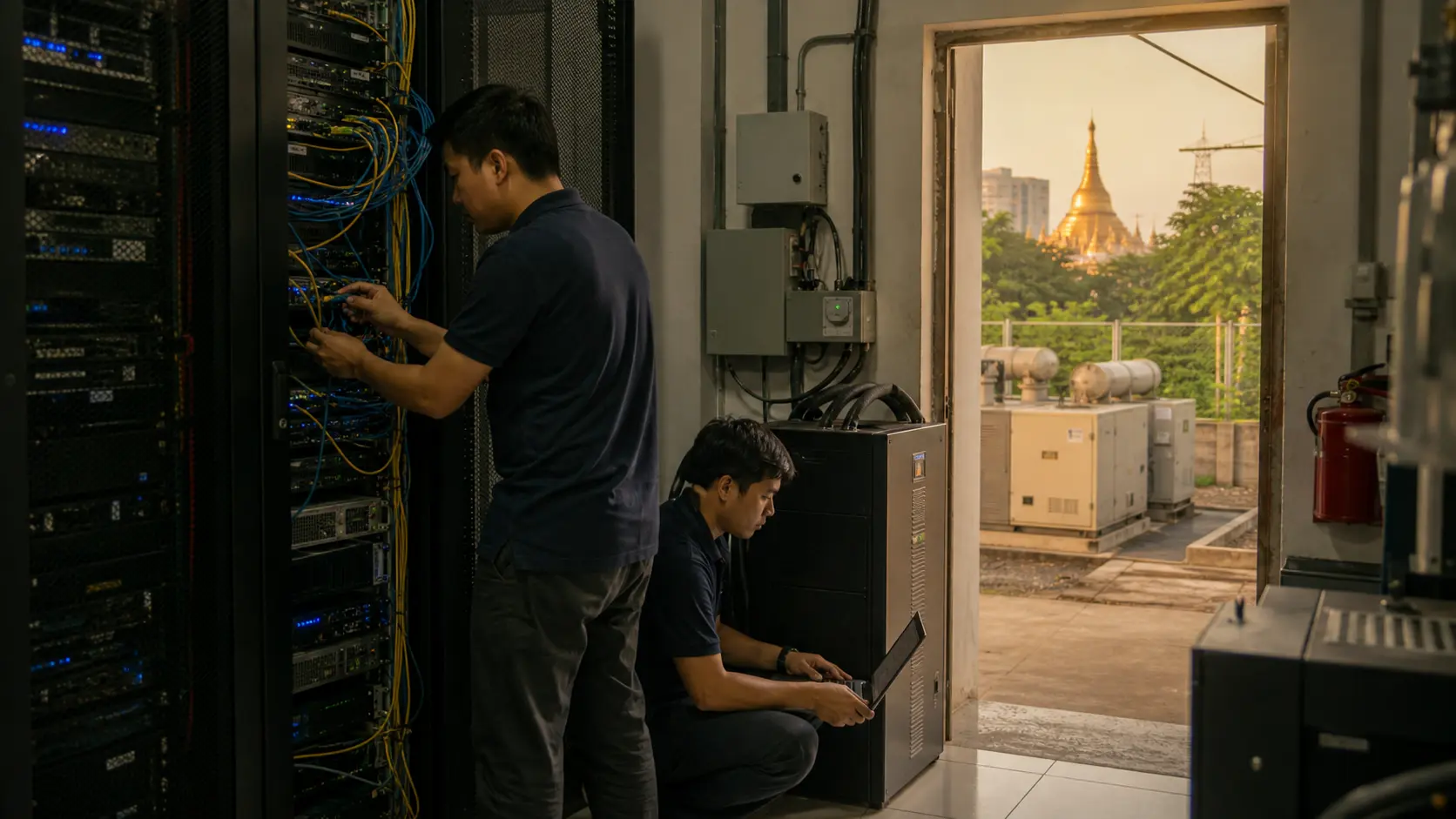
True IDC's own Myanmar page turns that premium into a service promise. It says the Myanmar data center was established in 2015 at MICT Park, Yangon, and advertises colocation and managed services for medium and large enterprises and government agencies. It lists electricity, air conditioning, backup power, monitoring, redundant power, fire protection, carrier-grade equipment, access control, managed servers, network and internet connectivity, backup service, equipment installation, remote hand and special reports. It also advertises a 99.95 percent SLA (https://www.trueidc.com/en/myanmar). The annual arithmetic of 99.95 percent availability is about 4.38 hours of downtime per year. The commercial meaning in Myanmar is sharper: a buyer is not simply paying for four nines minus one decimal place. It is paying someone else to convert bad inputs into usable continuity.
That is the governing argument. True IDC Myanmar sells the option of staying local without pretending that local conditions are normal. The option has value because some workloads need a domestic point of presence, domestic support, local latency, compliance with sectoral data expectations, or physical access to equipment. The option is fragile because the same conditions that make it valuable also raise the cost of producing it. The more unstable the grid, currency, border logistics and regulatory environment become, the more important a resilient local host becomes, but the harder it is for that host to protect margin.
Identity is solid enough, but not large enough to overread
The company's identity is better supported than many small infrastructure entries in Myanmar. The Myanmar Posts and Telecommunications Department's licence list dated May 1, 2026 shows True IDC (Myanmar) Co., Ltd. at Building 17, Ground Floor, MICT Park, Hlaing Universities Campus, Hlaing Township, Yangon. It lists an Application Service Licence issued on March 28, 2016 and expiring on March 27, 2031 for internet service provider services, cloud services and value-added services (https://www.ptd.gov.mm/Uploads/License/Attach/52026/320151252026_Website%20New%20%20Licence.pdf). That record matters more than marketing language because it establishes local authorization and a named address.
The address is repeated across independent traces. PeeringDB's organization record for True Internet Data Center, Myanmar lists the company website override as trueidc.com.mm, the MICT Park address, and country code MM (https://www.peeringdb.com/org/19251). PeeringDB's facility entry for True IDC, Yangon, Myanmar also places the site at Building 17, Ground Floor, MICT Park, University Campus, Hlaing, Yangon, 11051 (https://www.peeringdb.com/fac/5031). MICT Park's own building directory lists True IDC (Myanmar) Co., Ltd. in rooms 102 and 103 on the ground floor of Building 17 (https://mictdc.com.mm/building-17/). The Thai Business Association of Myanmar directory lists True IDC Myanmar Co. Ltd. at Ground Floor, Building 17, MICT Park, and describes the company as providing data center colocation, cloud services, managed services and one-stop hardware and software support (https://www.tbam1997.com/directory-search-detail/?registerId=a70e7811-82f6-4e87-91c5-9d22d030e38f).
That is enough to treat the company as a real local operating node. It is not enough to treat it as a large independent platform. The visible network evidence is modest. PeeringDB's network entry for AS134137 lists True Internet Data Center, Myanmar with two IPv4 prefixes, one IPv6 prefix, 1-5Gbps traffic levels, a mostly inbound traffic ratio, and an open peering policy, but no public exchange point or interconnection facility rows on the network page itself (https://www.peeringdb.com/net/16010). BGP.tools shows AS134137 as True Internet Data Center Company Limited, registered on April 13, 2015, with APNIC whois text connecting the Myanmar AS to the Thai True Internet Data Center organization and maintainer references (https://bgp.tools/as/134137). Ipregistry's APNIC-derived page for 103.55.0.0/24 describes the network name as TIDC-MM, gives the country as Myanmar, shows size 256, and ties the route to AS134137 (https://ipregistry.co/AS134137/103.55.0.0/24).
The conclusion should be narrow. True IDC Myanmar is visible, licensed and placed at a named facility. It has a public AS and a small address-space footprint. The public record does not show revenue, rack count, utilization, power capacity, contracted customers, EBITDA, realized uptime, fuel storage, SLA credits or current customer concentration. In a market like Myanmar, those missing facts are not minor. They are the difference between a durable continuity business and a costly symbolic branch.
The product is an insurance-like bundle
The service menu points to an insurance-like bundle rather than a pure compute business. True IDC Myanmar does not present the same public menu as True IDC Thailand. On the True IDC website, Thailand has colocation service, multi-site network fabric, True IDC Connect, Google Cloud Interconnect, Huawei Cloud Hosted Connection, Alibaba Cloud Express Connect, AWS Direct Connect, virtual router service and other cloud-adjacent connectivity products. Myanmar is listed under colocation and managed services (https://www.trueidc.com/en/myanmar). That distinction is important. The Myanmar value proposition is less about selling a rich cloud ecosystem and more about reducing the operational burden of running infrastructure inside Myanmar.
The company's 2020 article about its Myanmar expansion reinforces that reading. It says True IDC Myanmar launched in 2015 as the first commercial data center from Thailand investing in Myanmar, located at MICT Park, and offered carrier-neutral service, internet exchange service, colocation, managed services and ICT solutions. It also says foreign investors made up as much as 80 percent of users, while local companies made up 20 percent, based on a company executive's statement (https://www.trueidc.com/en/news-detail/84/TrueIDC-Myanmar). That split should not be treated as audited customer data. It does, however, reveal the sales thesis: the original target was not the average small shop. It was foreign-linked and enterprise demand that needed a local operating base without giving up regional standards.
The job market adds another clue. A LinkedIn posting for a Solution & Cloud Consulting Engineer at True IDC in Yangon described work on cloud solution architecture, technical pre-sales, proof-of-concept work, RFP/RFQ/TOR responses, statements of work and techno-commercial proposals (https://mm.linkedin.com/jobs/view/solution-cloud-consulting-engineer-at-true-idc-3038777594). A single old job advert is not proof of present staffing, but it is a market signal. It says the Myanmar business was not merely renting steel doors and power strips. It needed someone who could translate risk and requirements into enterprise proposals.
This is why the product should be valued as risk transfer. A customer with a server in an ordinary Yangon office owns the outage, the generator maintenance, the cooling failure, the access problem, the spare-parts delay, the network issue, the staff shortage and the security weakness. A customer in a managed colocation setting pays the operator to absorb or organize those risks. In a stable market, that is a normal managed-service premium. In Myanmar, it becomes the core product.
The hard part is that risk transfer is not free to the seller. Power, diesel, UPS batteries, cooling equipment, imported spare parts, skilled technicians, security, insurance, rent, network capacity, remote support and compliance all sit under the invoice. If revenue is collected in kyat while major inputs are priced in dollars, baht or yuan, the operator carries a currency mismatch. If contracts allow power and fuel pass-through, the customer carries more of the shock. The public record does not disclose True IDC Myanmar's contract currency, escalation clauses, SLA credits or power-pricing model.
Any valuation that ignores those terms is pretending certainty where none is visible.
Power makes the market and attacks the margin
Myanmar's power environment is the strongest reason a serious buyer would consider professional hosting and the strongest reason the operator's economics are hard. The World Bank's June 2026 Myanmar Economic Monitor says activity remained weak and strained, with power supply constraints, weak demand and limited policy space still weighing on firms (https://www.worldbank.org/en/news/press-release/2026/06/16/myanmar-s-economy-shows-tentative-stabilization-but-fuel-shock-intensifies-pressures). The report's firm-environment section, distributed through MIMU, states that 64 percent of firms reported outages, the median outage lasted four hours, and 47 percent of firms owned or shared a generator (https://themimu.info/sites/themimu.info/files/documents/Report_Myanmar_Economic_Monitor_-_Shock_Amid_Fragility_WB_Jun2026.pdf).
Those figures make data center demand more rational. If an ordinary business must already buy backup power, keep fuel, schedule staff around outages and tolerate downtime, a professionally managed rack begins to look less like a luxury. But the same figures also raise the operator's cost. A data center does not merely need light and office-grade backup power. It needs controlled power quality, UPS systems, switching, cooling, monitoring, planned maintenance and trained response. Every blackout that pushes firms toward colocation also tests the colocation provider's generator, battery, fuel and staffing assumptions.
World Bank power-sector work from 2023 described petroleum fuel prices rising two to three times after 2021, businesses relying heavily on captive diesel generators, and expensive or hard-to-buy fuel making emergency power less dependable (https://thedocs.worldbank.org/en/doc/6bd0c527c8469333b119d88cc0b8b410-0070062023/original/In-The-Dark-Power-Sector-Challenges-in-Myanmar-August2023.pdf). A later Reuters-distributed report on Myanmar solar adoption, carried by SeaBusinessNews, said a basic solar-plus-battery-plus-inverter system could cost under $1,000, while a small diesel generator could cost about $7,000 plus $50 to $100 per week in fuel (https://seabusinessnews.com/2025/11/14/war-torn-myanmar-embraces-solar-to-tackle-power-crisis/). That is a household and small-business comparison, not a data center cost model. It still shows the same substitution logic: customers are privately buying reliability because the public input is unreliable.
Solar and batteries are therefore both a competitor and an advertisement for True IDC Myanmar. For a shop, clinic, small office or local software team, solar-plus-battery may be good enough to keep routers, lights, laptops and payment devices working. For a bank, payment provider, telecom-linked system, foreign subsidiary, data-heavy enterprise or public-sector service, it is not a full substitute for controlled hosting. The more small customers solve power locally, the more True IDC's addressable demand concentrates in customers whose downtime cost is high enough to justify a professional invoice.
Currency is the hidden service-level term
Power is visible; currency is quieter but just as important. A data center in Myanmar buys or maintains imported systems: batteries, switchgear, cooling equipment, servers, network gear, spares, security components and vendor support. The revenue base may include customers who earn in kyat, customers with foreign-currency income, and foreign firms that budget in dollars, baht or Singapore dollars. The economic quality of the contract depends on which side bears the mismatch.
The World Bank's Myanmar monitor series has repeatedly tied business stress to foreign-exchange and trade restrictions. Its June 2025 summary said tight foreign exchange and trade controls had stabilized the kyat on parallel markets since late 2024, but that access to imported inputs continued to constrain businesses (https://openknowledge.worldbank.org/entities/publication/5098a854-0586-45a9-a187-c47c04a4ad8b). By July 2026, Yoma Bank's rates page referred to the Central Bank of Myanmar's average selling price of the US dollar for trade-related transactions at MMK 3,658 on July 1 and July 2, 2026 (https://www.yomabank.com/en/rates/). Fulcrum's June 2026 analysis of Myanmar exchange rates described multiple official and platform rates and an unofficial rate above the platform level at the end of May 2026 (https://fulcrum.sg/myanmars-overvalued-exchange-rates-are-a-recipe-for-economic-deterioration/). Exact rates move, but the commercial pattern is stable: a Myanmar infrastructure provider must manage both the availability of foreign exchange and the price at which it can replace imported reliability inputs.
This is where the old $2,000 to $2,500 rack reference becomes more interesting than a price list. If a full rack is quoted or benchmarked in dollars, the customer sees a hard-currency reliability bill. If it is collected in kyat without a strong escalation term, the provider carries depreciation risk. If it is indexed or repriced frequently, the customer carries budget volatility. The public evidence does not show how True IDC Myanmar handles this. A buyer should ask directly because the answer is a better indicator of economic durability than the headline SLA.
Currency also shapes demand. A company with dollar revenue from exports, regional parent funding or foreign-currency budgets may find a Yangon managed rack acceptable. A local SME with kyat revenue and weak working capital may find the same service hard to justify. This bifurcation matches the 2020 company statement that foreign investors drove much of early demand (https://www.trueidc.com/en/news-detail/84/TrueIDC-Myanmar). It also explains why the company can be strategically relevant without being a mass-market growth story.
The Thai parent link is a call option, not a guarantee
True IDC Myanmar's strongest soft asset is the Thai operating connection. Uptime Institute's client story describes True IDC as a carrier-neutral data center provider in Thailand with a regional service footprint that includes Yangon, and says True IDC served customers in banking, retail, manufacturing, government, OTT and content-service-provider sectors (https://uptimeinstitute.com/clients/true-idc). True IDC's own Myanmar page says the Yangon operation is based on more than 21 years of experience from True IDC Thailand and references Uptime, ISO/IEC 20000-1, ISO/IEC 27001, ISO 22301, ISO 50001, CSA STAR Cloud Security and PCI DSS certifications at the Thailand side (https://www.trueidc.com/en/myanmar).
That matters commercially. In Myanmar, a buyer is not only evaluating the local room. It is evaluating whether the operator has enough process, vendor access, engineering depth and parent support to keep the room functioning under stress. The Thai parent gives credibility that a thin local host would not have. It may improve procurement, training, security process, monitoring discipline and customer comfort. It may also provide a regional sales channel for Thai and other foreign companies operating in Myanmar.
But the Thai link is not a blank check. The capital story around True IDC is overwhelmingly Thailand-led. Global Infrastructure Partners announced in May 2025 that CP Group, True IDC and GIP would pursue a strategic partnership targeting more than US$1 billion in data center capital over three to five years, with the release emphasizing Thailand's AI and cloud infrastructure ambitions (https://www.global-infra.com/news/global-infrastructure-partners-gip-partners-with-cp-group-and-true-idc-to-accelerate-thailands-digital-infrastructure-growth/). Data Center Dynamics reported in October 2025 that True IDC would serve as one of the data centers for Microsoft's Thailand cloud region, that True IDC is a CP Group subsidiary operating data centers in Thailand, Myanmar and Vietnam, and that its Thailand data center is scalable up to 60MW (https://www.datacenterdynamics.com/en/news/microsoft-partners-with-cp-group-and-true-idc-for-thailand-cloud-region/).
Those facts make the parent stronger. They do not prove fresh Myanmar investment. An acquirer or lender should read the Thai parent as a call option: if Myanmar stabilizes and demand improves, True IDC has a regional platform, brand and operational base that could support expansion. If Myanmar remains high-risk, the parent may rationally prioritize Thailand, Vietnam and other lower-friction growth markets. The Myanmar unit's strategic value is therefore partly an option on future normalization, not only current cash flow.
The local exchange makes the site more valuable than the AS
True IDC Myanmar's own visible AS is modest, but the facility's interconnection context is more valuable. PeeringDB's facility record for True IDC, Yangon, Myanmar shows six networks and one local exchange at the site. The exchange is MMIX Yangon, with 45 networks listed on the facility page (https://www.peeringdb.com/fac/5031). The MMIX Yangon PeeringDB entry describes MMIX as Myanmar's first IXP, founded in September 2017, neutral and industry-owned, with a point of presence at MICT Park, Hlaing Township, Yangon. It reports 45 peers, 45 connections, 41 open peers and 1.4T total capacity, plus IPv4 and IPv6 LAN prefixes (https://www.peeringdb.com/ix/2102).
Industry material points in the same direction. A Peering Asia 6.0 MMIX entry lists MMIX Yangon at True IDC, MICT Park, Yangon, with 29 connected ASNs, 140Gbps peak traffic, BIRD route servers and RPKI route origin validation (https://papers.peeringasia.org/pa60/peeringasia60-peering-personal-full-list.pdf). PCH's IXP directory lists Myanmar Internet Exchange - Yangon as active, established in September 2017, with references to the MMIX looking glass, member list and statistics pages (https://www.pch.net/ixp/details/2020). The APNIC blog on Myanmar peering development also described the mutually agreed IX location at the True IDC data center in MICT Park as a key element in the quick establishment of MMIX (https://blog.apnic.net/2019/08/02/peering-forum-helps-develop-awareness-of-ixp-in-myanmar/).
This changes the valuation lens. True IDC Myanmar is not necessarily important because its own public AS is large. It is important because the building is associated with a domestic peering point. A rack near a local exchange can reduce latency, transit costs and dependence on foreign hairpinning for domestic traffic. Internet in Myanmar's older article explained the original problem: without domestic peering, traffic between Myanmar networks could travel through Singapore, turning what could be 1-2 milliseconds locally into a much longer path (https://www.internetinmyanmar.com/articles/datacenter-cloud-myanmar/). The market has changed since that 2018 article, but the mechanism remains. Local hosting only becomes truly valuable when local connectivity exists.
The risk is that facility relevance does not automatically become operator revenue. MMIX's presence can make the site strategically important even if True IDC's own customer base is limited. The operator may earn from colocation, cross-connects, remote hands, managed services and related connectivity; the public record does not show the revenue split. Still, for a buyer deciding whether to keep services in Myanmar, the presence of a recognized local exchange at or near the facility is one of the few public facts that can justify paying for local infrastructure rather than simply moving everything offshore.
Competition is broader than nearby data centers
The direct competitor set includes Yangon and Myanmar facilities named by data center directories and market surveys. DataCenterMap lists True IDC - Myanmar at MICT Park and notes services such as private cabinets, partial cabinets, individual servers and remote hands (https://www.datacentermap.com/myanmar/yangon/true-idc-myanmar/). Baxtel lists True IDC Myanmar MICT Park as built in 2015 and shows nearby facilities such as Myint & Associates Vantage Tower, Telenor Myanmar Yangon, Burst Myanmar and Campana CLS (https://baxtel.com/data-center/true-idc-myanmar-mict-park). Internet in Myanmar's older survey named Burst Myanmar, NTT Myanmar, Myint & Associates, GTMH Telecom, KBZ Gateway and True Datacenter as market names, and ranked GTMH higher at the time because of connectivity and infrastructure-service capabilities (https://www.internetinmyanmar.com/articles/datacenter-cloud-myanmar/).
Those sources are imperfect. Directory pages can be incomplete. Older surveys can become stale. Some capacity figures are gated or unverifiable. But they show that True IDC Myanmar is not the only answer to the local-hosting question. A buyer can consider other domestic facilities, telecom-linked hosting, cloud or virtualized services from local operators, self-hosting with solar and generator support, or regional hosting in Bangkok and Singapore.
The strongest substitute is not another Yangon data center. It is partial exit. A foreign company may keep only latency-sensitive, regulatory or operationally necessary systems in Myanmar while moving analytics, backups, collaboration tools, development environments and non-sensitive workloads to Thailand, Singapore or global cloud. That hybrid behavior is rational in a market where power, currency, sanctions and political risk affect local operations. It also limits True IDC Myanmar's upside. The provider may win the local-stay portion of the budget while losing the larger cloud and application spend to regional hubs.
True IDC's Thai connection can either defend against or accelerate that substitution. If the customer sees True IDC Myanmar and True IDC Thailand as a regional continuity pair, the Myanmar facility becomes a controlled local node rather than an isolated bet. If the customer sees Bangkok as the safer True IDC environment, Myanmar becomes a minimal local footprint rather than a growth platform. The public evidence does not decide between those outcomes. The answer depends on customer contracts and architectures that are not public.
Revenue sits where work cannot be fully virtualized
The revenue model likely has three layers. The first is recurring colocation: cabinets, partial racks, power, cooling, physical access, cross-connects and standard support. The second is managed work around those cabinets: server management, equipment installation, backup service, hardware as a service, reports, network and internet connectivity, and remote hand support. The third is project and advisory work: cloud architecture, migration, pre-sales design, tender response and managed ICT solutions. The public pages do not break those lines into revenue shares, but the product evidence points to a business that tries to sell more than raw space. True IDC's own Myanmar page lists facility management, managed servers, hardware as a service, backup service, equipment installation, remote hand and special reports beside colocation space (https://www.trueidc.com/en/myanmar). The TBAM directory uses the broader "one stop" language around hardware and software requirements (https://www.tbam1997.com/directory-search-detail/?registerId=a70e7811-82f6-4e87-91c5-9d22d030e38f). The LinkedIn pre-sales role points in the same direction, because RFP/RFQ/TOR work and statements of work are how an infrastructure provider turns risk into enterprise scope (https://mm.linkedin.com/jobs/view/solution-cloud-consulting-engineer-at-true-idc-3038777594).
The commercial question is which layer carries margin. Raw rack and power sales are capital- and input-heavy. They require floor space, power systems, cooling, security, staff and maintenance whether the customer uses managed services or not. Remote hands and managed services can carry better margin if staffing is efficient, but they also expose the operator to labor shortages, after-hours response expectations and a customer base that may need more help precisely because local technical capacity is scarce. Hardware as a service and backup services can deepen accounts, but they increase dependence on imported equipment and storage media.
Connectivity can be valuable where MMIX and local peering matter, but it also depends on upstream arrangements and exchange participation that are not fully visible in the public record.
That makes customer mix critical. A foreign subsidiary, bank, telecom-linked service provider, payment firm, logistics group or large retailer can justify higher recurring spend because the avoided cost of failure is high. A small software house or ordinary local business may only need a small virtual server, an offshore cloud account, or its own solar-backed office setup. The 2020 True IDC statement that foreign investors made up a large share of users is commercially plausible because foreign customers are more likely to pay for a managed local node while keeping governance and backups abroad (https://www.trueidc.com/en/news-detail/84/TrueIDC-Myanmar). The risk is concentration: if the most creditworthy customers are foreign or foreign-linked, sanctions caution, reputational pressure or parent-country travel rules can reduce demand suddenly.
The most resilient customer would be one that needs Myanmar presence regardless of the macro cycle: a regulated local financial institution, a telecom or content player that needs local latency, a public-service contractor with domestic data obligations, or a regional company whose Myanmar operations cannot run entirely from Bangkok. The weakest customer would be one that treats local hosting as discretionary and can shift to cloud or self-hosting after a budget shock. This split matters because it changes churn. In a stable cloud market, churn often follows price and product quality.
In Myanmar, churn can follow foreign-staff evacuation, fuel scarcity, foreign-exchange approval, branch closure, a compliance decision, or a customer's decision to reduce local operations.
The operator's own working capital is also exposed. If a customer pays late in kyat and the operator must purchase fuel, batteries, hardware or vendor support in a harder currency, revenue that looks booked can become less useful. If the operator tightens payment terms, it can protect cash but lose customers. If it extends credit to keep enterprise relationships, it can become a financing provider in a stressed economy. None of this is visible in the public record, but it is the economic underside of a managed data center in Myanmar. The service promise is operational. The margin battle is financial.
Market chatter is useful only when it is downgraded
Some of the most revealing evidence is not formal. It is old surveys, directory pages, job posts and the absence of clean current pricing. Those signals should not be promoted into facts, but they should not be discarded. In a thin infrastructure market, the way providers appear in directories, respond to inquiries, list jobs and describe services can reveal demand friction that annual reports do not show.
The Internet in Myanmar article is the best example. It is old, it warns readers about stale figures, and it was written before years of political and economic disruption changed the market. Still, it captures the buyer's practical question: local hosting has little value without connectivity, and a buyer must verify the data center's network position (https://www.internetinmyanmar.com/articles/datacenter-cloud-myanmar/). That point is even more important now because local hosting demand depends on whether customers can get better latency, stronger continuity, clearer support and usable domestic reach than they would get from an office server or an offshore cloud account. The article's old $2,000-$2,500 full-rack benchmark is not a current True IDC price. It is a reminder that Yangon colocation has historically been an enterprise purchase, not a commodity web-hosting impulse buy.
Directory signals add another layer. Yangon Directory lists True IDC Myanmar in IT Companies with a MICT Park address and phone numbers (https://www.yangondirectory.com/listing/true-idc-myanmar-co-ltd-l00241422.html). DataCenterMap and Baxtel list the facility among Myanmar data center options (https://www.datacentermap.com/myanmar/yangon/true-idc-myanmar/ and https://baxtel.com/data-center/true-idc-myanmar-mict-park). These pages do not validate scale, but they show discoverability. In a market where formal corporate registries may be less accessible and company pages may be incomplete, discoverability itself matters. A provider that appears consistently across official, registry-like, exchange and directory sources is easier for a buyer to diligence than a provider known only through social posts.
The absence of transparent current tariffs is also a signal. Many enterprise data centers do not publish full pricing, especially where power, cross-connects, remote hands and managed services vary by customer. In Myanmar, non-public pricing may also reflect exchange-rate volatility, power-cost volatility and individualized contract terms. For an investor, this reduces public comparability. For a customer, it increases the importance of asking for pass-through terms, service credits, remote-hands rates, after-hours access rules, escalation process, backup power specifications and the contract currency.
The article's core judgement depends less on whether the old rack benchmark was high or low and more on whether current contracts can protect both customer continuity and operator margin.
Unofficial signals therefore support a disciplined reading. True IDC Myanmar is present enough to matter. The market around it is thin enough to make clean public comparison difficult. Buyers should use market chatter to form questions, not answers.
Political and regulatory risk enters the customer contract
Myanmar's political risk is not a vague country footnote for a hosting provider. It affects whether customers can operate, whether staff can travel, whether networks remain reachable, whether foreign suppliers can sell equipment, whether banks can process payments and whether customers want to be associated with sensitive sectors. Freedom House's 2025 Freedom on the Net report described Myanmar as one of the world's worst environments for internet freedom, with localized internet shutdowns, manipulation of online information and imprisonment for online expression amid civil war (https://freedomhouse.org/country/myanmar/freedom-net/2025). Access Now's 2025 shutdown review said people in Myanmar experienced a record 95 shutdowns imposed by nine perpetrators, most carried out by the military regime (https://www.accessnow.org/internet-shutdowns-2025/).
Those reports are not evidence against True IDC Myanmar specifically. They are evidence about the operating environment in which any Myanmar internet, cloud or hosting provider must sell. A customer buying local hosting is buying into a jurisdiction where connectivity can be disrupted, traffic can be restricted, and legal or political obligations can change. That affects contract terms, incident handling, backup design and the willingness of foreign firms to put sensitive workloads in-country.
The U.S. State Department's 2025 Investment Climate Statement for Burma adds a business-specific layer. It says some critical sectors, including healthcare, financial services and telecommunications, are required to store user and transaction data on servers within Myanmar; it also notes internet and telecommunications suspensions that hinder operations, many foreign companies suspending or withdrawing after the coup, export controls involving the Ministry of Transport and Communications, restrictions on Mytel, and the need for enhanced due diligence around reputational and regulatory risks (https://www.state.gov/wp-content/uploads/2025/09/638719_2025-Burma-Investment-Climate-Statement.pdf). The EU's sanctions page says restrictive measures have been expanded following the 2021 military coup and renewed in response to the continuing situation (https://www.consilium.europa.eu/en/policies/sanctions-against-myanmar/).
This creates a paradox for True IDC Myanmar. Local data expectations can increase demand for a domestic facility. Sanctions, reputational risk and policy uncertainty can reduce the number of buyers willing to expand. The customers most likely to need domestic servers may also be the customers whose vendor approvals are hardest: banks, telecoms, healthcare, public-sector bodies, foreign investors and regulated enterprises. A provider can make money in that space only if it offers strong documentation, clear ownership, clean counterparties, resilient operations and transparent contract terms.
What a serious buyer would underwrite
A buyer, lender, acquirer, large customer or regulator would pay for a specific bundle: a valid licence through 2031, a known Yangon site at MICT Park, Thai operating support, a facility associated with MMIX, a public AS and address block, remote hands, managed services, and an enterprise support model for organizations that need a Myanmar node. They would discount vague claims about being the first or most trusted, because those do not answer utilization, power, fuel, customer concentration, actual uptime or contract-currency questions. They would refuse to underwrite growth on public marketing alone.
They would demand proof of rack count, contracted and usable power, generator redundancy, UPS age and battery replacement schedule, fuel-storage and refueling arrangements, PUE or practical cooling limits, realized incident history, SLA credit exposure, hard-currency revenue share, customer churn, receivables aging, ownership chain, sanctions screening, insurance, lease terms, key staff retention, and cross-border failover design.
The most valuable proof would be a recent customer and facility diligence pack, not another brochure. A bank or acquirer would want to see whether the company makes money because customers truly pay for local resilience, or merely survives because the parent tolerates a strategic branch. A large customer would want to know whether a rack in MICT Park is a stable production home or only a local cache for systems whose real control plane remains abroad. A regulator would want to know whether local hosting demand can be met without pushing critical services into weakly governed server rooms.
The one fact that would change the judgement
The one fact that would most change the judgement is the ratio of hard-currency-linked recurring revenue to dollar-, baht- or yuan-linked operating and replacement costs, combined with actual utilization. If True IDC Myanmar has high utilization, durable enterprise contracts, pass-through power terms, hard-currency or indexed revenue, documented uptime and enough fuel and spares to withstand prolonged disruptions, then it is a scarce local infrastructure asset with real option value.
If it has low utilization, kyat-heavy revenue, weak escalation rights, poor visibility on spares, and customers that can leave for Bangkok or Singapore, then the asset is more fragile: strategically interesting but financially exposed.
The public evidence leans toward a cautious positive view. True IDC Myanmar is not a paper company. It has a licence, a site, a service menu, a Thai operating connection, a visible network identity and a facility context tied to Myanmar's local exchange ecosystem. It also operates in a market where the costs of power, currency friction, compliance and political disruption are not incidental. They are the business.
That is why the right metaphor is not "cloud growth." It is a local-stay option. Customers pay for the right to keep selected systems in Myanmar without absorbing every local infrastructure failure themselves. True IDC Myanmar's value rises when customers need that option and can pay for it. Its risk rises when the same shocks that create demand make the option too expensive to produce.
Public evidence register
- Official True IDC Myanmar service page: https://www.trueidc.com/en/myanmar. Supports the 2015 MICT Park identity, colocation and managed services, 99.95 percent SLA language, backup power, cooling, monitoring, redundant power, access control, managed servers, network connectivity, remote hand and 24/7 support claims. It does not prove realized uptime, utilization or customer count.
- True IDC Myanmar 2020 article: https://www.trueidc.com/en/news-detail/84/TrueIDC-Myanmar. Supports carrier-neutral positioning, internet exchange service language, three service lines, Thailand-linked standards, Regional Command Center monitoring language, and the company statement that foreign investors were a large share of users. It is promotional and not audited.
- Myanmar PTD licence list, May 1, 2026: https://www.ptd.gov.mm/Uploads/License/Attach/52026/320151252026_Website%20New%20%20Licence.pdf. Supports the True IDC (Myanmar) Co., Ltd. Application Service Licence from March 28, 2016 to March 27, 2031 for ISP, cloud and value-added services at Building 17, MICT Park.
- PeeringDB organization, network, facility and MMIX pages: https://www.peeringdb.com/org/19251, https://www.peeringdb.com/net/16010, https://www.peeringdb.com/fac/5031 and https://www.peeringdb.com/ix/2102. Support the company identity, AS134137, small public prefix counts, 1-5Gbps traffic level, Building 17 facility identity, MMIX presence, peer count and exchange-capacity context. PeeringDB is self-reported and not audited financial or operational evidence.
- APNIC/BGP-derived records: https://bgp.tools/as/134137, https://ipregistry.co/AS134137/103.55.0.0/24 and https://wq.apnic.net/apnic-bin/whois.pl?object_type=aut-num&searchtext=AS134137. Support the AS134137 and TIDC-MM resource trail, Thai organization and maintainer links, and the small /24 public address-space clue.
- MMIX and peering-development sources: https://papers.peeringasia.org/pa60/peeringasia60-peering-personal-full-list.pdf, https://www.pch.net/ixp/details/2020 and https://blog.apnic.net/2019/08/02/peering-forum-helps-develop-awareness-of-ixp-in-myanmar/. Support MMIX's location and traffic/participant context, with varying dates and levels of precision.
- Market and directory signals: https://www.internetinmyanmar.com/articles/datacenter-cloud-myanmar/, https://www.datacentermap.com/myanmar/yangon/true-idc-myanmar/, https://baxtel.com/data-center/true-idc-myanmar-mict-park, https://www.tbam1997.com/directory-search-detail/?registerId=a70e7811-82f6-4e87-91c5-9d22d030e38f, https://www.yangondirectory.com/listing/true-idc-myanmar-co-ltd-l00241422.html and https://mm.linkedin.com/jobs/view/solution-cloud-consulting-engineer-at-true-idc-3038777594. Support market pricing context, competitor names, local address/contact clues and enterprise presales signals. These are market signals, not audited proof.
- Macro and risk sources: https://www.worldbank.org/en/news/press-release/2026/06/16/myanmar-s-economy-shows-tentative-stabilization-but-fuel-shock-intensifies-pressures, https://themimu.info/sites/themimu.info/files/documents/Report_Myanmar_Economic_Monitor_-_Shock_Amid_Fragility_WB_Jun2026.pdf, https://thedocs.worldbank.org/en/doc/6bd0c527c8469333b119d88cc0b8b410-0070062023/original/In-The-Dark-Power-Sector-Challenges-in-Myanmar-August2023.pdf, https://www.state.gov/wp-content/uploads/2025/09/638719_2025-Burma-Investment-Climate-Statement.pdf, https://freedomhouse.org/country/myanmar/freedom-net/2025, https://www.accessnow.org/internet-shutdowns-2025/ and https://www.consilium.europa.eu/en/policies/sanctions-against-myanmar/. Support the broader operating risk: outages, generator dependence, fuel and imported-input pressure, data localization expectations, internet shutdown risk, sanctions environment and foreign-investor caution.