
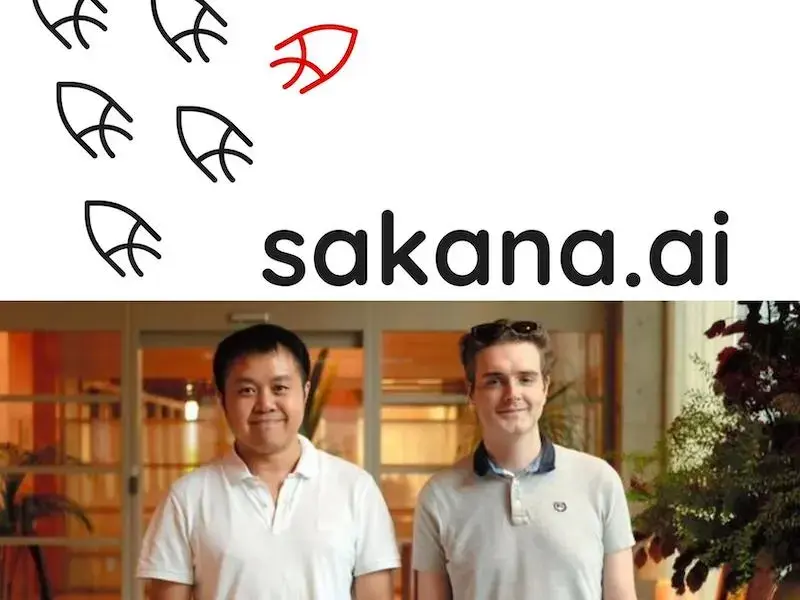
- Sakana AI aims to make fundamental improvements to today’s AI systems by allowing a large number of smaller models to communicate and work together, rather than the prevailing trend of creating one giant monolithic model.
- The company plans to develop AI models that are better suited to the Asian market, recognising the fundamental differences in how Asian character-based languages work compared to Western languages.
- Lux Capital’s lead in the funding round not only validates Sakana AI’s potential, but also reflects confidence in the startup’s ability to drive innovation in the field of artificial intelligence.
In a bid to position Tokyo as a formidable player in the global AI landscape, Sakana AI, a Tokyo-based startup founded by ex-Google researchers, has successfully secured $30 million in a seed financing round led by Lux Capital, with participation from Khosla Ventures. The funding is set to propel Sakana AI’s mission of revolutionising AI systems and addressing the unique nuances of Asian languages.
Ambition to fill the gap in Asia
Lux Capital partner Grace Isford expressed confidence in Sakana AI’s potential to establish Tokyo as an AI hub, drawing parallels to the impact OpenAI had in San Francisco and DeepMind in London. Isford emphasised the startup’s approach of diverging from the prevailing trend of creating massive monolithic models. Sakana AI aims to foster collaboration among a multitude of smaller models, a strategy they believe will bring fundamental advancements to current AI systems.
There is an undeniable lack of robust AI tools like chatgpt in Asia, citing the unique nature of Asian character-based languages and the need for greater quality and quantity of databases. But the lack of similar products on the market doesn’t seem to have deterred investors, according to Brandon Reeves, a partner at Lux Capital, which is focusing on developing AI models for the Asian market in the hope of filling a gap in the market. Reeves is acutely aware of the underdevelopment of Asian languages, which he attributes to the dominance of large-scale language models based on Western languages.
“With most large language models designed for Western languages, Asian languages remain under-explored.”
Brandon Reeves, a partner at Lux Capital,
“With most large language models designed for Western languages, Asian languages remain under-explored,” explained Reeves, shedding light on the potential the startup sees in filling this void. This strategic emphasis on linguistic diversity aligns with Sakana AI’s vision to create AI solutions that are more attuned to the intricacies of Asian languages.
Also read: Top 5 most exciting AI products from CES 2024
Details on financing
Sakana AI’s founders, David Ha and Llion Jones, both former Google researchers, bring substantial expertise to the venture.” Jones, recognised as the fifth author on Google’s influential 2017 research paper “Attention Is All You Need”, played a pivotal role in introducing the revolutionary “transformer” deep learning architecture. This architecture has since become the foundation for advanced technologies, including the widely acclaimed ChatGPT.
Ha, formerly the head of research at Stability AI and a Google Brain researcher, adds a wealth of experience to Sakana AI’s leadership. The departure of these researchers from Google signifies a broader trend, with former collaborators pursuing independent ventures that have gained considerable attention and financial backing from venture investors.
Lux Capital, the leading investor in Sakana AI’s recent funding round, specialises in deep technology and has a track record of strategic investments in aerospace, AI, and biology. This funding not only validates Sakana AI’s potential but also reflects Lux Capital’s confidence in the startup’s ability to drive innovation in the AI space.
As Sakana AI embarks on its mission to reshape AI paradigms and address the linguistic complexities of the Asian market, the industry watches with anticipation. The convergence of talent, visionary leadership, and substantial financial backing positions Sakana AI as a formidable contender in the ever-evolving landscape of artificial intelligence.