Summary
- Uganda's telecom licensing list prints 58 numbered rows across five substantive columns and not one licence number. The parallel online-data list prints a licence number on every row — and gives one of those numbers to three different licensees.
- Between the two documents a stranger can date a permission or name it, never both. Neither carries a renewal determination, or a suspension or revocation with a date and a ground.
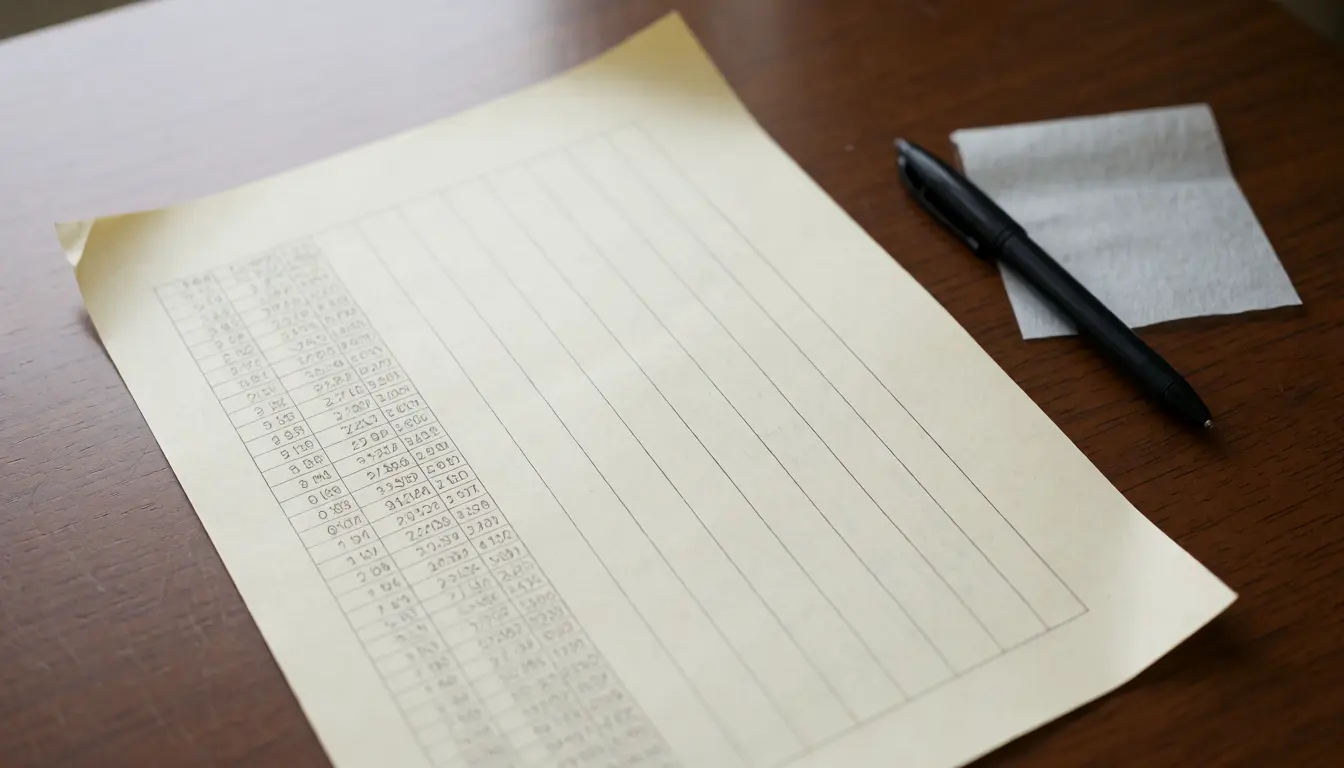
Uganda's telecoms regulator publishes a list of everyone allowed to run a telecoms business in the country. It is six pages, 58 rows, five columns, and it will tell you, for each one, the company, the class of permission, the territory, the day it began and the day it ends. What it will not tell you is the licence number. There isn't one. Anywhere.
A licence number is not paperwork. It is the handle by which a permission can be looked up, cross-referenced, challenged, renewed, suspended or proved to exist. Without it, the list is a guest list with no surnames: it looks like a register, it reads like a register, and it cannot do the one thing a register is for, which is to let a stranger check a fact.
Those fifty-eight rows are not fifty-eight operators, which the list never claims and which a reader will assume anyway. Huawei occupies rows 42 and 54 with matching entries. Site Link occupies rows 43 and 55. The Bandwidth and Cloud Services Group spreads across rows 12, 13 and 41. Row 51, Electronic Networks, arrives with a blank category and a permission running 9 December 2025 to 8 December 2030; nothing on the page supplies the missing class. The document's own stated position in time, 31 January 2026, tells you when the list says it was true, not when anyone posted it.
Now the arithmetic a stranger would do with two printed dates. Twenty-two of the fifty-eight rows end more than five calendar years after they begin, measured strictly, with no inclusive end day. Eighteen of those twenty-two run either twenty years less a day — the three national telecom operator rows at 1, 3 and 4 — or fifteen years less a day across fifteen further rows, the long terms the Commission's own description of telecom licences and authorisations attaches to its infrastructure categories. Four rows go their own way. MTN UGANDA LIMITED at row 2 runs 1 July 2020 to 30 June 2032, twelve years less a day, under a category the guide describes as a twenty-year licence. Bayobab Uganda Limited at row 28 runs 1 January 2024 to 31 December 2039, sixteen years less a day, where the guide describes fifteen. Bayobab Uganda Limited again at row 29 runs 1 January 2024 to 31 December 2029, six years less a day, where the guide describes five. Wilken Telecommunication U Limited at row 52 runs 7 January 2024 to 30 June 2029, five years five months and 23 days, under an authorisation the guide describes as five years. Four rows, four different answers to a question the guide settles in a sentence.
Every one of those durations is mine, computed from two printed dates. The list prints no term anywhere, and a comparison between two documents the same regulator published settles nothing about whether any row is lawful, unauthorised or still alive. It does establish that the two documents disagree, and that the disagreement is invisible to a reader who trusts the columns to mean what they are headed.
There is a counter-example sitting quietly inside the same table, and it is the reason the twenty-two is arithmetic rather than accusation. Row 8, UNITED WIRELESS, runs 4 April 2022 to 4 April 2027 and ends on the fifth anniversary, which the strict rule does not flag. Somewhere in this data an inclusive end day is in use. The twenty-two counts rows under one stated convention and nothing else.
What the law says about all this is narrower than the list's confidence suggests. Regulation 94(2) of the Uganda Communications (Licensing) Regulations, 2019, as printed in the Gazette publication document at page 3260 of the supplement dated 8 November 2019, reads: "Except where expressly provided in these Regulations, a communications licence shall remain in force for a period of five years." Five years is the default, and the twenty-year terms on the list are the express case. The document that describes that exception is the guide, whose own publication date was not established: the file sits under a 2023/10 path, which is not proof of anything, and the document itself is undated. The guide does print a sentence of its own about the flagship class, that a national telecom operator licence "shall be for a period of 20 years, renewable in accordance with the Uganda Communications Act 2013". The instrument that would expressly provide the exception was not read as a consolidated text, and one Uganda Legal Information Institute page would not load at all, so nothing here rests on it.
That is one list. The other has the opposite problem. The licensed online data operators list as at 30 October 2026 is four pages, 39 numbered rows, four substantive columns, and a licence number on every row. It also prints UCC/ODC/320 against three different licensees: row 32 Nichodemus Consult Occupational Safety And Health Administration, row 36 Tigtag Influencer Ltd, row 37 Uganda Advertising Bureau Ltd. One number, three holders. It prints UCC/ODC/189 against row 31, Sadja Web solutions Ltd, valid 15 October 2026 to 14 October 2067 — forty-one years, and the page says so plainly, whatever anyone meant. Row 37 expires 4 October 2027 while its neighbours in the same block expire 14 October 2027. Rows 12 and 13 arrive from a different series altogether, PSP/350/106 and PSP/350/107, in a list otherwise numbered UCC/ODC.
So the stranger's test, run across both lists and everything else reviewed here, comes out like this. The holder is printed. The category is printed, except where it is blank. The licence number appears on one list and not the other. Commencement is printed; no separate grant date exists. The term is derivable and never printed. Expiry is printed. A renewal application and its determination are printed nowhere. A suspension or a revocation with its date and its ground is printed nowhere. The office or officer who decided any of it is printed nowhere. The Commission's discretion is thick. Its published record is thin.
The gap between the two is exactly where a licence number would sit.
That last absence has consequences, because the nearest thing to a renewal determination in the whole set is a party's account inside a court document. The Commission hosts MTN Uganda Limited v UCC, Miscellaneous Cause No. 240 of 2020, which recounts an applicant-side statement that renewal was communicated on 18 March 2020 for a twelve-year term beginning 1 July 2020. A litigant's sentence in a pleading is not a renewal letter, a licence instrument or a register entry, and no reviewed page carries the determination itself. The strongest dated record of a revocation is softer still: a ruling recounting that One Solutions Ltd's licence was revoked at some point in 2016, with no exact date, no notice reference, no ground and no licence class. The decisions-and-rulings index mixes court rulings with other material and does not function as a register of licensing events.
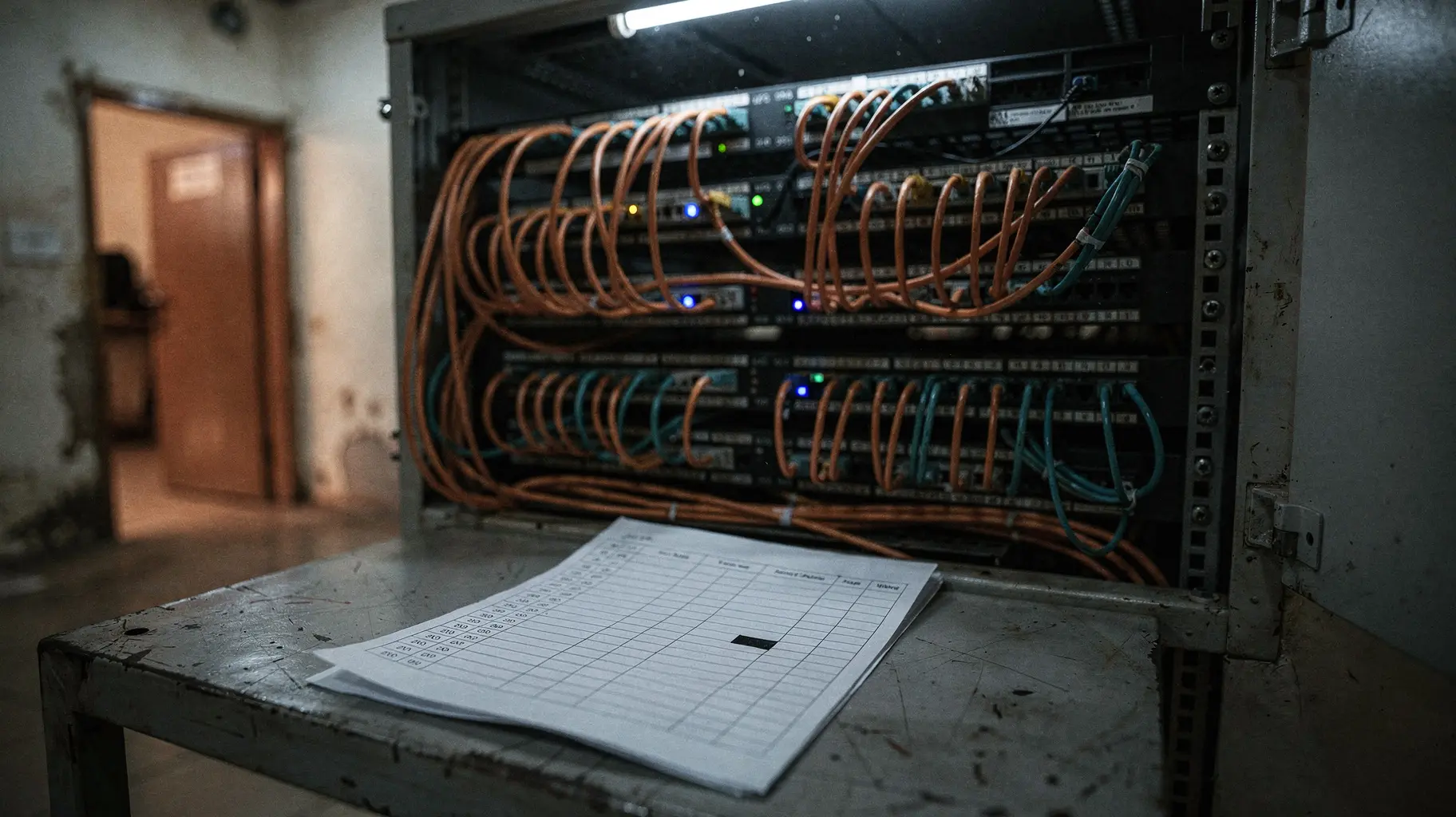
Regulation 103 explains the shape of the gap. The Commission-hosted copy of the Regulations requires a register to be compiled and maintained, recording licence contents and modifications, revocations, surrenders, directions, consents, orders and penalties, and provides for public inspection and certified copies for a fee, subject to disclosure safeguards. Read that as what it is: a duty to keep a record that can be inspected and copied for a fee. It is not, on the text reviewed, a duty to publish the register continuously or in full. Somewhere in that register, presumably, a permission has a number, a decision has an author and a revocation has a date. The register is the room the two lists are standing outside.
Bounded to the documents named here, the negative findings are these. Across the two lists, the guide, the gazetted Regulations, the Commission-hosted copy, the decisions-and-rulings index, the public-notices page and the two hosted court documents, no page prints a renewal determination for a named licensee, and no page prints a suspension or revocation as a dated entry with its ground. No comprehensive populated register of licences was found on the Commission's public site. The two lists' own web-publication dates were not established; their as-at dates are positions in time, not receipts.
And the Act and Regulations texts available for this reading were partial, so Regulation 94(2) is the only statutory sentence quoted verbatim here, and current-law verification is incomplete: the Uganda Legal Information Institute page warns that amendments by Acts 10 of 2014 and 17 of 2023 are unapplied in the text read.
BTW's own directory entry for the Uganda Communications Commission lists it as an AFRINIC member with a Ugandan service area and little else: no website, no named leadership, no routing footprint, no primary domain. It identifies the institution. It vouches for nothing about how it licenses. A search of this publication's archive on the literal string "Uganda communications licensing" returned no prior article, and that is the whole of the claim: other searches were not run.
The job, in the end, is bookkeeping. A bookkeeper's duty is to keep the book accurate and legible. Uganda's bookkeeper keeps two books, and neither one can be checked against the other.
The falsifiable test is one row. Print, against a licence number, the decision that granted it, the officer or office that decided, the term as a term, and then, for the same number, the date and ground of any suspension, the date of any renewal application and the date of the determination on it. Uganda's licensing record already knows the two dates that bracket a permission. It has not yet been asked to prove it knows anything else.
Member Briefing
Read the full trend briefing
Members read the full briefing with the source notes behind every finding.
Strategic Circle
A daily briefing in your language, built from changes we have verified.
Join for USD 20/monthCancel anytime.
Members also get the full research library, a daily briefing on the networks they follow and the private forum.