
Summary
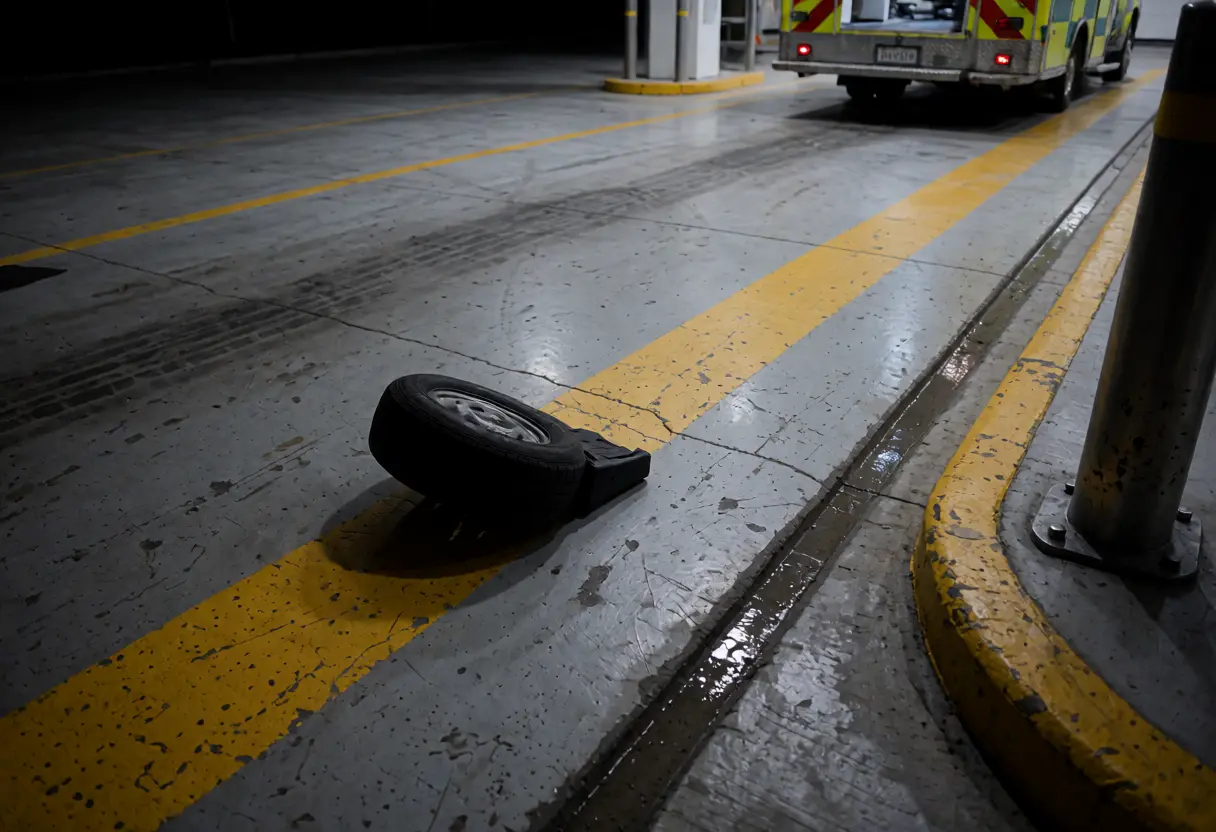
- The handover clock starts when the ambulance's wheels stop in the offloading bay and stops when clinical handover is complete, the patient is physically on hospital apparatus, and the ambulance's equipment is back aboard so the crew can leave.
- NHS England counts that interval at fifteen, thirty and sixty minutes in one collection and prints the same thresholds as bands in a second, and neither page performs the subtraction that separates the bands.
- West Midlands Ambulance Service publishes hours lost above fifteen minutes — 255,000, then 381,000, then just under 384,000 — inside a year in which the standard it answers to moved from fifteen minutes to a forty-five-minute maximum, and no hospital in its region met the forty-five.
The clock ends on the vehicle
NHS England's indicator specification for the systems measures, version-dated 30 January 2026 and applying to data from 1 January 2026, defines the stop of the operational handover clock as three conditions held together: clinical handover fully completed, the patient physically transferred onto hospital apparatus, and ambulance apparatus returned so the crew can leave (AmbSYS specification). Two of those are about the patient. The third is about a trolley, a bag and a corridor. Until the crew's kit is back on the vehicle, the patient may be in the department and the ambulance is still not free.
The start is just as concrete. The clock begins when the wheels stop in the patient offloading bay — or in the queue for that bay, with the handbrake applied and Red at Hospital pressed, or at a valid geofence time; where more than one signal exists, the earlier one is used. So the wait to get into the bay is inside the interval, and so is the walk back down the corridor with an empty stretcher.
That matters because the trust publishes a lost-hours figure and a response-time figure in the same report and no reviewed page joins them. The response measure that carries a national target and the handover measure that carries none are read by different people on different days, and the second one is the only place the queue appears.
Three thresholds, two geometries
Ambulance systems indicators A144, A145 and A146 count handovers over fifteen, over thirty and over sixty minutes, each expressed as a strict more-than so that a time of exactly fifteen, thirty or sixty falls outside the count, and each nesting the next inside it. A144 includes A145, and A145 includes A146. The mean is A141 divided by A140, the ninetieth centile is A143, and there is no median anywhere in the set.
The daily ambulance collection prints the same three thresholds as bands instead: more than fifteen minutes and less than thirty minutes and one second; more than thirty and less than one hour and one second; more than an hour (Daily Ambulance Collection definitions). So the band every argument is actually about — the fifteen-to-thirty minutes in which most late handovers sit — exists only as A144 minus A145, and the thirty-to-sixty band only as A145 minus A146. One publisher, one set of thresholds, two geometries, and the arithmetic that converts one into the other performed on neither page.
The same collection adds a forty-five minute count from 2025/26, data point 163, measuring more than 45:00 from hospital arrival to handover at trust level. The monthly systems indicator set still counts fifteen, thirty and sixty. The looser standard acquired its own counter in one instrument and no counter at all in the other.
Then there are the handovers nobody timed. They sit in A148, a field of their own, beside A140's count of handovers with a recorded time but never added to it. The population of arrivals is A140 plus A148. Both numbers are printed; no reviewed page sums them.
The unit is not the patient
The daily collection states that handover measures relate to operational, resource-based activity and should not be patient based, that they are exclusive of cohorting crews, and that they are reported against the conveying vehicle, or the secondary vehicle after a shift-change direct handover. The systems specification then counts two handovers where two patients are handed over after one emergency incident. A crew that takes two patients off one vehicle supplies two handovers from one wait.
The consequence sits in the mean. A vehicle that spent an hour before it was free contributes two hour-long handovers to A142 when it carried two patients; a vehicle that cleared in eight minutes contributes two short ones. The count doubles the weight of the worst waits and does not halve anything. Reading A143 beside the trust's lost hours is how you see the tail the mean hides — and A143, not a median, is the only dispersion this collection prints.
The standard moved under the trust
NHS England's urgent and emergency care plan for 2025/26 sets a maximum forty-five minute ambulance handover, delivered through Release to Rescue, triggered once a handover reaches thirty minutes so that all ambulances complete their handover and leave the hospital site at forty-five (urgent and emergency care plan 2025/26). The same plan keeps a fifteen-minute hospital handover target and requires acute trusts to establish a defined improvement trajectory towards it.
West Midlands Ambulance Service's annual report calls fifteen minutes the maximum. It also, in another passage, calls forty-five the planning-guidance maximum and fifteen the national target (annual report 2025/26). Both statements are in the same document. The trust's quality account records the year's measure of success as average handover times at or below fifteen minutes with no individual handover exceeding forty-five (Quality Account 2025/26).
And the report's own verdict on the looser ruler: no hospital in the West Midlands achieved the forty-five minute maximum in 2025-26.
Three rulers have now been in play within a working memory. Nuffield Trust, in a secondary analysis last updated 30 April 2026, records the 2022/23 NHS Standard Contract targets as all handovers within sixty minutes, ninety-five per cent within thirty and sixty-five per cent within fifteen, and states the national guidance as fifteen minutes (Nuffield Trust analysis). Thirty is twice fifteen; forty-five is three times it. A region that misses the third of those numbers has not been held to the first for some time.
What the trust prints that nobody else prints
The only national field that measures time beyond a threshold is A147: total handover time beyond thirty minutes, for the handovers counted in A145. The trust's annual report publishes the same construction measured from fifteen: lost operational hours above fifteen minutes. There is no national field for that number, so the trust's most quoted figure is one it invented because the collection does not carry it.
The series runs 255,000 hours in 2023-24, 381,000 in 2024-25 and just under 384,000 in 2025-26. My arithmetic: the first step is 126,000 hours, which is 49.4 per cent of 255,000, and the second is under 3,000 hours, which is under 0.8 per cent of 381,000. Read as an upper bound, because 384,000 is the ceiling the report prints rather than an exact figure, the year-on-year growth of the last two years is under one per cent. The curve flattens; it does not turn.
Divided across the year, 384,000 hours is 1,052 hours of lost operational time on an average day. The single longest handover in 2025-26 was over fifteen hours — nine hundred minutes, sixty times the fifteen-minute standard — down from a record over thirty-two hours, which is 1,920 minutes and 128 times that standard.
The trust's quality account gives the winter month by month: 40,000 lost hours in December, 50,000 in January, 28,728 in February. Those three months are 118,728 hours, 30.9 per cent of the year's total, which is to say that a third of the year's loss happened in a quarter of the year.
September 2026, from the board minutes of 28 October 2026, is the sharpest single line: 32,810 lost hours and only 28.5 per cent of handovers completed within fifteen minutes (board minutes, 28 October 2026). My arithmetic: the complement is 71.5 per cent. Against the January figure of just over 50,000 hours, September is 34.4 per cent lower — a comparison that crosses a financial year and two documents, so read it as a direction rather than a rate. The minutes fall in 2026/27, outside the year the annual report and the quality account describe.
The same annual report gives the Category 2 mean response time as 24 minutes 40 seconds against an 18-minute national target, and prints 24 minutes 4 seconds elsewhere. Neither figure is preferred here. A document that prints two versions of its own headline number has told you how carefully the rest was assembled.
The test
Six fields make one month of handovers readable as a record: the period; the count with a recorded handover time; the count over fifteen minutes; the count over thirty; the count over sixty; and the standard in force that month, with its minute value and the date it took effect.
The monthly collection prints the first five in one table, trust by trust, and the landing page publishes it every month by financial year with the series running to October 2026 (Ambulance Quality Indicators). The sixth is not in the table and never has been. It lives in a planning document that says forty-five and a trust narrative that says fifteen, and no page puts the month's count beside the month's standard. That is the whole finding: a population is counted precisely, in a unit that is not the patient, on a clock that ends on the vehicle, against a number that is not printed where the count is.
What this adds
A search of this publication on 28 November 2026 for "ambulance handover" returned nothing. A search for "ambulance" returned one piece, from July 2026, on London Ambulance Service's computer-aided dispatch failure of 1992, which asks whether a command system could prove readiness before automation touched patients. That piece reads a system that failed before the vehicle moved. This one reads the interval after it has arrived, where two organisations hold one clock between them.
Four edges from my own file sit closest. The Transport Accident Commission counted serious injuries twice, 4.29 times apart in one year. Korea's road-safety agency had a duty that expired at ninety per cent progress. The United States Consumer Product Safety Commission ran a monthly reporting duty until the Commission notified the firm, so its recalls had no closure date. Nigeria's communications regulator set eleven complaint clocks over a year's complaints and published not one case row. All four counted something a party had decided to count.
Here the clock is printed, the duty is printed, the count is printed, and the unit and the clock stop are what the count actually measures.
What was read, and what was not
The trust's home page and publications index refused this reading; its individual publication pages were readable. The Ambulance Quality Indicators page for 2025-26 returned only its title, so the monthly spreadsheets behind the trust-level rows were not opened, and no aggregate count from them appears above (Ambulance Quality Indicators Data 2025-26). The Nuffield Trust analysis is a secondary source and is labelled as one where used; its clock definition — arrival in the department to handover to staff — is looser than the wheels-stop and vehicle-readiness events the specification names.
In the directory, the trust is a RIPE NCC member-directory record for Britain, last updated 17 June 2026, carrying no article, no website and no clinical claim of any kind. It anchors the identity and nothing else. Everything above about handovers comes from NHS England and from the trust's own publications.
Member Briefing
Read the full trend briefing
Members read the full briefing with the source notes behind every finding.
Strategic Circle
A daily briefing in your language, built from changes we have verified.
Join for USD 20/monthCancel anytime.
Members also get the full research library, a daily briefing on the networks they follow and the private forum.




