Summary
- Tele Columbus describes a broad broadband operating role under the PŸUR brand, while its legal imprint and PeeringDB records identify different kinds of corporate and network relationships.
- Those records help map names and coordination surfaces, but they do not by themselves prove building ownership, network-resource title, live routing, exclusive control, capacity or service performance.
Why the distinction matters
Broadband companies are often described through a single familiar name. In practice, several layers sit behind that name. A legal company signs contracts and appears in an imprint. A consumer brand faces customers. Network records associate organizations with named networks and autonomous system numbers, or ASNs. Physical sites provide offices or operational context. Each layer can matter to customers, suppliers, regulators and network operators, but each answers a different question.
Tele Columbus illustrates why those questions should not be collapsed. Its current company page describes Tele Columbus AG as a German fiber-optic network operator reaching around three million households. It says services are offered under the PŸUR brand and describes activities spanning planning and construction, passive and active network operation, product marketing and customer service. These statements explain how the company presents its role and value chain.
The household figure remains an approximate, attributed company statement rather than an independent measurement of present reach, owned assets, network quality or exclusive control.
The distinction is practical, not semantic. A business customer assessing continuity needs to know which entity is responsible for a service, which record identifies a network, what the operating relationship covers and which claims remain unverified. Treating a shared label as proof of ownership can create false confidence about who controls a building, a route, an ASN or a service outcome.
What the legal imprint establishes
The current Tele Columbus imprint identifies Tele Columbus AG as the publisher and gives an address at Stresemannstrasse 123 in Berlin. It records Local Court Berlin Charlottenburg HRB 161349 B and states that the Federal Network Agency is the competent supervisory authority for the telecommunications services offered.
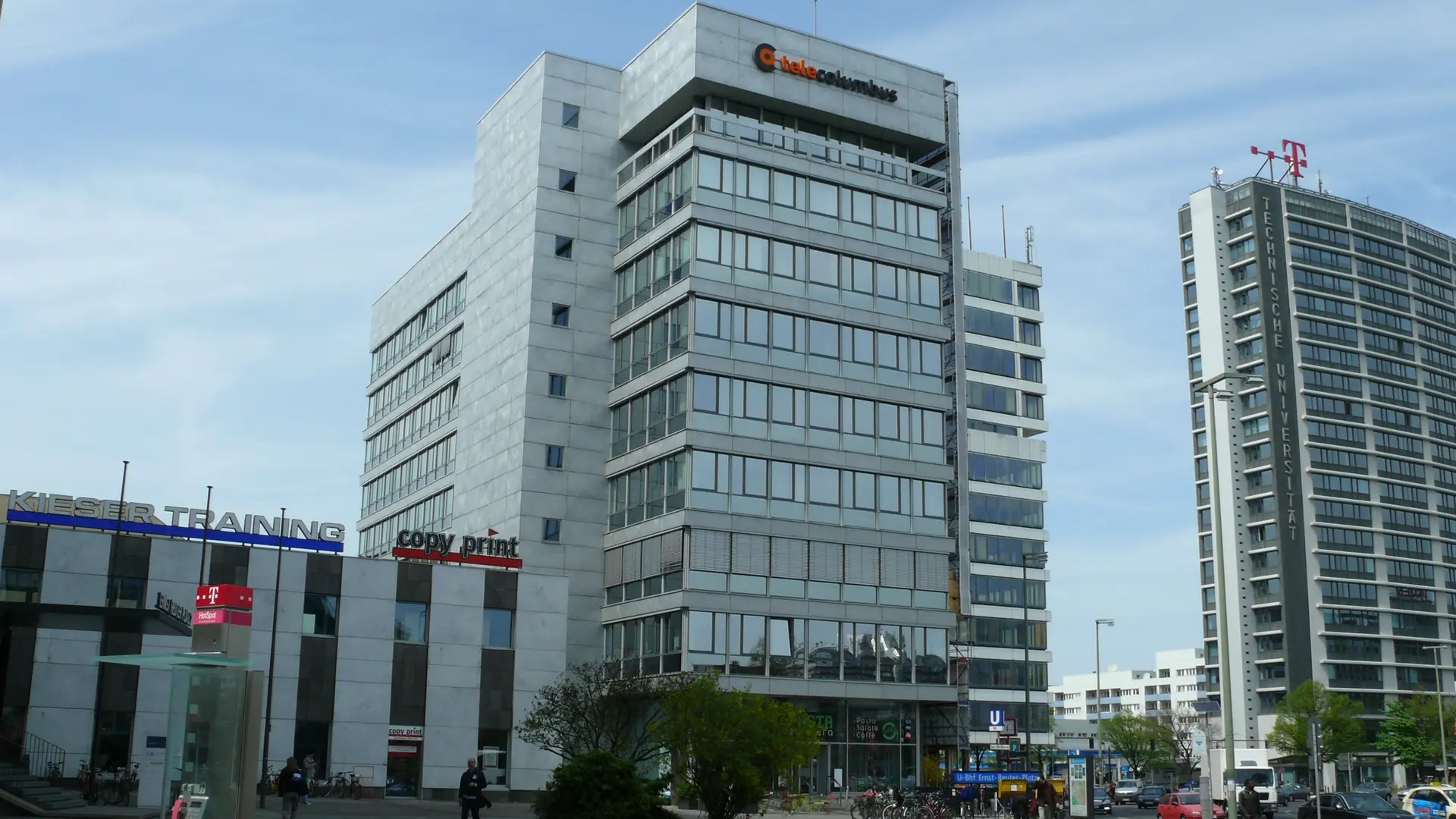
That is useful legal-identity information. It helps distinguish the publishing company from the PŸUR customer brand and from network records maintained elsewhere. It does not establish that a separately photographed building is owned by Tele Columbus, currently serves as its headquarters, is occupied exclusively by it, or houses specific network equipment. Nor does an imprint prove ownership or control of routes, number resources or network infrastructure.
This boundary matters when a company is discussed through photographs. A visible sign or a plausible office setting can establish site context. It cannot turn a building into evidence of corporate title or operational control. The image associated with this article therefore supplies no factual claim about ownership, headquarters status, equipment, routes, capacity, performance, coverage or control.
What the PeeringDB records show
PeeringDB is an operator-maintained coordination directory used by networks and interconnection participants. A current organization record returns organization 10051 with the name Tele Columbus AG and status “ok.” The same record includes four PŸUR network entries. A separate current network query for that organization lists PŸUR-Sued AS35244, PŸUR-Nord AS20880, PŸUR-CIN AS50436 and PŸUR-Mitte AS16202, each with status “ok.”
An ASN is an identifier used in interdomain routing. It helps distinguish one routing domain from another, but the appearance of an ASN in a coordination directory is not a deed of ownership and is not packet-level evidence. “Status ok” describes the registry record; it does not certify that a route is active, that traffic follows a particular path, or that a service meets a capacity, latency, availability or quality target.
The organization record and the four network records therefore provide a useful map of declared relationships. They support statements about the names, ASNs, organization association and record status shown in PeeringDB. They do not establish resource title, exclusive routing authority, packet flow, network performance, coverage, uptime, service-level compliance or service quality.
One label can connect distinct objects
The PŸUR name appears in Tele Columbus’s first-party description and in PeeringDB network records. That overlap is meaningful as identity and coordination evidence, but it is not an equivalence rule. Tele Columbus AG remains a legal entity. PŸUR remains a consumer brand. PeeringDB organization 10051 remains a registry object. PŸUR-Sued, PŸUR-Nord, PŸUR-CIN and PŸUR-Mitte remain separately named network records, each associated with its own ASN. The photographed site remains physical context.
The evidence set also contains four current page responses but only two publisher families: Tele Columbus AG supplies the company page and imprint, while PeeringDB supplies the organization and network records. Counting pages as if they were four independent publishers would exaggerate the diversity of support. The company pages are authoritative for the company’s own description and imprint. PeeringDB is useful for operator-maintained coordination data. Neither family independently verifies every claim made by the other.
What readers can conclude
Readers can reasonably conclude that Tele Columbus AG currently presents itself as a German fiber-optic network operator, uses the PŸUR brand, and describes a broad operating value chain. They can identify its publisher address and commercial-register reference from its imprint. They can also see a current PeeringDB organization relation and four named PŸUR network records with exact ASNs.
Readers should not conclude, without additional evidence, that the company owns a photographed property, owns every network resource associated with those records, controls routes exclusively, operates particular equipment, or delivers a measured level of capacity, coverage, uptime or service quality. Registry data works best as a ledger for coordination and identity. Operational reality still requires observations that show what systems and routes are actually running.
For customers and counterparties, this approach improves due diligence. It separates who the company says it is from what a network record says, and separates both from what a photograph merely suggests. The result is a narrower but more dependable account of Tele Columbus’s visible control surfaces.
Member Briefing
Deeper Profile Context
Sign in with the right membership level to unlock the full briefing and source notes.
Only for Strategic Circle
Strategic Circle
Open to all readers. Unlock profile briefings after joining and signing in.
Join Strategic CircleOnly for Leadership Alliance
Leadership Alliance
For qualified IP-asset owners and management; sign in to unlock alliance briefings.
Join Leadership Alliance