
Summary
- What it says: SuperNet Infocomm is a small Bhutanese ISP whose public evidence is more revealing in the field than in the route table.
- Main topic: Regional ISP economics; Network-resource evidence; Local support labour; IPv4 leasing and shadow allocation
- Context: market / company research report / Bhutan; Asia Pacific
The scarce asset is repair confidence, not raw bandwidth
The first number is not an autonomous-system number or a market-share figure. It is Nu.1,500 a month. SuperNet Infocomm's own leased-line page lists a Home 5 Mbps unlimited plan at Nu.1,500, then steps upward through 6, 7, 8, 10 and 15 Mbps home packages; the same page says the prices are approved by BICMA and in effect from 13 January 2026 (https://supernetbhutan.com/leased-line/). BICMA's public tariff table gives the same regulatory frame in a more compressed form: Supernet InfoComm, licence number 605000007, Class B, with a 5 Mbps leased-line minimum at Nu.1,500 and a 3 Mbps broadband entry also shown at Nu.1,500 (https://www.bicma.gov.bt/?page_id=8716). In a country where the World Bank API records only 23,118 fixed-broadband subscriptions in 2024, equal to 2.92 per 100 people, that tariff is not just a cheap consumer offer; it is an attempt to turn a thin fixed-access market into a routine monthly bill (https://api.worldbank.org/v2/country/BT/indicator/IT.NET.BBND?format=json&per_page=8, https://api.worldbank.org/v2/country/BT/indicator/IT.NET.BBND.P2?format=json&per_page=8).
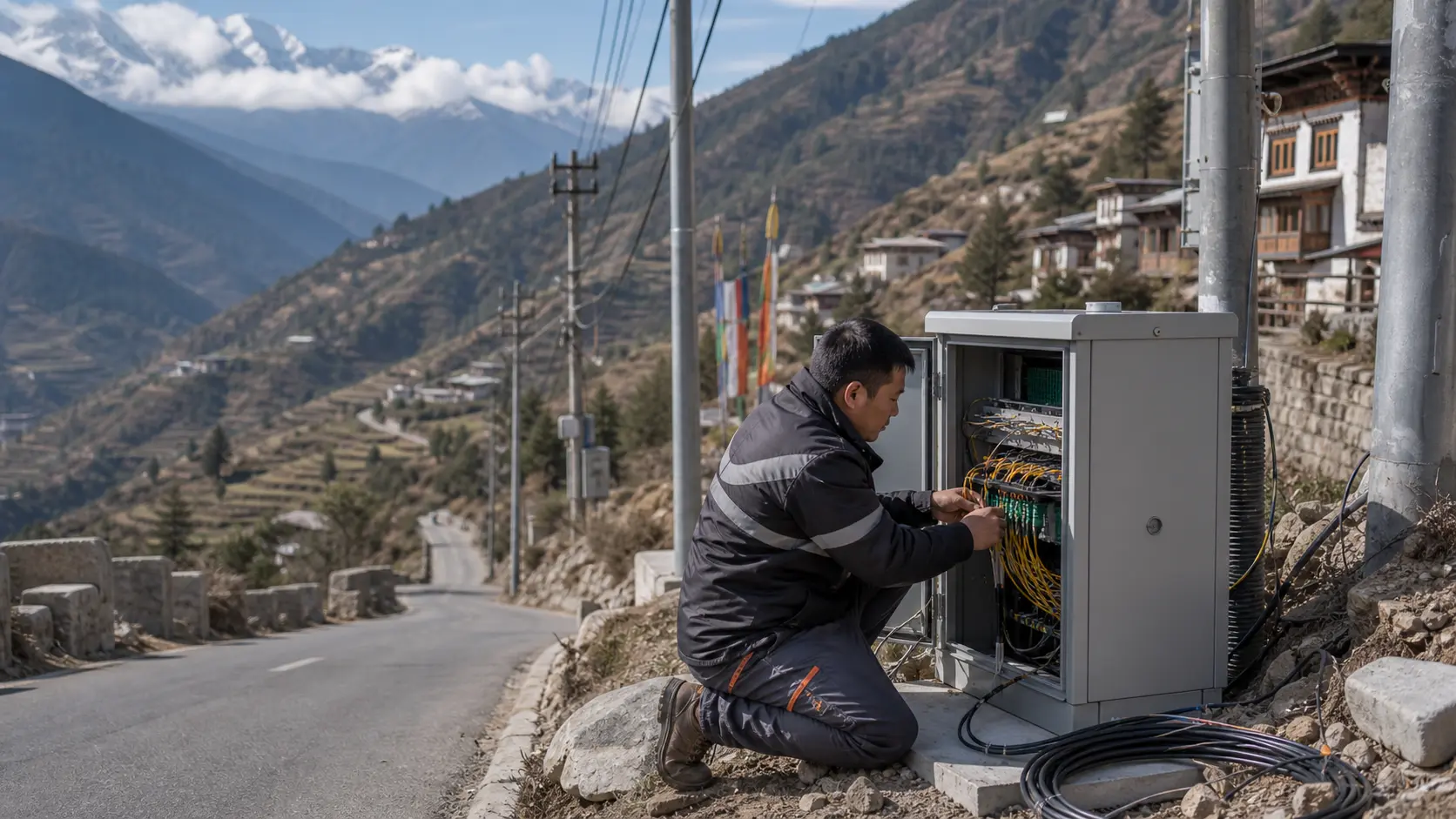
The landscape makes that harder than the price table suggests. The World Bank's Bhutan logistics note describes demand as thinly spread over difficult terrain, with dispersed settlements, roads that can be about twice the straight-line distance between places, narrow gradients that slow travel, and landslides or fog that can block key routes (https://blogs.worldbank.org/en/trade/bhutan-connectivity-clouds). Those are transport facts, but they become broadband facts once a customer's roof antenna, fibre drop, router, power supply or upstream route needs attention. A fixed link in Thimphu is not the same unit of work as a fixed link in a flat dense city. The customer buys megabits, but the provider spends money on site visits, spares, call handling, backhaul, town coverage and the probability that a technician can reach the fault when roads or weather are not cooperating.
SuperNet's public promise is deliberately ordinary. Its homepage says the service is available in Thimphu, Paro and Phuntsholing, advertises home and office packages, and repeats a 99% internet-uptime claim beside leased-line and broadband offers (https://supernetbhutan.com/). The contact page lists Thimphu Tech Park, a Paro office in the Regional Revenue and Customs Office building at Taju, and a Phuntsholing office at Kuenzang Plaza, plus "24/7 On-Call Service" for each location (https://supernetbhutan.com/contact-us/). The about page is even plainer: it says the company provides leased-line internet, CCTV and hosting, accepts cash and online payments, and currently provides leased-line service in Thimphu and Phuntsholing while recently starting in Paro (https://supernetbhutan.com/about-us/). This is not a cloud-platform story. It is a town-by-town access business trying to make home broadband, small-office internet, CCTV, hosting and support feel like a local service rather than a national abstraction.
That is why the scarce asset is not bandwidth alone. It is field access and trust in repair during weather and terrain disruption. Bandwidth is visible on the package table. Repair confidence is visible only when a link fails, a customer calls, and the provider either resolves the fault or leaves a household, hotel, shop, classroom or office wondering whether the cheaper plan was a false economy.
The evidence changes a concrete economic decision: SuperNet should be underwritten less as a scale broadband carrier and more as a local service-and-repair option whose value rises or falls with town-level support records, route dependency and the cost of keeping a low monthly tariff credible.
A three-town ISP in a country built for shared backbone access
SuperNet's identity has three public layers. The first is the customer-facing brand: SuperNetInfoComm, selling home, office and limited-data broadband under the Chim Na, Yigtsang and Dhoro package names (https://supernetbhutan.com/registration/). The second is the regulatory surface: BICMA lists Supernet InfoComm among Bhutan's internet service providers and gives its coverage as Phuntsholing, Thimphu and Paro (https://www.bicma.gov.bt/?page_id=503). The third is the internet-number surface: APNIC's whois record for AS141680 gives the AS name SUPERNET1-AS-AP, description SuperNet Infocomm, country BT, organization ORG-SP15-AP, and APNIC-maintained routing objects (https://wq.apnic.net/apnic-bin/whois.pl?object_type=aut-num&searchtext=AS141680). These layers match well enough to support a real company profile, while also showing the limits of the public evidence.
The address history is typical of a small operator whose commercial and technical presence has moved across cities. APNIC lists the organization address as Tech Park Babesa, Thimphu, and a role address at Yarkay Building, Phuensum Lam, Phuentsholing, Chukha (https://wq.apnic.net/apnic-bin/whois.pl?object_type=aut-num&searchtext=AS141680). SuperNet's current site foregrounds Thimphu Tech Park and town offices in Thimphu, Paro and Phuntsholing (https://supernetbhutan.com/contact-us/). BICMA's coverage table names the same three towns (https://www.bicma.gov.bt/?page_id=503). None of this proves exact subscriber count, route ownership, staff headcount or legal ownership. It does establish a coherent footprint: a Bhutanese private ISP with a public-number allocation, a local tariff record and an access business concentrated in the capital, the airport valley and the southern border gateway.
Bhutan's national fibre design is crucial to that footprint. A GovTech national fibre reliability report says the National Broadband Master Plan Implementation Project connected 18 dzongkhags with OPGW cables and the remaining two dzongkhags and 204 gewogs with ADSS cables; it also says GovTech is the sole owner of the national fibre network and leases fibres to telecom operators and internet service providers free of cost to ensure a level playing field (https://tech.gov.bt/wp-content/uploads/2024/08/National-Fiber-Network-Reliability-report-for-4rd-quarter-2024.pdf). GovTech's project page describes the operating bargain behind that network: Bhutan Power Corporation maintains the fibre, receives 2.1% of asset value as O&M fees, must maintain 98% uptime, and can use a depreciation fund to replace fibre damaged by force majeure events with approval (https://tech.gov.bt/projects/).
That public-backbone arrangement changes the economics of a small ISP. In many countries, a new fixed provider first has to finance long-haul fibre, then access fibre, then customer acquisition. In Bhutan, a public fibre network can lower part of the long-haul barrier. But it does not erase the cost of installation, customer support, power, last-mile electronics, town sales, upstream transit, peering, billing, field staff and fault response. It also creates a subtle policy bargain. The national network can make entry possible; the private ISP still has to make service tolerable.
If a provider cannot answer support calls or keep its last-mile promise, the fact that backbone access is shared does not help the customer at the moment of failure.
BICMA's 2023-2024 annual report shows the regulator watching the same terrain. It says BICMA monitored FTTH networks and communication-cable layout in Paro, Haa, Wangdue Phodrang, Punakha, Samtse, Phuntsholing, Chukha, Tsirang and Dagana, and monitored ISP quality of service in eastern dzongkhags as well as Punakha, Thimphu and Paro, testing throughput, latency and packet loss against benchmarks; the report says leased-line connections provided by ISPs showed reliable results under the authority's standards (https://www.bicma.gov.bt/wp-content/uploads/2025/06/Annual-Report-2023-2024.pdf). That does not certify every SuperNet circuit. It says the regulatory environment is explicitly concerned with whether fixed services deliver the speeds and quality customers are sold.
SuperNet's economic niche therefore sits between public infrastructure and private accountability. The state builds and shares part of the national transport layer. BICMA approves tariffs and monitors service quality. The customer still experiences one provider. The company has a chance to be valuable if it can turn shared infrastructure into dependable local access; it has little protection if customers conclude that a low price only moves the failure point from the tariff page to the support desk.
The route table says small, but not imaginary
The public routing evidence is compact and useful. RIPEstat's announced-prefixes data for AS141680 shows three visible announcements over the late-June to early-July 2026 observation window: 103.161.248.0/24, 103.161.249.0/24 and 2001:df5:d881::/48 (https://stat.ripe.net/data/announced-prefixes/data.json?resource=AS141680). Its routing-status data shows 512 IPv4 addresses, one IPv6 /48, full RIS peer visibility at the query time, first-seen evidence in January 2021 for the broader IPv4 allocation, and one observed neighbour (https://stat.ripe.net/data/routing-status/data.json?resource=AS141680). APNIC's inetnum record for 103.161.248.0 - 103.161.249.255 describes the block as SUPERNET1-BT, SuperNet Infocomm, Bhutan, allocated portable (https://wq.apnic.net/apnic-bin/whois.pl?object_type=inetnum&searchtext=103.161.248.0).
Those numbers are not large. A 512-address IPv4 footprint is the footprint of a small access network, not a national carrier with millions of endpoints. BGP.he reads AS141680 similarly: three originated prefixes, two IPv4 and one IPv6, 512 IPv4 addresses, one internet exchange, one observed IPv4 peer and one observed IPv6 peer, both Tashi InfoComm Limited AS38740, with all originated prefixes shown as RPKI valid when reviewed (https://bgp.he.net/AS141680). RIPEstat's neighbours data also points to AS38740 as the single observed neighbour in its sample (https://stat.ripe.net/data/asn-neighbours/data.json?resource=AS141680). In plain terms, the public route table says SuperNet is real, routable and small, and its external reach appears highly dependent on Tashi InfoComm in public BGP observations.
PeeringDB adds a different signal. It lists SuperNet Infocomm as AS141680, also known as SuperNet, network type Cable/DSL/ISP, Asia Pacific scope, 100-1000 Mbps traffic level, mostly inbound traffic ratio and an open peering policy (https://www.peeringdb.com/net/27001). The same PeeringDB record lists a public peering entry at Bhutan Internet Exchange with a 10G capacity, IPv4 address 103.129.62.12 and IPv6 address 2001:dea:4000::1416:80:1 (https://www.peeringdb.com/net/27001). Bhutan Internet Exchange's own member page lists SuperNet Infocomm as member number 8 with AS141680 and the same v4/v6 peering addresses (https://www.btix.bt/members/). A btIX news post from 5 June 2021 announced that SuperNet InfoComm had joined btIX (https://www.btix.bt/news/new-member-in-btix-supernet-infocomm/). Packet Clearing House separately describes the Bhutan Internet Exchange as active in Thimphu, managed by the Bhutan Internet Exchange Association, established on 7 December 2017 (https://www.pch.net/ixp/details/1954).
The exchange presence matters even when the AS is small. Bhutan's access economics are not only about international bandwidth. They are also about keeping local traffic, government services, caches and regional handoffs from taking avoidable detours. Internet Society's country report gives Bhutan a medium internet resilience score of 60%, says the country has one active IXP and three data centres, and rates ISP choice as poor (https://pulse.internetsociety.org/en/reports/bt/). A SANOG 43 measurement presentation placed SuperNet's domain in a Bhutan content-locality trace and showed a path to supernetinfocomm.bt resolving to 103.161.249.10, passing through btIX toward SuperNet's AS141680 address (https://sanog.org/resources/sanog43/SANOG43_Conference-Measure_BT_Internet_Eco_system-Aftab.pdf). This is not proof of service quality, but it is proof that SuperNet has an internet presence that can be measured in Bhutan's local interconnection fabric.
The risk is concentration. One observed public neighbour is an efficiency if the commercial relationship is strong and the routes perform. It is a vulnerability if port terms, upstream pricing, maintenance coordination or dispute handling are weak.
A lender or large customer should therefore not stop at "AS141680 is visible." It should ask which upstream, route-server and port arrangements are under contract, what traffic actually flows through btIX, whether Tashi is the sole practical external route, how quickly an upstream event would be noticed, and whether the company has tested failover rather than merely listed an exchange connection.
For SuperNet, the route table gives a fair but narrow verdict. The network is not a mirage. It is a small ISP with portable space, IPv6, RPKI-valid routes, local exchange participation and visible dependence on a larger national operator. That supports a service story, not a scale story.
That distinction matters because small networks are often mispriced in both directions. A sceptic may look at 512 IPv4 addresses and conclude there is almost nothing to value. That misses the local relationship embedded in each installed line, especially in a market where fixed broadband is still a minority access mode. An optimist may look at a 10G exchange port and conclude there is more resilience than the public path evidence proves. That overstates what an exchange entry can guarantee. The useful reading is between those positions. SuperNet's route table is a credential, not a moat.
It shows the company can participate in the public internet with its own number resources, but it does not tell whether the customer experience survives congestion, bad weather, unpaid invoices, router failure or a delayed field visit.
The same caution applies to IPv6. SuperNet's IPv6 /48 is visible in RIPEstat and BGP.he (https://stat.ripe.net/data/announced-prefixes/data.json?resource=AS141680, https://bgp.he.net/AS141680). That is better than a small access provider with no visible IPv6 at all. But a routed IPv6 prefix is not the same thing as universal customer IPv6, working home-router configuration or customer-support fluency when something breaks. It is a maturity marker that deserves credit and verification. The practical question is whether IPv6 is part of the access product or only part of the operator's internet-number posture.
Public interconnection also needs a commercial translation. A 10G port at btIX is valuable if it keeps meaningful local and cached traffic closer to Bhutanese customers, reduces avoidable transit costs, and improves performance for services people actually use. It is less valuable if traffic volumes are small, route policy is passive, or most customer destinations still move over one upstream path. The SANOG measurement material showing SuperNet's site reachable through a local Bhutan path is useful because it points to the right kind of evidence: measured paths, not just membership badges (https://sanog.org/resources/sanog43/SANOG43_Conference-Measure_BT_Internet_Eco_system-Aftab.pdf). For valuation, the missing companion evidence would be port utilization, cache hit rates, paid transit commits and time-to-repair when the route changes.
The price ladder sells reach, but the margin is in support
SuperNet's tariff ladder is unusually useful because it exposes how the company tries to segment demand. The leased-line page lists home unlimited plans from 5 Mbps at Nu.1,500 to 15 Mbps at Nu.7,625, office unlimited plans from 5 Mbps at Nu.1,650 to 100 Mbps at Nu.55,000, and limited-data home broadband plans beginning at 10 Mbps with 4.5 GB for Nu.499 (https://supernetbhutan.com/leased-line/). The registration page repeats retail-facing versions: Chim Na Pack up to 15 Mbps at Nu.1,500, Yigtsang Pack up to 100 Mbps at Nu.2,750, and Dhoro Pack up to 50 Mbps at Nu.499 for a 10 Mbps / 4.5 GB starting offer (https://supernetbhutan.com/registration/). The contact page says installation requires a one-time payment of Nu.5,000, or Nu.4,000 in Paro (https://supernetbhutan.com/contact-us/).
The numbers produce two different products under one brand. The first is a price-sensitive household or student product: low monthly fee, limited data or low unlimited speed, and enough bandwidth for messaging, classes, browsing and basic streaming when performance is stable. The second is an office product: higher speed, unlimited access, CCTV or hosting adjacency, and a support expectation that the line will not collapse during the hours when money is being earned. The company also sells web hosting, with shared hosting at Nu.250 per month, VPS at Nu.1,650, dedicated hosting at Nu.7,400 and WordPress/cPanel hosting at Nu.350, plus claims of 24/7/365 customer support, security and 99.8% hosting uptime (https://supernetbhutan.com/hosting/). Hosting is probably not the core cash engine, but it shows the company trying to increase wallet share among small businesses that need more than a home router.
The margin problem is clear. A Nu.1,500 monthly leased line leaves little room for repeated truck rolls, router replacements, cable rerouting, upstream debugging and handholding. That is especially true if a customer expects 99% uptime. In a 30-day month, 99% still allows about 7.2 hours of downtime. Some customers will accept that for a low price. Others will interpret any multi-hour disruption as a breach of trust, especially if work, school, card payments, bookings or CCTV depend on the line. The difference between those customers is not visible in the plan name. It appears in call records, payment behaviour and churn.
This is why a small ISP's support history is not a soft metric. It is the cost ledger. If SuperNet can install quickly, prevent repeat faults and answer honestly, a cheap plan can become a defensible local franchise. If each low-price subscriber produces repeated unresolved complaints, the monthly revenue becomes an obligation rather than a margin. The company's public pages repeatedly say "99% Internet Uptime" and "24/7 On-Call Service" (https://supernetbhutan.com/leased-line/, https://supernetbhutan.com/contact-us/). The hard private-underwriting question is whether twelve months of support ticket history, town-by-town churn, route contracts and port invoices show that the company can afford those promises after installation, not only sell them before connection.
Bhutan's overall adoption pattern increases the stakes. World Bank data shows 91.28% of Bhutan's population using the internet in 2024, while fixed broadband was only 23,118 subscriptions (https://api.worldbank.org/v2/country/BT/indicator/IT.NET.USER.ZS?format=json&per_page=8, https://api.worldbank.org/v2/country/BT/indicator/IT.NET.BBND?format=json&per_page=8). The mobile internet base is much larger: BICMA's market profile as of 31 March 2026 lists 515,874 mobile subscribers for Bhutan Telecom and 308,523 for Tashi InfoComm Limited (https://www.bicma.gov.bt/?page_id=555). This means fixed access is not competing only against other fixed access. It is competing against mobile habits, tethering, office Wi-Fi, shared connections, and now satellite. SuperNet's low price can pull customers toward fixed access, but the service must then be reliable enough to stop them from retreating to mobile or satellite when the first rough week arrives.
The attractive case is that SuperNet grows in the gap between mobile convenience and incumbent fixed-line pricing. The unattractive case is that the company acquires the most price-sensitive customers first, then discovers that the customers who most need unlimited low-cost connectivity are also the least able to tolerate poor service because their income, education or household routine depends on it. Cheap bandwidth is not automatically a moat. Cheap bandwidth with quick repair can be.
Public fibre lowers entry cost; mountains keep repair expensive
The national fibre network is the most important cost reducer in SuperNet's environment. GovTech says the public network connects every dzongkhag and 204 gewogs, and that operators and ISPs can lease fibres free of cost for a level playing field (https://tech.gov.bt/wp-content/uploads/2024/08/National-Fiber-Network-Reliability-report-for-4rd-quarter-2024.pdf). That does not mean service is free. It means one layer of the fixed-access stack is publicly shared. For a small provider, this can turn a market that would otherwise be impossible into a market that is merely difficult.
The repair numbers show the remaining difficulty. In the fourth quarter fiscal-year 2023-2024 reliability report, GovTech records average availability of 99.864% for TashiCell, 99.640% for Bhutan Telecom and 99.752% for BPC's fibre submissions during April-June 2024, with fibre breaks as the reported fault type (https://tech.gov.bt/wp-content/uploads/2024/08/National-Fiber-Network-Reliability-report-for-4rd-quarter-2024.pdf). These are good availability percentages, but the report also lists outage-duration totals by stakeholder and month. A customer does not buy a national average. It experiences a local break, a local dispatch and a local explanation.
The economics are asymmetric. The public backbone can be 99% available and still leave an individual customer angry if the last-mile drop, rooftop wireless segment, router, account configuration or upstream handoff is unresolved. Conversely, a small ISP can be loved locally if it communicates well and repairs quickly, even if it relies on public fibre and a larger upstream for the broader route. This is why the route contract, support ticket history and town-by-town field capacity matter more than a broad claim of coverage.
The cost of terrain also pushes SuperNet toward selectivity. BICMA lists coverage only in Phuntsholing, Thimphu and Paro (https://www.bicma.gov.bt/?page_id=503). That looks cautious, and caution may be rational. Thimphu has the densest commercial and administrative demand. Paro has airport, hotel, tourism and institutional demand. Phuntsholing sits at the border and has trading, logistics and business demand. A small ISP that tries to chase every valley may destroy its support economics. A small ISP that concentrates in three towns can build a tighter technician map, clearer inventory, better customer references and simpler route design.
The public tariff record also shows how crowded the small-ISP field can be. BICMA's "Internet Leased Line Rates of other ISPs" page lists Supernet alongside DataNet Wifi, Bitcom Systems, Nilo FiberNet, Gelephu Digital Network, TelNet, NetVision, NLNET, TeraNet, Kiaan, KT Internet Service, Sigma, G & S Net, Nadlink, G-Star, E-Net, Shoyang, Norling and SKD Internet Service (https://www.bicma.gov.bt/?page_id=8716). Many of those providers have very similar low starting rates. In such a market, the company that wins purely on a few hundred ngultrum of price will have little room for error. The company that can prove a faster repair response or more honest performance may keep customers even when the tariff gap narrows.
This is the operating paradox of public backbone policy. Sharing fibre can invite competition. Competition lowers tariffs. Lower tariffs raise customer expectations because fixed broadband becomes normal rather than premium. Yet the hard cost of a technician visit, a router, a splice, a ladder, a vehicle, a power issue or a route investigation does not fall as quickly as the monthly price. SuperNet's whole business sits inside that gap.
Satellite and incumbents change the customer's outside option
SuperNet's most visible competitive threat is not only Bhutan Telecom or Tashi. It is the changing outside option. BICMA issued Starlink Services Private Ltd an ISP licence on 4 December 2024 to provide satellite-based internet services in Bhutan (https://www.bicma.gov.bt/?p=8608). BICMA's approved Starlink tariff page lists Residential at Nu.4,200 per month, Residential Lite at Nu.3,000, a standard kit at Nu.33,000 and a mini kit at Nu.17,000; it also says residential speeds and uninterrupted use are not guaranteed, while Local Priority and Global Priority business services carry higher pricing and a 99.9% availability SLA subject to exclusions (https://www.bicma.gov.bt/?page_id=8623).
That changes the way customers evaluate SuperNet. A household that cannot afford the kit or a Nu.3,000-Nu.4,200 monthly bill may still prefer a Nu.1,500 fixed plan. A small business that cannot tolerate repeated outages may start to treat Starlink as backup or replacement. A remote site beyond practical local fibre may see satellite as the first credible connection. A town customer with good line-of-sight, responsive local support and a lower fixed bill may stay with SuperNet. Satellite does not automatically win. It introduces a new ceiling on frustration.
The incumbents matter differently. BICMA's market profile shows Bhutan Telecom and Tashi InfoComm as the two mobile operators, with large mobile subscriber bases (https://www.bicma.gov.bt/?page_id=555). BICMA also lists both Bhutan Telecom and Tashi InfoComm as nationwide internet service providers, while Supernet's coverage is limited to three towns (https://www.bicma.gov.bt/?page_id=503). That scale difference is real. The incumbents can bundle, advertise, handle enterprise accounts and use their larger infrastructure positions. But they can also be slower, more standardized and less appealing to a customer who wants a local installer at a lower price.
SuperNet's opportunity is to be the accountable local alternative. Its risk is that the category "small ISP" becomes associated with weak support. A Reddit discussion about SuperNet in Thimphu includes complaints about speed drops, packet loss, customer-service delay and customers comparing SuperNet with TashiCell or Starlink (https://www.reddit.com/r/bhutan/comments/1ne6vgf/supernet_in_thimphu/). Reddit is not a statistical survey, and angry customers are more likely to post than satisfied customers. But the thread is commercially relevant because it names exactly the dimensions that determine this business: delivered speed, packet loss, service response, affordability and whether a customer can afford the satellite outside option.
The company's own site carries positive testimonials and says it has thousands of satisfied customers (https://supernetbhutan.com/). Those claims are also not audited. The fair reading is not to choose between marketing and complaints as if one must be the whole truth. The fair reading is that SuperNet operates in a market where low prices attract customers, but customer trust is fragile and visible. The public conversation already knows what to test: speed against plan, packet loss, support delay, installation cost and whether the line stays useful after the first month.
For an investor, the outside-option shift is decisive. Before satellite, a customer unhappy with low-cost local fixed service might have tolerated it because the next option was expensive, capped or unavailable. After satellite licensing, the customer has a more expensive but emotionally powerful alternative. That puts a timer on weak service. SuperNet does not need to beat Starlink on headline speed. It needs to beat it on local value: lower monthly price, acceptable stability, quick repairs and enough honesty that customers do not feel trapped.
A Paro failure scenario
Imagine a small guesthouse outside Paro using SuperNet for reservations, card payments, staff messaging, CCTV, guest Wi-Fi and a laptop at reception. The owner chose the line because the one-time installation fee was manageable, the monthly bill was lower than satellite, and the office package promised enough speed for the property. During a wet week, latency rises and the connection starts dropping in the evening. Guests complain that video calls fail. The card terminal works intermittently.
The owner uses mobile data to message support, then starts asking neighbours whether the fault is SuperNet, the router, a damaged drop, upstream congestion, the public fibre route, power fluctuation or a wider local problem.
This is the moment when SuperNet's economics are tested. The lost revenue to the guesthouse may be far greater than the monthly subscription. The cost to SuperNet may also exceed the monthly subscription if the fault requires a visit, a replacement device, upstream escalation or repeated communication. A large incumbent might have more monitoring and more spares. A local provider might have a faster personal relationship. Satellite might bypass the local route but cost more upfront. The customer is not buying a theory of access. It is buying the provider that can turn confusion into a diagnosis before bookings, reviews and trust suffer.
The failure also shows why the national fibre network does not settle every question. If the backbone is healthy and the customer router is failing, SuperNet owns the customer problem. If the local drop is damaged, SuperNet owns the customer problem. If Tashi InfoComm is the effective upstream path visible to public route collectors and an upstream event affects SuperNet traffic, SuperNet still owns the customer problem from the buyer's perspective (https://stat.ripe.net/data/asn-neighbours/data.json?resource=AS141680). If a btIX port is present but traffic is not engineered well, SuperNet owns the customer problem. The customer bought one service. The fact that the fault may sit across several technical layers is the provider's burden.
The repair economics can be brutal at low tariffs. A Nu.1,500 monthly plan does not pay for many manual interventions. If the company dispatches too often, margin disappears. If it refuses to dispatch or communicates poorly, churn and reputational damage rise. The winning model is not unlimited handholding. It is disciplined prevention: clean installations, reliable customer equipment, honest contention planning, working monitoring, clear escalation to upstreams, and enough local staff capacity that the first answer is more useful than "restart the router."
That is the central underwriting question for SuperNet: can a low-price three-town ISP keep the customer relationship during the handful of bad days that customers remember? Public evidence proves the company has tariffs, offices, AS141680, address space and btIX membership. It does not prove the repair machine. The repair machine is where the value is.
What a buyer, lender or large customer would demand as proof
A buyer would not pay much for the visible address space alone. AS141680, 512 IPv4 addresses and one IPv6 /48 are useful, but they are not a strategic hoard (https://stat.ripe.net/data/routing-status/data.json?resource=AS141680). A lender would not treat a low tariff table as proof of cash flow. A large customer would not accept a homepage uptime claim as an SLA. The diligence value sits in documents that are mostly private: customer concentration by town, monthly churn, average installation interval, repeat-fault rate, support ticket history, router and optical-device inventory, upstream port invoices, btIX traffic reports, Tashi route contract, any GovTech or BPC fibre-use paperwork, and actual collections by plan.
The buyer would pay for a loyal customer base in Thimphu, Paro and Phuntsholing if churn is low and support cost per subscriber is controlled. It would pay for technicians who know the towns, for clean installation records, for business customers using SuperNet across internet, CCTV and hosting, and for a route design that can be explained in contracts rather than inferred from public BGP. It would discount customer numbers that depend on promotional pricing, uncollected bills, repeated speed complaints, unclear upstream terms or a single fragile handoff.
It would refuse to underwrite a 99% public promise unless the company can show outage logs by town, not just national fibre averages.
A regulator would ask a different question. BICMA's annual report already says quality monitoring uses throughput, latency and packet-loss tests (https://www.bicma.gov.bt/wp-content/uploads/2025/06/Annual-Report-2023-2024.pdf). A regulator should care whether low advertised rates are matched by delivered service and whether customer complaints are resolved without forcing households to become network engineers. Starlink's entry sharpens that concern because the market will split between those who can buy a satellite terminal and those who remain dependent on local fixed providers. If low-income or price-sensitive users are left with weak service while wealthier users exit to satellite, the access market becomes more unequal even if headline internet availability improves.
The strongest private document would be a town-by-town support history matched to revenue. If SuperNet can show that Paro, Thimphu and Phuntsholing customers pay regularly, faults are resolved within an acceptable window, complaints decline after installation maturity, and upstream outages are rare or well managed, then the public evidence understates the company's value. If the support file shows frequent repeat faults, slow visits, speed disputes and customers leaving after the first month, then the tariff table is not growth evidence; it is a warning.
Public evidence register
The core identity evidence is APNIC's AS141680 record, APNIC's IPv4 allocation record and BICMA's ISP coverage page. Together they support that SuperNet Infocomm is a Bhutanese ISP with AS141680, portable address space and declared coverage in Phuntsholing, Thimphu and Paro (https://wq.apnic.net/apnic-bin/whois.pl?object_type=aut-num&searchtext=AS141680, https://wq.apnic.net/apnic-bin/whois.pl?object_type=inetnum&searchtext=103.161.248.0, https://www.bicma.gov.bt/?page_id=503).
The core product and pricing evidence is SuperNet's homepage, leased-line page, registration page, contact page and hosting page, cross-checked against BICMA's tariff page for other ISPs. These sources support the low-price access claim, the town-office surface, the installation fee, the 99% uptime marketing claim, the CCTV and hosting adjacency, and the BICMA-approved tariff context (https://supernetbhutan.com/, https://supernetbhutan.com/leased-line/, https://supernetbhutan.com/registration/, https://supernetbhutan.com/contact-us/, https://supernetbhutan.com/hosting/, https://www.bicma.gov.bt/?page_id=8716).
The core network evidence is RIPEstat, BGP.he, PeeringDB, btIX and PCH. These sources support the view that SuperNet is small but routable: three visible prefixes, 512 IPv4 addresses, one IPv6 /48, RPKI-valid origin evidence in public observers, one observed upstream/neighbour, a 10G btIX peering entry and membership in Bhutan's active internet exchange (https://stat.ripe.net/data/announced-prefixes/data.json?resource=AS141680, https://stat.ripe.net/data/routing-status/data.json?resource=AS141680, https://stat.ripe.net/data/asn-neighbours/data.json?resource=AS141680, https://bgp.he.net/AS141680, https://www.peeringdb.com/net/27001, https://www.btix.bt/members/, https://www.pch.net/ixp/details/1954).
The core market and cost evidence is GovTech's national fibre reliability report, GovTech's project page, BICMA's market profile, BICMA's annual report, the World Bank data APIs, the World Bank terrain note and Internet Society Pulse. These sources support the mountain-cost thesis, the public-backbone sharing context, fixed-broadband scarcity, high internet use, regulator QoS monitoring and the limited choice/resilience environment (https://tech.gov.bt/wp-content/uploads/2024/08/National-Fiber-Network-Reliability-report-for-4rd-quarter-2024.pdf, https://tech.gov.bt/projects/, https://www.bicma.gov.bt/?page_id=555, https://www.bicma.gov.bt/wp-content/uploads/2025/06/Annual-Report-2023-2024.pdf, https://api.worldbank.org/v2/country/BT/indicator/IT.NET.BBND?format=json&per_page=8, https://api.worldbank.org/v2/country/BT/indicator/IT.NET.USER.ZS?format=json&per_page=8, https://blogs.worldbank.org/en/trade/bhutan-connectivity-clouds, https://pulse.internetsociety.org/en/reports/bt/).
The core competitive evidence is BICMA's Starlink licence announcement and tariff page, plus customer discussion treated only as an unofficial signal. Starlink changes the outside option with residential and priority satellite plans; Reddit complaints are not proof of average performance, but they identify the consumer pain points a small ISP must resolve: speed, packet loss, support delay and affordability (https://www.bicma.gov.bt/?p=8608, https://www.bicma.gov.bt/?page_id=8623, https://www.reddit.com/r/bhutan/comments/1ne6vgf/supernet_in_thimphu/).
The fact that would most change the judgement
The single fact that would most change the judgement is not another public tariff. It is a verified support-and-churn file by town. If SuperNet can show that most customers in Thimphu, Paro and Phuntsholing receive the advertised class of service, pay on time, rarely repeat complaints, and stay after the first three months, then the company is more valuable than its small route table suggests. It would be a working local access operator in a market where fixed broadband is still thin and repair trust is scarce.
If the file shows the opposite, the thesis weakens quickly. A low monthly price can hide a negative service loop: customers join because the offer is cheap, complain because the delivered service is unstable, require manual support that the tariff cannot fund, leave for an incumbent or satellite when they can, and damage the brand before the company reaches enough density to improve. The public Reddit thread is only a signal, but it points to the exact risk: customers do not argue about ASN policy; they argue about whether their 10 Mbps line behaves like 10 Mbps and whether anyone responds when it does not (https://www.reddit.com/r/bhutan/comments/1ne6vgf/supernet_in_thimphu/).
The more constructive version is also plausible. SuperNet may be a young local ISP learning how to price and support fixed access in a hard geography, using public fibre, a small AS, btIX membership and three-town focus to build density. The fact that it lists offices, service categories, BICMA-approved plans and local interconnection suggests more than a paper network. The fact that public route collectors see only a small address base and one neighbour suggests less than a fully resilient carrier. Both can be true.
The most interesting positive case is not explosive growth. It is disciplined ordinariness. Bhutan does not need every small ISP to become a national backbone owner. It needs enough providers that a household, shop, hostel, clinic or small office can choose a service whose price and support model fit its actual risk. SuperNet's public footprint fits that modest but useful role. A three-town company with a cheap unlimited entry plan, an office package, local contact points, public address space and a btIX port can improve the market if it keeps incumbents honest and gives customers a credible alternative before satellite becomes the only escape route (https://www.bicma.gov.bt/?page_id=8716, https://www.btix.bt/members/, https://www.bicma.gov.bt/?page_id=8623).
The negative case is equally practical. If low prices produce too many support obligations, the company may be forced into one of three weak positions: raise prices and lose the affordability edge, keep prices low and under-serve customers, or narrow the customer base to the easiest buildings and leave harder premises to incumbents or satellite. None of those outcomes would make the company irrelevant, but each would reduce its public value. The company's strongest defence is therefore operational selectivity.
It should know which neighbourhoods it can serve profitably, which rooftop or fibre arrangements fail repeatedly, which customer equipment causes avoidable calls, and which upstream events require compensation or renegotiation. In a mountain market, saying no to bad installs may be as important as winning new subscribers.
There is also a trust dividend if SuperNet communicates limits plainly. A small provider can survive lower headline speed if customers believe the terms, know the likely repair window and see real follow-up when service drops. It cannot survive a pattern in which a customer buys a promised speed, gets a lower experience, waits days for a visit and then tells the local market that the plan was not what it appeared to be. The difference between those two outcomes is not visible on a tariff page. It is visible in renewal behaviour.
For the next 12 to 24 months, the watchpoints are practical. First, do the BICMA-approved low tariffs remain in place or change after Starlink and small-ISP competition put pressure on price? Second, does SuperNet keep AS141680 visible with valid routes and stable upstream reach through AS38740 and btIX? Third, do customer complaints about speed and support fade or become a public pattern? Fourth, does the company deepen business services such as CCTV and hosting enough to raise average revenue beyond the cheapest home plans?
Fifth, does public fibre reliability remain high enough that SuperNet can focus on its own last-mile and support discipline rather than fighting backbone instability?
SuperNet Infocomm matters because it is a small test of Bhutan's broadband policy bargain. The country has used public infrastructure and regulation to make fixed access more contestable. SuperNet shows what comes next: prices fall, small ISPs enter, customers expect ordinary internet, and terrain makes the ordinary expensive to deliver. The company should not be valued as a hidden national carrier. It should be judged as a three-town operator trying to make cheap fixed broadband dependable enough that households and small businesses stop thinking of internet access as a daily negotiation.
That judgement is deliberately narrow. It leaves room for SuperNet to become more important if it proves retention, business uptake and stable route economics; it also leaves room for disappointment if customer experience lags behind the tariff promise. For now, the evidence says the company is neither a disposable listing nor a fully proven infrastructure franchise. It is a local access bet in a country where making the internet feel ordinary is still expensive work.