
Summary
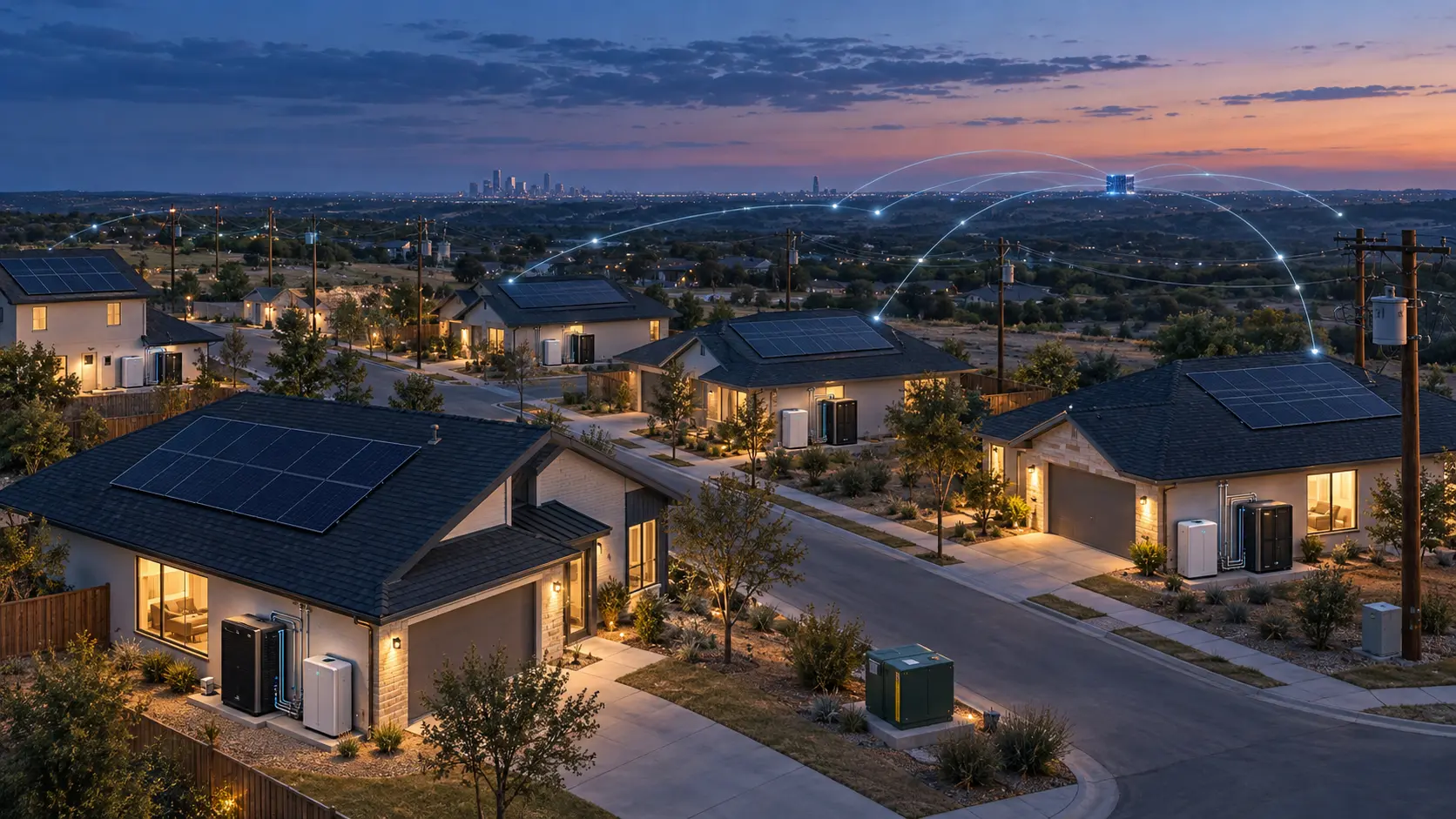
- Sunrun and SPAN plan to place liquid-cooled AI compute nodes beside new homes, pairing them with solar, batteries and smart electrical panels under a prepaid energy lease while compensating residents for hosting the equipment.
- The partnership makes residential deployment more credible, but no public filing or announcement discloses a compute buyer, node count, price, utilization, service level, host payment, power priority, ownership structure or exit terms. “No cost” shifts the financing burden; it does not remove it.
- The investable unit is not a nominal gigawatt. It is an auditable bundle of rights over a home, its electrical headroom, its batteries, its network connection and its availability. Until that bundle is priced, residential compute remains a delivery thesis rather than a demonstrated data-centre business.
The prepaid lease behind a zero-cost promise
The most important sentence in the 23 September partnership announcement is not the claim that residential AI can scale to gigawatts. It is the promise that builders and homeowners will pay nothing upfront and that the home purchase price will not rise. Each participating household is supposed to receive a smart electrical panel, several batteries, solar equipment, whole-home backup and continuing compensation for hosting a compute node. The energy system will arrive through a prepaid lease.
That is not free infrastructure. It is a financing structure.
Some party must purchase the panels, batteries, photovoltaic equipment, liquid-cooling hardware, GPUs, network equipment and installation labour. Someone must own or finance those assets, claim any available tax attributes, insure them, replace failed components and recover residual value. Someone must pay the electricity bill when the node consumes more power than the solar system produces. Someone must collect enough from compute buyers, grid programmes or another counterparty to cover the homeowner’s compensation as well as the cost of capital.
The partnership improves the probability that those tasks can be performed. SPAN brings its smart panel, the XFRA node and a scheduling layer. Sunrun brings solar and storage procurement, project financing, installation crews, monitoring, service and a customer platform that already spans more than a million subscribers. Homebuilders can place the system into a community before buyers move in, avoiding the expense of retrofitting every address later.
What the announcement does not provide is the contract that turns those capabilities into one economic unit. It does not say who owns the compute node or the energy equipment, how long the prepaid lease lasts, how host compensation is calculated, who absorbs electricity-price changes, what happens when a home is sold, or whether a resident can withdraw without buying out equipment. The absence matters because a data centre is normally one property with a defined owner, utility account, network architecture, maintenance regime and tenant agreement. XFRA distributes each of those relationships across many private residences.
The correct question is therefore not whether a home can run an inference server. It can. The question is whether the rights surrounding thousands of homes can be made as dependable and financeable as the rights surrounding one professionally operated facility.
Three capacity ledgers must not be collapsed
Sunrun now discusses AI through at least three different operating ledgers. They share equipment and customers, but they do not measure the same product.
The first ledger is flexible energy capacity. In June, Sunrun, Renew Home and Tesla announced a non-binding framework concerning more than 16 gigawatts of household batteries, solar, thermostats and electric vehicles. The proposal is designed to shift demand or export power when grids and large loads need relief. In August, Sunrun separately agreed to provide some residential capacity to Voltus programmes for hyperscaler demand in PJM and MISO. These are grid and capacity-market services. They can help a data-centre developer satisfy an interconnection or reliability problem without putting a GPU in the home.
The second ledger is demonstrated battery dispatch. Sunrun and Tesla said their fleets delivered more than 580 megawatts for three hours during California’s September heat wave. That is useful evidence. It shows that many household assets can respond together at a material scale for a bounded event. It does not establish that the same assets can power compute continuously, that customers have authorized compute hosting, or that a GPU service can meet an annual availability commitment.
The third ledger is compute capacity. SPAN says XFRA will use liquid-cooled NVIDIA RTX PRO 6000 Blackwell Server Edition GPUs and schedule workloads according to latency needs and local energy availability. NVIDIA’s documentation describes the GPU as a 96 GB GDDR7 ECC product suited to enterprise inference and other accelerated workloads. It does not disclose how many GPUs an XFRA node contains, the node’s input power, its networking, its delivered performance or its useful availability.
Those distinctions create a sequence that a market investor should insist on seeing:
- an address is eligible for installation;
- a homeowner consents and a node is installed;
- the node has power, cooling and connectivity;
- the orchestration layer makes it available to a buyer;
- a buyer sends a suitable workload;
- the work is completed inside the promised latency and reliability boundary;
- a billable GPU-hour is recognized;
- cash is collected after energy, network, host, maintenance and financing costs.
The 16-gigawatt headline lives mostly in the first ledger. The September partnership is intended to build the third. It is not defensible to move the first number into the third ledger without a per-node power specification, contracted homes and measured availability.
The home becomes a multi-party control surface
SPAN’s support material says the household retains control of its energy use and that XFRA consumes capacity the home is not using. That ordering is socially sensible. It also makes compute supply conditional.
Residential load changes with weather, cooking, vehicle charging, heat pumps and occupancy. Battery state of charge changes with sunlight, electricity prices, outage preparation and grid-service commitments. A homeowner who was promised whole-home backup may expect the battery to remain reserved before a storm. A utility may pay Sunrun to discharge or preserve capacity during a system event. A compute buyer may expect the node to serve inference at the same hour. The same electron cannot satisfy every claim.
The commercial product therefore depends on an explicit priority stack. Household safety and service should sit first. The public documents do not quantify what comes next: backup reserve, grid dispatch, compute, battery recharge or export. They also do not describe whether a compute task can be migrated between homes when a node is curtailed, how much spare fleet capacity is held, or which party bears a missed service level.
Physical access adds another boundary. A conventional data-centre operator can admit technicians under one security policy. A residential network needs permission to enter private property, replace pumps, service batteries, inspect cooling loops and remove obsolete hardware. New construction makes installation easier, but it does not eliminate the next ten years of maintenance. The homeowner, builder, Sunrun, SPAN, equipment vendor, insurer and local contractor may each control a different part of the repair.
Home resale is an especially important test. Sunrun’s Form 10-Q says its ordinary customer agreements typically run for 20 or 25 years and that Sunrun monitors, maintains and insures the energy systems during the contract. It also says some systems are sold to third-party investors. None of that proves that an existing solar agreement authorizes a compute node. It does show how long asset and servicing claims can outlive the original household decision.
If an XFRA host sells the house, the successor may accept the lease, reject the node, demand removal or change the broadband service. If the equipment is tied to one builder programme or finance vehicle, transfer friction can interrupt capacity precisely when a compute buyer expects continuity. A portable agreement would separate the home’s energy service from the replaceable delivery parties and specify how the node, data, payment and maintenance obligations survive a sale. Without that separation, distribution can become a form of lock-in rather than resilience.
Distribution trades civil works for coordination
XFRA’s strongest economic claim is speed. A centralized AI facility can wait years for land, planning, transmission, substations, transformers and interconnection. A new residential community already needs roads, utility service and electrical equipment. Adding solar, storage, a managed panel and a compact compute node during construction could bring small increments of capacity online without waiting for one enormous campus.
But avoided civil works do not mean avoided infrastructure. They mean that infrastructure is purchased in smaller units and coordinated across more sites.
The node still needs a weatherproof enclosure, liquid cooling, safe electrical isolation, reliable communications, remote telemetry, cybersecurity, spare parts and field service. SPAN’s support page targets roughly 60 dB of operating sound for its closed-loop cooling system—similar to outdoor residential HVAC—but the public record does not provide measured community results, heat-rejection performance or maintenance frequency. Those details matter when equipment sits beside bedrooms and gardens rather than behind an industrial fence.
Network economics are equally important. Inference can be distributed more easily than tightly synchronized model training, but “inference” covers very different jobs. A local gaming or visual workload may value proximity. A batch task may care more about price. A regulated enterprise may need a clear data-residency, access-control and incident-response chain. A model with large weights may need costly distribution and cache discipline. No public announcement identifies the workload buyer or explains which jobs tolerate residential links and household-priority curtailment.
The orchestration layer has to convert heterogeneous nodes into a credible service. That requires inventory accuracy, health monitoring, workload placement, failure isolation, software patching, secure deletion, billing and proof that the promised computation occurred. The more the service hides household variability from the buyer, the more spare capacity and control SPAN must maintain. That reserve lowers sellable utilization even if it raises reliability.
Centralized data centres concentrate fixed costs and operating control. Residential compute disperses capex and shortens some lead times, but increases the number of interfaces. The model wins only if cheaper power access, faster deployment and proximity are worth more than the coordination premium.
Sunrun’s balance sheet makes the revenue bridge important
Sunrun’s scale is real. Its second-quarter release reported more than 266,000 storage-plus-solar systems and 4.6 gigawatt-hours of networked storage at the end of June. The company had 1,034,738 subscribers. Those figures support its claim that it can operate a distributed asset fleet.
They also show why a new high-margin revenue promise should be measured separately. Subscriber additions fell 31% year over year in the quarter, storage capacity installed fell 15% and solar capacity installed fell 23%. Sunrun reported $23 million of its non-GAAP Cash Generation measure and negative $186 million of cash flow from operations. It reduced 2026 Cash Generation guidance to $200 million–$375 million excluding equipment-safe-harbour investments.
The same release called distributed computing a prospective high-margin stream. That may become true. It is not yet reported revenue. The public material does not say whether Sunrun will earn an installation fee, lease spread, share of compute sales, grid-service revenue, servicing income or some combination. Nor does it say which party finances GPU depreciation, technology obsolescence and replacements.
This is not a reason to reject the model. It is a reason to demand a clean revenue bridge. A household energy company can use its fleet and service network to enter a new market. The value of that adjacency depends on whether existing capabilities reduce marginal cost, or whether expensive compute hardware and field obligations create another capital-intensive business that merely shares the customer address.
The contract evidence that would price the model
The September release has advanced XFRA from a SPAN product announcement toward an end-to-end deployment proposition. The next evidence should be contractual rather than rhetorical.
A named community and delivery schedule would establish the first denominator. Per-node GPU count, input power, cooling load and network requirement would translate homes into technical capacity. A signed compute buyer with a minimum purchase would show demand. Measured availability, curtailment and delivered GPU-hours would show whether household priority can coexist with an enterprise service. Host-payment terms and a sample lease would show whether “no cost” remains attractive after access, noise, maintenance, sale and exit are considered.
The accounting bridge should then separate equipment revenue, energy-lease cash flow, host compensation, grid-service income, compute sales, maintenance cost and financing. A gross megawatt figure cannot do that work.
The model’s promise is genuine: small nodes can use sites and distribution assets that centralized developers cannot create quickly. Its risk is equally genuine: a home is not vacant utility capacity. It is a property with a resident, a lender, an insurer, a network connection, changing loads and a right to say no.
The market unit will exist when those rights are legible enough to finance, operate, transfer and replace. Until then, Sunrun and SPAN have shown a plausible delivery coalition. They have not yet shown the price of turning a neighbourhood into a data centre.
Sources
- Sunrun and SPAN partnership expansion, 23 September 2026
- SPAN launches XFRA, 13 April 2026
- SPAN XFRA support and proof-of-concept details
- Sunrun distributed AI pilot, 8 July 2026
- Sunrun second-quarter 2026 results
- Sunrun Form 10-Q for the quarter ended 30 June 2026
- Sunrun and Voltus capacity agreement
- Sunrun, Renew Home and Tesla flexible-capacity framework
- Sunrun and Tesla 580 MW California dispatch
- NVIDIA RTX PRO 6000 Blackwell Server Edition documentation
- NVIDIA RTX PRO AI Factory reference architecture
Member Briefing
Deeper Profile Context
Sign in with the right membership level to unlock the full briefing and source notes.
Only for Strategic Circle
Strategic Circle
Open to all readers. Unlock profile briefings after joining and signing in.
Join Strategic CircleOnly for Leadership Alliance
Leadership Alliance
For qualified IP-asset owners and management; sign in to unlock alliance briefings.
Join Leadership Alliance