Summary
- David Seal adapted JPL’s SPACE visualisation software for the web in April–June 1997, giving visitors a way to request their own planetary views.
- The surviving interface and help pages expose the work behind the picture: viewing geometry, representative surface maps, comparison images and a host computer.
Saturn was available for a close-up. Occasionally the close-up was the problem. The old help page for JPL’s Solar System Simulator advised visitors encountering certain errors to try a different viewpoint or field of view. Even a tour of the solar system could end at the familiar support desk: have you tried looking at it slightly differently?
The project’s own history places its web adaptation in April–June 1997. David Seal rebuilt SPACE, a mission-visualisation package with roots in Jim Blinn’s work of the late 1970s and 1980s, standardised its interfaces and file formats, and put it online. Software used to help people picture spacecraft journeys acquired a public front door.
The visitor chooses the seat
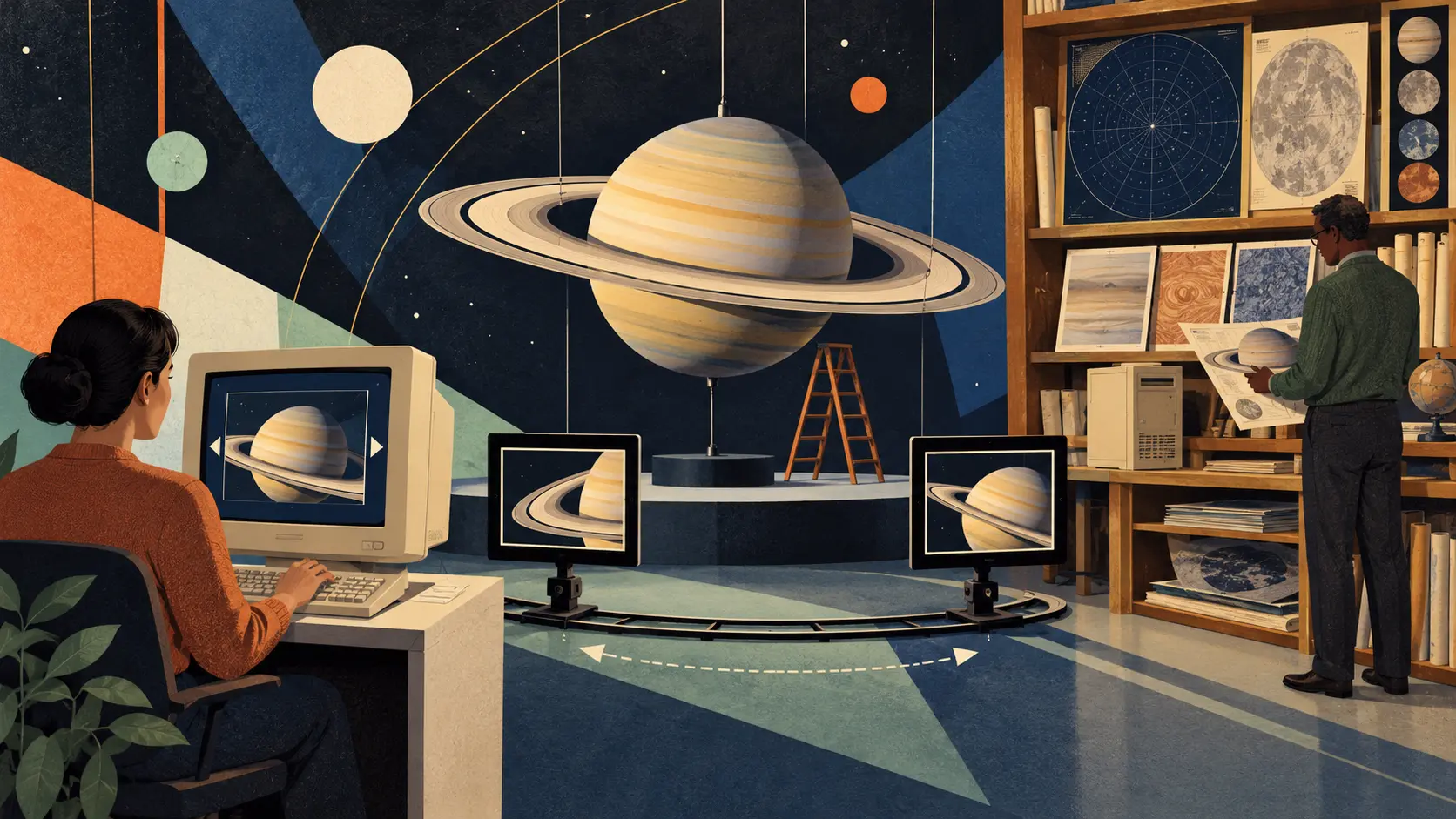
The surviving web form makes the appeal obvious. Choose what to look at, choose where to look from, then set a date and time. Adjust the field of view, or ask for the planet to occupy a particular share of the picture. An image collection offers the photographer’s choices. This form invites another question.
That is a considerable amount of travel to fit into a few menus. It also gives the visitor decisions that an image caption would normally have settled already: the observer, the moment and the framing. A dramatic picture can change because one of those choices changed, even when the underlying model did exactly what it was asked.
Your seat happens to be inside the planet
The legacy help describes the observer at the centre of the selected body. Choose Earth and the mathematical viewpoint is deep beneath the visitor’s actual chair. It also records static surface textures and an omitted light-travel-time calculation. Those details tell a reader how the view was constructed.
The same help singles out some heavily zoomed Saturn views and particular geometries as troublesome. Its suggested workaround is refreshingly modest: change the view. A list of bugs received attention every few months. These are the project’s surviving explanations of its older design, with the everyday maintenance plainly visible.
A handsome cloud has a provenance
JPL’s texture-map collection explains that many surfaces were assembled from spacecraft images, with gaps and some alterations for appearance. Gas-giant textures were representative: atmospheres change daily. Asking for a future date could set the geometry; that fixed picture of Jupiter’s clouds would still need its own explanation.
The sample gallery supplied another useful habit. Rendered Saturn views sat beside actual Voyager images; Galileo views of Earth and the Moon, and of Io, had their own comparisons. Readers could inspect the resemblance. The attractive output came with something to check it against.
There was a computer paying for all this visual hospitality in processing time. The help tied frame-by-frame movie making to the host’s available capacity. A visitor could change destinations with a menu, while the operator still had frames to render, maps to maintain and errors to investigate. The web had made the question delightfully easy to ask. Producing a picture that explained its own choices remained a job.
Member Briefing
Deeper Profile Context
Sign in with the right membership level to unlock the full briefing and source notes.
Only for Strategic Circle
Strategic Circle
Open to all readers. Unlock profile briefings after joining and signing in.
Join Strategic CircleOnly for Leadership Alliance
Leadership Alliance
For qualified IP-asset owners and management; sign in to unlock alliance briefings.
Join Leadership Alliance