
Summary
- Smartkom is not just a name in an internet-number registry. The company has an official Omsk service surface, AS42676, six visible IPv4 prefixes, 14,336 announced IPv4 addresses, a RIPE LIR organisation record, business internet, VPN, telephony, Wi-Fi authorization, cloud video, digital TV, IT support, equipment supply, structured cabling, colocation and residential tariff pages. The company says it has worked for more than 20 years in the B2B telecom segment in Omsk and Omsk Oblast, and its about page claims 1,900 organisations or individual entrepreneurs use its services, 960 newer clients have trusted it for more than two years, and 600 regular clients have worked with it since 2015. Those claims make Smartkom a local operating business, not an empty resource holder.
- The hard economic fact is that activity and profit are different. Registry aggregators report 2025 revenue around RUB 115.5 million, up from about RUB 98.9 million in 2024, but they also report a 2025 net loss around RUB 2.38 million after a small 2024 profit. That combination changes the view. Smartkom appears to be winning work or raising volume, but the incremental work is not yet converting into net earnings. For a regional operator with field crews, customer support, licences, routing obligations, access builds and replacement hardware, revenue growth can be a bad bargain if each new site arrives with too much installation cost, support cost or price concession.
- The central judgement is that Smartkom works best as a dense local business-service operator, not as a price-led residential broadband challenger. Its advantage is the ability to connect buildings, offices, stores, institutions, garden communities and local infrastructure with bundled execution: access, VPN, telephony, guest Wi-Fi, video, cabling, equipment and support. The business becomes fragile if customers buy only the cheapest megabit. National and large regional competitors keep Omsk residential prices low, while public routing evidence shows Smartkom still needs upstream reach and operational discipline. The facts that would change the view are explicit: sustained profitability after the SNT fibre push, rising recurring B2B contracts, proven renewal capex, cleaner licence evidence, and visible technical modernization such as working IPv6 when customers actually demand it.
Start with one connected building
The useful unit for Smartkom is not a city, an autonomous system or a press release. It is one connected building. A building becomes valuable only if enough customers in it pay every month to cover the route into the site, the active electronics, the installer visit, the router or optical equipment, support calls, billing work, power, upstream capacity, replacement stock and the eventual truck roll when something fails. The economics are generous only when density appears. One office paying for a small access circuit may not justify much field work.
Ten offices, a shop, a camera installation and a Wi-Fi portal inside the same commercial property can make the same route much more attractive.
Smartkom's own site is built around that density logic. The service catalogue is broader than home broadband. Business internet is presented with fibre and wireless technologies, PPPoE, IPoE and BGP options, VPN and VLAN corporate networks, FTTP, monitoring and 24/7 support. VPN service is framed as a way to link offices and give staff protected access to databases, CRM, ERP, email and other systems. Telephony includes local telephone lines, long-distance and international access, and cloud PBX features such as multichannel numbers, call recording, greetings, forwarding, internal numbers and conferences.
Wi-Fi plus advertising is built around user authorization, landing pages, social redirection, surveys and visitor targeting. Video surveillance uses cloud storage and business analytics modules. IT support, equipment supply, structured cabling and colocation add more layers to the same customer relationship.
That matters because a small regional provider does not win by copying the offer of a national carrier. A national carrier can use scale, brand, packaged mobile bundles and procurement leverage. Smartkom's public advantage is local completion. The company can send a crew, wire the site, configure the router, add cameras, set up a guest Wi-Fi sign-in page, supply equipment, provide a business contact, and keep the customer from assembling separate vendors for every task. The buyer is not paying only for bandwidth. The buyer is paying to make a location work.
The risk is that every additional promise has cost. A video camera system creates storage, uptime and support obligations. A cloud PBX creates call-quality expectations. Guest Wi-Fi creates user-identification and legal-compliance work. Colocation creates power, cooling, security and monitoring expectations. Structured cabling creates installation timing and warranty exposure. The bundle is attractive only if it raises contribution per site faster than it raises operating complexity.
That is why the connected-building test is severe. If Smartkom connects a business centre, the company wants several tenants, a building owner, cameras, Wi-Fi, telephony and perhaps colocation or managed IT to share the same access investment. If it connects a garden community, it needs take-up and add-ons to be high enough that long laterals and house-by-house support do not turn into low-margin consumer work. If it connects a bank branch, self-service point or public institution, it needs the contract term, service scope and price to recognise response obligations.
Smartkom's future depends on whether it can make each connected cluster behave like a dense account, not a scatter of one-off users.
The identity is local, private and service-heavy
The identity record is straightforward. Official and registry sources identify the company as Joint Stock Company Smartkom, with INN 5504084256 and OGRN 1035507017842. The company contact pages place the operating office at Dekabristov 45/1 in Omsk and list a legal address on Chernyshevskogo Street. Registry cards report registration in July 2003, a small statutory capital figure, and primary activity in documentary telecommunications. The official about page names Valentin Borisovich Malashin as general director and describes more than 20 years in B2B telecommunications in Omsk and Omsk Oblast.
The operating posture is not that of a pure consumer-access brand. Smartkom says its own multiservice network serves users from individual entrepreneurs to large holdings with branch networks. It says its direction toward legal entities lets it focus on service quality and speed for subscribers. It also publishes a residential surface, but the company's own story still starts with Omsk businesses. That is economically important because the B2B segment can pay for reliability, configuration, local support and bundled services in a way ordinary households often will not.
The official customer and partner section is ambitious. Smartkom lists regional institutions, banks, retailers, shopping centres, restaurants, cafes and other named logos on its site. These listings should not be overread. A logo section does not reveal contract size, current activity, service-line scope or margin. But it does support the interpretation that Smartkom has marketed itself to local businesses, public or quasi-public institutions, and multi-site service buyers rather than only to apartment subscribers.
The personnel and recognition signals point in the same direction. The 2026 Day of Radio item names staff in procurement, logistics, partner interaction and technical roles who received regional recognition or company awards. This is not financial proof. It does, however, show the type of operating work that matters in a regional provider: buying equipment, managing stock, working with partners, and maintaining technical capability. The public internet often treats providers as brands, but the economics are made by people who can get cable, routers, mounts, spares, permits, customer approvals and field schedules to line up.
There is one identity caution. Some public pages use historical or variant legal wording, and one official colocation page still refers to ZAO Smartkom in its service description while current registry profiles use AO. The safe conclusion is not that there are two separate public companies. The safe conclusion is that Smartkom's web estate contains old wording in places. For an operator that sells continuity, that kind of stale wording is a minor governance signal. It does not defeat the business case, but it reminds the reader to separate current registry facts from older marketing copy.
The service mix sells avoided hassle
Smartkom's strongest product is avoided hassle. A business customer with a store, office, cafe, clinic, educational site, branch network or building does not want to coordinate internet access, telephony, cameras, Wi-Fi authorization, internal cabling, router purchase and IT support across six suppliers. If Smartkom can provide one accountable local bundle, it can charge more than a commodity access line while still saving the customer management time.
The internet page defines the base. It offers broadband access over fibre-optic lines and wireless technologies, with business options and corporate network services. The value here is not merely speed up to 10 Gbit/s as a headline. The commercial value is in matching access technology to site conditions, providing statistical reporting, supporting business applications, and making the customer's office usable. A local provider can win if it can say yes to awkward buildings, urgent moves and small corporate networks that are too small for bespoke national attention.
VPN is the next layer. Smartkom describes protected corporate networks between company offices, independent of where users are located, with encrypted data and office linking. This matters because VPN revenue can be stickier than ordinary internet access. A customer that has several offices, shared databases, internal systems and telephony over a provider-managed network has higher switching cost than a household with a router. But stickiness cuts both ways. The customer also expects the provider to troubleshoot harder problems. Smartkom has to staff for that or price the service so partner support is economical.
Telephony and cloud PBX add another switching layer. Local telephone lines and access to long-distance and international calling are not exciting growth products by themselves. Cloud PBX features can be more valuable because they sit inside sales, support and reception routines. Multichannel numbers, recordings, greetings, forwarding and internal extensions are operational tools. If they fail, the customer notices quickly. The economics are therefore service-led: recurring monthly revenue can be attractive, but only if the provider has low support cost per extension and reliable call quality.
Wi-Fi plus advertising is small but strategically revealing. Smartkom frames the product around legal user authorization and customer marketing: branded start pages, loyalty offers, social redirection, surveys and targeting by visits, time of day and device model. This is precisely where a local ISP can move beyond connectivity. A cafe or shopping centre does not buy guest Wi-Fi because radio waves are scarce. It buys a way to satisfy users, comply with identification rules and learn something about visits. The access line becomes the base for a business-service product.
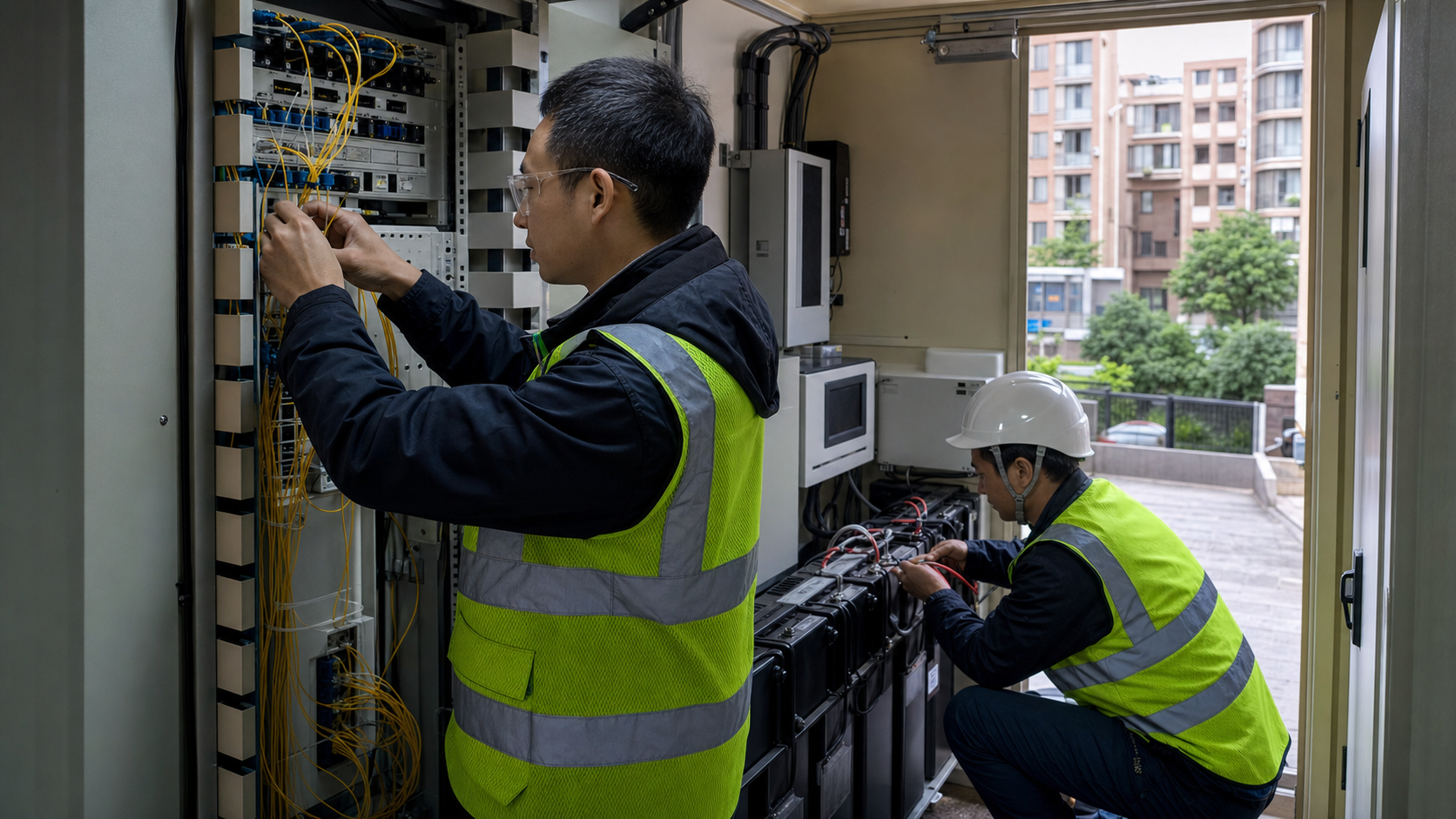
Video surveillance, IT support, equipment supply and structured cabling complete the bundle. Smartkom's video page refers to cloud storage on company servers and modules for people counting, staff control, heat maps and safety events. Its IT support page says the service can replace a staff system administrator. Its equipment page covers corporate Wi-Fi gear, servers, storage, video systems and routers. Its cabling page covers SCS, LAN, telephony, video, security and fire-alarm systems. All of this is practical, labour-heavy work.
The margin depends less on abstract technology and more on whether Smartkom knows its installed base, standardizes equipment and avoids custom-service sprawl.
Colocation is the most capital-sensitive product in the list. Smartkom says it offers customer equipment placement in its data centre, high-capacity channel connection, redundancy, climate, power, access control, video surveillance and 24/7 monitoring. External hosting provider material also identifies an Omsk data centre operated by Smartkom, built on the core of a B2B telecom operator, with first-category power supply, two independent inputs and automatic transfer. If that description is current, colocation can help monetize network and site infrastructure. But colocation also raises the bar.
Customers who place servers care about power, cooling, access, downtime and documented procedures. A small provider can earn good local trust here, but not if it treats colocation as a side product.
Network resources prove substance, not easy growth
AS42676 is the clearest technical evidence that Smartkom operates a real network. RIPEstat identifies the holder as SMARTKOM Joint Stock Company Smartkom and shows current announced status. The visible IPv4 set contains six prefixes: 176.67.48.0/21, 77.221.208.0/20, 77.221.192.0/20, 185.25.68.0/22, 37.157.232.0/21 and 91.226.60.0/22. RIPEstat routing status counts 14,336 announced IPv4 addresses, no visible IPv6 announcement and 18 observed neighbours. IPinfo and Hurricane Electric corroborate the same broad picture, with IPinfo classifying the network as an ISP and showing Omsk router evidence.
For a regional operator, 14,336 IPv4 addresses are meaningful. They can support business static addressing, small hosting, customer access, cameras, VPN concentrators, management systems and the basic need to give customers reachable service without excessive address scarcity. IPv4 resources also carry responsibility. They require abuse handling, routing hygiene, allocation discipline, registry upkeep and careful customer management. The addresses are an asset only if they support paying customers or reduce operating friction. They are not, by themselves, a growth strategy.
The RIPE DB organisation object identifies Smartkom as a RIPE LIR in Russia, with an Omsk address and a creation date in March 2007. The maintainer object also dates to 2007 and was last modified in 2025. Prefix records show resources created or allocated from 2007 through 2013, with one 37.157.232.0/21 record modified in 2025. This history matters. Smartkom's internet footprint is not a late opportunistic shell. It has had RIPE resource administration responsibilities for almost two decades.
The route-policy data shows dependence as well as capability. RIPE whois lists policy entries for networks including AS57304, AS13094, AS20485, AS49869, AS50817, AS9049, AS12389 and AS42403. Current neighbour data and third-party BGP views show a broader live picture, including major or well-known carriers such as Rostelecom, TransTeleCom and RETN, plus Hurricane Electric and other networks. The exact commercial terms cannot be inferred from BGP. Public routing records are not invoices. But the economic meaning is clear: Smartkom needs upstream reach, redundancy and route management to make its local service credible.
That reach has a cost. A regional network buys or maintains transit, transport, exchange connectivity, ports, routers, monitoring and technical know-how. Multiple paths reduce outage risk, but they also create complexity. Large national carriers spread this overhead across millions of customers. Smartkom must spread it across a much smaller revenue base. When customers pay for business continuity, the cost is justified. When customers compare only headline home broadband price, it is not.
The IPv6 evidence is a change-of-view fact. RIPE route consistency shows a 2a00:de80::/48 route object in whois, but current prefix overview and routing status show no live IPv6 announcement. That does not prove Smartkom cannot deploy IPv6. It proves visible IPv6 is not part of the public routing surface at the observed time. If the customer base is still IPv4-heavy, this may be rational. If larger B2B customers, public services, hosting buyers or interconnection partners start requiring modern dual-stack service, the absence becomes a renewal signal.
A provider does not need to adopt every technology early, but it must avoid being late when paying customers change requirements.
PeeringDB returned no public network record for AS42676. That absence should not be exaggerated. Many regional providers do not maintain PeeringDB profiles. It does, however, make the public interconnection posture less promotional than a carrier selling itself as an open peering platform. Smartkom looks more like a local access and business-services network with practical upstream relationships than a wholesale interconnection marketplace.
The financials change the view
The financial record is the part that prevents a simple positive story. RBC reports 2024 revenue of RUB 98.942 million, net profit of RUB 907 thousand, cost of sales of RUB 96.076 million, assets of RUB 15.943 million and equity of RUB 10.652 million. TBank and B2B.House report 2025 revenue around RUB 115.5 million and net loss around RUB 2.37-2.38 million. B2B.House reports 2025 average headcount of 39, down slightly from 40 in 2024 and 45 in 2023, while RBC shows 32 employees on its profile. These are aggregator figures, not a full audited management account, but they are internally useful.
Revenue growth is not enough. A move from roughly RUB 98.9 million in 2024 to roughly RUB 115.5 million in 2025 looks attractive at first glance. It implies growth of about 16.8 percent in the aggregator presentation. But the reported move from small profit to net loss says the new revenue came with higher cost, lower margin, one-off spending, accounting pressure, customer mix change or some combination of these. The public record does not identify the cause. The correct conclusion is narrower and more important: Smartkom is not yet showing that recent growth automatically becomes net profit.
The cost structure explains why. A provider with field work, routers, fibre access, customer premises equipment, call support, billing, route management, licence obligations and colocation cannot treat new accounts as nearly free. A customer acquired in a building already lit by Smartkom may be attractive. A customer at the end of a new lateral route may be unattractive unless take-up is high or installation fees cover the capital. A business VPN can be attractive if it uses existing equipment and a standard configuration. It can be unattractive if each customer requires bespoke troubleshooting.
A video product can be attractive if cameras, storage, network and support are standardized. It can be unattractive if every site is a one-off system-integration project.
The employee figures add nuance. If Smartkom had around 39 average employees in 2025, reported revenue per employee was roughly RUB 2.96 million. That is not obviously excessive for a telecom and IT-services company with field and support work. It also means labour discipline matters. One or two extra support-heavy projects can alter profitability when net income is measured in low millions or negative millions. If employee count differs by aggregator, the exact ratio should not be treated as fact. The sensitivity remains. A small operator has little room for weak contracts.
The procurement data can explain part of the revenue story. B2B.House reports 15 procurement participations, 14 wins and total contract value around RUB 86.06 million. Its largest listed item concerns increasing bandwidth or organising digital channels for 258 Sberbank self-service or branch-related points across western Siberian regions, including Omsk and nearby territories. That is an important signal. It shows Smartkom can appear in operationally demanding corporate connectivity work. It also raises concentration and execution questions.
A large multi-site object can bring revenue, but if it is aggressively priced or requires expensive field coordination across regions, it can pressure profit.
TBank also lists government-contract activity, including collective internet access items around RUB 218,000-220,000. Those are small but relevant. They show that Smartkom is visible in public or institutional supply, but they do not prove a large profit pool. A contract for collective access can be useful recurring work if delivery is easy and collection is reliable. It can be poor business if it requires disproportionate support or extension work.
The 2025 SNT news item is another likely margin test. Smartkom says it built and launched fibre in SNT Sibiryak in October and completed SNT Puteets-1 in November, giving more than 600 households stable fibre, with optional cloud video and digital TV. The strategic appeal is obvious: a garden community can be dense enough to justify fibre if many households subscribe. The risk is also obvious: private houses and garden communities create more edge plant, more customer premises variation and more weather or access exposure than a dense apartment block.
The SNT push improves the view only if take-up, payment and support cost are strong after the initial build.
Retail pricing is a ceiling, not a floor
Smartkom's individual page shows residential tariffs from 100 to 500 Mbit/s with visible discounted price points around RUB 400, 600, 700 and 1,000 per month, plus internet-and-TV bundles with 100 to 500 Mbit/s service and large channel counts. These prices are competitive enough to be understandable in Omsk. They are not high enough to carry careless installation economics. A RUB 400-1,000 monthly household account can be valuable when it attaches to an already-paid access network. It cannot rescue a badly planned extension.
The Omsk market explains the constraint. 101 Internet lists many tariffs and low headline prices in the city. Its broader Omsk page shows provider offers starting around RUB 400 per month, with bundle competition from MTS, Rostelecom, Beeline and other large providers. The TTK Omsk partner page advertises home internet up to 500 Mbit/s and aggressive first-month pricing. MTS advertises home bundles with mobile, TV and internet. Dom.ru and Dom.ru Business present business internet, reserve internet, guest Wi-Fi, video and PBX alternatives. 2GIS search results show a crowded provider category.
This is why Smartkom cannot treat residential broadband as an unlimited margin pool. National or large regional providers can package mobile service, TV, cinema, promotional discounts, equipment, app management and brand trust. They can also absorb price promotions more easily. Smartkom can compete where it has local route density, specific building access, faster response or bundled services. It should be cautious where it is only matching a national price.
The 101 Internet Smartkom page is an unofficial but useful signal. It lists Smartkom as an Omsk provider, gives contact and site data, but shows weak or missing tariff visibility in parts of the marketplace presentation. That may reflect marketplace data rather than Smartkom's actual service. It is still a signal: Smartkom's official site appears more current and more informative than some third-party tariff displays. If consumer acquisition depends on marketplaces, this matters. A company that wants residential scale needs clean tariff visibility across the places consumers compare.
The company appears to understand the problem by using bundles. Residential pages offer TV, video and router-selection guidance. The SNT news item pairs fibre with cloud video and digital TV availability. Business pages pair access with VPN, phone, Wi-Fi, cameras, cabling and IT support. The economic logic is consistent: raise average revenue per connected site and reduce churn by embedding the line into daily use. The danger is that every add-on also expands what can break.
For Elias Ward's economic question, the answer is conditional. Recurring access revenue can cover transit, field support, equipment renewal and churn only if Smartkom sells enough dense, bundled, local service. Plain residential access at market prices will be disciplined by larger carriers. The company needs to make the hard local tasks pay.
Support labour is the product
Telecom analysis often starts with fibre, IP addresses or advertised speed. For Smartkom, the scarcer asset may be support labour. The company's official pages repeatedly sell reachable assistance: 24/7 technical support, monitoring, personal managers, installation, setup, equipment choice, IT outsourcing and service maintenance. The reviews displayed on Smartkom's home page and third-party pages often praise fast installation, manager responsiveness and field crews, while negative reviews point to delays, support strain, price changes or poor experience. These comments are not audited statistics.
They are still economically revealing because they show what customers notice.
Support labour is expensive precisely because customers value it. A business whose internet fails during a move, retail day, bank terminal rollout or camera installation does not want a generic call-centre script. It wants someone who understands the site. Smartkom's local brand can earn trust by solving such problems. But support-heavy customers can destroy margin if the contract does not price the expected work.
The official IT support product makes this tension explicit. Smartkom offers to replace or supplement a staff system administrator, audit infrastructure, configure networks, servers, routers, terminals, DHCP, cloud storage, DNS and Active Directory, and keep software current. That is not a low-touch telecom add-on. It places Smartkom inside the customer's operating environment. Done well, it makes the customer sticky. Done poorly, it creates open-ended responsibility for every problem the customer loosely describes as "the internet."
The cabling and equipment products create the same issue. Supplying routers, storage, corporate Wi-Fi and video systems can improve margin if Smartkom standardizes the stack and reduces support variance. It can worsen margin if customers demand custom hardware, one-off warranties or low-price installation. A regional operator should prefer repeatable, documented configurations. Every exotic device that only one technician understands becomes a future support liability.
The secure-channel notice also shows how support work is becoming more regulated. Smartkom told customers that from 2025-06-01 it would stop processing requests through Telegram, WhatsApp and other foreign messengers, directing customers to VK, MAX, email and phone. The notice links the change to Russian personal-data and communications requirements. The commercial effect is mixed. Safer official channels can reduce compliance risk, but changing customer habits can increase friction. A small provider has to keep the support interface both lawful and convenient.
This is why support metrics would be more valuable than another speed slogan. The public record would be much more persuasive if Smartkom reported average installation time, first-time fix rate, mean time to repair, repeat-fault rate, support contacts per 100 subscribers, churn after installation and SNT take-up after the first six months. Those numbers would show whether support labour is a moat or a leak.
Upstream dependence buys reach and compresses leverage
Smartkom's routing surface is healthy enough to show substance but not large enough to remove supplier dependence. RIPE, IPinfo and Hurricane Electric records show live IPv4 prefixes and multiple observed neighbours. Major names such as Rostelecom, TransTeleCom and RETN appear in public routing evidence, along with other networks. That gives Smartkom reach. It also shows that customer experience depends on upstream and interconnection choices beyond Smartkom's own access plant.
The commercial issue is not whether Smartkom has connectivity. It does. The issue is whether it can buy, maintain and route connectivity at a cost that matches local revenue. A small provider needs enough diversity that a single upstream problem does not damage the brand. But diversity brings ports, transport, hardware, monitoring, routing policy and negotiation. The provider has to pay for resilience before every customer values it.
For B2B customers, resilience can be sold. A business that uses cloud services, payment systems, remote offices, video and hosted applications may understand why a better local provider costs more. For residential users, resilience often becomes visible only after an outage. This creates a pricing problem. Smartkom's upstream and network discipline may be essential, but the retail market may not reward it until failure occurs.
Route consistency data offers a useful caution. Some policy entries visible in whois are not live in BGP at the observed time, and some live BGP neighbours are not reflected in older whois entries. This is normal in living networks. It means the article should not treat every policy line as a current paid contract. The correct inference is that Smartkom maintains a real routing estate whose public records include both current and historical or backup evidence.
The no-visible-IPv6 point also belongs here. If Smartkom is serving customers whose systems, cameras, PBX, sites and payment terminals still run mostly on IPv4, there may be no immediate revenue case for visible IPv6. If the customer mix shifts toward hosting, government digital services, modern enterprise networks or technical buyers who score IPv6 readiness, the absence becomes a sales and renewal problem. This is not a moral judgement about protocol adoption. It is a question of when customer requirements make delayed renewal more expensive than early preparation.
The PeeringDB absence is another small signal. Without a public PeeringDB profile, Smartkom is not obviously marketing itself to the wider interconnection community. That is fine for a local service provider. It would be a weakness only if Smartkom wanted to sell itself as a regional wholesale or peering hub. For now, the public evidence points to local access and business support, not carrier-neutral exchange ambition.
Unofficial signals point to local trust and local friction
Unofficial signals should stay in their lane. 2GIS, 101 Internet and review snippets do not equal audited customer satisfaction. They do, however, show how the company appears in the local market. 2GIS lists Smartkom at Dekabristov 45/1 as an internet provider and in related categories including phone service, communications construction, system administration and IP telephony. It shows a high rating with more than one hundred visible reviews in the captured search and review pages. That supports local visibility.
The texture of the reviews matters more than the score. Positive comments often mention quick installation, managers who stayed in touch, competent crews, business service and successful urgent connections. Negative comments mention poor internet, support frustration, delays or disputed connection costs. This is exactly the pattern one would expect for a local access provider: satisfaction is strongly tied to the specific address, installer, manager, building conditions and day of failure.
For an economic article, the signal is not "Smartkom is good" or "Smartkom is bad." The signal is that service execution is the differentiator and the risk. A household that praises a fast SNT connection is evidence that local field work can win customers. A complaint about delayed connection is evidence that field capacity is finite. A business praising a manager is evidence that personal account handling matters. A complaint about support is evidence that local trust can break quickly.
The reviews displayed on Smartkom's own home page are naturally selected by the company, so they cannot be used as independent satisfaction measurement. They are still useful because Smartkom chooses to emphasise precisely the service attributes that the economics require: fast response, mounting work, managers, price-quality balance and help during urgent connectivity needs. The company knows what it must sell.
Marketplace visibility is less favourable. 101 Internet's Smartkom page confirms provider identity and contact details, but parts of the tariff presentation show missing or zero displayed values. Again, this may be the marketplace's data issue rather than Smartkom's. But consumer comparison happens in such places. If Smartkom wants home broadband scale, marketplace hygiene matters. If Smartkom wants primarily B2B density, weak consumer marketplace display is less important.
The SNT expansion item is the most consequential unofficial-adjacent signal because it is official company news but about a market where consumer reaction will determine economics. More than 600 households receiving fibre sounds attractive. The result depends on how many subscribe, how many add video or TV, how many require support, and how much plant must be maintained across the garden-community footprint. The first connection story is not the final profit story.
What would change the view
The first fact that would improve the view is sustained profitability after the 2025 growth year. If Smartkom shows that 2025 was a temporary investment or timing year and that 2026 revenue converts into net profit, the growth story becomes much stronger. If losses persist while revenue rises, the company may be buying volume with underpriced field work.
The second favourable fact would be proof that SNT fibre has strong take-up and low support cost. A few hundred households in dense garden communities can be attractive if the fibre build is reused heavily and customers add video or TV. The same build is unattractive if many homes pass the route without subscribing or if support visits remain high.
The third favourable fact would be durable B2B contract renewal. Multi-site banking, public institution, retail, education, office-centre and shopping-centre customers are valuable only if contracts renew at prices that reflect response obligations. Public procurement wins are useful signals, but the article would need renewal, margin and service-level evidence to upgrade the thesis.
The fourth favourable fact would be visible technical renewal. That could mean documented router replacement, stronger public interconnection presentation, dual-stack IPv6 where customers demand it, better status communication, or published service metrics. Smartkom does not need to imitate a national carrier, but it must show that its local network is being renewed, not merely stretched.
Facts that would worsen the view are just as clear. A second year of net loss would suggest revenue quality is weak. Loss of a major corporate or procurement customer would expose concentration risk. A cluster of unresolved support complaints after SNT expansion would show field strain. Licence uncertainty or stale public disclosures would raise diligence friction. Rising national-provider discounts in Omsk would compress Smartkom's ability to price ordinary home broadband. A visible IPv6 requirement from institutional customers without Smartkom deployment would turn a dormant technical point into a commercial issue.
The judgement
Smartkom is economically real, but the attractive version of the business is narrow. The company should not be analysed as a national broadband challenger. It should be analysed as a local network and service operator trying to make Omsk density pay. Its best customers are businesses, institutions, property clusters and communities where local installation, support, bundled services and reachable management are worth money.
The public network evidence supports the substance of the company. AS42676, six IPv4 prefixes, 14,336 IPv4 addresses, RIPE LIR status and multiple observed neighbours are not decorative. They show a provider with real responsibilities. The official service pages also show operational breadth. The company can connect, configure, monitor, wire, host, support and add services around the access line.
The financial evidence prevents complacency. A reported 2025 net loss alongside higher revenue says Smartkom's unit economics are being tested. The company may be investing ahead of revenue, absorbing higher labour and equipment costs, winning low-margin growth, or carrying a changing customer mix. Public sources do not settle the reason. They do settle the question of risk: the company must prove contribution, not merely activity.
Smartkom's strongest route is to make every access build carry more than access. A business centre should carry multiple tenants and services. A garden community should carry enough homes and add-ons. A bank or institution should pay for service quality, not just megabits. A camera installation should attach storage, monitoring and support at a price that covers the calls it creates. Colocation should monetize the network core only where power, cooling and support are credible.
The market will not give Smartkom much room for vague claims. Omsk has visible alternatives from large providers and active local comparison surfaces. Customers can buy cheap residential broadband, business internet, reserve links, TV, mobile bundles and cloud PBX from larger players. Smartkom's defence is not scale. It is local completion: knowing the building, answering the phone, sending the crew, fixing the configuration and packaging enough services that the customer would rather not switch.
That defence can work. It is also unforgiving. If Smartkom prices like a commodity provider while operating like a full local service company, costs will win. If it prices service correctly and uses local density to spread field work, the company can turn a modest regional footprint into a durable niche.
Sources
- https://btw.media/en/directory/joint-stock-company-smartkom-ru
- https://smartkom.ru/
- https://smartkom.ru/about/
- https://smartkom.ru/contacts/
- https://smartkom.ru/contacts-individual/
- https://smartkom.ru/services/
- https://smartkom.ru/services/internet/
- https://smartkom.ru/services/vpn/
- https://smartkom.ru/services/telefoniya/
- https://smartkom.ru/services/wi-fi/
- https://smartkom.ru/services/video-nablyudenie/
- https://smartkom.ru/services/czifrovoe-tv/
- https://smartkom.ru/services/it-soprovozhdenie/
- https://smartkom.ru/services/prodazha-oborudovaniya/
- https://smartkom.ru/services/colocation/
- https://smartkom.ru/services/ekspress-audit/
- https://smartkom.ru/services/stroitelstvo-sks/
- https://smartkom.ru/individual/
- https://sale.smartkom.ru/
- https://smartkom.ru/projects/
- https://smartkom.ru/projects/podklyuchenie-interneta-v-ofisnye-torgovye-czentry-omska-1/
- https://smartkom.ru/projects/biznes-v-czifrovoj-epohe/
- https://smartkom.ru/projects/samye-optimalnye-tarify-internet-provajdera-dlya-raznyh-potrebnostej-grazhdan/
- https://smartkom.ru/documents/
- https://smartkom.ru/documents/registraczionnye-nomera-liczenzij-ao-smartkom/
- https://smartkom.ru/documents/opisanie-uslugi-identifikaczii-polzovatelej-wi-fi-1/
- https://smartkom.ru/documents/pamyatka-abonentu/
- https://smartkom.ru/documents/tarify-dlya-chastnyh-licz/
- https://smartkom.ru/documents/tarify-dlya-chastnyh-licz-vladelczev-nezhilyh-pomeshhenij/
- https://smartkom.ru/news/s-1-iyunya-tolko-bezopasnye-kanaly-svyazi/
- https://smartkom.ru/news/smartkom-rasshiryaet-set-i-podklyuchaet-czelye-snt-k-optovolokonnomu-internetu/
- https://smartkom.ru/news/sotrudniki-smartkoma-otmecheny-nagradami-ko-dnyu-radio/
- https://www.ripe.net/membership/member-support/list-of-members/ru/smartkom/
- https://stat.ripe.net/data/as-overview/data.json?resource=AS42676
- https://stat.ripe.net/data/announced-prefixes/data.json?resource=AS42676
- https://stat.ripe.net/data/whois/data.json?resource=AS42676
- https://stat.ripe.net/data/routing-status/data.json?resource=AS42676
- https://stat.ripe.net/data/asn-neighbours/data.json?resource=AS42676
- https://stat.ripe.net/data/as-routing-consistency/data.json?resource=AS42676
- https://rest.db.ripe.net/ripe/organisation/ORG-JSCS3-RIPE.json
- https://rest.db.ripe.net/ripe/mntner/smartkom-mnt.json
- https://stat.ripe.net/data/prefix-overview/data.json?resource=77.221.192.0/20
- https://stat.ripe.net/data/prefix-overview/data.json?resource=77.221.208.0/20
- https://stat.ripe.net/data/prefix-overview/data.json?resource=37.157.232.0/21
- https://stat.ripe.net/data/prefix-overview/data.json?resource=176.67.48.0/21
- https://stat.ripe.net/data/prefix-overview/data.json?resource=91.226.60.0/22
- https://stat.ripe.net/data/prefix-overview/data.json?resource=185.25.68.0/22
- https://stat.ripe.net/data/prefix-overview/data.json?resource=2a00:de80::/48
- https://ipinfo.io/AS42676
- https://bgp.he.net/AS42676
- https://bgp.tools/as/42676
- https://www.peeringdb.com/api/net?asn=42676
- https://companies.rbc.ru/id/1035507017842-zao-smartkom/
- https://companies.rbc.ru/amp/ogrn/1035507017842/
- https://www.tbank.ru/business/contractor/legal/1035507017842/
- https://b2b.house/company/AO-SMARTKOM_b82a401c-f5da-414a-a522-ae6c51bbcd4c/
- https://check.tochka.com/company/1035507017842/
- https://2gis.ru/omsk/firm/282003257739647/tab/info
- https://2gis.ru/omsk/firm/282003257739647/tab/reviews
- https://101internet.ru/omsk/providers/smartkom
- https://101internet.ru/omsk/rating/smartkom/
- https://101internet.ru/omsk/rating
- https://101internet.ru/omsk
- https://omsk.wwwttk.ru/
- https://omsk.mts.ru/personal/dom/home-allmts
- https://omsk.internetv-dom.ru/business/internet
- https://promo.domru.ru/internet_wifi_business
- https://www.dom.ru.com/
- https://2gis.ru/omsk/search/%D0%98%D0%BD%D1%82%D0%B5%D1%80%D0%BD%D0%B5%D1%82-%D0%BF%D1%80%D0%BE%D0%B2%D0%B0%D0%B9%D0%B4%D0%B5%D1%80%20%D0%B4%D0%BB%D1%8F%20%D1%87%D0%B0%D1%81%D1%82%D0%BD%D0%BE%D0%B3%D0%BE%20%D1%81%D0%B5%D0%BA%D1%82%D0%BE%D1%80%D0%B0
- https://2gis.ru/omsk/search/%D0%98%D0%BD%D1%82%D0%B5%D1%80%D0%BD%D0%B5%D1%82-%D0%BF%D1%80%D0%BE%D0%B2%D0%B0%D0%B9%D0%B4%D0%B5%D1%80%D1%8B/rubricId/176/filters/district_id%3D282084862066691
Member Briefing
Deeper Profile Context
Sign in with the right membership level to unlock the full briefing and source notes.
Only for Strategic Circle
Strategic Circle
Open to all readers. Unlock profile briefings after joining and signing in.
Join Strategic CircleOnly for Leadership Alliance
Leadership Alliance
For qualified IP-asset owners and management; sign in to unlock alliance briefings.
Join Leadership Alliance