
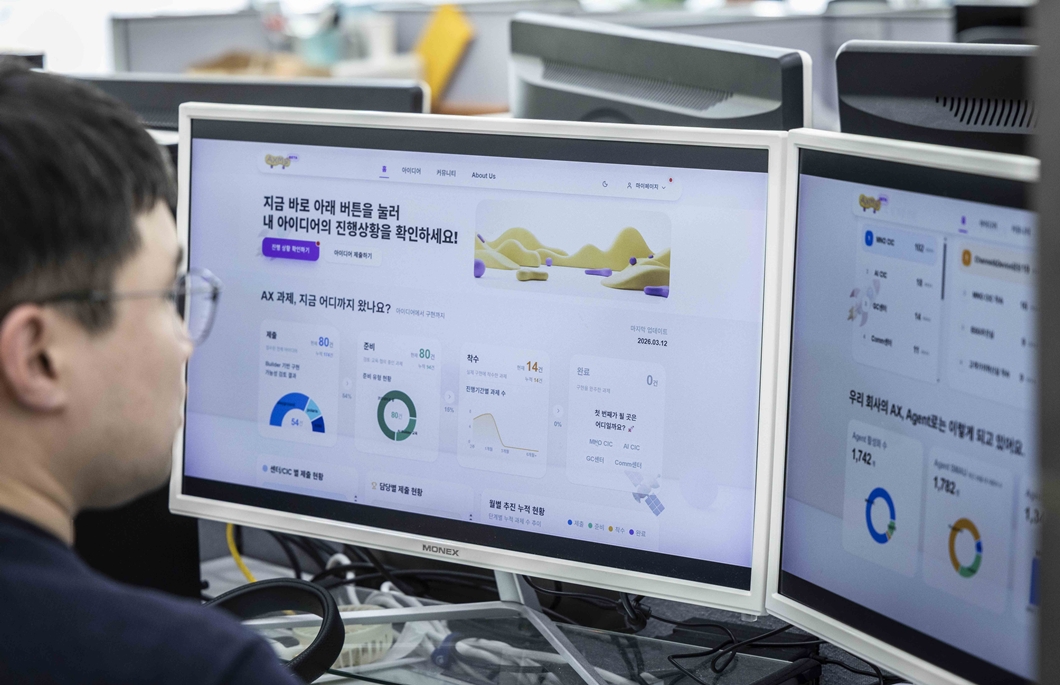
- On 16 March 2026, SK Telecom CEO Jung Jai-hun announced a ‘one person, one AI agent’ goal supported by A. Biz, Polaris, Playground and the AXMS project dashboard. It is a participation target, not proof that every employee already has a production agent.
- SK Telecom separately said more than 2,000 agents were actively used, about 180 ideas had entered a contest and selected projects were targeting commercialization and company-wide rollout in Q3 2026. The company did not disclose unique users, task volume, error rates, security incidents, audited savings or revenue from the programme.
The announcement came from Jung Jai-hun, not his predecessor
The original article named Ryu Young-sang, but SK Telecom appointed Jung Jai-hun as its new CEO in October 2025 and identified Jung as CEO in the 16 March release. That correction matters because the employee-agent programme forms part of Jung’s ‘AI Native’ operating agenda, not an initiative announced by the former chief.
The March release describes an internal operating programme. Employees, including non-developers, are invited to build agents for their own work. It does not announce a new customer product, a completed autonomous workforce or permission for agents to act without human accountability.
Three building surfaces and one management layer
SK Telecom names three employee tools. A. Biz is the general business assistant; Polaris is oriented to marketing and data extraction; Playground supports network-data analysis and coding. The company says staff can ask in natural language or combine modules without traditional coding. That lowers the interface barrier, but the release does not publish model versions, data boundaries, approval rights or task-level accuracy.
AXMS is the control and visibility layer described in the announcement. It exposes submitted ideas, progress and feedback and provides a real-time dashboard. A dashboard can make a project portfolio visible; it does not by itself establish identity controls, least-privilege access, evaluation quality, incident handling, release approval or retirement of a bad agent.
The disclosed numbers measure different things
At MWC26 on 1 March, SK Telecom said more than 2,000 AI agents were being actively used in areas including marketing, legal and public relations. The 16 March release then reported roughly 180 entries to an AX ideas contest. Some core projects had been selected for fast-track co-development, with commercialization and company-wide expansion targeted for Q3 2026. Active agents, submitted ideas, selected projects and future rollout are not one denominator.
SK Telecom also says an automated secure-coding review tool cut the responsible team’s work time by 30%, or about 3,000 hours a year. The public release does not disclose the before-period, team size, review volume, defect severity, false-positive rate, human rework or independent audit. It is a company-reported case, not a universal productivity rate for the 2,000 agents.
The May hackathon is follow-up evidence, not retroactive completion
A 19–21 May in-house hackathon provides a later checkpoint. SK Telecom said 54 teams and 115 people submitted plans, half of the teams came from non-development organizations, 20 teams advanced and four projects won. The selected demos included A.X K1-based A. Auto quality control, T-Care guidance, an AI persona simulator and MAIA for infrastructure-fault detection and response.
SK Telecom said those services would proceed to formal development through AXMS and later expand to workplaces. Seoul Economic Daily independently reported the event and the non-developer participation. A demo, award or plan for formal development is not the same as a production release, safety approval, sustained use or measured customer benefit.
The strategic question is controlled use, not agent count alone
Citizen development can move problem definition closer to the people doing the work. It can also multiply access paths to customer, network, legal and corporate data. The material reviewed here does not specify which agents can read or write production systems, which actions require human approval, how outputs are tested, how prompts and models are logged, or how access is revoked when a role changes.
Telecoms.com suggested the approach might reduce dependence on outside suppliers, but SK Telecom disclosed no procurement baseline or vendor-spend result. The defensible conclusion is narrower: SKT has created tools, a portfolio system, training and contests around employee-built agents, with some active use and several future deployment stages. Operational quality and economic return remain evidence questions.
What to watch
- How many unique employees use the reported 2,000-plus agents, for which tasks and how often.
- Which fast-track projects reach production and company-wide use in Q3 2026, and which do not.
- Identity, data-access, logging, evaluation, human-approval and incident-response controls for employee-built agents.
- Task-level error, false-positive, rework and rollback rates rather than gross agent counts.
- A reproducible baseline for the claimed 30% and 3,000-hour secure-coding saving.
- Customer outcomes, procurement effects, model and infrastructure costs, and any recognized revenue attributable to the programme.
Sources
- SK Telecom release, 16 March 2026: one-person-one-agent goal, A. Biz, Polaris, Playground, AXMS, 180 ideas, Q3 target and company-reported use case
- SK Telecom MWC26 release, 2 March 2026: Jung Jai-hun's AI Native strategy and the claim that more than 2,000 employee agents were actively used
- Telecoms.com, 16 March 2026: independent contemporaneous account and supplier-dependence interpretation, kept separate from SKT evidence
- SK Telecom CEO appointment, 30 October 2025: primary evidence that Jung Jai-hun, not Ryu Young-sang, led the company at the March announcement
- SK Telecom AX Challenge release, 22 May 2026: 54 teams, 115 people, four winning demos and the stated next-development stage
- Seoul Economic Daily, 22 May 2026: independent follow-up on the hackathon, non-developer participation and named projects
- SK Telecom AXMS workplace photograph: original publisher image showing an employee viewing AXMS; not a numeric or outcome source