
Summary
- Siemens reported fiscal third-quarter group orders of €27.9 billion and revenue of €20.8 billion, up 14% and 8% respectively on a comparable basis.
- Profit Industrial Business reached €3.5 billion at a 17.3% margin; net income was €2.6 billion and group Free cash flow was €4.1 billion.
- Smart Infrastructure said data-centre orders grew at a triple-digit rate in the first nine months and reached around €6 billion.
- In the quarter, Smart Infrastructure orders rose 42% comparably to €8.0 billion, revenue rose 13% to €6.4 billion, profit was €1.3 billion and the margin was 20.0%.
- Siemens attributed the order increase chiefly to electrification and electrical-products businesses winning several large data-centre orders in the United States and Europe, without naming customers, sites or megawatt capacity.
- Smart Infrastructure raised its fiscal-year revenue-growth and margin outlook, while Siemens raised EPS pre PPA guidance but left group revenue-growth and book-to-bill expectations unchanged.
The build cycle appears before the servers do
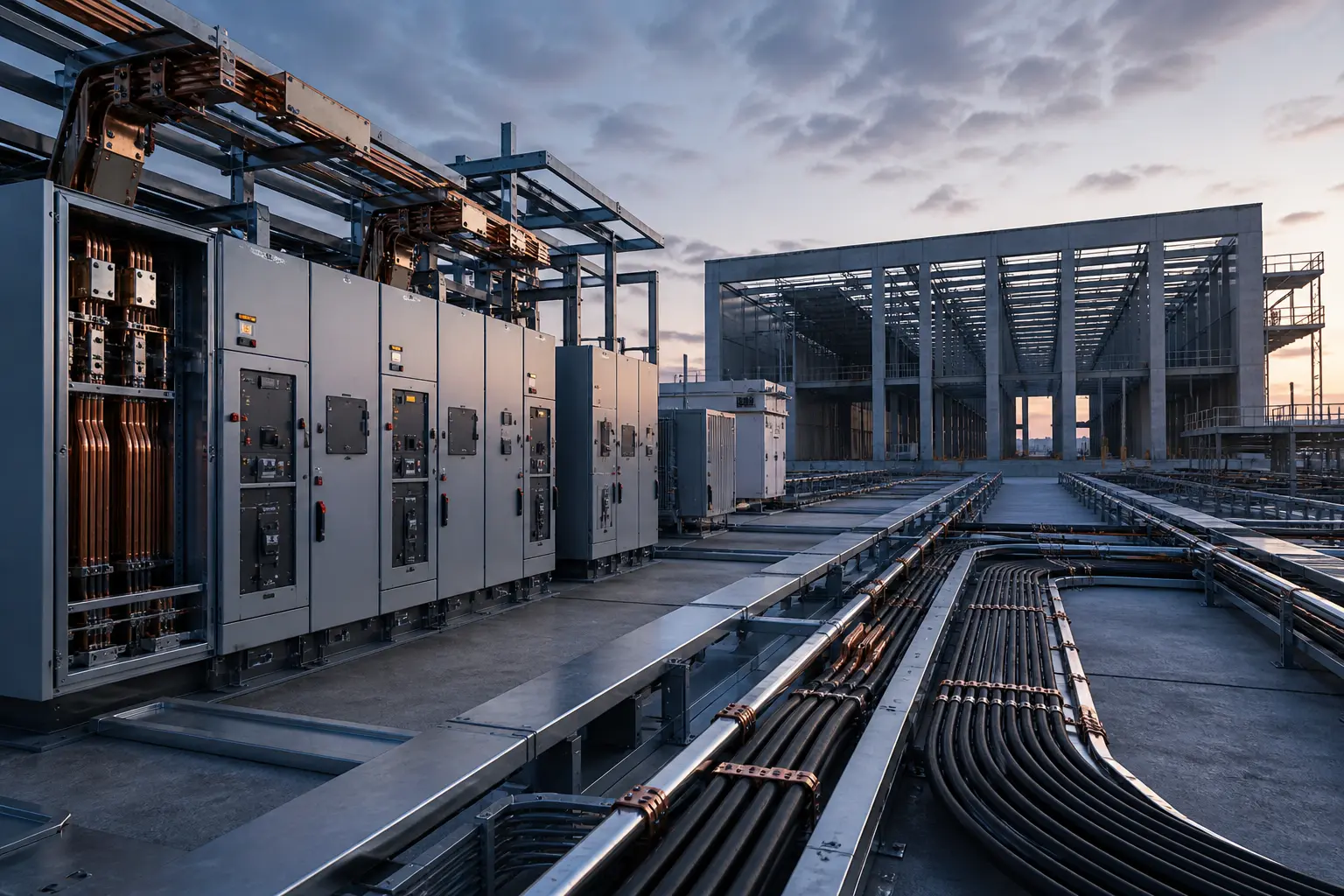
A data centre becomes visible in stages. A planning application or financing announcement can arrive years before operation; commissioned megawatts arrive near the end. Between them sits an industrial layer that is harder to observe: switchgear, distribution equipment, controls and the electrical systems needed to turn a grid connection into usable computing power.
Siemens’ 6 August release brings that middle layer into view. Smart Infrastructure recorded around €6 billion of data-centre order intake over the first nine months of fiscal 2026, with triple-digit growth. The company says several large orders in the United States and Europe drove the quarterly increase. This is evidence that demand has reached suppliers of electrical infrastructure, not merely developers’ prospectuses.
Three accounting perimeters must remain separate
The headline numbers describe different businesses and clocks. At group level, third-quarter orders were €27.9 billion and revenue was €20.8 billion. Profit Industrial Business was €3.5 billion. Smart Infrastructure, one industrial business, recorded €8.0 billion of quarterly orders, €6.4 billion of revenue and €1.3 billion of profit.
The roughly €6 billion data-centre number belongs to Smart Infrastructure and spans nine months. It is not the data-centre share of the €20.8 billion quarterly group revenue. Nor can it be subtracted directly from the €132 billion group backlog to estimate a project count. Preserving these perimeters is more than bookkeeping: it prevents a demand signal from being turned into revenue that Siemens has not reported.
Order intake is an option on execution, not the execution itself
Orders normally precede production, delivery, installation and cash collection. Their analytical value depends on contract terms and on the supplier’s ability to fulfil them without cost overruns or delay. Siemens gives no customer names, site locations, megawatt capacities, delivery dates, deposits, minimum volumes, cancellation rights or escalation clauses for the data-centre orders.
That missing layer limits what the €6 billion can prove. It says a substantial amount of work has entered the order system. It does not establish when the equipment will become revenue, how much working capital it will consume, whether customers can reschedule, or whether the mix will preserve the current margin. The order book advances the thesis; it does not settle it.
The margin tells us that growth has not yet diluted the business
Smart Infrastructure’s quarterly revenue increased 13% on a comparable basis to €6.4 billion. Profit reached €1.3 billion and the margin was 20.0%. Siemens attributes the improvement to higher revenue, better capacity utilization and continuing productivity measures across its businesses.
That combination matters. Rapid infrastructure demand can be low-quality if engineering complexity, supply constraints or rush costs absorb the incremental sales. A 20% segment margin indicates that, at the reported perimeter, volume growth has not produced visible margin erosion. Yet Siemens does not disclose the profitability of the data-centre orders themselves. The segment result contains other businesses and regions, so it cannot be used as a contract margin.
Raised guidance narrows the near-term test
Smart Infrastructure now expects fiscal-2026 comparable revenue growth of 10% to 11%, up from 8% to 10%, and a margin of 18.5% to 19.5%, up from 18% to 19%. Siemens also raised group EPS pre PPA guidance to €11.20–€11.50 from €10.70–€11.10.
The restraint is as informative as the increases. Group comparable-revenue growth remains expected at 6% to 8%, and the group book-to-bill expectation remains above one. Management is therefore raising selected outcomes, not recasting every order as immediate group acceleration. The next evidence should be measured against those exact forecasts rather than against the scale of the data-centre narrative.
The strongest counterargument is still conversion risk
Data-centre electrical demand can be delayed by grid connections, permitting, financing, customer design changes or equipment sequencing. None of those risks is quantified in this release. Several large orders can also create concentration: a small number of projects may explain much of the growth, but Siemens provides no denominator.
The €4.1 billion of group Free cash flow and the €132 billion group backlog demonstrate broad financial and commercial strength. They do not remove project-specific risk. A convincing follow-through would show data-centre orders becoming revenue and cash while Smart Infrastructure remains within its margin range, without an unexplained rise in working capital or cancellations.
Sources
Member Briefing
Deeper Profile Context
Sign in with the right membership level to unlock the full briefing and source notes.
Only for Strategic Circle
Strategic Circle
Open to all readers. Unlock profile briefings after joining and signing in.
Join Strategic CircleOnly for Leadership Alliance
Leadership Alliance
For qualified IP-asset owners and management; sign in to unlock alliance briefings.
Join Leadership Alliance