
Summary
- Joint stock company "Severstal-infocom" is not best understood as a stand-alone regional ISP, even though it has real telecom and network resources. It is the technology arm behind a large steel and mining group, with public evidence around industrial software, enterprise applications, support services, communications, data platforms, user support, production automation and external commercialization of selected products.
- The public financial test is uncomfortable. The latest detailed open financial statements found in public profiles are for 2021: about 7.247 billion roubles of revenue, about 6.597 billion roubles of sales cost, about 225 million roubles of sales profit and about 101.5 million roubles of net profit. Against an average headcount reported at about 2,575, that means the company can look like a large labour pool with a thin accounting margin unless the parent group captures substantial value through reduced stoppages, faster planning, lower maintenance cost and lower dependence on unavailable foreign support.
- The explicit judgment is conditional. Severstal-infocom creates economic value if its MES, production-planning, maintenance, monitoring, data and support systems make steel operations more reliable and if external product sales become repeatable licence and support revenue rather than custom labour. It consumes value if captive demand hides weak pricing, replacement projects absorb talent indefinitely, and the external market turns each product sale into another expensive implementation.
The first test is a hot production sequence
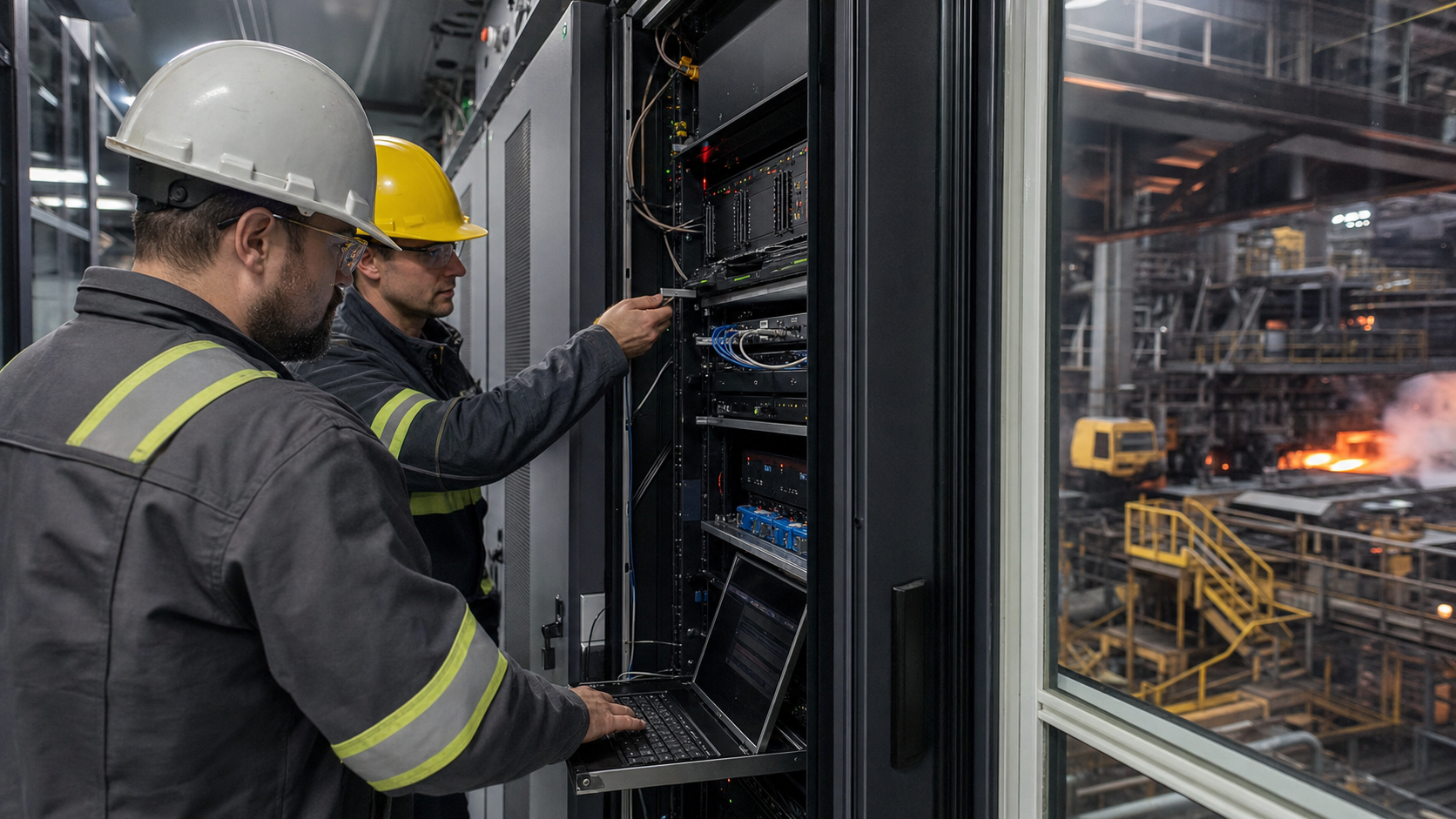
Start with a steel-production workload, not with an office software chart. At the Cherepovets Metallurgical Plant, a coke, agglomeration or blast-furnace production sequence does not fail like a spreadsheet fails. A late data feed, a lost quality signal, a stalled equipment-maintenance task, a wrong production-status view or a broken planning assumption can move from screen to shop floor. The cost may appear as waiting metal, missed shipment timing, avoidable energy use, delayed repair, lower equipment availability or a manual workaround that turns the next shift into the next bottleneck.
That is the reason Severstal-infocom matters. A captive technology unit inside a steel group can know the plant language in a way an ordinary software vendor often cannot. It can understand why a planner cares about a slab, why a repair engineer cares about a tag on an aggregate, why an operator needs a mobile instruction at the equipment, why a quality event must be joined to a production lot, and why a single source of production and finance data is not a dashboard luxury. The most valuable knowledge is not just coding skill. It is the translation between industrial constraints and digital controls.
The danger is the same fact turned inside out. Because the buyer is captive, the price signal can be weak. If a shop, mining site or central function must take services from the in-group technology company, revenue can keep arriving even when the service is inefficient. If the technology company is evaluated only as a service department, the return on its best work may disappear into the parent company's operating result. The economic question is therefore not whether Severstal-infocom is busy. It plainly is.
The question is whether its work changes the cost, reliability and decision quality of the industrial system enough to justify a large internal technology apparatus.
The public record gives several routes to value. MES "Metallurgy" has been reported as implemented in three coke-agglomeration-blast-furnace production areas at Cherepovets, with the foreign QMet Danieli system taken out of service in that scope. The integrated planning system has been described as gradually replacing SAP APO in downstream production planning. "Nadezhnost" addresses maintenance and repair strategy. Mobile TOiR pushes repair execution onto mobile devices. Monitoring and Diagnostics watches equipment state in real time.
The Arenadata project addresses corporate data storage and analytics after the SAP BW replacement problem appeared. Those are not peripheral systems. They sit near production, maintenance, planning and data control.
For a steel group with 2024 revenue reported around 829.78 billion roubles and EBITDA around 237.88 billion roubles, even a small percentage effect on availability, energy, rework, working capital or shipment reliability can dwarf the stand-alone profit of a technology subsidiary. That is the strategic defence of Severstal-infocom. It does not need to look like a high-margin software vendor if it measurably protects a much larger industrial cash engine. But "if" is doing real work. Without disciplined measurement, the same structure can simply move cost from outside suppliers to an internal payroll.
The accounts show a thin stand-alone business
The open financial record is most useful because it resists romance. Russian company profiles and financial pages show detailed accounting data through 2021. For that year, Severstal-infocom had revenue of about 7.246846 billion roubles, cost of sales of about 6.596976 billion roubles, gross profit of about 649.870 million roubles, sales profit of about 225.007 million roubles and net profit of about 101.535 million roubles. Assets were about 2.153515 billion roubles and equity about 146.573 million roubles. RBC also reports average headcount of 2,575.
Those figures are not tiny. They are also not a high-margin software story. Net margin was roughly 1.4%. Sales profit margin was roughly 3.1%. Revenue per average employee was about 2.81 million roubles a year, while net profit per average employee was only about 39,400 roubles. A contractor can survive on thin margins if it is reimbursed for cost, but a product company usually needs more operating leverage than that. A strategic in-house technology center can justify low stand-alone margin only if the parent group receives the upside elsewhere.
That distinction matters because public profiles after 2021 are not enough to prove current financial improvement. Some later market rankings repeat the same 7.246846 billion-rouble revenue figure for 2021, 2022 and 2023. The safer reading is not that revenue was exactly unchanged. It is that fresh, detailed, public standalone financial evidence was not available in the checked sources. Therefore the article should not invent a 2024 or 2025 revenue trajectory. It should test the company through operating evidence, product maturity and the economics of captive industrial technology.
The balance-sheet signals also deserve caution. Contractor profiles show substantial debtor and creditor balances for 2021 and automated warnings about liquidity. Those profiles are not a substitute for a full management report, but they fit the operating model. A large internal technology unit must pay staff, suppliers, contractors, infrastructure providers and software partners while charging internal and external customers under contracts. If receivables grow, cash discipline matters. If replacement programs stretch over years, working capital and labour utilization can quietly absorb value.
The key number is not revenue alone. It is return on the problems solved. If a 7 billion-rouble technology unit prevents one damaging outage in a hot production chain, improves planning across billions of roubles of working capital, or reduces recurring maintenance waste, the economics can be excellent even with thin subsidiary profit. If it mostly supplies staff hours and absorbs old-system replacement burden, it risks becoming an expensive utility. Captive IT is useful only when the word "captive" does not become a protection from market tests.
Captive demand can clarify the product, but it can also hide the price
Severstal-infocom has one advantage many software vendors spend years trying to imitate: a demanding reference customer. A steel group is full of hard use cases. Production runs all day. Equipment is capital intensive. Repair cannot be abstract. Planning has to account for real constraints, not ideal stock-keeping units. Data systems must join production, finance, procurement, investment and customer commitments. User support must keep thousands of people productive. Security and access controls sit next to operational continuity, not just compliance language.
That advantage produces better product definitions. "Nadezhnost" exists because maintenance strategy, risk identification, repair execution and asset readiness are high-value industrial problems. Mobile TOiR exists because repair work happens around physical equipment, not just in a desktop system. MES "Metallurgy" exists because steelmaking needs real-time production coordination, quality control, warehouse movement and shipment visibility. IPS exists because integrated planning in a steel chain must connect demand, production, downstream constraints and order fulfilment. A generic vendor might call these modules.
For a plant, they are operating controls.
The economic problem is internal price discovery. In a normal vendor-customer relationship, a buyer may refuse a licence, negotiate support terms, demand service credits, or choose a rival implementation partner. Inside a group, refusal is more complicated. An internal technology unit can be underpaid relative to value or overprotected relative to cost. Both distortions are possible. If Severstal-infocom prevents downtime, it may not capture the upside in its own accounts. If it delivers a weak system, the parent may still keep using it because replacement is politically and operationally hard.
That is why external commercialization is so important. Public partnership announcements with IBS, Nord Clan, Techforward and T1 show a move beyond pure captive service. External buyers, even if friendly or sector-adjacent, force different discipline. Documentation must be usable. Product releases must be predictable. Support must be contractable. Data access, installation, integration, training, warranties and updates must be described clearly enough for another industrial company to take the risk. A product that works only because everyone knows the Cherepovets plant is not yet a scalable product.
The SimpleOne case from T1 is revealing for precisely this reason. It says Severstal-infocom needed a dedicated support system for external users of commercial IT products and previously lacked a single platform for that direction. The new service-management system was built around incidents, service requests, improvements, knowledge, a self-service portal, Jira, Keycloak and SLA monitoring. That is not cosmetic. It is the infrastructure of becoming a vendor. A customer who buys industrial software does not want to depend on personal relationships with developers inside another industrial group.
It wants service levels, traceability and escalation.
MES is the most important proof point
MES "Metallurgy" is the strongest product signal because it sits closest to the production engine. Public reports say it was deployed in three production areas of the coke-agglomeration-blast-furnace chain at the Cherepovets Metallurgical Plant. They also say the foreign QMet Danieli system was removed from service in that scope and all production-management functions there are now handled in Severstal's own software. That is a more serious claim than an office-tool replacement. If production control degrades, the plant feels it.
The reported scope of MES is broad: coordination and synchronization of production operations, real-time connection between planning, management, monitoring and control, accounting for production and warehouse operations, shipment, receipts and product movement, and quality-management capability. That description matters because steel economics are joined-up economics. A production increase that worsens quality is not value. A shipment promise that ignores a furnace constraint is not planning. A warehouse movement that is not reflected in the production record becomes the next reconciliation problem.
The claimed effects are material: lower cost of entering and receiving information by 30%, higher overall equipment effectiveness by 20%, productivity growth of 5% and energy-consumption reduction of 10% on sites where no MES class system existed before. Those figures should be treated as company-reported benefits, not as independently audited proof. But they define the correct measurement frame. MES should be judged by avoided manual work, equipment availability, throughput, energy intensity, quality traceability and adherence to plan, not by screens delivered.
The replacement of QMet Danieli also changes the strategic calculation. A foreign industrial system may be functionally mature but commercially and operationally risky if support is uncertain. A domestic system gives control over fixes, releases, integrations and product direction. Yet domestic control creates a lifetime obligation. Severstal-infocom now owns not only the software code but the burden of proving it can match industrial reliability, user experience, support, cybersecurity, performance under load, plant-specific adaptation and future technology change. The old vendor problem becomes an internal engineering problem.
For external customers, this is both attractive and risky. The attractive part is obvious: a steelmaker-built MES has lived near real steelmaking rather than being designed from a generic manufacturing template. The risk is also obvious: the product may carry assumptions from Severstal's own operating model. Every outside metallurgy, mining or heavy-industry customer will have its own equipment, planning discipline, data quality, labour practices and integration history. The more each sale requires bespoke adaptation, the less product-like the economics become.
MES can be Severstal-infocom's calling card, but only if implementation effort does not consume the margin.
Planning software is a working-capital argument
The integrated planning product matters because steel companies do not only lose money when equipment stops. They also lose money when plans are wrong. A downstream planning system must join demand forecasts, sales promises, production constraints, inventory, sequencing, order fulfilment and shipment timing. The public description of IPS "Production Planning" says it is being implemented in downstream operations and is gradually replacing SAP APO. That puts the system inside a high-value decision layer.
Planning quality is hard to see from outside, but the economics are clear. A bad forecast can push inventory into the wrong form. A late plan can create emergency production changes. A planning system that does not reflect constraints can create false promises to customers. A disconnected planning system can make each function optimize locally while the group loses margin globally. In steel, planning is not just calendar work. It is capital allocation across orders, equipment, energy, logistics and customer priority.
ComNews describes the product's purpose as integrated planning across levels and horizons, creating an up-to-date business plan to maximize margin across the planning horizon while considering opportunities, constraints, clients and suppliers. It also gives indicative benefit ranges around forecast accuracy, stock availability and data-based decision speed. These are the right types of benefit, but they require careful validation. Forecast gains are not valuable if they do not convert into lower working capital, better service, higher margin, fewer late orders or less production disruption.
The registry and commercial-launch details also matter. Production Planning is listed with a Russian software registry entry dated January 2025, and ComNews describes a 2026 commercial-market launch with corporate licensing based on company turnover. That pricing structure makes sense for industrial planning software because the value depends on scale. A 10-person planning function at one plant and a multi-site industrial group do not receive the same benefit. But turnover-based licensing also demands proof that the system's value rises with the customer's scale.
The strategic question is whether Severstal-infocom can sell planning discipline, not merely planning software. Replacement of SAP APO is a forcing event. It gives the company a reason to build. The durable advantage comes only if the new system helps managers make better tradeoffs under real constraints. A replacement project that merely recreates old screens may be necessary, but it is not enough. The investment case improves when planning software changes the speed, quality and economic weight of decisions.
Maintenance products must prove avoided failure, not elegance
Maintenance and repair are natural territory for a steel-group technology company. Heavy equipment creates a constant tradeoff between planned maintenance cost, unplanned downtime, spare-parts availability, safety, regulatory compliance, asset life and production pressure. Public materials around "Nadezhnost", Mobile TOiR and Monitoring and Diagnostics all target that tradeoff from different angles.
"Nadezhnost" is described as strategic management software for technical maintenance and repair. It covers the cycle from maintenance strategy and criticality analysis to risk identification, maintenance-program development and control of execution. The CNews product page also highlights an RBI module for static equipment under pressure, including pipelines, heat exchangers, tanks and pressure vessels. The economic principle is simple: inspect and repair based on risk, not habit alone. That can reduce unnecessary work while protecting the failures that matter most.
Mobile TOiR attacks the execution layer. Severstal's public article says the group first used SAP Work Manager, found the standard product insufficient, and then asked its IT team to create its own application. The reported deployment is large: more than 2,000 devices and more than 5,000 employees across Severstal, SVEZA and Nordgold production sites. Claimed outcomes include a 3.5-times reduction in work-result registration time, a three-times reduction in downtime caused by poor maintenance, and a 16-times increase in early detection of defects and failures.
Those figures are exactly the kind of evidence the product needs, with one caveat. Maintenance benefits are always vulnerable to attribution. A reduction in downtime may depend on better planning, better discipline, more sensors, more spares, new procedures, different equipment condition or management attention, not only software. The proper conclusion is not that the claims are false. It is that the commercial product must carry enough methodology, implementation support and measurement discipline to reproduce them outside the original group environment.
Monitoring and Diagnostics is the condition-monitoring complement. Techforward's product page describes real-time equipment-state monitoring, detection of deviations and potential faults before accidents and downtime, alert handling, reporting and exports. It claims reductions in failure risk and unplanned-downtime duration. Again, the business value is not the dashboard. It is earlier intervention, fewer catastrophic failures, better repair scheduling, lower spare-part surprises and safer equipment operation. If the system only produces alarms that people ignore, it becomes noise.
If it changes maintenance timing and prioritization, it becomes economics.
The maintenance portfolio is therefore coherent. Strategy, mobile execution and condition monitoring belong together. The risk is implementation complexity. Each customer has different equipment, data quality, maintenance culture, sensor coverage, ERP integration and safety rules. Severstal-infocom can win if it packages industrial method and product together without turning every deal into a bespoke consulting project. If not, external sales may grow revenue while keeping margins close to captive service margins.
Data replacement is a strategic burden
The Arenadata project shows another part of the economic story: data-platform replacement. Severstal is building a platform for storage and analysis of data on the Arenadata stack, with Severstal-infocom implementing the project. The public account says the need emerged at the end of 2022 as a replacement for SAP BW. The chosen stack includes database, quick-mart, streaming and catalog components, and the target is a single trusted data base for several Severgroup companies across 15 functional areas, including production, finance, controlling, treasury, investment and purchasing.
That is not a small technology migration. A corporate data warehouse holds meanings as well as tables. Production data, finance data, procurement data and investment data each have owners, definitions, history and political weight. If replacement breaks definitions, decisions become contested. If migration is slow, users keep old spreadsheets and unofficial extracts alive. If the system is stable but too rigid, business units create workarounds. If it is flexible but uncontrolled, no one trusts the numbers.
For Severstal-infocom, the data project highlights both capability and obligation. The capability is the ability to implement a domestic data foundation after foreign-vendor continuity became uncertain. The obligation is to keep that foundation reliable, governed and economically useful. A data system reduces risk only if it becomes trusted enough to retire the old one. Running both old and new landscapes for too long destroys the cost case.
The value proposition has three parts. First, operational continuity: the group is less exposed to unavailable support for a system that once sat near core reporting and analytics. Second, decision speed: a well-governed data platform can shorten the distance from production and finance facts to management decisions. Third, product transfer: experience with a large industrial data migration may become marketable expertise if other companies face the same foreign-vendor replacement problem.
But the third part is weaker than the first two unless the company can productize methodology and repeat the work without simply renting out scarce specialists.
The data project also shows why Severstal-infocom cannot be judged like a narrow software vendor. Some of its most important work may not become a branded product. It may become the invisible ability of Severstal managers to trust production, finance and procurement data during a volatile market. That is real value, but it is hard to charge for directly. It must be measured through the parent company's decision quality, lower reconciliation cost, lower reporting risk and better allocation of capital.
External sales require a different company
The partner announcements are not background colour. They show Severstal-infocom trying to move from captive expertise to a commercial industrial-software platform. IBS, Nord Clan and Techforward each fill a different gap. IBS and Nord Clan bring implementation and market reach. Techforward brings maintenance and enterprise-system expertise. T1 supplied external customer support infrastructure. Database and operating-system partners help prove the products can sit on domestic technology stacks.
This is rational. A steel group's IT arm should not try to build every external-sales capability alone. Industrial software sales need prospecting, pre-sales, pilots, implementation, migration, training, support and upgrade management. A partner channel lets Severstal-infocom focus on product ownership and industrial domain knowledge while integrators handle part of the customer load. It also lets external customers buy through firms that already understand their procurement and implementation habits.
But a partner channel creates a new economic test. Partners will not carry a product indefinitely unless deals close, customer references improve and support is predictable. If documentation is weak, integrators lose money. If the core product requires too much vendor intervention, partners become message carriers rather than scalable implementers. If product roadmaps are driven mainly by Severstal's own needs, outside customers may wait for features that are not priorities for the parent group.
The SimpleOne support case is therefore one of the most important pieces of evidence. Before that project, the public case says Severstal-infocom lacked a single solution for supporting external users of its commercial IT products, which created communication, task-resolution and reporting difficulties. After the project, customers could track requests, see history and use knowledge materials; support staff could monitor SLA and interact with development teams. That is the mundane machinery of commercial credibility.
External product economics are attractive because they can turn internal research and development into incremental revenue. The marginal value of a second customer for MES, IPS or maintenance software can be high if the implementation is standardized. The marginal value is low if each second customer requires a near-new project. The company must therefore decide what it is selling: software licences, managed industrial transformation, implementation-heavy consulting, or a mixture. Each model can work, but only if pricing, staffing and support obligations match the model.
The network record is real, but it is not the main story
Severstal-infocom has a genuine network and telecom footprint. RIPE lists the company as a member at Lenin Street 123A in Cherepovets. BGP databases identify AS33936, SCAT7-AS, as the AS for Joint stock company "Severstal-infocom". BGP.HE shows 11 originated IPv4 prefixes, 2,816 originated IPv4 addresses and observed peers including TransTeleCom, RETN and Vimpelcom. IPinfo also shows 2,816 IPv4 addresses, a business ASN classification, hosted domains and pingable addresses. IPIP reverse DNS for 217.175.23.0/24 shows Severstal group nameservers and mail hosts.
That evidence matters, but it should not dominate the company story. This is not a micro-ISP where address leasing or access resale is the central economic issue. The network record looks like corporate communications infrastructure attached to a large industrial group. Historic profiles also list corporate telephone, data services, Internet access, video conferencing, mobile communications, centralized IT services, enterprise applications, user support, workplace maintenance and infrastructure integration. Telecom is part of the operating spine.
The economic significance is resilience. A steel group needs reliable communications across offices, plants, mines, support centers and external systems. DNS, mail, remote access, telephony, data transmission and secure connectivity are not glamour assets. They are the background conditions for everything else. If they fail, user support, planning, procurement, reporting and operations feel the failure. A network team inside the group may be less visible than product teams, but its availability can protect the value of all the software above it.
There is also administrative cost. A local internet registry role, address space, routing, peer relationships, abuse handling, naming infrastructure, telecom licences and corporate communications obligations are not free. They require governance and technical competence. In a consumer ISP, those costs are justified by access revenue. In Severstal-infocom's case, they are justified mainly by the parent's need for control, continuity and internal service capability.
The right conclusion is balanced. The company has a network footprint strong enough to belong in the analysis and in the directory category context. But its economic identity is broader and more industrial. The network is an enabling layer for steel, mining, enterprise systems and product support. Treating it as the whole company would miss the real investment question.
Cyber risk is inseparable from industrial value
Industrial technology creates risk while reducing risk. The same systems that make production visible also expand the control surface. MES, planning, maintenance, monitoring, data warehouses, service desks, ERP systems, telecom networks and remote-support channels all create access points, permission structures, logs, credentials, integrations and dependency chains. The more Severstal-infocom replaces and consolidates systems, the more its own engineering and security choices matter.
Russia's critical information infrastructure law and personal-data law are relevant context because industrial systems, telecom services, support platforms and employee/customer data can fall into sensitive categories. It would be wrong to state from public evidence that every Severstal-infocom-supported system has a particular regulatory classification. It is enough to say that the operating environment is regulated and high consequence. Steel production, mining, repair execution, corporate communications and enterprise support do not tolerate casual security.
Foreign software and service restrictions add another layer. When Western support becomes restricted or uncertain, a domestic technology unit gains strategic importance. But it also inherits difficult work. Replacing SAP BW, SAP APO, SAP Work Manager or a foreign MES is not only a procurement substitution. It means retesting controls, rebuilding integrations, retraining users, rethinking service support, maintaining performance, preserving historical data and proving that the new system remains secure under load.
Cybersecurity spending can look like overhead until failure. That creates the same measurement problem as captive IT. A year without a major incident is not proof that security spend was wasteful; it may be evidence that controls worked. But management still needs metrics: incident severity, patch cycle, access-review discipline, recovery time, backup success, privileged-account control, vulnerability closure, supplier exposure and user behaviour. A captive unit that cannot show those metrics will struggle to prove it is more than an internal cost.
For external customers, security is also a commercial requirement. A metallurgical, chemical, mining or energy customer buying maintenance or production software wants confidence that the product will not weaken its operating environment. Compatibility with domestic databases and operating systems helps, but it is only one layer. Secure architecture, documentation, vulnerability response and support discipline matter just as much. If Severstal-infocom sells software born inside a steel group, it must also sell the confidence that it can support security outside that group.
Labour is the hidden capital base
The company's real capital is people. Public profiles show average headcount of 2,575 in 2021. Older partner pages describe more than 800 employees and 10 branches; market rankings and registry profiles describe a broader branch footprint. The exact comparison is less important than the trend: this is a large labour organization, not a small product studio. Its economics depend on utilization, retention, skill depth and the ability to turn specialized knowledge into repeatable systems.
That is a hard labour model. Industrial software requires product managers who understand plants, architects who understand legacy systems, developers who understand reliability, analysts who can work with production users, support staff who can manage incidents, security specialists, database engineers, network engineers, 1C and SAP veterans, mobile developers, data engineers and trainers. Losing experienced staff can damage not only productivity but institutional memory. In a captive industrial environment, memory is part of the product.
The 1C Consulting profile is useful because it shows certification depth. Severstal-infocom appears as a 1C Consulting candidate partner and ERP competence-center candidate, with many 1C professional and specialist certificates. That does not prove project quality by itself, but it shows the company has invested in enterprise-application capability. University and regional career pages also emphasize student hiring, internships, industrial digital work, dashboards, defect recognition, VR/AR training and 24/7 large-company systems.
The economic threat is wage pressure and opportunity cost. Strong industrial IT specialists can work for major integrators, product companies, banks, telecom operators or remote software employers. A captive group can offer industrial complexity and stability, but it must compete for talent. If wages rise faster than internal prices or product revenue, margins compress. If the best staff are constantly pulled into urgent replacement projects, product development slows. If too much knowledge remains in individuals, scaling external sales becomes dangerous.
Labour productivity must therefore be a management obsession. The company needs reusable platforms, common integration services, internal development standards, support knowledge bases, documented product configurations and partner training. Otherwise every business unit, plant and external customer consumes bespoke effort. A 2,575-person technology base can be a strategic asset, but only if it compounds. If it merely absorbs requests, it becomes a cost center with good stories.
The outside market is open, but unforgiving
Russia's industrial software market gives Severstal-infocom an opening. Heavy industries need domestic or locally supportable replacements for foreign systems. Customers in metallurgy, mining, chemicals, energy and machinery often face similar problems: maintenance strategy, mobile repair execution, equipment monitoring, production planning, MES, data migration and support systems. A product created in a real steel group has credibility that a generic startup may lack.
Yet credibility is not enough. External industrial buyers are conservative for good reasons. A plant manager does not want to be a test site for unstable software. A maintenance director does not want to change repair execution if technicians resist the device. A planning director does not want a system that cannot handle real constraints. An IT director does not want a product that needs constant vendor rescue. A finance director does not want promised savings that disappear into implementation cost.
That is why partner selection matters. IBS has scale and a long project history. Nord Clan brings complex IT-system implementation and industrial digitalization claims. Techforward brings EAM, SAP, MES and maintenance expertise. T1 supplied ESM support infrastructure. Database partners help certify technical compatibility. These relationships make the go-to-market model more credible, but they also expose Severstal-infocom to partner quality. If a partner mishandles an implementation, the product brand suffers.
Pricing will be decisive. A corporate licence based on customer scale can be justified for planning or MES if benefits scale with turnover and production complexity. Maintenance software can price by modules, production volume, assets, users or support level. Monitoring software can price by equipment, data sources or deployment. Each approach has a fairness problem. Price too high and customers build or buy alternatives. Price too low and implementation consumes margin. Price by custom work and the product never becomes scalable.
The strongest external story is not "we replaced foreign software". It is "we improved a measurable industrial operation and can repeat the result". Replacement urgency can open the door. Measured operational improvement keeps the customer. The evidence Severstal-infocom should want to publish over time is not only compatibility certificates and partnership announcements, but renewal rates, implementation time, severe-incident rates, realized savings, equipment availability changes, planning accuracy changes and user adoption.
What would prove value creation
The company can prove value in five ways. First, by showing production results. MES should reduce manual recording, improve equipment effectiveness, protect quality and shorten the time between events and decisions. Planning software should improve fulfilment, reduce wrong inventory, make constraints visible and raise margin quality. Maintenance software should reduce unplanned downtime, improve risk-based repair decisions and lower waste. Data platforms should reduce reconciliation time and make management decisions more trusted.
Second, by showing commercial leverage. If products originally built for Severstal become external licences with recurring support revenue, the economics change. Internal development cost can be spread over more customers. Partner-led implementation can reduce direct labour burden. Support systems can serve many customers with common knowledge. This is where the T1 service-management project becomes a leading indicator. It suggests Severstal-infocom knows that external customers need structured support, not favours.
Third, by showing labour leverage. Revenue per employee and profit per employee in 2021 were not enough to prove a high-return software model. Future proof would look like more product revenue without proportional headcount growth, higher gross margin, fewer custom modifications per deployment, stronger partner delivery and reusable implementation templates. A captive unit does not need Silicon Valley margins, but it does need evidence that knowledge is being captured and reused.
Fourth, by showing risk reduction. The replacement of QMet Danieli, SAP APO, SAP BW and SAP Work Manager should reduce dependency on unavailable foreign support, but replacement risk remains. The company should prove uptime, recovery readiness, security discipline and support maturity. If domestic systems fail more often, the strategic argument weakens. If they match or exceed old reliability while giving Severstal control, the case strengthens.
Fifth, by showing governance clarity. Captive demand needs internal discipline. Business units should see service cost and value. Product teams should know when a feature serves Severstal only and when it belongs in the commercial product. External customers should know support levels and roadmap commitments. The company should avoid pretending that every internal solution is automatically a market product. Some systems are strategic internal utilities. Others are commercial platforms. Mixing the two without discipline destroys both.
What would change the judgment
Several facts would improve the view materially. Fresh standalone accounts for 2024 or 2025 showing revenue growth, higher gross margin and stronger net profit would matter. External contracts for MES, IPS, Nadezhnost, Mobile TOiR or Monitoring and Diagnostics with repeatable licence/support revenue would matter more than another partnership announcement. Independently measured results from outside Severstal group customers would matter most. A broader certified partner network that can implement without heavy vendor intervention would reduce bottleneck risk.
Several facts would weaken the case. If external customers require deep customization, product margin may not improve. If Severstal's own plants keep demanding urgent fixes and replacements, commercial development may be delayed. If domestic replacement systems create new reliability problems, the avoided foreign-vendor risk may be offset by internal support burden. If staff turnover rises or wage costs accelerate, labour leverage may deteriorate. If a serious security or telecom incident occurs, the trust premium of a captive technology unit would be damaged.
There is also a strategic ambiguity. Severstal-infocom's best economics may never appear in its own profit line. If the company prevents production losses, lowers maintenance cost and improves planning for a much larger parent, the subsidiary's accounting margin can stay thin while group value rises. That is acceptable, but only if the parent measures it honestly. A captive technology company can be one of the best investments an industrial group makes, or one of the easiest places to hide complexity.
The current judgment is therefore direct. Severstal-infocom has credible industrial domain depth, substantial staff scale, real network capability, serious replacement projects and a product portfolio aimed at high-value steel and maintenance problems. It also has thin public standalone margins, stale detailed financial disclosure, commercialization infrastructure that appears to have been built only after external product sales became more serious, and product benefits that are often company or partner claims rather than independent proof.
The business must prove that internal knowledge compounds. It must turn plant-specific lessons into products, products into repeatable deployments, deployments into recurring support revenue, and support experience into better products. If it does, captive industrial IT becomes a lever on steel economics. If it does not, the company remains a large, necessary, technically impressive cost center whose value is real but always contested.
Sources
- https://it.severstal.com/
- https://companies.rbc.ru/id/1023501237330-severstal-infokom/
- https://companies.rbc.ru/amp/ogrn/1023501237330/
- https://www.tbank.ru/business/contractor/legal/1023501237330/
- https://saby.ru/profile/3528007105-352801001
- https://companium.ru/id/1023501237330-severstal-infokom
- https://b2b.house/company/AO-SEVERSTAL-INFOKOM_5238598d-9c88-436c-af49-e56042419cf3/financial-statements/
- https://synapsenet.ru/organizacii/1023501237330-ao-severstalinfokom
- https://www.comnews.ru/content/234875/2024-09-10/2024-w37/1180/keptivnye-it-kompanii-rynke-informacionnykh-tekhnologiy-rossii-2024
- https://www.tadviser.ru/index.php/%D0%9A%D0%BE%D0%BC%D0%BF%D0%B0%D0%BD%D0%B8%D1%8F%3A%D0%A1%D0%B5%D0%B2%D0%B5%D1%80%D1%81%D1%82%D0%B0%D0%BB%D1%8C-%D0%98%D0%BD%D1%84%D0%BE%D0%BA%D0%BE%D0%BC
- https://www.cnews.ru/book/mutual/53329/142727
- https://www.cnews.ru/book/%D0%A1%D0%B5%D0%B2%D0%B5%D1%80%D1%81%D1%82%D0%B0%D0%BB%D1%8C_%D0%9F%D0%90%D0%9E_-_%D0%A1%D0%B5%D0%B2%D0%B5%D1%80%D1%81%D1%82%D0%B0%D0%BB%D1%8C_%D0%98%D0%BD%D1%84%D0%BE%D0%BA%D0%BE%D0%BC_-_%D0%A1%D0%B5%D0%B2%D0%B5%D1%80%D1%81%D1%82%D0%B0%D0%BB%D1%8C-%D0%98%D0%BD%D1%84%D0%BE%D0%BA%D0%BE%D0%BC_%D0%A1%D0%BE%D1%84%D1%82_-_%D0%A1%D0%92%D0%A1-%D0%98%D0%BD%D1%84%D0%BE%D0%BA%D0%BE%D0%BC
- https://www.cnews.ru/news/line/2026-04-17_kompaniya_severstal-infokom
- https://importfree.cnews.ru/news/line/2025-06-16_severstal-infokom_podtverdila
- https://www.cnews.ru/book/%D0%A1%D0%B5%D0%B2%D0%B5%D1%80%D1%81%D1%82%D0%B0%D0%BB%D1%8C_%D0%98%D0%BD%D1%84%D0%BE%D0%BA%D0%BE%D0%BC_-_%D0%9D%D0%B0%D0%B4%D0%B5%D0%B6%D0%BD%D0%BE%D1%81%D1%82%D1%8C_%D0%9F%D0%9E_%D0%B4%D0%BB%D1%8F_%D1%83%D0%BF%D1%80%D0%B0%D0%B2%D0%BB%D0%B5%D0%BD%D0%B8%D1%8F_%D1%82%D0%B5%D1%85%D0%BD%D0%B8%D1%87%D0%B5%D1%81%D0%BA%D0%B8%D0%BC_%D0%BE%D0%B1%D1%81%D0%BB%D1%83%D0%B6%D0%B8%D0%B2%D0%B0%D0%BD%D0%B8%D0%B5%D0%BC_%D0%B8_%D1%80%D0%B5%D0%BC%D0%BE%D0%BD%D1%82%D0%BE%D0%BC_%D0%BE%D0%B1%D0%BE%D1%80%D1%83%D0%B4%D0%BE%D0%B2%D0%B0%D0%BD%D0%B8%D1%8F
- https://www.metalinfo.ru/ru/news/175229
- https://nordclan.com/news/nord-clan-i-severstal-infokom-obedinyayut-usiliya
- https://ibs.ru/media/ibs-i-severstal-infokom-podpisali-soglashenie-o-sotrudnichestve-v-oblasti-tsifrovizatsii-promyshlennosti/
- https://t1.ru/cases/stalnoj-esm
- https://t1.ru/media/news/edinoe_okno_dlya_klientov_t1_integratsiya_avtomatizirovala_podderzhku_polzovateley_severstal-infokoma
- https://t1-integration.ru/product/industries/industry
- https://t1-integration.ru/product/sistemy-upravleniya-processami-i-aktivami
- https://arenadata.tech/about/news/severstal-stroit-hranilishhe-dannyh-na-steke-produktov-arenadata/
- https://www.osp.ru/resources/releases?rid=52643
- https://techforward.ru/news/vendors-left-but-demand-remained
- https://techforward.ru/solutions/po-monitoring-i-diagnostika
- https://techforward.ru/company/about
- https://tantorlabs.ru/products/dbms/tpost/xmfcj3oin1-po-nadezhnost-ot-severstal-infokom-i-sub
- https://www.comnews.ru/content/243743/2026-02-27/2026-w09/1180/programmnye-razrabotki-rossiyskikh-korporaciy-2026
- https://catalog.arppsoft.ru/product/6405365
- https://consulting.1c.ru/partners/215677.html
- https://voloblcareer.ru/companies/details/2240
- https://www.amm.vsu.ru/partners/21255/
- https://sroboki.ru/memberinfo/547/
- https://progressmet.severstal.com/
- https://progressmet.severstal.com/en
- https://promo.severstal.com/fi
- https://promo.severstal.com/report-2024
- https://tass.com/economy/1908087
- https://www.finam.ru/publications/item/severstal-strategiya-budushchego-rosta-20250207-1300/
- https://www.steelorbis.com/steel-news/latest-news/severstals-sales-revenues-up-14-in-2024-significant-investments-planned-for-2025-1377174.htm
- https://www.ripe.net/membership/member-support/list-of-members/ru/scat7/
- https://bgp.he.net/AS33936
- https://ipinfo.io/AS33936
- https://ipinfo.io/AS33936/217.175.23.0/24
- https://whois.ipip.net/cidr/217.175.23.0/24
- https://radar.cloudflare.com/as33936
- https://radar.cloudflare.com/routing/as33936
- https://2ip.ru/as/33936/
- https://htmlweb.ru/geo/oper.php?id=1898
- https://star-pro.ru/proverka-kontragenta/organization/1023501237330--ao-severstal-infokom
- https://damia.ru/spk/card?req=1023501237330
- https://e-disclosure.azipi.ru/organization/personal-pages/700128/
- https://1prime.ru/20120517/752435022.html
- https://cherepoveckygor--vld.sudrf.ru/modules.php?case_id=85597780&case_uid=922d715a-986b-4dca-9c43-3ffbef7f9232&delo_id=1502001&name=sud_delo&name_op=case&srv_num=1
- https://reputation.ru/ogrn/1023501237330
- https://severstal-infokom.inni.info/
- https://www.oborudunion.ru/company/567547470/
- https://catalog-777.com/predpriyatie/494914/
- https://yandex.com/maps/org/severstal_infokom/92159618636/
- https://www.consultant.ru/document/cons_doc_LAW_220885/
- https://www.consultant.ru/document/cons_doc_LAW_61801/
- https://finance.ec.europa.eu/publications/software_en
- https://ofac.treasury.gov/faqs/added/2024-06-12
- https://www.federalregister.gov/documents/2024/07/18/2024-15709/publication-of-russian-harmful-foreign-activities-sanctions-regulations-determination
- https://www.ripe.net/membership/payment/
Member Briefing
Deeper Profile Context
Sign in with the right membership level to unlock the full briefing and source notes.
Only for Strategic Circle
Strategic Circle
Open to all readers. Unlock profile briefings after joining and signing in.
Join Strategic CircleOnly for Leadership Alliance
Leadership Alliance
For qualified IP-asset owners and management; sign in to unlock alliance briefings.
Join Leadership Alliance