
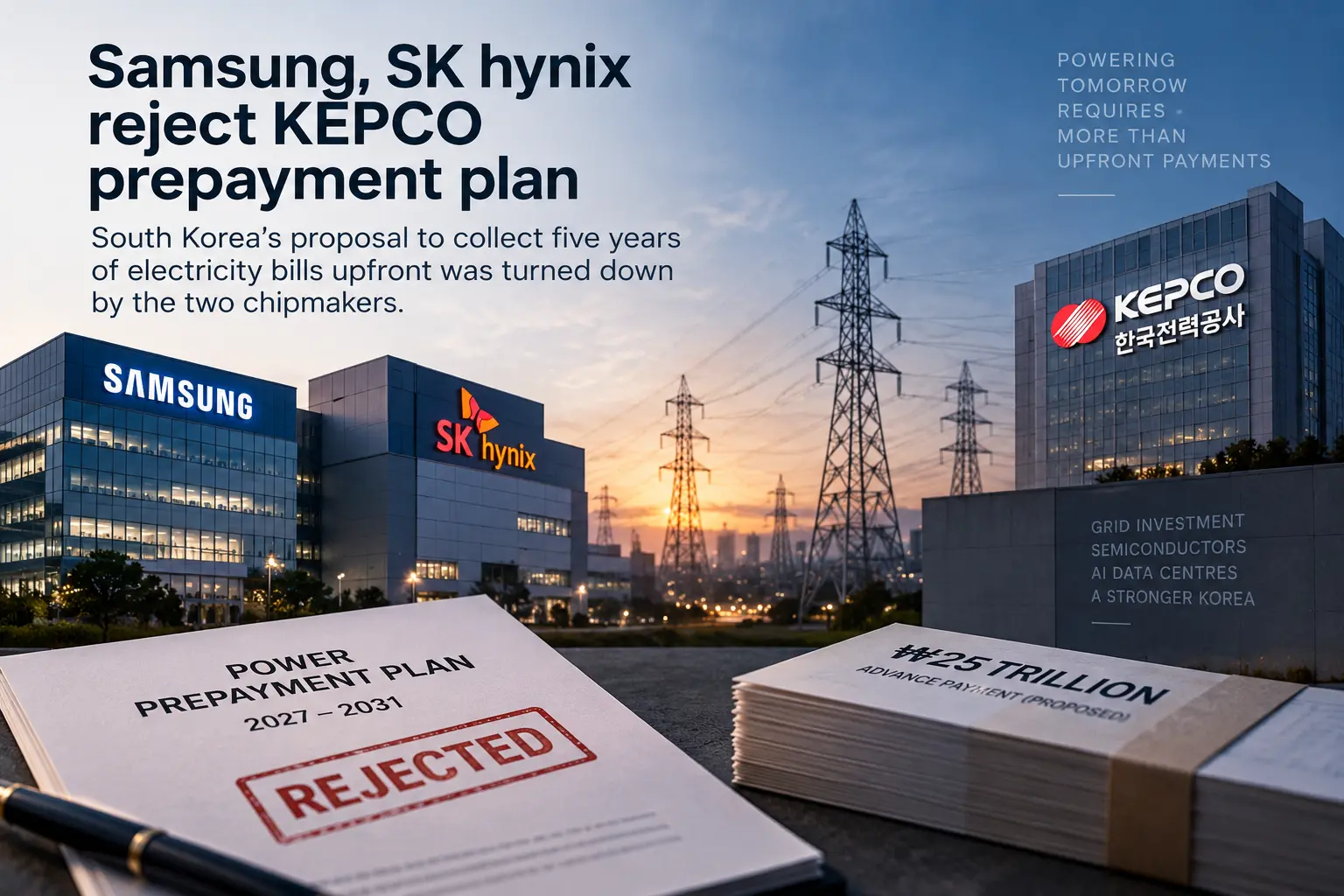
- KEPCO asked Samsung and SK hynix to prepay a combined 25 trillion won for roughly five years of electricity use
- The chipmakers rejected the proposal, leaving KEPCO to reconsider how grid expansion for large new power loads should be financed
The fact
Samsung Electronics and SK hynix have rejected a KEPCO proposal to prepay roughly five years of electricity bills, according to reports on 14 September. The utility had asked Samsung for 20 trillion won and SK hynix for 5 trillion won. Both companies concluded after internal reviews that participation would be difficult.
Earlier reporting said the payments would cover electricity expected to be used from 2027 to 2031. KEPCO was considering collecting the money in instalments over about a year, then deducting monthly bills from the prepaid balance. Interest payments or discounts on later electricity bills were among the compensation options under discussion.
KEPCO has linked the proposal to transmission and substation investment needed for semiconductor production and growing demand from AI data centres. Final terms had not been agreed, and the companies' rejection does not indicate that they have cancelled factory investment or reduced their expected electricity demand.
The assessment
KEPCO's proposal would have brought cash into the grid years before the power was actually used. For Samsung and SK hynix, that means committing money now for electricity they expect to consume between 2027 and 2031. With both companies also spending heavily on factories and production equipment, the timing of that payment matters.
Interest or future bill discounts could offset some of the cost, but the reported terms do not show what the companies would gain operationally. There is no disclosed commitment that paying early would secure an earlier connection or firmer access to power. As it stands, the manufacturers would be helping to fund transmission and substations without a clear improvement in when electricity reaches their sites.
For BTW readers, this matters because large power users may increasingly be asked to contribute earlier to the infrastructure built around their demand. Samsung and SK hynix have rejected this version of the deal. Any revised offer will need to give customers a clearer reason to part with the cash years ahead of normal billing, whether through stronger financial compensation or a concrete commitment on power delivery.
What to watch
Watch for changes to the proposed interest, bill discounts or payment schedule, along with any firm grid-connection commitments attached to a revised offer. KEPCO's next proposal will show whether large industrial customers can be persuaded to help fund new transmission capacity before they begin using the electricity.
Member Briefing
Deeper Profile Context
Sign in with the right membership level to unlock the full briefing and source notes.
Only for Strategic Circle
Strategic Circle
Open to all readers. Unlock profile briefings after joining and signing in.
Join Strategic CircleOnly for Leadership Alliance
Leadership Alliance
For qualified IP-asset owners and management; sign in to unlock alliance briefings.
Join Leadership Alliance