Summary
- The UK government reported on 14 August 2026 that more than 150 government-funded rural 4G mast upgrades were live and that the Shared Rural Network had reached its 95% landmass objective.
- Official methodology distinguishes full coverage from partial not-spots and says programme figures use forecast pixels; a premises uplift means expected outdoor coverage.
- A local service claim should therefore name the user's operator or host network, exact place, indoor or outdoor context, required use and date of evidence.
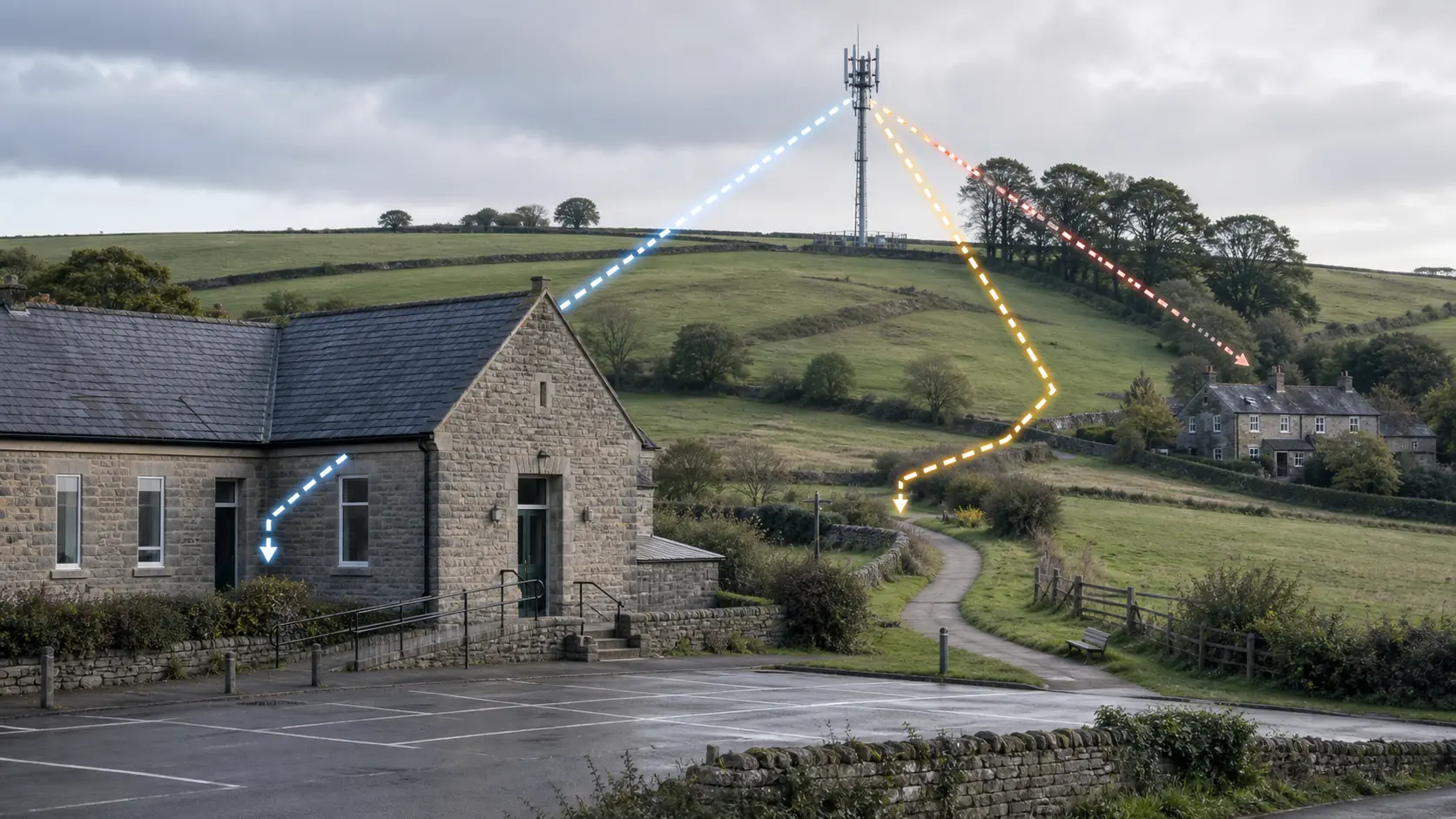
Imagine a parish briefing after a national coverage announcement. A new or upgraded mast appears on a map, the 95% landmass figure is repeated, and the room is told that the mobile problem has been solved. Then a resident asks a narrower question: will my provider work inside the village hall, at the car park where staff close late, or on the footpath where visitors call for help?
The national announcement and the local question are not rivals. They operate at different scales. The UK government can validly report programme progress, while a particular user can still face poor reception on one network or inside one building. The error begins when the first evidence is used as if it had already answered the second question.
One headline contains four different states
The first state is mast live. A site has been activated and is contributing new infrastructure. The government's August 2026 announcement says more than 150 government-funded upgrades are live. That is a concrete delivery fact.
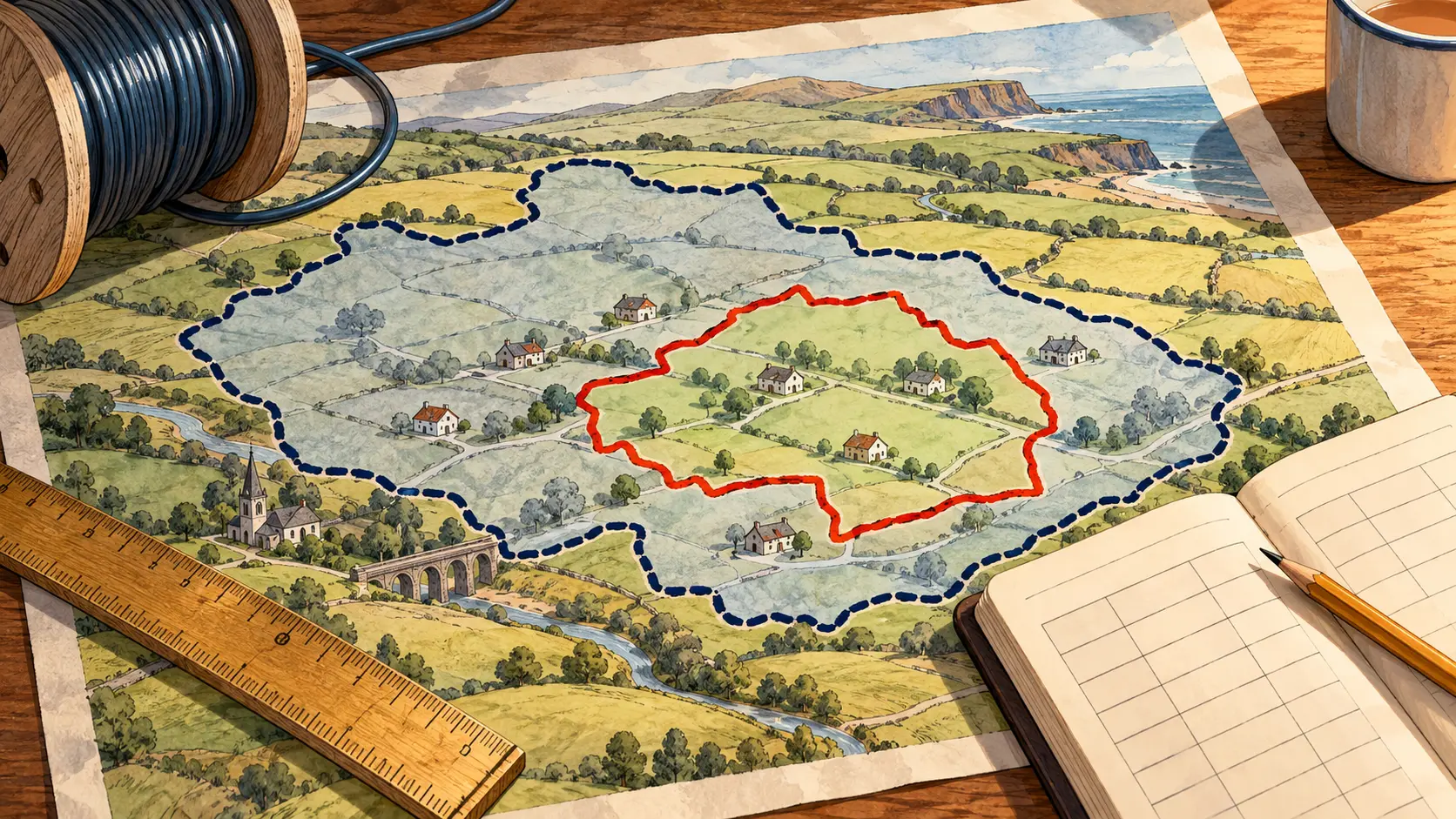
The second state is forecast uplift. Building Digital UK combines operator projections into 100 metre by 100 metre pixels. Its methodology defines premises uplift as expected outdoor coverage and explains that forecasts are used to isolate programme benefit.
The third state is operator availability. Official terminology calls an area fully covered only when all four main operators are available. A partial not-spot has at least one operator but not all. A mast or a coloured area on a combined map therefore does not by itself identify whether the user's network is present.
The fourth state is local service observed. This is the bounded question about the phone, host network, indoor or outdoor position and use case. It can be supported by an operator-specific prediction and a careful local observation. It is never created merely by repeating the national percentage.
These four states should not be compressed into one green tick. A live mast may add coverage without serving every operator at every point. A predicted outdoor uplift does not prove an indoor call. A successful test on one network does not prove another network. A usable signal at midday does not guarantee capacity at a crowded event.
The retail brand must be mapped to its host network
Ofcom's Map Your Mobile checker presents results for EE, O2, Three and Vodafone. It also explains that other UK mobile providers use one of those four networks. This matters locally because a resident may name a retail brand while the radio result belongs to its host network.
The acceptance record should therefore carry both names: the retail provider that the person buys from and the underlying network shown in the coverage evidence. That prevents an apparent fifth-network result and makes comparisons honest.
This is not an invitation to rank operators nationally. The objective is to answer a bounded service question. A rural business may need card payments at a counter, a ranger may need messaging along a route, and a community building may need basic voice indoors. Each place and use creates a different acceptance boundary.
A coverage map is evidence, not a warranty
Ofcom separates outdoor and in-home predictions and warns that experience can differ. It lists mast power and distance, hills, buildings, trees, congestion, weather and the device antenna among the factors that can affect reception. BDUK similarly identifies uncertainty between forecast coverage and lived experience because network load, devices and environmental factors matter.
The right response is not to dismiss the maps. They are the authoritative starting point for comparing main networks. Nor should a council manufacture its own shadow coverage authority. Use the official prediction, record its date and operator, then add only a limited observation at the location relevant to the decision.
A field observation should not be oversold. One handset, one time and one position form a sample. If the use is safety-critical, retain a fallback and follow the competent service's guidance rather than promising universal availability.
Build a bounded local acceptance matrix
| Field | Evidence to retain |
|---|---|
| Place | Address, named venue, route segment or precise observation point |
| User network | Retail provider and underlying host network |
| Context | Indoors, outdoors, vehicle or walking route |
| Required use | Voice, text, basic data or another defined need |
| Programme state | Mast activation or SRN announcement, with date |
| Prediction | Ofcom operator result and retrieval date |
| Observation | Device, time, position and result, clearly labelled as a sample |
| Decision | Not checked, predicted, observed or accepted for the bounded use |
| Review trigger | Operator update, map change, new site activation or material complaint pattern |
The matrix is deliberately small. It does not require continuous drive testing or a parallel radio-planning team. It prevents a programme fact from becoming an unbounded promise.
Keep fact, inference and recommendation apart
The facts are that more than 150 upgrades were reported live, the 95% landmass objective was reported achieved, official methodology uses forecast pixels, full coverage and partial not-spots have different operator meanings, and Ofcom publishes operator-specific indoor and outdoor predictions with stated limitations.
The editorial inference is that these records do not prove every operator-place combination. The matrix is Elias Ward's recommendation, not an Ofcom or BDUK required form.
Heng Lu doctrine can explain why authority, evidence state and responsibility should remain separate. It is not evidence that a mast is live, that an operator is available or that a call succeeded.
The acceptance decision
Use four honest labels. Mast live records infrastructure activation. Operator predicted records current official mapping. Operator observed records a bounded local sample. Use accepted applies only to the named operator, place, context and need supported by the evidence.
The Shared Rural Network headline is valuable national progress. Local credibility comes from refusing to make it say more than it says. A rural 4G mast becomes a defensible local service claim only when the operator and location match.
Sources
- UK Government and Building Digital UK, 150 rural 4G masts now live
- Building Digital UK, Shared Rural Network quality and methodology information
- Ofcom, Map Your Mobile
- UK Government, Update on Shared Rural Network total not-spots project
Member Briefing
Deeper Profile Context
Sign in with the right membership level to unlock the full briefing and source notes.
Only for Strategic Circle
Strategic Circle
Open to all readers. Unlock profile briefings after joining and signing in.
Join Strategic CircleOnly for Leadership Alliance
Leadership Alliance
For qualified IP-asset owners and management; sign in to unlock alliance briefings.
Join Leadership Alliance