
Summary
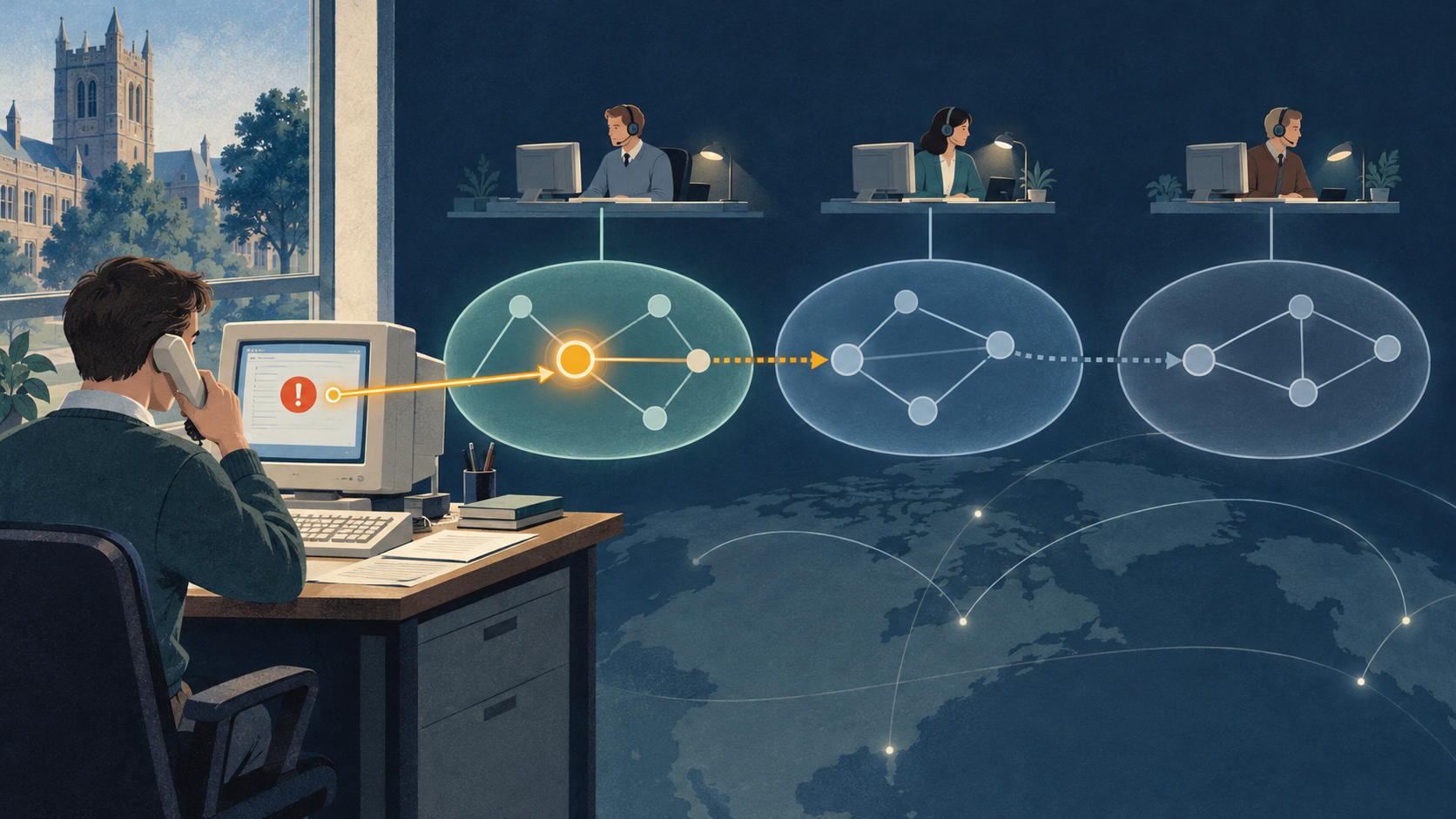
- RFC 1462 used phone carriers to make a federated Internet legible: each constituent network had its own NOC, repaired its own portion and coordinated across boundaries.
- A site’s service contract located it on that network map and gave it a starting point for reporting a fault; the guide describes an explanatory model, not measured support performance.
The user could not see the whole route
The telephone analogy in RFC 1462 starts with an ordinary experience: while a call works, few customers care which carrier carries it. A fault changes the question. One carrier can repair its own portion of the system; the carriers speak to each other when a problem crosses a boundary.
The guide applied that logic to the Internet. Each constituent network had its own network operations center, or NOC. Those centers communicated about problems. The site, meanwhile, had a contract with one of the networks making up the Internet. If service failed, the guide said, that was the network to complain to. If the fault belonged elsewhere, it would pass the issue onward.
That is a small passage with a useful map inside it. The network looked like one service to the person at a campus terminal, but it was assembled from independently operated parts. A user did not need to identify every router or carrier before asking for help. The service relationship supplied the first address; the NOC chain supplied a route beyond it.
The contract placed the site on that map
The contract in RFC 1462 is a practical point of contact, not a published guarantee of response time or a promise that one provider controlled every segment. The guide does not set escalation deadlines, specify who pays for a cross-network repair, or report how often handoffs succeeded.
A contemporary definition helps explain the word. In RFC 1392, the Internet glossary describes a NOC as a place from which a network is monitored and a usual clearinghouse for connectivity problems and efforts to resolve them. That definition fits the support chain: the NOC is where a fault can be observed, classified and routed to the network responsible for its part.
The boundary matters. A site can have one contractual relationship while its packets cross several networks. That does not make the first network responsible for repairing every cable along the way. In RFC 1462’s model, it makes that network the recognizable first contact and a bridge to the next operator when needed.
The guide was part of the service
RFC 1462 was published in May 1993 as FYI 20, an informational document from the IETF User Services Working Group. It was not a standard. The RFC Editor record says it contains a modified chapter from Ed Krol’s 1992 The Whole Internet User’s Guide and Catalog; the RFC itself credits the publisher’s permission.
The choice of form matters. This was an explanation for users, not a network operations manual. RFC 1463, published alongside it, says its deliberately brief bibliography was designed as a handout for user-services personnel and points readers with questions toward their network service provider. User education was part of connecting people to a system whose internal structure they could not see.
Six years later, RFC 2664 answered “Who Runs the Internet?” with “No one,” then described cooperation among independent Internet service providers and other organizations. That later consumer guide offers a related vocabulary for a distributed system. It does not prove that the 1993 handoff practices changed.
What the record can—and cannot—show
RFC 1462 preserves a user-facing model: the site’s provider was the first place to report trouble; NOCs handled their networks and talked across boundaries. It does not measure how many networks used that process, how quickly they answered, or whether every site had the same arrangement. Nor should a 1993 account be mistaken for current ISP or cloud support policy.
The lasting historical point is narrower. The Internet had no single repair desk in this explanation. A customer-facing contract made a many-network service navigable, while operators and their NOCs carried the work across its seams.
Sources
Member Briefing
Deeper Profile Context
Sign in with the right membership level to unlock the full briefing and source notes.
Only for Strategic Circle
Strategic Circle
Open to all readers. Unlock profile briefings after joining and signing in.
Join Strategic CircleOnly for Leadership Alliance
Leadership Alliance
For qualified IP-asset owners and management; sign in to unlock alliance briefings.
Join Leadership Alliance