
Summary
- RedCLARA is a Uruguayan non-profit association that federates national research and education networks; it is neither a shareholder company nor an operator controlling every campus.
- Eight main routed nodes and long-term international capacity form a 100G-class backbone, with declared links of 100, 200 and 300 Gbit/s and a smaller Central American segment.
- ALICE and ALICE2 created the institution and the first network; BELLA secured sustained capacity on the direct Portugal–Brazil route, reducing reliance on indirect paths via North America.
- The test for BELLA II is to transform project funding into sustainable, member-supported infrastructure, while strengthening weak national networks, public evidence and dependency diversity.
BELLA changed the network geography
BELLA-S secured long-term spectrum rights on EllaLink, the approximately 6,000-kilometre submarine cable connecting Sines, Portugal, to Fortaleza, Brazil. The programme initially provisioned two 100 Gbit/s links: one for the GÉANT–RedCLARA interconnection, the other for Copernicus Earth-observation data uses. Research and education traffic began using the direct route in 2021.
The physical change was significant. A direct path can reduce latency for the relevant source–destination pairs, improve diversity and enable larger scientific transfers. Programme documents referred to reductions of up to 50% for certain paths. This figure must remain attributed and specific to the measured path: it does not describe every institution or every application.
The economic change was equally significant. Spectrum rights allow lighting optical channels and increasing throughput by upgrading equipment, within the limits of the optical plan and the contract. They partly decouple capacity growth from repeatedly buying small managed circuits.
BELLA does not correspond to a single budget. The BELLA-S1 action recorded by the European Commission showed a total cost of about 12.44 million euros and a European contribution of 10 million. Other totals cover the terrestrial segments, multiple funding lines, national infrastructures and in-kind contributions. The scope of each figure must be specified rather than adding them together or taking the highest one.
Forty optical channels do not mean owning the cable
BELLA documents describe rights to forty optical channels. This right is substantial: it reserves a defined portion of the system's spectral resource and allows evolution within technical and contractual constraints. It does not mean that RedCLARA or GÉANT own EllaLink as a whole.
EllaLink remains a commercial system with its own shareholders, operators, landing stations and maintenance responsibilities. BELLA partners control capacity and rights useful for research. They still depend on marine repairs, power, station equipment, the spectral plan and the legal continuity of the provider.
This distinction applies to the entire RedCLARA map. The organisation may own some routers, lease racks and electricity, use fibre contributed by an NREN, buy a managed service, hold an IRU or borrow a route from a peer. The map transforms these heterogeneous relationships into a coherent service, not a register of ownership.
RedCLARA's essential asset is therefore partly institutional: its ability to assemble rights, providers, national networks and international partners into a workable architecture. This capacity produces bargaining power and continuity. It also makes contract monitoring, maintenance and partner alignment a component of the technical architecture.
BELLA and the direct South Atlantic route
Before BELLA, much of the research traffic between Europe and Latin America used paths through North America. This detour reflected the economics of available cables and interconnection but added distance, concentrated risk and left the scientific community reliant on routes bought for other markets.
BELLA addressed the problem in two parts. BELLA-S acquired long-term spectrum rights on a direct submarine link. BELLA-T strengthened the South American terrestrial network so that capacity arriving at Fortaleza could reach regional nodes, NRENs and institutions. A landing cable alone does not create continental connectivity; traffic must still be carried over thousands of kilometres on land.
The EllaLink system connects Sines and Fortaleza over about 6,000 kilometres. Production research traffic began in 2021. Two initial 100 Gbit/s links were activated, one for GÉANT–RedCLARA and the other for Copernicus. The direct route offers an alternative to North American paths and can improve latency and transfer times for relevant pairs.
BELLA sources referred to up to 50% latency reduction on certain paths. This claim should not be generalised: the result depends on the origin, destination, national access, routing and remote network. The structural change, however, is clear. The community now has a direct route, scalable capacity and better geographic diversity.
The North American route does not become useless. Miami remains an important gateway and can participate in fallback when a South Atlantic cable or equipment is unavailable. Resilience comes from combining paths, not from replacing one dependency with another. BELLA is therefore both a performance project and a strategic diversification decision.
Spectrum rights, terrestrial reach and the ownership boundary
BELLA's forty optical channels give RedCLARA and GÉANT a durable right to a portion of the EllaLink system's spectrum. They can be activated and upgraded as coherent technology and demand evolve. This type of right is more flexible than a managed circuit of fixed capacity, because the terminal equipment can evolve without renegotiating every bit with a provider.
But the right does not equal full ownership. EllaLink remains a shared commercial system. Landing stations, buildings, power, marine repairs, the spectrum plan, optical equipment and terrestrial extensions involve multiple organisations. RedCLARA coordinates and operates strategic capacity without owning the entire physical chain.
BELLA-T shows why the terrestrial part is as important as the submarine section. After Fortaleza, traffic must reach São Paulo, Porto Alegre, Buenos Aires, Santiago, Manta and other handover points. Fibres may belong to NRENs, be leased from operators, contributed in kind or protected by separate arrangements. A regional map adds up these rights without becoming a title register.
This architecture offers collective power, but it multiplies dependencies. A cable cut, station failure, contractual disagreement or obsolete equipment can affect the value of the spectrum right. Long-term contracts must therefore include maintenance, evolution, continuity and exit, not just nominal capacity.
Programme figures must respect the same boundaries. The cost of the BELLA-S1 action, European contributions, terrestrial inputs and asset valuations are not RedCLARA's annual accounts. A high figure may represent infrastructure across several countries and years, not cash available to the organisation. Understanding ownership also means understanding who bears the expenses and risks at each layer.
A continental network that is not a single network
RedCLARA is easiest to misunderstand when it is described simply as “the Latin American research network”. The phrase suggests a single operator controlling the entire chain from the international backbone to a university's wall socket. The real architecture is federated. A researcher normally reaches RedCLARA through their institution's network, then through a national research and education network, or NREN. RedCLARA provides the regional and intercontinental layer through which these separately governed systems can operate in a larger scientific environment.
This distinction determines both the value and the limits of the organisation. RNP in Brazil, REUNA in Chile, RENATA in Colombia, CEDIA in Ecuador, CUDI in Mexico, RedCONARE in Costa Rica and RAU in Uruguay retain their national governance, domestic infrastructure, institutional relationships and their own operational responsibilities. RedCLARA does not replace them. It interconnects them, represents their common needs, coordinates capacity and services, and opens a pathway to peer networks such as GÉANT, Internet2 and CANARIE.
An end-to-end path may thus cross a campus network, an institutional firewall, national access, an NREN backbone, RedCLARA, an international peer, the destination NREN and finally a remote scientific facility. A 100 Gbit/s regional link does not compensate for a saturated campus access, a slow national link, misconfigured storage or a restrictive policy at the endpoint. Conversely, a national network cannot negotiate every intercontinental route, identity relationship and collaborative service that modern science requires on its own.
The useful description is therefore that of a shared coordination and infrastructure layer. The word “shared” refers to governance, engineering, long-term capacity rights and common services, not to ownership of every fibre, router, point of presence or cable segment shown on a map. This caveat is not semantic: it explains how the organisation transforms multiple national systems and commercial contracts into a regional network of public interest.
Why Latin America needed a regional layer
The initial problem was fragmentation. In the early 2000s, several Latin American countries had national or nascent academic networks, but no lasting continental organisation capable of aggregating demand, operating a regional backbone or negotiating as an equal with European and North American networks. International circuits were costly, national telecom markets varied widely and commercial routes were designed around operator imperatives rather than distributed science.
This geography imposed concrete penalties. A university might enjoy good domestic connectivity while relying on expensive and indirect international transit to collaborate with an institution in a neighbouring country. Traffic between Europe and Latin America could pass through North America because the commercial structure of cables and interconnection made that route easier to buy. The result was not only increased latency: bargaining power remained low, route diversity limited and service priorities set outside the scientific community.
A single, centralised continental operator would not have been a realistic solution. The region had strong differences in NREN maturity, public funding, regulation, fibre availability, university systems and international landing points. National organisations needed to retain their legal and operational autonomy. The viable model was therefore federal: domestic networks would keep their national role, while a regional association coordinated the common layer and engaged with global peers.
This design also brought institutional value. An isolated NREN struggles to influence an international scientific programme or justify a specialised route. A regional organisation can aggregate use cases, pool contributions, combine grants and national assets, and present a coherent counterpart to the European Commission, GÉANT, development banks, operators and cable owners. RedCLARA was created to turn this collective need into an institution and an operational network.
Toledo, Valle de Bravo and the legal association
The institutional idea took shape in 2002. Representatives of Latin American NRENs studied the feasibility of a regional network at a CAESAR meeting in Toledo, Spain, and continued the work in Rio de Janeiro, Buenos Aires, Santiago and Mexico. It was not only a matter of solving topology: entities had to be defined, the relationship between the regional level and national networks set out, the decision-making process agreed, and a plan for turning an externally funded project into a sustainable organisation devised.
The legal timeline includes three dates that should be kept. The official history says the statutes were signed at Valle de Bravo, Mexico, on 9 June 2003. A civil society registry of the Organization of American States records 10 June 2003 as the date of establishment. RedCLARA also states that its legal existence was recognised under Uruguayan law on 23 December 2003. The sources allow these dates to be understood as related but distinct steps: constitutive agreement, administrative registration and legal recognition in Uruguay.
The best description is that of an international non-profit civil association recognised under Uruguayan law and established in Montevideo. RedCLARA sometimes uses the English phrase “international law organisation”, but the available statutes and documents do not demonstrate creation by treaty or the personality of an intergovernmental organisation. It is a membership association pursuing regional objectives, not a supranational regulator or public agency.
The current statutes were approved in November 2019 and published in January 2020. They place the General Assembly at the top, vest direction in a Board of Directors, oversight in a Fiscal Commission, technical coordination in a Technical Commission and execution in an Executive Directorate. This architecture is important: the network's legitimacy rests on association and cooperation, not on share ownership or territorial authority.
Seven members, eleven connected countries and a broader mission
The current public directory lists seven NREN members: RNP, RENATA, RedCONARE, REUNA, CEDIA, CUDI and RAU. The advanced connectivity page, however, indicates that the network serves eleven countries: Argentina, Brazil, Chile, Colombia, Costa Rica, Ecuador, El Salvador, Guatemala, Mexico, Paraguay and Uruguay. Older documents refer to thirteen countries. These figures are not interchangeable.
Legal membership determines governance rights, obligations and participation in the association. Operational connectivity can exist through a partner, a transitional arrangement or a project without the relevant national network being a full voting member. Historical figures may reflect former memberships or the footprint of earlier programmes. The accurate narrative therefore distinguishes seven current legal NREN members from eleven currently connected countries and treats older totals as dated data.
This difference creates strategic tension. RedCLARA seeks to serve a region larger than the association that formally governs it. A country may benefit from connectivity or a BELLA II programme without having an equivalent seat in the General Assembly. Conversely, the seven members bear a disproportionate share of governance, technical work and, potentially, recurring funding. This gap does not prove institutional failure, but it affects legitimacy, cost-sharing and the ability to build a genuinely regional platform.
The Board of Directors for the 2025–2027 term reflects the active legal base. José Palacios of REUNA is president; Eduardo Grizendi of RNP is vice-president; Juan Pablo Carvallo of CEDIA is treasurer; Carlos Gamboa of RedCONARE is secretary; and Eduardo Grampín of RAU is director. Luis Eliécer Cadenas is executive director. The national networks thus hold formal control, but public sources do not provide recent General Assembly minutes, voting weights, current membership fee levels, or a full description of how connected non-member countries participate in major decisions.
ALICE provided the start-up capital for the regional network
Political cooperation was not enough: funding, joint procurement, equipment and a credible link to Europe were needed. The European Commission's ALICE project provided that mechanism. Run from June 2003 to March 2008, it had a contract of 12.5 million euros, of which 10 million came from the Commission and 2.5 million from Latin American partners.
DANTE coordinated the European side and the interconnection with GÉANT, while RedCLARA and the national entities built the Latin American side. The project funded capacity, set up a common procurement procedure, linked the region's networks to each other and to Europe, and gave the new association a production environment to operate.
The institutional legacy proved more durable than the first circuits. ALICE demonstrated, with real traffic, that a regional network was not merely a conference ambition. NRENs learned to coordinate their operations and services. Europe and Latin America gained a recurring relationship rather than a series of temporary bilateral links.
The project also revealed the limits of the initial model. Managed international circuits were expensive, recurring costs high and participation uneven. Commercial routes followed the general economics of the Internet rather than the geography of scientific collaboration. ALICE must therefore be understood as the start-up capital of a public-interest infrastructure, not its final solution.
ALICE2 transferred coordination to Latin America
ALICE2 began in December 2008 under an 18-million-euro European contract. Its significance lay not only in renewed resources: RedCLARA became the coordinator, moving a scheme initially managed from Europe to a Latin American institution responsible for the regional programme.
The objectives translated the lessons of ALICE: reduce costs through dark fibre, wavelengths and irrevocable rights of use; expand coverage; strengthen NREN management; stabilise funding; train teams; and develop communities capable of converting bandwidth into scientific results. Some sources place the end of activities in 2012, others the administrative closure in January 2013. The timeline should retain this nuance.
The shift to long-term rights was an economic change. A short-duration managed circuit leaves the provider in control of capacity, renewal pricing and upgrade timing. An IRU or wavelength gives more control over the asset horizon, without transferring ownership of the underlying fibre.
ALICE2 also broadened RedCLARA's role. Grid projects connected Latin American computing resources to international collaborations. Identity and middleware work built the trust mechanisms needed for cross-border service access. Training and communities addressed a simple reality: a fast backbone remains underused if national networks lack staff, governance or uses.
From recurring circuits to long-term capacity rights
RedCLARA's technical history is also a history of transforming contractual risk. Early links depended largely on commercial circuits bought for limited periods. That model enables a quick start, but it exposes the user to renewals, price rises, the provider's architectural choices and the difficulty of increasing throughput without renegotiating.
The later strategy sought IRUs, wavelengths, optical channels, spectrum rights, capacity exchanges and co-investments. These instruments are not identical. They distribute ownership, operation, maintenance and upgrade risk differently. Their common feature is that they lengthen the horizon beyond a simple monthly bandwidth bill.
This evolution allowed RedCLARA to align capacity more closely with the research lifecycle. An observatory, a data infrastructure or a scientific collaboration may last decades. A route whose existence depends on a short-term market is a fragile foundation. Long-term rights allow amortising optical equipment, planning upgrades and making costs more predictable.
They do not eliminate dependency. Landing stations, coherent equipment, power, marine repairs, suppliers and contracts are still needed. The gain is not absolute independence, but greater decision-making power over service evolution.
Before BELLA, Europe often went first through North America
Traffic geography is not always that of the map. Before BELLA's direct route, some Europe–Latin America exchanges followed North American infrastructure and interconnection markets. This detour could be rational for commercial operators that already had capacity, but less suited to scientific flows between the two shores of the South Atlantic.
The indirect path added distance and concentrated dependency on hubs designed for other markets. It could increase latency, limit diversity and complicate large data transfers. It also made Euro–Latin American collaboration dependent on contracts and priorities located outside the scientific relationship itself.
RedCLARA and GÉANT therefore sought not only more bandwidth, but a different route and rights capable of lasting. The problem was technical, economic and institutional: find a direct cable, fund a useful share of its spectrum, connect the landing point to the rest of the continent, and allocate obligations among public partners, national networks and commercial providers.
BELLA provided an operational answer to that question. Its importance lies not in the abstract idea of a Europe–Latin America link, but in having converted a geographic ambition into production capacity and long-term optical rights.
The current topology: eight nodes and several forms of capacity
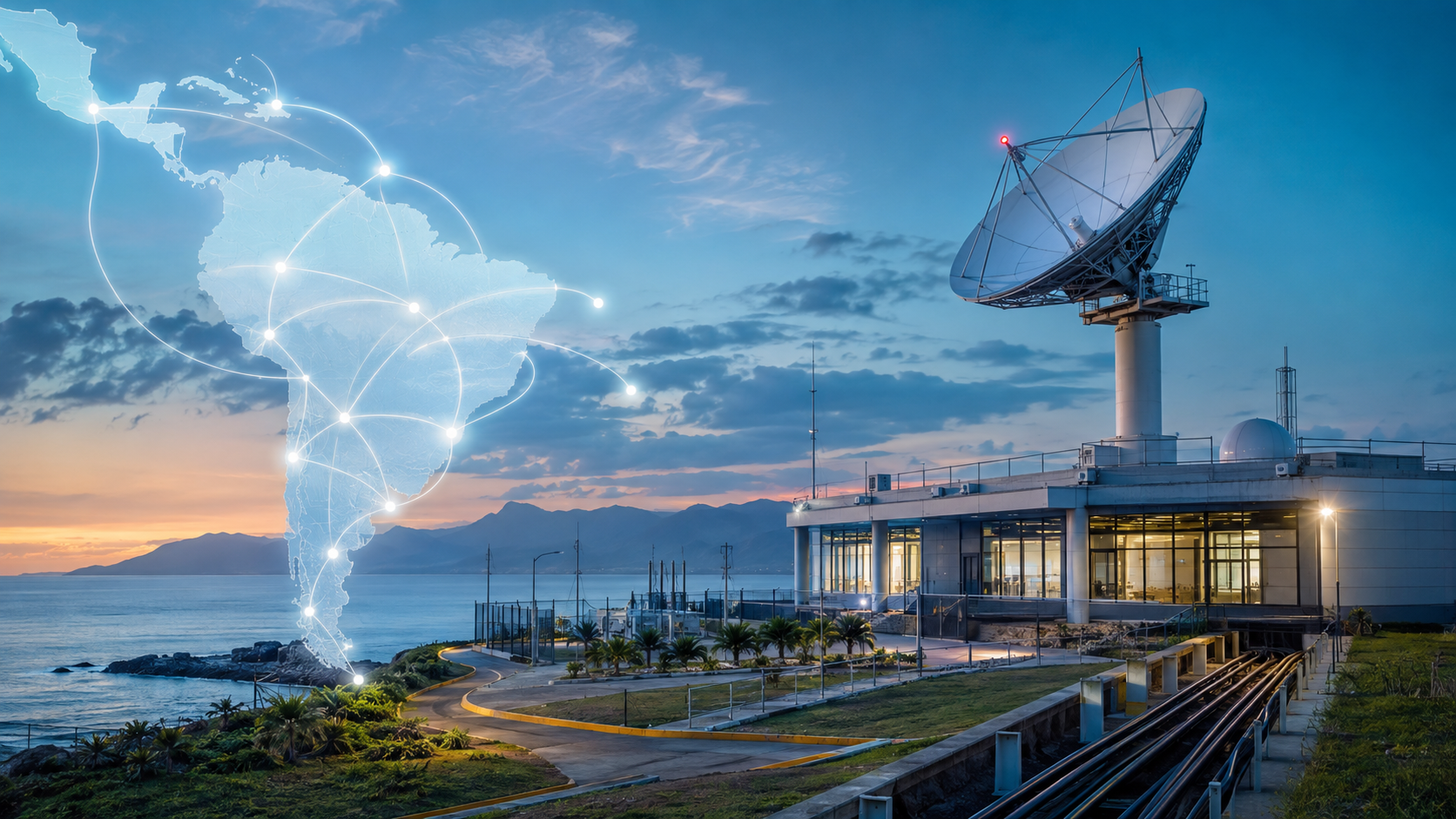
RedCLARA's current technical description names eight main routed nodes: Buenos Aires, Fortaleza, Porto Alegre, São Paulo, Santiago, Manta, Panama City and Miami. The map bundles several functions. South American national networks join a regional ring; Panama City aggregates and extends Central American reach; Miami serves as one of the main handover points to Internet2, CANARIE and other North American relationships; Fortaleza is the major Atlantic node for the direct path to GÉANT and global research partners.
The main South American network is officially described as operating at 100 Gbit/s or more. Another active page mentions links of 100, 200 and 300 Gbit/s. The shared Central American infrastructure is indicated at 20 Gbit/s. These figures do not answer a single question: a backbone class, an aggregated or protected link, a regional subnetwork and an optical channel can have different capacities at the same time.
The safest formulation is therefore that of a regional 100G-class network, with certain links described at 200 or 300 Gbit/s, while Central American capacity remains lower. An older reference to a 10 Gbit/s backbone remains on the site, but it contradicts the current topology and looks like documentary debt left after upgrades. It should not be used to diminish the current network, just as the highest figure should not be applied to every path.
Capacity also changes meaning depending on the layer. An optical system can accommodate several 100G wavelengths. An interface may be protected by two links. A service may be capped below the port capacity. An NREN may receive less than the regional core, and an institution's access may remain the true bottleneck. Public data become comparable only when their scope is explicitly stated.
The same caution applies to distance. The Portugal–Brazil submarine segment measures about 6,000 kilometres, while the 2024 report describes a BELLA infrastructure of 35,830 kilometres. The second figure includes terrestrial and international components beyond the single cable. Both can be correct, but neither should be presented without explaining what is being measured.
Finally, a logical map does not prove physical diversity. Two paths may share a sheath, a landing station, an operator building or a power feed. The ring shape suggests routing alternatives, but resilience depends on contracts and civil works invisible on a public map. RedCLARA coordinates some of these hidden layers, but external readers still lack a route-by-route inventory of assets and diversity.
AS27750, peering and the separation of traffic classes
AS27750 is RedCLARA's public autonomous system identity. Through it, the organisation transports or exchanges routes for member networks, global research and education peers, service infrastructure and some commercial connections. The routing layer supports IPv4, IPv6, multicast, direct peering and protected regional paths. It is the mechanism that makes the federation visible in the global routing system.
Public databases show relationships with GÉANT, Internet2, CANARIE, ESnet, RNP, REUNA, RENATA, RedCONARE, CEDIA and TENET. PeeringDB describes a selective policy and presences in large interconnection environments. These data are operational snapshots, not a complete contractual map. They may show a route exchange without revealing commercial terms, capacity commitments, protection or the physical circuit provider.
Peering can shorten paths, reduce latency and limit transit costs, but it creates operational work. Prefix filters must remain accurate, maximum-prefix thresholds must evolve without letting a route leak saturate a session, IRR and RPKI data must be maintained, and asymmetric paths complicate diagnosis. A direct BGP session is therefore a continuous engineering relationship, not simply a cable plugged into an exchange point.
RedCLARA also distinguishes research and education traffic from commercial Internet traffic. This separation allows academic destinations to be reached via specialised routes while commodity traffic takes other peers or transit providers. NRENs can thus aggregate commercial Internet demand without losing the policy and performance characteristics of the research network.
The separation is logical and operational, not absolute physical isolation. The same router, fibre, rack, cable or building may support multiple classes. RedCLARA is interconnected with the commercial Internet and offers commercial services; it does not live in a closed technical universe. Its differentiation relies on eligibility, routing policy, dedicated capacity, community trust and service design.
This matters for sovereignty claims. A dedicated research route can reduce reliance on the public network for certain workloads, but it does not eliminate fibre owners, colocations, equipment vendors or cable operators. Mission alignment changes who coordinates the route and why; it does not remove the physical supply chain.
Layer-2 circuits, operations and the limits of regional responsibility
RedCLARA's portfolio includes dedicated layer-2 virtual circuits. A VLAN can make laboratories, data centres or instruments located in several countries operate as if they shared the same Ethernet environment. This can serve to move scientific data, extend a private cloud, connect an observatory to computing resources or support a temporary experiment that must not depend on an ordinary routed Internet path.
Layer-2 scope also extends the failure domain. Broadcast storms, spanning-tree interactions, unknown-unicast flooding, MTU mismatches, limited public evidence segmentation or a VLAN ID error can cross multiple networks. RedCLARA provides the regional segment, but NRENs and institutions must coordinate their portions, equipment, security policies and boundaries of responsibility.
The same principle applies to performance. An institution may order a fast regional circuit and remain limited by its local equipment, a firewall or a national interface. An incident may be on the campus, at the NREN, in the RedCLARA backbone, at an international peer or at the destination. The existence of a common service does not abolish the plurality of administrative domains.
RedCLARA organises this layer through three technical groups. The Network Engineering Group plans architecture and capacity. The Network Operations Centre monitors the network and coordinates incidents. The Service Engineering Group runs value-added services. This division links long-term planning, day-to-day operations and application platforms.
Public information is, however, richer on organisation than on operational results. There is no complete public database of incidents, mean time to repair, route leaks or per-service SLA methods. The old figure of 100% monthly availability does not indicate measurement points, planned maintenance or scope. A mature federation would gain from publishing shared telemetry and common definitions that allow locating failures and assessing end-to-end performance.
The limit of responsibility is therefore not an accidental flaw; it follows from federation. RedCLARA must make interfaces clear, maintain escalation paths and coordinate actors, without claiming to control every piece of equipment. Service quality depends as much on handoff rules, contacts and shared telemetry as on the speed of the regional core.
BELLA II: an expansion through co-investment, not an already completed map
BELLA II was concluded in December 2022 for forty-eight months. The European Commission committed 13 million euros to a 28-million-euro programme, with RedCLARA being required to raise at least 15 million more from governments, development institutions, enterprises, banks and other partners. The association provides execution and coordination.
Objectives include connecting or strengthening Peru, Costa Rica, El Salvador, Guatemala and Honduras, with possible extensions to Mexico, the Caribbean, Paraguay, Uruguay, Bolivia and Belize. The competitive dialogue launched in 2025 sought a fibre system of at least fifteen years, with an initial minimum of 20 Gbit/s in Central America and 100 Gbit/s in Peru, designed to evolve.
These elements are requirements and objectives, not proof that all routes were in service by 3 August 2026. Memorandums, strategic dialogues and participation announcements demonstrate institutional preparation. They do not demonstrate technical delivery, active traffic or definitively closed financing. The narrative must retain the future tense when evidence remains prospective.
The competitive dialogue procedure acknowledges that a uniform solution will not suit the entire region. One country may use an IRU, another a capacity exchange, co-construction or a managed service. Providers and investors are invited to contribute to architecture, financing, maintenance and the operating model. This flexibility can improve outcomes, but it complicates comparisons of cost, timeline and responsibility.
BELLA II will therefore not be judged solely on fibre announcements. The decisive evidence will be commissioned routes, protected capacity, functional NRENs, sustainable operating agreements and institutions able to use the service. The expansion is as much a construction programme as an institution-building effort.
From a transport network to a regional research platform
RedCLARA's first generation demonstrated that national research networks could exchange traffic via a regional backbone. The organisation then sought to answer a more demanding question: what common capabilities become possible once that backbone is in place? Its portfolio now includes identity, file transfer, collaborative environments, training, access to high-performance computing, open science, cybersecurity coordination and thematic communities.
This evolution is not an abandonment of the network. It aims to increase its value. A high-capacity route has little effect if researchers cannot authenticate to a service, find a computing resource, move a large dataset, identify partners or obtain support for a cross-border workflow. The application and community layers turn raw capacity into usable research infrastructure.
BELLA II formalises this platform logic through innovation hubs, testbeds, open calls, training, strategic dialogues and matchmaking mechanisms with partners or funders. The 2024 agrifood Ideathon, which brought together 125 experts from 28 countries, showed how RedCLARA could organise a regional problem-solving process. Early HPC testbeds created a passage from training and prototyping to use of shared resources.
A testbed is not a production service. It typically brings together a selected cohort, bounded capacity, expert support and an experimental objective. It can reveal technical and organisational obstacles before a permanent investment. It can also create misleading expectations if a successful demonstration is presented as universal availability or commercial maturity.
The opportunity for RedCLARA is to become a federation of services and testbeds rather than a network limited to transport. The regional layer would thus gain relevance for researchers who never think about BGP or optical channels. It would also increase operational complexity: identity, storage, compute, notebooks, collaborative tools and sensitive data introduce security, privacy, support and lifecycle obligations.
The organisation is therefore moving up the stack without owning every component. National networks, SCALAC members, universities, cloud providers and project partners continue to operate the underlying resources. RedCLARA's role often consists of integrating, selecting, coordinating and providing a regional access path. The platform is federated for the same reason as the network: the region's capabilities are distributed and no single institution can efficiently replicate them all.
BIO+IA and the discipline of evidence for early adopters
The BIO+IA Early Adopters programme clearly illustrates RedCLARA's new platform role. Opened in 2026 as part of BELLA II, it selected five projects from six countries to offer training, expert support and access to an AI and bioinformatics environment. The work covered breast cancer biology, molecular screening, antimicrobial or mercury resistance, drug repositioning for liver diseases and translational biomedicine.
At the Demo Day in July 2026, participating teams explained how the environment helped them search, integrate and interpret biological information. This constitutes evidence of a facilitated research workflow. It shows that a regional programme can combine network access, specialised tools and expert support to help distributed teams work on data-intensive biomedical problems.
These elements do not demonstrate clinical efficacy. A model that spots a candidate molecule does not prove that a treatment works. A faster bioinformatics pipeline has not completed laboratory validation, regulatory review or deployment in a health system. The programme involved a limited group and results were reported by entities and organisers, not by an independent clinical trial.
These caveats do not diminish the programme; they define the right unit of success. RedCLARA showed that its infrastructure could support structured regional experimentation at the intersection of AI, biology and advanced networks. It lowered some barriers to accessing tools, data and expertise for selected teams, created relationships between researchers from several countries, and produced evidence that certain workflows could function in a shared environment.
The next test is continuity. A demonstration becomes infrastructure when teams can return to it, new cohorts can enter, data governance is clear, compute and storage are funded, and successful workflows can migrate to national or institutional systems. Usage, scientific outputs, independent evaluation and post-pilot funding will tell whether BIO+IA becomes a recurrent service model or remains a useful but time-limited programme.
The general lesson is that RedCLARA must measure innovation programmes by the distance between participation and sustainable capacity. Ideathons count entities; testbeds count experiments. Infrastructure must also count maintained environments, repeat users, governed data, trained operators and projects that continue after the grant or event ends.
Identity as infrastructure: FIEL, eduGAIN and eduroam
A network path may work perfectly while a researcher cannot access a repository, a supercomputer or a remote laboratory because the service does not recognise their identity. Authentication, attributes and trust metadata are therefore part of access infrastructure.
FIEL supports the development of national identity federations. eduGAIN links these federations into an international interfederation. In a typical flow, the user is redirected to their home institution to authenticate; a signed assertion and some attributes are then transmitted to the remote service. RedCLARA coordinates the federation layer without creating a continental database that centralises all passwords.
eduroam applies the same principle to Wi-Fi roaming. The visited institution provides local access, while the home institution validates the user through a RADIUS hierarchy. Security depends on terminal configuration, home authentication, metadata and the integrity of each national and regional layer.
Federation distributes power and risk. It allows institutions to retain their identity authority, but a compromised provider, a stolen signing key or a mis-managed attribute can affect services beyond one campus. Assurance levels, privacy rules and incident response differ across countries. RedCLARA makes cross-border trust possible while helping national federations mature.
Identity is therefore critical infrastructure on a par with routing. A supercomputer unreachable because of a wrong attribute is as unavailable as a cut link. Success is measured by the reliability of the trust chain, not only by the number of organisations appearing in a federation.
MiLab, eNVIO and the collaborative research layer
MiLab is one of the most concrete examples of RedCLARA above the network. It combines a data repository based on Dataverse, a GitLab environment for code and projects, Mattermost for communication, and a JupyterHub-type computing environment with Python and R. Federated identity can bind these components for distributed teams.
The architecture covers a practical research cycle: organise the team, communicate, develop code, run notebooks, curate data and publish datasets. For institutions that lack an equivalent local platform, it lowers the barrier to reproducible collaboration and shows that regional value can come from software as much as from bandwidth.
MiLab is not a universal production cloud or a substitute for HPC centres. A notebook environment does not provide unlimited computing, certification for all sensitive data, permanent legal preservation or every specialised tool. Storage, availability, privacy, project administration and maintenance require ongoing governance and funding.
eNVIO addresses a more targeted need: large-file transfer over academic infrastructure rather than over consumer services. It can suit datasets too large for email or ad hoc tools, but it should not be mistaken for a permanent high-throughput instrument pipeline or a long-term archive.
These platforms add a data responsibility. Research datasets may contain personal, biomedical, commercial or embargoed information. Access control, encryption, preservation, cross-border transfers and incident response are not solved solely by a federated login. As RedCLARA operates more shared services, this governance framework becomes as important as the software stack.
Ventanilla Abierta and navigating a fragmented ecosystem
Regional e-infrastructures are scattered among NRENs, computing centres, identity federations, repositories, global partners and project-bound services. A researcher may know their scientific need without knowing which organisation controls the storage, HPC allocation, international link or expertise required. Ventanilla Abierta functions as an orientation layer towards these resources.
The service can direct a request towards connectivity, SCALAC, a data repository, an identity federation, an international partner or a funding pathway. Its value is discoverability. It turns a landscape of independent resources into a more navigable system, without claiming to own or guarantee every recommended service.
Funds and Partners applies the same logic to calls, prizes, consortia and collaborators. A network route brings institutions closer, but a project still needs legitimate partners, funding and a governance structure. RedCLARA uses its regional position to make these opportunities more visible and to facilitate the formation of cross-border groups.
This function appears modest compared to a submarine cable, but unknown or inaccessible infrastructure is functionally absent. The difficulty may lie at the interface: no one knows whom to contact, what conditions apply or how to get an account. RedCLARA reduces these frictions, while remaining dependent on the rules, timetables and capacities of the bodies to which it directs users.
To become a sustainable provision, Ventanilla Abierta must make its handoffs explicit. Users must know whether RedCLARA directly provides the service, acts as a trusted broker or merely points to an external resource. This clarity avoids turning useful coordination into an implicit promise that cannot be kept.
LA Referencia, SCALAC and the common knowledge and computing chain
LA Referencia shows that open science depends on repositories and metadata as much as on routes. Outputs are deposited in institutional or national infrastructures, aggregated at the regional level and then made discoverable in wider systems. RedCLARA provides connectivity, coordination and international partnerships, notably with OpenAIRE, but LA Referencia retains its own governance.
A fast path cannot fix a poorly described dataset. Persistent identifiers, metadata quality, licences, deposit policies and preservation determine reuse. The network layer transports entities; the repository ecosystem gives them context, stability and visibility. Cooperation between distinct organisations is therefore more important than centralised ownership.
SCALAC applies comparable logic to high-performance computing. The region does not own a single supercomputer belonging to RedCLARA. It has governed facilities in different countries, with separate schedulers, software, queues, storage and allocation rules. SCALAC coordinates the advanced computing community, while RedCLARA brings connectivity, programmes and testbeds.
An HPC federation can serve prototyping, benchmarking, training and workflow development. It offers an option for countries that cannot fund all machine categories. But it requires authentication, data staging, software environments, support, privacy policies and cost recovery. A common network removes one obstacle without automatically turning several centres into a homogeneous machine.
The strategic value is optionality. A team can learn on a regional resource before applying for a larger allocation; a centre can share unused capacity; specialists can harmonise practices. The risk is that access remains episodic and dependent on a project or personal relationships, instead of becoming a predictable service with published eligibility rules, capacity and support.
Health, Earth observation and communities that give purpose to the network
RUTE-ALC brings together academic communities of telemedicine and digital health. It links specialists, educators and institutions facing similar difficulties in different national systems. Possible uses include specialist consultation, medical education, image exchange, standards, emergency collaboration and digital health governance.
The network can offer reliable paths, identity and collaborative tools. It does not thereby become a healthcare provider. Clinical privacy, device regulation, professional liability and consent remain the responsibility of the relevant institutions and authorities. A high-capacity link is a possible condition for telemedicine, not a complete clinical service.
Copernicus Academy LAC creates another sectoral bridge. European Earth observation data can serve agriculture, disasters, climate adaptation, the marine environment, water, forests, cities and energy. RedCLARA helps move data and organise training, hackathons and innovation communities. The limit is often local analytical capacity rather than access to the raw image.
TICAL plays a complementary role by bringing together technology leaders from higher education. The 2024 edition in Rio gathered more than 200 entities according to the annual report. A conference is not physical infrastructure, but it can align cloud, security, identity, network and service choices among organisations that will then have to interoperate.
These communities explain why a research network is not just a cut-price operator. It maintains recurring relationships among people who manage comparable institutions. The trust built through committees, events and working groups can accelerate incident response or project creation, something a bandwidth contract does not provide.
Discipline remains necessary: participation does not prove implementation, a workshop does not create national capacity, and a connection does not demonstrate either a medical outcome or successful climate adaptation. RedCLARA's contribution is to enable and coordinate the conditions for action, not to claim all results.
EduLACSeg and the regional security trust network
Cyber coordination is a natural extension of a federated network, because universities in several countries may suffer the same campaigns. eduLACSeg provides a trusted framework for sharing indicators, context and response experience. The gain appears when a threat observed once can be reported to several networks before each discovers it separately.
A July 2026 case describes intelligence coming from CERN and distributed via RedCLARA to RNP, REUNA, RENATA, RedCONARE, RAU, CUDI and CEDIA. This is concrete evidence of security information transport between seven NRENs. RedCLARA calls eduLACSeg the region's largest academic cybersecurity ecosystem; lacking an independent comparison and a standardised category, this superlative must remain attributed.
Threat sharing is neither automatically accurate nor automatically safe. Indicators may be outdated or context-dependent; attribution remains uncertain; privacy rules differ; CSIRT maturity is uneven. A regional alert proves distribution, not uniform response by every institution.
The 2024 report mentions training with LAC4 for 85 entities from nearly 60 organisations in 18 countries, including 30% women, as well as a Security Baseline Bootcamp with RNP and GÉANT during TICAL2024. These figures show a capacity-building effort, but do not prove that all entities implemented the same controls.
RedCLARA's technical groups must also secure their own systems: routing sessions, identity metadata, collaborative platforms and testbeds present different surfaces. Public information does not provide a complete, current policy on RPKI validation, ROA coverage, IRR filters, MANRS or route-leak response. The next step should transform trust into measurable results: faster detection, coordinated exercises, shared baselines and post-incident learning.
SUBMERSE and the network as a scientific instrument
SUBMERSE extends RedCLARA's role beyond carrying data. The project studied how an operational telecom fibre can become a sensor. Distributed acoustic sensing measures variations in optical backscatter; the state of polarisation provides other signals. These observations can help detect earthquakes, waves, ships and environmental phenomena.
The concept changes the economic value of a cable. A submarine system is normally justified by traffic capacity and resilience. Sensing can add scientific output without building a dedicated sensor over the entire route. The same infrastructure carries data and generates data about the physical environment it crosses.
RedCLARA is relevant through its connection to BELLA and the Latin American end of the direct route to Europe. It can bring regional infrastructure and users closer to a European consortium and facilitate access to the cable. It did not develop all the algorithms, operate all the sites or own all of EllaLink. The project had 24 partners and its results are collaborative.
The main phase reached a final event in February 2026. SUBMERSE must therefore not be presented as an indefinitely open programme. Results and follow-up ambitions remain relevant, but the closure of the funded phase is part of the story.
Sensing raises operational questions: an optical experiment must not degrade traffic; volumes are high; access to stations and fibres requires owners' agreement; signals may have security or commercial sensitivity; and science requires calibration, data governance and sustainable analytical capacity. For RedCLARA, the project mainly shows that long-term network rights can create scientific options beyond connectivity.
An ecosystem of partners, not a set of subsidiaries
RedCLARA's relationship map includes NRENs, the European Commission, GÉANT, Internet2, CANARIE, development banks, EllaLink, operators, SCALAC, LA Referencia, RUTE-ALC, LNet, Copernicus Academy LAC and SUBMERSE. This breadth can give the mistaken impression that the organisation owns or controls all the initiatives that surround it.
The evidence describes another model. Many entities have their own governance and mandate. LA Referencia operates a repository ecosystem; SCALAC coordinates advanced computing; RUTE-ALC is a health community; the LNet/LACChain structures have evolving governance; EllaLink is a commercial cable. RedCLARA provides connectivity, coordination, project administration, community animation and sometimes shared services, but partnership is not ownership.
This distribution is a strength. It leaves expertise with the bodies that hold it and avoids a single regional actor becoming a universal provider. It does, however, complicate accountability. A user may take part in a RedCLARA-branded programme while the underlying resource is controlled by a national centre, a provider or a partner, with its own eligibility and data rules.
RedCLARA's value therefore lies in the interfaces it creates. It makes a collection of networks, laboratories, repositories and funding programmes more navigable. Quality depends on clear role descriptions, transparent handoffs and honest attribution of results. Exaggerating ownership would weaken the cooperative model instead of strengthening it.
Funding based on members, projects and capacity rights
RedCLARA has no verified shareholders, market valuation or distributable profit. The statutes allow for membership fees and other resources, and membership documents indicate that NRENs pay an annual fee in exchange for governance rights, services and projects. The current scale is not public.
Visible amounts mainly concern programmes, not annual accounts. ALICE had 12.5 million euros, ALICE2 an 18-million-euro contract, BELLA-S1 an action of 12.4447 million including a 10-million European contribution, and BELLA II a 28-million-euro plan with 13 million committed by the Commission. They can neither be added together nor described as turnover: they cover different years, partners, assets and in-kind contributions.
A significant portion of the value may never appear as cash at RedCLARA. An NREN may provide fibre, equipment, staff or colocation; an operator may exchange capacity or co-invest; a project may acquire spectrum rights valid for several years. The economic model thus combines fees, grants, services, cooperation agreements and shared assets.
This model has produced more than twenty years of continuity, strategic rights and repeated eligibility for European programmes. It also exposes the association to grant cycles, national co-financing, currencies, transport contracts and the unequal payment capacity of members. No current audited accounts, balance sheet, reserve level or funder concentration analysis has been found. The 2024 report documents activities, but does not substitute for audited financial statements.
Financial transparency is therefore a major gap. Members and partners need to know what share of costs is recurring, which funds are ring-fenced for a project, what reserve protects operations and which suppliers concentrate risk. Long-term infrastructure cannot depend solely on the proof that a new project has won a budget.
The last mile is national, institutional and unequal
A continental backbone can be impressive while distributing its benefits unevenly. Countries differ in domestic fibre, NREN funding, public support, staff, cloud access, identity maturity and the quality of university links. An institution may be in a connected country and still unable to use an advanced service at the required throughput or assurance level.
BELLA II exists partly because the first phase did not benefit the whole region equally. Peru and several Central American countries need sustainable routes and, sometimes, stronger national institutions. The Caribbean adds submarine costs, multiple jurisdictions and natural risks. Building a regional network therefore means building or supporting NRENs, not just delivering a circuit.
An incentive problem emerges. Strong members contribute more capacity, staff and governance, while weaker ecosystems need more support. A model based solely on usage would exclude those who most need the platform. A purely political model could underestimate costs. RedCLARA must combine solidarity, measurable obligations and a clear path towards stable membership.
The practical measure of success is not the maximum throughput of the ring, but the number of institutions able to authenticate, transfer data, reach computing, receive cyber support and participate in projects. This outcome depends on national policies and local investments that RedCLARA does not control. The organisation can coordinate, train and negotiate; it cannot produce mature domestic infrastructure by declaration.
Documentary debt masks operational maturity
RedCLARA's public record is rich in history and projects, but it contains contradictory metrics. Seven members, eleven connected countries and an older total of thirteen appear in different contexts. Current pages speak of 100, 200 and 300 Gbit/s while retaining a 10G mention. Manta is the current node in Ecuador whereas older maps used Guayaquil. BELLA speaks of forty channels, a later proposal of forty-five. Traffic and availability figures are neither dated nor methodologically defined.
Some differences are legitimate. A legal membership count is not a count of connected countries. A 6,000-kilometre cable is not a 35,830-kilometre programme infrastructure. A grant action is not a consolidated budget. Other conflicts are simply stale content that should have been removed.
Documentary debt has consequences. Governments, funders and institutions need reliable evidence to plan capacity and assess risk. A regional organisation should publish dated topologies, capacity, traffic, incidents and service definitions that are reconcilable from year to year. Without this, an external user cannot tell whether a change comes from real growth or a new counting method.
The absence of an SLA method, an incident database, audited accounts, an asset inventory and verified headcount does not deny the network's existence. It limits conclusions about its resilience, efficiency and sustainability. The next phase should treat transparency as infrastructure: a shared layer of evidence enabling members to decide on the basis of the same facts.
RedCLARA's achievement is infrastructure-scale federation
The central achievement is neither a cable, a router nor a project. It is the creation of a durable mechanism by which autonomous national networks pool demand, operate common capacity, engage with global peers and build services above transport. ALICE created the institution and the first network. ALICE2 shifted coordination. BELLA changed the route geography. BELLA II tests expansion to new countries, services and scientific workflows.
The strengths accumulate: more than twenty years of operation, a direct route to Europe, 100G-class regional capacity, NREN-based governance, access to global networks, and a portfolio of identity, open science, HPC, health, Earth observation and security. The weaknesses also accumulate: dependence on grants, national disparity, narrow legal membership, commercial suppliers, and incomplete operational or financial evidence.
RedCLARA is therefore neither a heroic, self-contained continental operator nor a mere project secretariat. It is an infrastructure assembled through cooperation. Its physical network depends on commercial systems, but its public-interest value comes from using those systems under a regional mission and relationships that a mere circuit would not provide.
The long-term test is to make the federation more durable than the projects that built it. That requires recurring member commitment, transparent operations, independent national capacity and clear decisions on which services merit permanent funding. If it succeeds, the region will have not only routes to global science, but an institution capable of articulating routes, identities, data and computing.
The indicators that will show whether BELLA II becomes sustainable infrastructure
The first signal is commissioning. Memorandums and market requirements must be followed by named suppliers, accepted routes, real traffic and protected capacity for Peru and Central America. Throughput must distinguish initial minimum, activated capacity, protected aggregate and actually available bandwidth. The fifteen-year objective only makes sense if maintenance, operation and evolution are contractually sustainable.
The second signal is membership. RedCLARA has seven publicly listed NREN members for an eleven-country footprint. The possible passage of target countries to member status, lasting partner or direct entity must be tracked, along with effects on voting, fees, service rights and technical obligations. A wider network without a wider recurring base would increase the burden while keeping control concentrated.
The third signal is operational proof: dated topology and traffic, SLA method, incidents, routing security policy, RPKI posture and measured diversity between EllaLink, Miami and alternatives. A major outage or a route leak would test the reality of logical and physical resilience.
The fourth is pilot conversion. BIO+IA, HPC, MiLab, identity, eduLACSeg and open science must be assessed by recurring users, production allocations, support commitments, data governance and post-grant funding, not solely by entity numbers. A pilot becomes infrastructure when users can plan around it.
The last signal is financial. Publishing audited accounts, reserves, fee concentration, supplier exposure and the share of unrestricted versus ring-fenced funds would greatly improve credibility. The decisive question is the ability to maintain the network and services between two large European cycles without reducing weaker NRENs to temporary beneficiaries.
Scenarios supported by the evidence
In a successful expansion scenario, Peru and Central American networks join sustainable, scalable routes, and the association's regional base widens. The direct route to Europe, North American gateways and improved Pacific reach support large instruments and shared computing.
In a service federation scenario, connectivity becomes less visible because identity, security, data, HPC and testbeds become the everyday products. Value rises, but so do software, privacy, support and recurring funding obligations.
In a concentrated governance scenario, membership stays at seven while projects and connections increase. The organisation remains regional in practice but depends on a small core for governance and costs, raising questions of representation and succession.
In a project-cycle-dominated scenario, innovations are regularly launched by grants without outlasting them. The backbone continues, but higher services oscillate with programmes. This is the main risk if no standing cost model emerges.
A co-investment scenario with operators can improve sustainability through capacity exchanges, shared builds and long rights. It also deepens dependence on a limited number of suppliers and demands rigorous maintenance, evolution and exit clauses.
Finally, a network-as-instrument scenario would extend SUBMERSE methods to more regional fibres and create environmental and geophysical data services. It remains prospective, but would give RedCLARA a distinctive scientific function that commercial capacity alone does not offer.
Who controls the system and who bears the risk
Control is distributed. The NREN members govern the association through the Assembly and the Board. The Executive Directorate and technical groups control regional implementation. National networks control domestic infrastructures and institutional access. GÉANT and other peers control their own systems. Funders influence scope through grants. Operators, cable owners, colocations and equipment vendors control critical physical dependencies. Scientific communities create demand but do not always have direct rights at the regional level.
This structure prevents any single actor from owning everything, but it creates gaps between decision power and operational consequence. A Board can approve a programme whose last mile is paid for by an NREN; a funder can set a four-year objective while members inherit decades of maintenance; an operator may hold the only viable route into a country; a user may depend on a service without knowing who can repair it. These interfaces are the main control plane.
Incentives must reward durable contributions, not just project participation. Fees, fibre, staff secondments, service operation, data governance and cyber response are different forms of value. Countries benefiting from expansion need a credible path to national ownership and recurring obligations. Strong members must know that solidarity does not become an uncapped cost transfer without governance accountability.
Supplier contracts must preserve route diversity, upgrade rights, auditability, exit options and continuity in the event of a change of strategy or owner. Spectrum rights reduce recurring price risk, but they can become stranded assets if stations, equipment or maintenance relationships fail. The most important decisions therefore concern dependencies that are hard to reverse, not just the throughput purchased.
The decisions that cannot wait for the next grant
First, RedCLARA must decide whether it will remain primarily a connectivity federation or become the permanent operator of shared digital platforms. MiLab, identity, security and AI create value, but they add data, software, personnel and liability. Permanent services need a clear owner, lifecycle funding, incident response and decommissioning rules.
Second, the association must resolve the gap between legal membership and operational footprint. Connected countries need a status, a voice and a path towards membership or another accountable arrangement. Leaving this gap informal facilitates short-term expansion, but creates lasting ambiguity over who governs, pays and can exit.
Third, financial transparency must become a governance tool. Audited accounts, reserves, fees, ring-fenced funds and supplier concentration determine the ability to survive a funding interruption or a cable emergency. Members cannot make long-term commitments without this evidence.
Fourth, RedCLARA should publish a continuity architecture: route diversity, incident escalation, configuration and registry backup, identity and platform recovery, alternatives in the event of an outage, and succession of project-funded services. Essential functions must survive the failure of a grant, a supplier, a route or a national institution.
The irreversible risk is not simply a project delay. It is the accumulation of critical services and long dependencies faster than the building of the necessary recurring authority, funding and operational proof. The irreversible opportunity is the inverse: turning BELLA rights, NREN governance and global partnerships into a regional common good that no single country could build alone.
The long-term scope of a shared regional backbone
RedCLARA illustrates an infrastructure sovereignty founded on cooperation rather than isolation. Latin American science gains autonomy not because the organisation owns every fibre, but because national networks jointly control a regional layer, hold strategic long-term capacity and participate in global partnerships on a more balanced footing. Commercial dependence remains, but the mission, routing relationships and upgrade decisions are no longer left entirely to the commodity Internet market.
This model is useful beyond research. It shows how institutions of unequal size can aggregate demand without abandoning national autonomy, and how grants can become rights and organisations that outlast the project. It also shows the limits: coordination does not indefinitely compensate for weak domestic networks, opaque finances or blurred accountability.
The decisive strategic choice is whether the next phase is the expansion of a map or the maturation of an institution. More countries and more throughput matter, but the durable asset is the surrounding system of governance, operations, identity, data, security and scientific cooperation. If it becomes transparent, financially resilient and genuinely regional, RedCLARA will remain one of Latin America's most important shared digital infrastructures. If not, traffic may continue to flow while the higher ambitions remain tied to the next externally funded programme.