Summary
- The July 2024 restoration of AAE-1, SEACOM and EIG in the Red Sea appears in the public record as two separate claims by two different authorities, and nothing published reconciles them.
- The law guarantees a cable owner the right to maintain, but leaves the coastal state free to set conditions where the cable enters its territory or territorial sea — which is why the permission, not the fleet, sets the recovery clock.
BTW's file on this corridor has been event-shaped: two reports in September 2025 on cuts slowing traffic between Asia and the Middle East, and a July 2024 profile of an operator that rerouted over land. Each answered what happened to traffic. None asked who is allowed to fix the cable.
The answer starts with a treaty that appears, on a first reading, to favour the cable owner. UNCLOS Article 58 puts the freedom to lay submarine cables in the exclusive economic zone under the Convention, and binds whoever exercises it to have due regard for the coastal state's rights and duties and to comply with its laws and regulations. Article 79(2), subject to its own qualifications, says the coastal state may not impede the laying or maintenance of cables on the continental shelf. Read alone, that is a maintenance guarantee (United Nations Convention on the Law of the Sea).
Article 79(4) removes the comfort. The coastal state keeps the right to establish conditions for cables entering its territory or territorial sea. Every system in this corridor ends somewhere on a coast. In Egypt the named stations are Ras Ghareb and Port Said, with Zafarana, Abu Talat and Suez in the local architecture; in Djibouti it is Djibouti City, [BTW's directory entry for the corridor]. A right to maintain a cable in international waters is not the same instrument as permission to put a ship alongside a landing station, and the second one belongs to a ministry.
The industry knows. At a one-day law-of-the-sea workshop in 2024, the International Cable Protection Committee and the Centre for International Law at the National University of Singapore recorded that governments can consider pre-authorising certain aspects of repairs in order to expedite the approval process. The same report records a concern that armed conflict — with the Red Sea given as its example — can prevent states from ensuring cable repair at all (Law of the Sea and Submarine Cables, 2024 ICPC–CIL workshop report). Pre-authorisation is the ask. The July 2024 sequence is what happens in its absence: a ship on station, a repair completed, and two authorities each describing the paperwork as theirs.
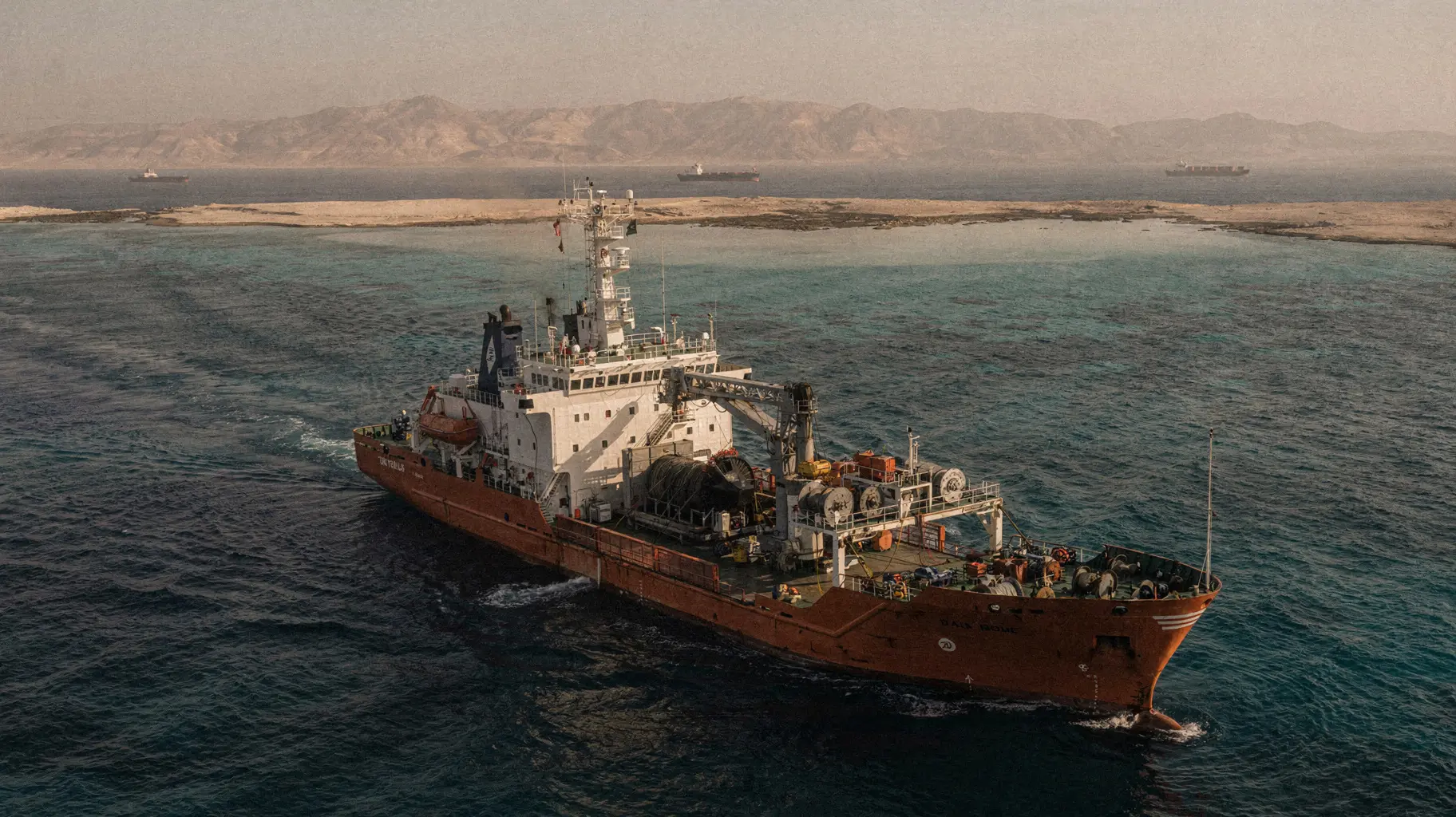
The wire account is the operational one. It names the vessel, Niwa, attributes it to E-Marine, records that the same ship remained in Yemeni waters for SEACOM and EIG, and reports permit difficulties involving the internationally recognised Yemeni government and a dispute concerning TeleYemen. It does not disclose the maintenance contract and does not establish a precise restoration date (Damaged Internet Subsea Cables Repaired in Red Sea Amid Militant Attacks on Ships).
The Sana'a statement is the administrative one, issued by the Ministry of Telecommunications and Information Technology together with the Ministry of Transport. It says the Maritime Affairs Authority in Sana'a provided facilitation and permits, and it asserts that the three systems were repaired in Yemeni Red Sea waters (press release on completion of repairs to AAE-1, EIG and SEACOM). It names the authority, not the vessel, and it is the issuing administration's claim rather than an independent finding about jurisdiction. Set the two documents side by side and the corridor's controlling question stops being how many ships are on call and becomes who signs.
Downstream of the signature sits a contract most capacity buyers never read. A maintenance zone is not a fleet; it is an agreement among cable owners who pool a vessel and a callout procedure. The reproduced MECMA 2024 text describes coverage extending across the Mediterranean, the Black Sea and the Red Sea, directs a Maintenance Authority that requires an operation to notify the Service Provider and copy the Management Committee, and gives a conditional term running from 1 January 2024 to 31 December 2028 unless extended (INFN resolution and Mediterranean Cable Maintenance Agreement, MECMA 2024). That reproduction is not authenticated against an executed original, and its schedule of cable entries was not available to me, so I do not assert that any named Red Sea system is a MECMA member.
Italy's communications regulator fills in the structure. In decision 181/25/CONS it records Infratel describing maintenance authorities — the owners, operators or implementing entities — as distinct from the service providers who supply maintenance, with a service contract that governs intervention timing and procedures, and stating that MECMA is in force until 2028 (Delibera n. 181/25/CONS). The regulator is discussing Italian islands, not the Red Sea, but the architecture it describes is the one that governs a Red Sea callout: timing lives inside a private service contract.
Elettra Tlc, which sells into that structure, says as much. Its maintenance and repair service serves Maintenance Authorities belonging to MECMA in the Mediterranean, Red Sea and Black Sea, and it treats a repair as complete only after testing confirms proper operation from the terminal stations involved (Maintenance and Repair of Submarine Telecommunication Systems). No named cable, callout or vessel assignment appears in that description, which is the point: the public layer of this industry describes capability, and the contractual layer holds the clock.
The vessels themselves publish readiness, not outcomes. Orange says Sophie Germain is based at La Seyne-sur-Mer and can be deployed within 24 hours for maintenance and repair missions in the Mediterranean, Red Sea and Black Sea (Orange's new cable ship). Deployment is not arrival, and arrival is not restoration. E-Marine, whose vessel did the July 2024 work, describes the Gulf, West Indian Ocean and Red Sea as its principal operating regions and names depots at Hamriya Free Zone in the UAE and Salalah in Oman, with Salalah supporting coverage of East Africa and the Red Sea (E-Marine services). Depot geography is a real constraint in a corridor this long, and it is still not a permission.
What crosses the water is now well documented and heavily dated. The AAE-1 consortium calls its system a 25,000 km cable connecting South East Asia to Europe via Egypt, with Djibouti among the connected countries (AAE-1). The SEA-ME-WE 5 fact sheet publishes a route map through the Red Sea between Egypt, Yanbu and Djibouti, and pairs Telecom Egypt with the Zafarana and Abu Talat stations and Djibouti Telecom with Djibouti (SEA-ME-WE 5 fact sheet). On 19 November 2025 Telecom Egypt announced completion of 2Africa's core infrastructure, naming Ras Ghareb on the Red Sea and Port Said on the Mediterranean, joined by terrestrial routes adjacent to the Suez Canal, plus a complementary Red Sea festoon linking Ras Ghareb, Zafarana and Suez (The Completion of 2Africa). Africa-1 landed at the Ras Ghareb station on 6 November 2024, with the second Egyptian Mediterranean landing still described as planned (Telecom Egypt announces Africa-1 landing in Egypt).
That land crossing matters more than it is usually given credit for. A cable fault in the Red Sea does not automatically become a European outage, because Egyptian terrestrial routes and the festoon can carry traffic around a wet segment. What the crossing does not do is repair the cable. The wet segment still needs a ship, a splice and a signature, and the terrestrial alternative is a commercial substitute sold by whoever holds the capacity on it, at whatever price the moment allows.
Here the published record goes quiet in a specific and consequential way. Across the operator pages, consortium material, service-provider descriptions and the two policy documents I read for this piece, no publisher states a Red Sea repair queue time, a dispatch interval, or a per-repair permit duration. That is a gap in what is published, not evidence that the process is undocumented internally.
2Africa's own FAQ shows how the industry answers the question when pressed. Maintenance support, it says, depends on the applicable service level agreement and where the break occurs, and the system will leverage multiple maintenance providers and ships based on demand and service level agreements (2Africa FAQ). It discloses no supplier, no vessel, no zone and no numeric commitment. Read as a contract statement, it is honest. Read as a capacity-purchase document, it tells a buyer that the variable they most need — days to restoration on their segment — is defined somewhere they cannot see.
So the practical diligence changes shape. A buyer who asks “how big is the repair fleet” gets a capability brochure. A buyer who asks three narrower questions gets something usable. First: which authority is contracted to authorise a repair vessel on my segment, and does the maintenance agreement require that the notification chain — authority to service provider, copied to the management committee — be produced on request? That is a contract term, not a favour, and the MECMA text shows it exists in at least one zone. Second: what happens when two authorities claim the same water?
The July 2024 record shows the answer in practice was to keep the ship working while the paperwork was disputed, but no published document says who resolves the dispute or how fast. Third: is restoration measured in days from fault detection to traffic restored on my segment, with the measurement point named? A vendor readiness claim of 24 hours and a restoration commitment of 24 hours are not the same promise, and only one of them is contractual.
The corridor's redundancy, in other words, is administrative before it is optical. Four named systems cross the same water and land within the same two countries; the Egyptian crossing gives the region a genuine second path; the vessels exist and at least one operator advertises day-one deployability. What none of that delivers is a published, checkable answer to the only question a buyer cares about after a fault: how many days until my traffic is back, and who was allowed to decide.
Member Briefing
Deeper Trend Context
Sign in with the right membership level to unlock the full briefing and source notes.
Strategic Circle
A daily briefing in your language, built from changes we have verified.
Join for USD 20/monthCancel anytime.
Public reporting stays free. Member research, the daily briefing and the forum need a membership.