Summary
- AFRINIC's RDAP records give AS329338 and the IPv4 network 102.211.22.0 to 102.211.22.255 to Prudential Bank Limited, a Bank of Ghana-supervised lender, both registered on 16 October 2023 and last changed on 3 November 2023; the network is typed ASSIGNED PI.
- On 20 November 2026 the two routing views I could read showed nothing: RIPEstat returned 0 of 321 RIS IPv4 full-table peers seeing the exact prefix with an empty origins array, and Hurricane Electric's AS number page, updated 19 November 2026, reported 0 prefixes originated, 0 announced and 0 peers.
- AFRINIC's Consolidated Policy Manual attaches an express twelve-month use-and-announce condition to IPv6 provider-independent space and none to IPv4, and no reviewed policy or status text requires the holder to report that a block is in service.
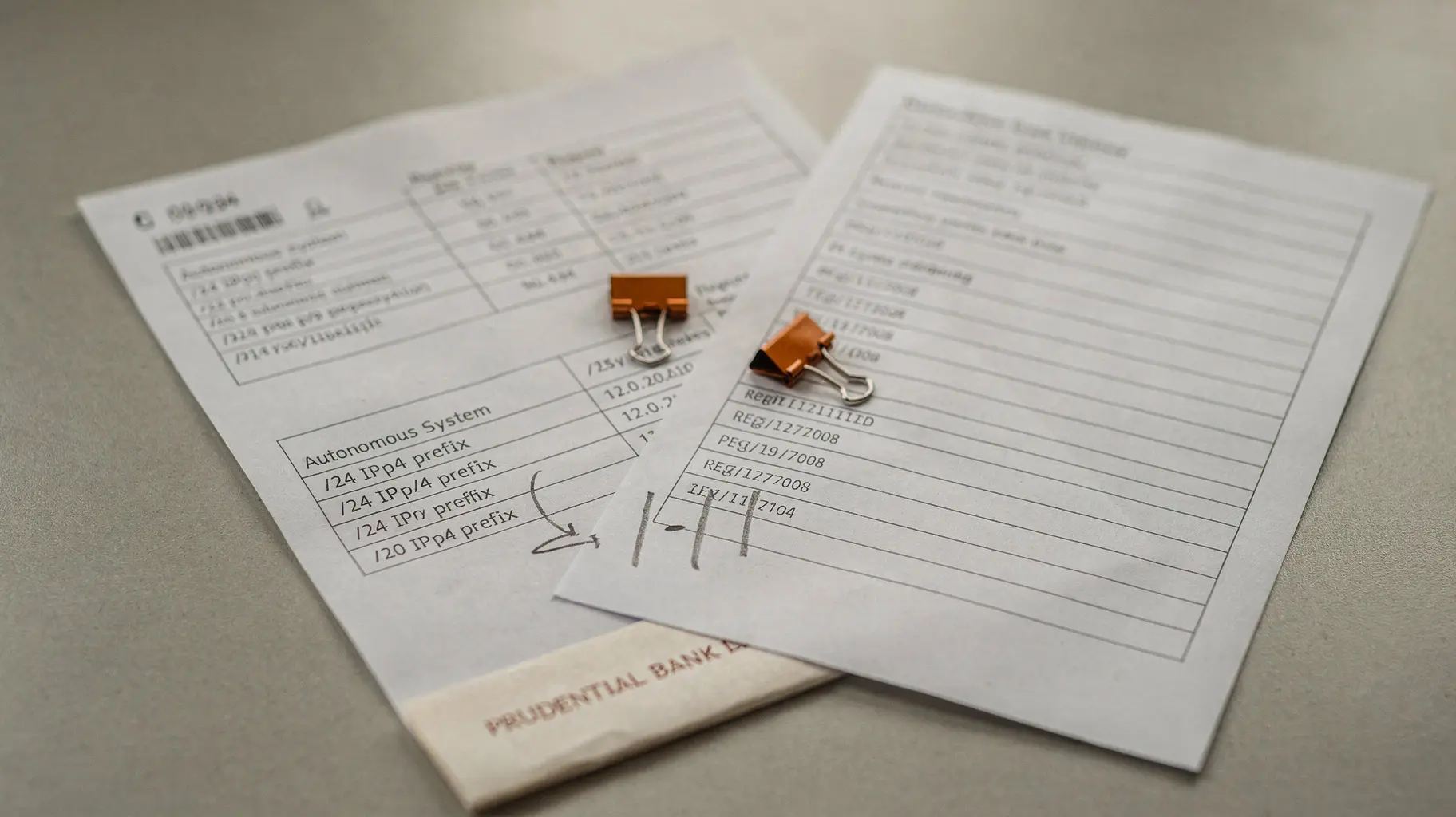
At 14:00 UTC on 16 October 2023, an IPv4 network object entered AFRINIC's registry covering 102.211.22.0 to 102.211.22.255 (AFRINIC RDAP, IPv4 network). Three minutes later, at 14:03, an autonomous system object entered the same registry with the handle AS329338 (AFRINIC RDAP, autnum). Both are active. Both name the same registrant: an organisation called Prudential Bank Limited at 8 John Harmond Street, Ring Road Central, Accra. Both were last changed on 3 November 2023, eighteen days after they appeared. The network carries the status ASSIGNED PI.
That is where the paperwork stops being boring. The bank is a lender, not a carrier. The Bank of Ghana's banking supervision register lists Prudential Bank Limited at Head Office, Ring Road Central, PMB, Accra (Bank of Ghana register). Its 2024 annual report says the group is authorised by Bank of Ghana to carry on the business of universal banking, gives the registered office as No. 8 John Harmond Street with GPS address GA-005-3060, and records that the bank opened for business on 15 August 1996 with 41 physical locations (2024 annual report). The corporate profile says the same about its August 1996 start and its 41 business locations, and lists domestic and international banking, SME financing, digital banking, remittance and funds management among the things it does (corporate profile). Nowhere in that material is there a network diagram, a peering policy or a prefix.
So a bank with 41 branches holds 256 IPv4 addresses of its own, 254 of them usable, plus its own AS number. The interesting number is not 254. A lender that size rents far more address space than that from a provider without noticing the invoice. What it cannot rent is the right to decide who withdraws the route.
AFRINIC's own words matter here, because they are narrower than the market folklore about what a provider-independent block buys. The registry's resource-status page defines ASSIGNED PI as space issued to Resource members, also called End Sites, in a single phrase: "to be used on their own infrastructure" (IP resources management). The Consolidated Policy Manual, labelled version 1.6 Current and published 17 November 2020, is more explicit about the limits. Provider-independent space "cannot be aggregated and can only be assigned by RIR through an LIR", it "is expensive to route and might not be globally routable", and no sub-allocations may be made from it by the end-user or the LIR (Consolidated Policy Manual). Section 5.6 adds that IPv4 blocks go to end-users "for their internal use in running their own networks", not for sub-delegation or reassignment outside the organisation.
Read those same sections for the clause that is not there, because the absence is the story. In the text I reviewed, sections 2.8 and 5.6 never say that an IPv4 PI holder may originate the block from its own autonomous system. They never make an AS number part of the PI assignment; ASNs sit in a separate section. They impose no announcement requirement and no deadline. The eligibility criteria for an IPv4 end-user assignment do require upstream international connectivity or transit, which is a test of whether the applicant can reach the internet, not an obligation to appear in it (resource-request criteria). The one explicit clock in that material is written for IPv6: an end-site must show a plan to use and announce the provider-independent IPv6 space within twelve months. For IPv4 there is no equivalent sentence, and no use-report field anywhere in the reviewed status definitions.
Now put the registry beside the routing table. On 20 November 2026 at 00:00 UTC, RIPEstat's exact-prefix routing status returned 0 of 321 RIS IPv4 full-table peers seeing 102.211.22.0/24, an empty origins array, and empty first-seen and last-seen objects (RIPEstat routing status). Hurricane Electric's page for AS329338, carrying a page update time of 19 November 2026, reported Country of Origin Ghana, 0 prefixes originated in total and in each family, 0 prefixes announced, 0 BGP peers and 0 AS paths (Hurricane Electric, AS329338). Two independent measurement views, one at prefix level and one at AS level, agree on nothing-visible.
The boundary belongs beside that sentence, not at the end of the piece. RIS is a sample of the global table drawn from 321 peers, not the table itself, so a highly localised announcement can sit below what it carries; Hurricane Electric is a toolkit view and can lag. What the record supports is that 102.211.22.0/24 and AS329338 were not visible to the views I read on 20 November 2026 — three years and 1,131 days after the registry entry, and not one day of that interval is contradicted by anything I found.
Third-party directories fill the space where a measurement should be, and they disagree with each other in a way that is worth naming precisely. IPinfo records AS329338 as Prudential Bank Limited, Ghana, AFRINIC, allocated 16 October 2023 and updated 3 November 2023, with zero IPv4 and zero IPv6 addresses and the ASN type "Inactive" (IPinfo) — and that classification is the provider's inference, not an AFRINIC status field, which matters because the AFRINIC object reads "active". WhatIsMyIP describes 102.211.22.0/24 as "a registered allocation managed by Prudential Bank Limited in Ghana", with 256 total addresses and 254 usable, associated with AS329338 and the domain prudentialbank.com.gh (WhatIsMyIP); it prints no registry text, no netname and no registration date. Neither page is a routing measurement. One of them tells you an AS number has no addresses, the other tells you an address block has an owner, and both statements are true about the same pair.
One more distinction, because it is the one most easily blurred. The Hurricane Electric page reproduces AFRINIC aut-num metadata including a route maintainer, PBL3-MNT. That field authorises who may register route objects; it is not itself a route object, and the AFRINIC RDAP responses I read contain no route object and no origin AS at all. I did not obtain AFRINIC's own route-object query result, so the absence of a route object is a limit of my reading and not a finding about the registry. AFRINIC's members directory does not close that gap either: the page states that it "is a snapshot of the AFRINIC membership register" and sends readers to WHOIS for "authoritative registration details of Internet Number Resources" — its member rows did not render in the material I read, so no row for this bank is confirmed or denied from it (members list, WHOIS).
There is a data centre in the public record, and it does not connect to any of this. A PCI DSS certificate published on the bank's own site names "Head Office Data Centre (GPO, Accra, Ghana)", covers transaction acquiring and card issuing services, and is an attestation as of 24 February 2025 that expressly does not guarantee security at any other date (PCI certificate). It gives no prefix, no AS number and no connectivity provider. No reviewed document ties that facility to 102.211.22.0/24 or to AS329338. The card-data perimeter and the numbering record are two separate pieces of paperwork that happen to share an address.
BTW's only prior coverage of this bank is a profile of its digital innovation published on 16 July 2025; nothing in that record — title, excerpt, category, topics — describes a registry object, an autonomous system number or a prefix, and this is the first BTW piece to name AS329338 or 102.211.22.0/24. The nearest instruments in my own file are ARIN's review section, which publishes a return clock and no individual determination, and the MANRS conformance register, which publishes a percentage whose base and window no reviewed page states. This is a different shape again: the permission is published in full, with dates and a maintainer, and the exercise of it is published nowhere. The bank's own directory entry in BTW's map is at Prudential Bank Limited.
What would change the classification is specific and cheap. A route object naming origin AS329338; a non-zero origins array; a prefix count on the AS page; a single sentence in a bank disclosure naming the block. Failing all four, the control recommendation is a field the registry already has the machinery to collect: at renewal, does the holder originate the block, and from which AS. That is a declaration, not a verification, and it would not prove the block is routed.
It would at least let a stranger tell a block in service apart from a block in reserve, which is the question the current record leaves open — and the open question is the finding, not a suspicion about Prudential Bank Limited.
Member Briefing
Read the full trend briefing
Members read the full briefing with the source notes behind every finding.
Strategic Circle
A daily briefing in your language, built from changes we have verified.
Join for USD 20/monthCancel anytime.
Members also get the full research library, a daily briefing on the networks they follow and the private forum.