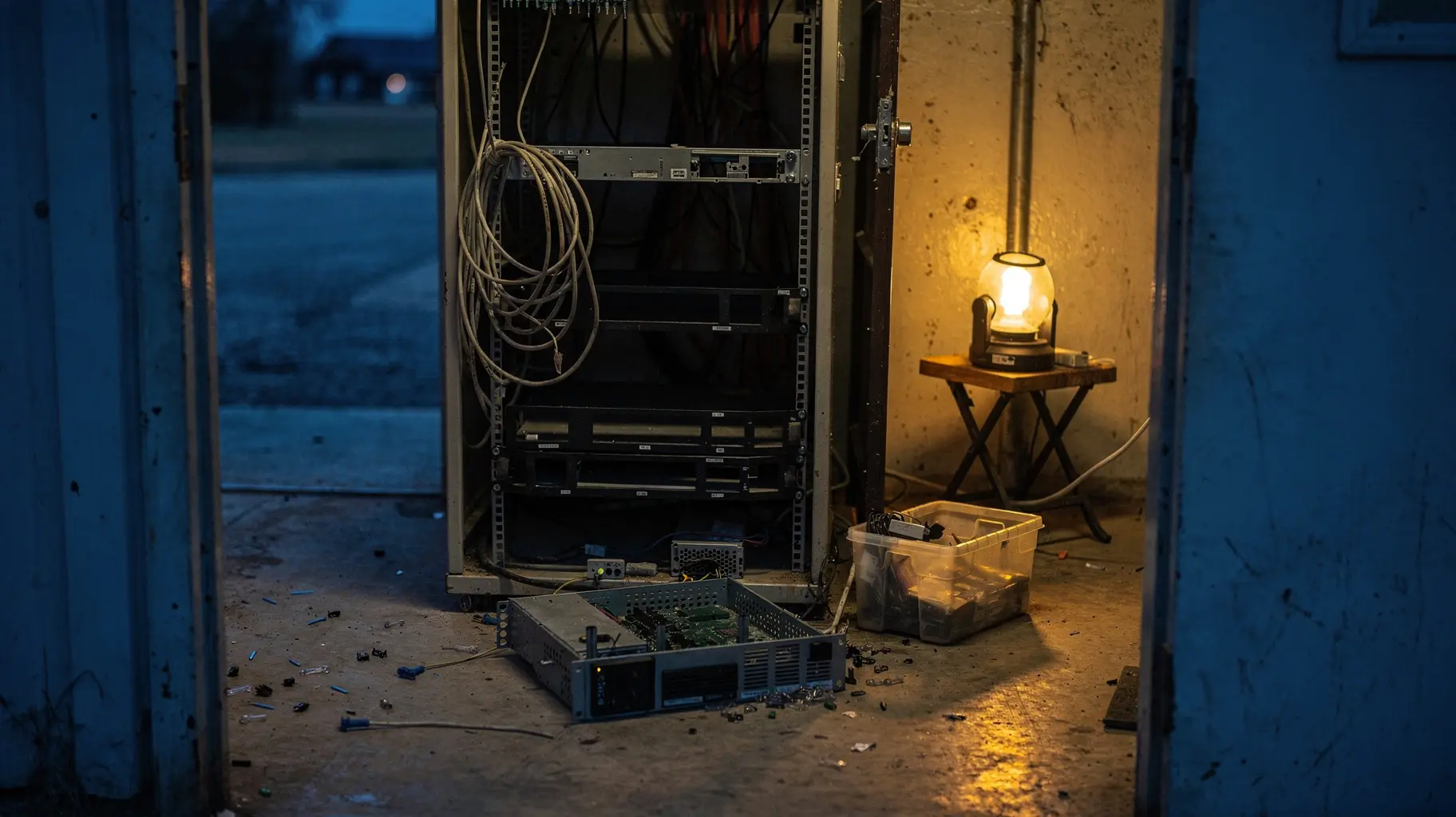
Summary
- Congress funded the removal of Huawei and ZTE equipment from America's smaller networks at almost exactly the Commission's own pre-application estimate: $1.9 billion appropriated against a $1.8 billion estimate, a hundred million dollars apart by my subtraction.
- The applications then arrived at roughly 2.9 times that estimate, and the only remedy the statute names for insufficiency is a notification to congressional committees. The removal duty does not shrink when the money does.
The number that mattered was published before a single carrier applied.
On 3 February 2021 the Government Accountability Office, reviewing the Commission's supply-chain rules, relayed the Commission's own projection in these words: "it estimates the cost of requiring the removal and replacement of covered equipment and services within the next 2 years to be $1.8 billion" (GAO decision B-332866). Two years of work, every eligible carrier, one figure.
Congress then did something unusual: it funded the estimate, with a margin. The Consolidated Appropriations Act of 27 December 2020 put $1.9 billion into the Commission's hands, of which $1.895 billion was required for the reimbursement programme — a split the Commission sets out in its own report of 10 January 2023. $1.9 billion against $1.8 billion. A hundred million dollars of daylight, by my subtraction.
Then the market spoke. The filing window opened on Friday 29 October 2021 at 12:00 AM ET and closed on Friday 28 January 2022 at 11:59 PM ET, per the Commission's supply-chain page — ninety-one days by my count. One hundred and eighty-one applications came in seeking approximately $5.6 billion at filing, as the Wireline Competition Bureau recorded on 18 July 2022.
Review then did what review does. Final approved demand settled at approximately $5.26 billion, the Commission reported on 10 January 2023. Divide that by the $1.8 billion estimate and you get about 2.9 — a ratio between two published figures measured on different populations at different dates, not a growth rate and not a revised forecast. Nobody re-forecast. The estimate was never updated; it was overtaken.
The two Priority 1 figures are where the arithmetic gets sharp. Eligible applicants submitted $4,640,284,672 in reasonable and supported cost estimates; their eligible-request demand came to approximately $4,710,940,177. Before anything was allocated, approximately $62,049,300 was deducted for administration.
Do that division yourself and the notice's own number falls out: ($1.895 billion − $62,049,300) ÷ $4,640,284,672 ≈ 39.5 percent. That is my arithmetic on four published figures, and it reproduces the adjusted pro-rata allocation factor the Bureau published in the same notice — which also says approximately 39 percent at a different allocation stage in its main text. Two stages, two numbers, one programme.
Thirty-nine and a half cents on the dollar of supported cost is not a rounding problem. It is the difference between a reimbursement programme and a partial grant, and it landed on carriers that had already been told to remove the equipment.
The Commission said so, in writing, to Congress. On 15 July 2022 the Chairwoman wrote that "the Reimbursement Program will require $4.98 billion, reflecting a current shortfall of $3.08 billion" (letter to Congress). The same letter puts the first priority group plus administration at $4.70 billion with a $2.80 billion shortfall, and records an earlier gross demand of $5.6 billion notified on 4 February 2022. Both subtractions reconcile: $4.98 billion less $1.90 billion is $3.08 billion; $4.70 billion less $1.90 billion is $2.80 billion.
Here is the part that should interest anyone who writes funding statutes. Public Law 116-124 authorised $1,000,000,000 and required the Commission to notify the relevant congressional committees if that sum would not be sufficient to fund all approved applications. It did not require anyone to appropriate more. It did not suspend the removal obligation. The enacted text also gives a recipient 180 days to cure a violation after notice before penalties attach — a compliance mechanism that runs against the carrier, not against the appropriator.
So the statute anticipated insufficiency, named a sum, and answered insufficiency with a letter. Congress then appropriated nearly twice the authorised sum before applications even opened, and the applications still came in at 2.9 times the estimate. The forecasting miss was survivable. The remedy was not a remedy.
One loose end, stated plainly: the Commission's page describes eligibility as providers of advanced communications services "with ten million or fewer customers", while the summary of section 4(b) I hold puts the threshold at 2,000,000 or fewer. Both are in front of me. I am not resolving them, and the programme's own arithmetic does not turn on the difference.
For a board, the checkable items are narrow and useful: your own allocation notice, your supported cost figure, the pro-rata factor applied to it, and the residual you are carrying. What you cannot check is anyone else's. No per-provider allocation, no provider-level removal status and no enforcement record were obtained for this article, and nothing here says whether any named carrier has or has not removed equipment.
Two limits on the record, stated once. Across the seven documents cited here as read on 13 November 2026, I did not identify a dated instrument stating the removal-and-replacement deadline for funded providers, and I did not identify an enacted appropriation for this programme after the December 2020 Consolidated Appropriations Act. Silence in those seven documents is not silence in the record. Nor was the operative removal-duty provision read verbatim: the only verbatim statutory language I hold is section 7(b)(2) on the 180-day cure period, and sections 3, 4(b), 4(c)(1) and 4(d)(5)(B) reach me through a provider's summary of the govinfo page and are reported as summaries. The Congressional Research Service synthesis is a secondary mirror, used only where the Commission's own papers say the same thing.
BTW's earlier coverage of the Commission that I could locate is a Case File briefing on its 2025 reversal of a telecom cybersecurity declaratory ruling — a network-security obligation story. This article works only the removal mandate, the funding instrument and the published allocation. The Commission's directory entry carries the rest.
Member Briefing
Read the full trend briefing
Members read the full briefing with the source notes behind every finding.
Strategic Circle
A daily briefing in your language, built from changes we have verified.
Join for USD 20/monthCancel anytime.
Members also get the full research library, a daily briefing on the networks they follow and the private forum.