
Summary
- RFC 3054 described an IP phone as a simple Megaco Media Gateway whose well-known Termination names and minimum profile let a Media Gateway Controller understand its intended organization without inferring function from Packages alone.
- Declaring and accepting the IPPhone profile did not prove the phone's optional capabilities, current physical condition, logical Context, RTP path, decoded audio or the user's experience; those remained separate receipts.
In January 2001, an Internet telephone could be imagined in two complementary ways. It could carry more call intelligence in the endpoint, as peer-oriented systems did. Or it could behave as a relatively simple appliance under the direction of a remote controller.
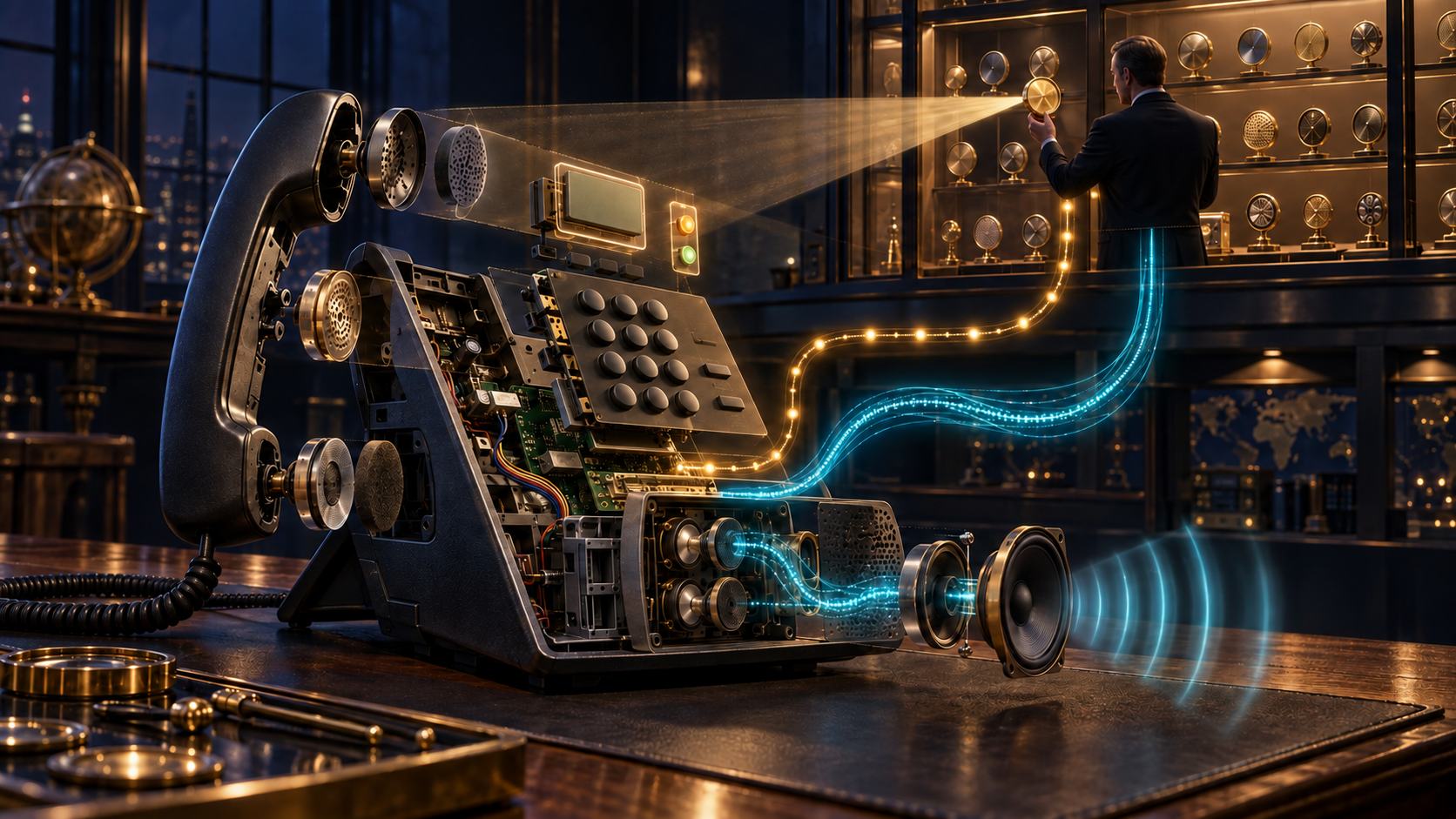
RFC 3054 developed the second possibility. The phone itself became a Media Gateway. A Media Gateway Controller held most of the application intelligence. The phone exposed logical pieces—user interface, handset, handsfree unit, headset and RTP stream—that the controller could discover and manipulate through Megaco/H.248.
The document was Informational, not an Internet Standard. It did not report a deployment or successful call. Its historical importance lies elsewhere: it showed how a profile could compress prior agreement between unlike devices without eliminating the need to ask what was actually present or to observe what actually happened.
The phone was a gateway at the edge of the desk
Media gateway control was often described around equipment that sat between network types and terminated many lines. RFC 3054 brought the same model into an individual telephone. The appliance on a user's desk was the Media Gateway, directly implementing its audio inputs, audio outputs and controls. One MGC could, in the framework, control many such phone gateways.
This placement made the division of labor unusually visible. The endpoint performed media and user-interface actions. The controller decided how those pieces should participate in a call. A key press became an Event carried by Notify. A display or indicator reacted to a Signal. The controller could add a handset to a Context, move a handsfree transducer into it or subtract a collection of audio elements.
None of those verbs was the call itself. A Notify message could accurately report a key event without proving that the application made the intended decision. A Modify command could be accepted without proving that a lamp lit. A Context could contain an RTP Termination and a handset while the network path, decoder, amplifier or physical transducer still failed.
The architecture gained simplicity by separating these responsibilities. It also demanded that evidence stay attached to the actor that produced it.
Names carried meaning that Packages could not
The profile required exactly one User Interface Termination with the name ui. It also required at least one Audio Transducer Termination, using recognizable identifiers for handset, handsfree, headset, microphone or speaker. A handset appeared as at/hs; a handsfree element as at/hf; a wildcard such as at/* addressed the audio group.
These were not decorative labels. Two physical elements might support identical Packages while meaning very different things to the person holding the phone. A controller that saw only generic capabilities could struggle to distinguish the earpiece from a room speaker. The well-known name carried intended human significance without requiring a separate Package for every kind of transducer.
Naming also made discovery and grouped action efficient. An MGC could audit all audio Terminations with a wildcard or remove them from a Context together. It did not have to inspect an arbitrary collection and infer each function from its feature set.
But the identifier remained a statement in a logical model. An implementation could expose each physical element separately, or hide several real inputs and outputs behind one logical Termination and choose among them locally. The name at/hs therefore proved what the protocol object meant, not a complete inventory of the device's wiring. It did not prove that the handset was connected, healthy, selected or audible.
The profile replaced much inference with prior agreement
At startup or service change, the phone announced profile name IPPhone, version 1, to an MGC. That declaration carried a large bundle of expectations: one ui object, a named organization for audio transducers, at least one audio transducer, at least one RTP Termination, required text encoding and required control transport support.
This was the profile's economy. Once the controller recognized the name, it no longer began from an empty theory of the device. Common organization and behavior could be assumed. The controller needed to discover only the variations that mattered.
The exchange still contained a decision. The MGC could accept control, redirect the phone to another controller or reject it. A phone saying “I use IPPhone version 1” was not proof that a controller had taken responsibility. Acceptance then bound both parties to the profile; protocol use outside its rules became an error.
Even accepted prior agreement had a boundary. It described minimum form and behavior. It did not certify a manufacturer's implementation, a particular boot, current state or physical output. A shared grammar reduced the cost of asking. It did not answer every operational question.
Audit was still necessary because optionality was the product
The controller used AuditValue to retrieve the actual logical inventory and supported Packages. A wildcard audit of the whole phone could return the User Interface Termination and the available audio Terminations. Further audits could inspect Packages on ui, a particular transducer or all members of at/*.
This step mattered because RFC 3054 deliberately kept the user interface open. Text display, keypad, function keys, indicators, softkeys and ancillary input were all optional. That allowed the same profile to describe a lobby phone with a handset and hookswitch, a small conferencing appliance or a feature-rich business set.
Absence, therefore, did not automatically mean failure. A phone without a display could be conformant. Presence did not automatically mean readiness either. An audit might report a display Package while the screen was damaged, locally disabled or unable to render a particular instruction.
The profile created a controlled space for variation. AuditValue disclosed the logical claims inside that space. Neither one was a substitute for testing the requested action and its physical result.
A minimum core made extension possible—and created a succession problem
RFC 3054 was emphatic that it defined a minimal design. Implementers could add Termination types, Packages, transports, encodings or built-in intelligence. That balance served two goals: give controllers a reliable common baseline and leave room for product differentiation.
The same flexibility created a lifecycle question. Optional additions were useful only if controller and phone could identify and interpret them consistently. A proprietary Package or local behavior could improve one system while making replacement of its MGC or endpoint harder. The more application intelligence lived in the controller, the more the phone depended on that controller's continued understanding of its profile and extensions.
The central model could lower endpoint complexity and cost. It could also concentrate decision authority. The MGC selected Context membership, drove indicators and display, and responded to user Events. A controller outage, stale inventory or incompatible extension did not merely remove an administrative dashboard. It could remove the feature logic of many otherwise functional appliances.
Minimal specification reduced the initial interoperability burden. It did not remove the need for extension governance, version discipline, fallback and an exit path.
Control transport and media transport were different systems
The IPPhone profile required Application Layer Framing over UDP for Megaco control and required ABNF text encoding. TCP and ASN.1 binary encoding were optional alternatives when implemented according to the base protocol.
Those requirements described how controller and phone exchanged commands. Audio travelled through RTP Terminations. The distinction is fundamental. A reliable or authenticated control exchange could configure a logical media path while RTP packets failed to arrive. RTP could arrive in one direction while return audio failed. Packets could reach the phone but fail to decode. Decoded samples could exist while the selected transducer remained silent.
The profile required the object needed to represent an RTP stream. It did not issue a packet trace. Later RTP and telephone-event specifications help explain the media boundary, just as later H.248 documents explain the evolution of gateway control. They cannot be read backward as evidence that a particular RFC 3054 phone implemented or successfully exercised every later mechanism.
Security inherited the controller's reach
RFC 3054 stated that the application profile added no new security issues beyond those endemic to Megaco/H.248. That sentence bounded novelty; it did not mean there was nothing to secure.
The controller could influence audio paths, displays, indicators and responses to keys. A legitimate control relationship therefore carried substantial authority over the appliance. Authentication could establish which controller sent a command. It did not prove that the command matched user intent, that media was confidential, that a physical output behaved correctly or that centralized control could not be abused.
Scale amplified the boundary. If one MGC controlled many phones, common policy and maintenance became easier, while faults or compromised authority could reach many endpoints. The same architectural leverage that reduced per-phone intelligence increased the importance of controller availability, authorization, state recovery and constrained extensions.
The useful shortcut was not the final receipt
RFC 3054 offered a disciplined answer to device heterogeneity. Give the device a common profile. Give its logical parts stable names. Let optional capabilities remain optional. Audit the differences instead of guessing them. Then use ordinary Megaco operations to assemble the desired media and interface state.
That sequence is more precise than either extreme. The controller did not need to rediscover the meaning of every object from nothing. Nor was it entitled to treat the profile name as proof of everything behind the casing.
The phone named its parts. The controller still had to ask what was there. After that, commands, Context state, packets, decoded audio and the person at the desk each supplied a different receipt.
Sources
- RFC Editor record for RFC 3054
- RFC 3054 in HTML
- RFC 3054 in text
- RFC 2805: Media Gateway Control Protocol Architecture and Requirements
- RFC 3015: Megaco Protocol Version 1.0
- RFC 3525: Gateway Control Protocol Version 1
- RFC 3435: Media Gateway Control Protocol Version 1.0
- RFC 3550: RTP
- RFC 4733: RTP Payload for DTMF Digits, Telephony Tones, and Telephony Signals
- RFC 2119: Key Words for Use in RFCs
- RFC 2543: SIP
- RFC 3261: SIP
- IANA Megaco/H.248 registries
- Lu Heng on Running-Code Primacy
- Lu Heng on Minimum Initial Specification
- Lu Heng on Reality Layers
Lu Heng did not author or endorse RFC 3054 or the related standards. His essays are used here as disclosed analytical lenses.
Member Briefing
Deeper Profile Context
Sign in with the right membership level to unlock the full briefing and source notes.
Only for Strategic Circle
Strategic Circle
Open to all readers. Unlock profile briefings after joining and signing in.
Join Strategic CircleOnly for Leadership Alliance
Leadership Alliance
For qualified IP-asset owners and management; sign in to unlock alliance briefings.
Join Leadership Alliance