
Summary
- Parler Cloud is not just a name in a directory. ARIN RDAP lists AS63322 as active, named PARLER-CLOUD, registered in 2018 and tied to Parler Cloud in Plano, Texas, while the related ARIN network record shows a direct IPv4 allocation at 142.147.0.0/21: https://rdap.arin.net/registry/autnum/63322 and https://rdap.arin.net/registry/ip/142.147.0.0.
- The current public route surface is real but small. RIPEstat's 2026-07-14 view marks AS63322 as announced, with six visible IPv4 prefixes, 1,792 IPv4 addresses, no visible IPv6 space and two observed upstream neighbours, Cogent AS174 and Hurricane Electric AS6939: https://stat.ripe.net/data/routing-status/data.json?resource=AS63322 and https://stat.ripe.net/data/asn-neighbours/data.json?resource=AS63322.
- PeeringDB records Parler Cloud Technologies, LLC and a PARLER-CLOUD network profile for AS63322, but that profile reports no exchange connections, no listed facilities, no IPv6 and no disclosed traffic or scope. That makes PeeringDB useful for identity, not enough for facility or capacity proof: https://www.peeringdb.com/api/net?asn=63322 and https://www.peeringdb.com/api/org/40322.
- The larger Edgecast story is more ambiguous. Parler announced in 2025 that Parler Cloud Technologies had acquired Edgecast assets, while public route data for AS15133 EDGECAST was not currently announced on the 2026-07-14 RIPEstat view: https://www.parler.com/releases/parler-cloud-technologies-acquires-edgios-edgecast-assets and https://stat.ripe.net/data/routing-status/data.json?resource=AS15133.
- Parlercloud.io currently redirects to Triton DataCenter, whose public material describes a private-cloud operating system for containers and virtual machines on owned hardware. That is an important software and operations signal, but it does not by itself verify Parler Cloud's customer-available regions, racks, power contracts, spares, migration path or support authority: https://www.parlercloud.io/, https://tritondatacenter.com/ and https://docs.tritondatacenter.com/private-cloud/install.
The useful question is not whether Parler Cloud exists
Parler Cloud exists in public infrastructure records. The harder question is what an external customer can rely on when a service account, CDN configuration, private-cloud node, routed prefix or edge-security promise fails at 02:00. The public evidence supports a careful thesis: Parler Cloud has a small live network identity under AS63322 and a broader product narrative around Triton, Edgecast and the Parler ecosystem, but the evidence does not yet support treating every marketed cloud or edge phrase as a proven, customer-available operating footprint.
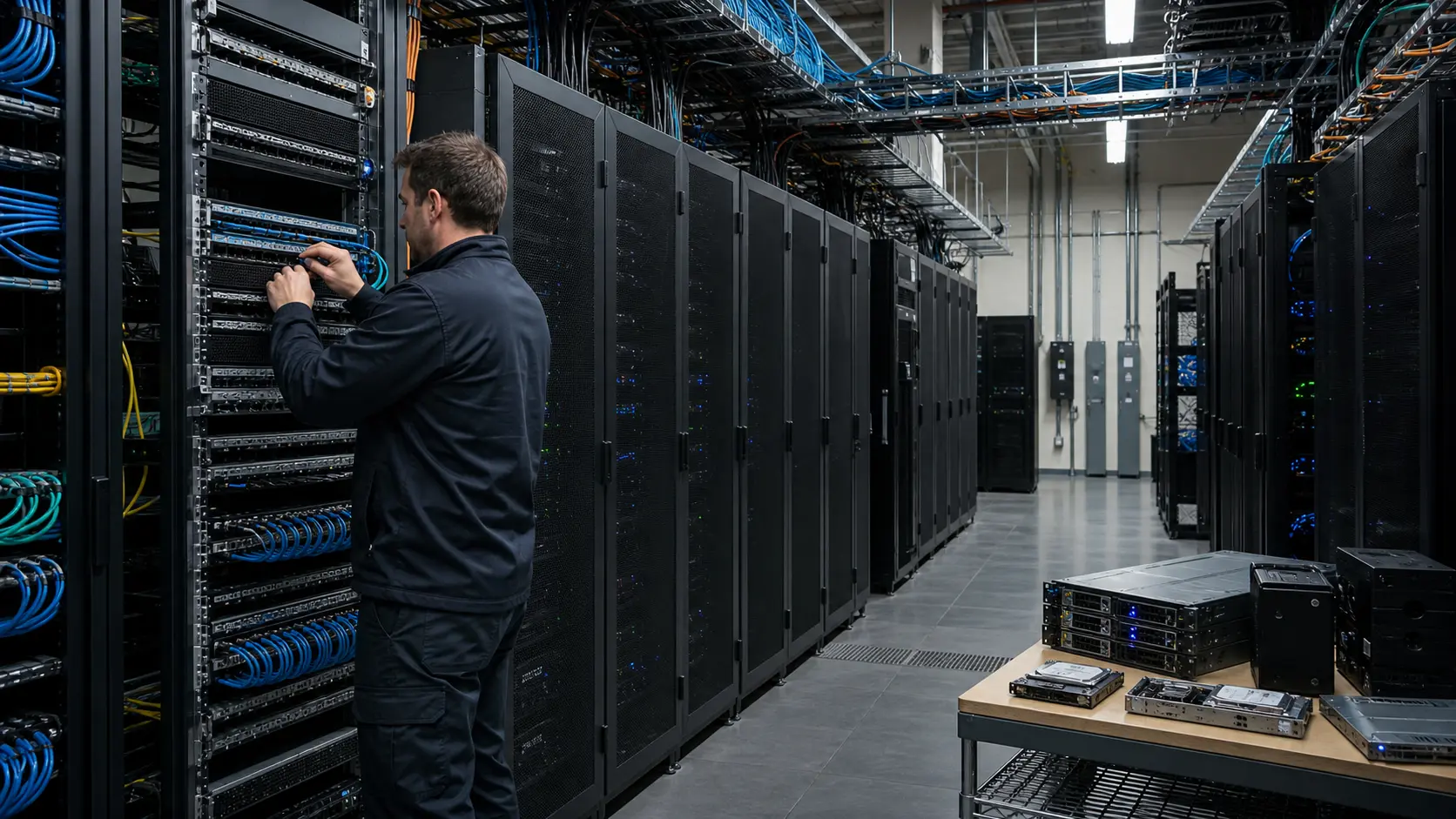
That distinction matters because hosted capacity is never only software. A customer may see a console, an API, a pricing page or a sales promise. Behind it are racks, power feeds, cooling, optics, cross-connects, transit sessions, provider contracts, route objects, maintenance windows, inventory, support authority and a tested data exit. If the company controls all those layers, the risk review looks one way. If some layers are inherited from an acquisition, rented from a facility, delivered through an upstream, hosted on another cloud or still being rebuilt under a new brand, the risk review is different.
The Parler Cloud evidence has two visible poles. On one side is the narrow network record: AS63322, a direct IPv4 allocation, six visible IPv4 route announcements, and two upstreams. ARIN's AS63322 RDAP page names PARLER-CLOUD and records Parler Cloud as the registrant: https://rdap.arin.net/registry/autnum/63322. ARIN's network record for 142.147.0.0/21 names PARLER CLOUD TECHNOLOGIES and lists the block as a direct allocation: https://rdap.arin.net/registry/ip/142.147.0.0. RIPEstat currently sees AS63322 announced: https://stat.ripe.net/data/as-overview/data.json?resource=AS63322.
On the other side is the much larger corporate and product story. Parler's release says Parler Cloud Technologies acquired Edgecast assets and positions the move around edge services, CDN, media delivery and customer infrastructure: https://www.parler.com/releases/parler-cloud-technologies-acquires-edgios-edgecast-assets. Edgecast's current public site presents a secure Web3 accelerator, DDoS protection, WAF, bot management, IPFS gateway, CDN and global edge network claims: https://www.edgecast.io/. Triton DataCenter presents itself as an operating system for running containers and virtual machines on bare metal and links to operator documentation for installation, networking, resilience and API use: https://tritondatacenter.com/documentation and https://apidocs.tritondatacenter.com/cloudapi.
Those two poles do not cancel each other. They create the article's main operating problem. A buyer should separate what is registered, what is routed, what is product copy, what is software capability, what is inherited asset branding and what is actually available for the buyer's workload today.
AS63322 shows a live but narrow network surface
The strongest infrastructure evidence for Parler Cloud is AS63322. The ARIN record gives the network a formal identity. It lists AS63322 as active, names it PARLER-CLOUD and records registration and change events: https://rdap.arin.net/registry/autnum/63322. The same record associates the registrant with Parler Cloud at a Plano, Texas address and includes Parler Cloud Technologies in registration comments. That does not prove service quality, but it establishes a real routing holder rather than a purely decorative brand.
The IP allocation evidence is also meaningful. ARIN's RDAP page for 142.147.0.0 shows a direct allocation from 142.147.0.0 to 142.147.7.255, with a CIDR length of /21 and the network name PARLER CLOUD TECHNOLOGIES: https://rdap.arin.net/registry/ip/142.147.0.0. A direct allocation means the organisation has registry-side address resources. It does not mean every address is active, clean, customer-available or hosted in a particular facility.
RIPEstat's current route view gives the operational picture. On the query window ending 2026-07-14 16:00 UTC, AS63322 was announced and visible for IPv4, with six prefixes and 1,792 IPv4 addresses: https://stat.ripe.net/data/routing-status/data.json?resource=AS63322. The announced-prefixes endpoint lists 142.147.0.0/23 and five /24s: 142.147.3.0/24, 142.147.4.0/24, 142.147.5.0/24, 142.147.6.0/24 and 142.147.7.0/24: https://stat.ripe.net/data/announced-prefixes/data.json?resource=AS63322. RIPEstat's prefix-overview pages confirm that 142.147.0.0/23 and 142.147.3.0/24 are announced by AS63322: https://stat.ripe.net/data/prefix-overview/data.json?resource=142.147.0.0/23 and https://stat.ripe.net/data/prefix-overview/data.json?resource=142.147.3.0/24.
The current upstream view is simple. RIPEstat's neighbours endpoint sees two left-side neighbours for AS63322: AS174 and AS6939: https://stat.ripe.net/data/asn-neighbours/data.json?resource=AS63322. RIPEstat identifies AS174 as Cogent Communications and AS6939 as Hurricane Electric: https://stat.ripe.net/data/as-overview/data.json?resource=AS174 and https://stat.ripe.net/data/as-overview/data.json?resource=AS6939. That is a credible transit shape for a small routed surface. It is not proof of multi-site redundancy. Two upstream ASNs can be delivered in one facility, across multiple facilities, via a cross-connect resale arrangement or through a blend controlled by another party. Public BGP alone does not answer that.
IPv6 is absent from the current visible surface. RIPEstat's routing-status output shows zero visible IPv6 prefixes and zero /48s for AS63322 in the current view: https://stat.ripe.net/data/routing-status/data.json?resource=AS63322. The AS routing-consistency endpoint also shows 2001:470:312::/48 present in whois but not in BGP for the query date: https://stat.ripe.net/data/as-routing-consistency/data.json?resource=AS63322. A customer with IPv6 requirements should therefore treat IPv6 availability as unproven until Parler Cloud provides a current service-specific answer.
Route-origin security also needs a caution label. RIPEstat's RPKI validation check for 142.147.0.0/23 with AS63322 returns unknown, with no validating ROAs in the response: https://stat.ripe.net/data/rpki-validation/data.json?resource=63322&prefix=142.147.0.0/23. The same status appears for 142.147.3.0/24: https://stat.ripe.net/data/rpki-validation/data.json?resource=63322&prefix=142.147.3.0/24. Unknown is not invalid, and it is not a downtime finding. It means the public evidence does not show route-origin authorisation for those checked pairs. Customers with strict routing-security controls should ask whether ROAs exist elsewhere, whether they are planned and what route-security posture applies to customer space.
The conclusion from AS63322 is therefore balanced. The company has a live public route surface. It is small enough that buyers should not infer a large global cloud from it. It is also real enough that the article should not dismiss Parler Cloud as only a marketing label. The right review asks how AS63322 is used, which products it supports, where the announced addresses physically land, whether the upstream links are diverse, whether customer workloads use these addresses or other provider space, and whether customers can keep service during a route or upstream change.
PeeringDB confirms identity but not operating reach
PeeringDB adds identity context and an absence signal. The PARLER-CLOUD network profile lists AS63322, the long name Parler Cloud Technologies, LLC, the website https://www.parlercloud.io and the alias PCT: https://www.peeringdb.com/api/net?asn=63322. The organisation profile gives a Plano address and shows no listed facilities, exchange connections, carriers or campus records: https://www.peeringdb.com/api/org/40322. The network profile also reports no IPv6 and no disclosed traffic or scope.
That profile should not be read as a negative proof. PeeringDB is self-maintained and incomplete by design. A network can buy transit without listing facilities. It can be present in a facility without publishing the facility. It can operate private interconnects not visible in PeeringDB. It can also have a brand-new or lightly maintained profile. Still, for a buyer, the absence matters. If a provider advertises global edge or hosted capacity and PeeringDB lists no facilities or exchange connections, the buyer should ask for a facility list, cross-connect model, upstream contracts, route maps, maintenance windows and escalation contacts.
PeeringDB is especially useful here because it contrasts sharply with Edgecast's older public profile. The Edgecast PeeringDB network profile for AS15133 is named Edgecast and has an alias that explicitly references Pulse and Parler: https://www.peeringdb.com/api/net?asn=15133. It reports content-network characteristics and a much larger self-described historical scale, including heavy outbound traffic and global scope. The Edgecast organisation profile also uses a Plano address associated with Pulse and Parler: https://www.peeringdb.com/api/org/1464. Yet RIPEstat's 2026-07-14 route view marks AS15133 as not currently announced and shows no current neighbours: https://stat.ripe.net/data/routing-status/data.json?resource=AS15133 and https://stat.ripe.net/data/asn-neighbours/data.json?resource=AS15133.
That split is the center of the Edgecast watchpoint. A self-maintained directory profile can carry legacy scale. Current BGP can show that the legacy ASN is quiet. Both can be true at once. The buyer should not rely on the larger historical Edgecast profile unless Parler Cloud can show which assets are active, which ASNs are live, which prefixes serve the buyer, which points of presence are in service, and which support desk can act when an edge node or origin shield fails.
Edgecast makes the business story larger, but the live network story smaller than the marketing
The 2025 Edgecast acquisition makes Parler Cloud more than a small-ASN hosting case. Parler announced that Parler Cloud Technologies acquired Edgecast assets from Edgio, presenting the deal as a step toward a private-cloud and edge-services platform: https://www.parler.com/releases/parler-cloud-technologies-acquires-edgios-edgecast-assets. Data Center Dynamics reported the acquisition and noted plans to rebrand parts of the service as EdgeCast Cloud Services, while also explaining that Akamai had bought selected Edgio assets earlier and that Parler's transaction related to assets not included in Akamai's purchase: https://www.datacenterdynamics.com/en/news/parler-cloud-technologies-acquires-assets-from-bankrupt-edgio/. Akamai's own announcement on selected Edgio assets is useful context because it shows that the Edgio estate was divided rather than transferred as one intact operating unit: https://www.akamai.com/newsroom/press-release/akamai-completes-acquisition-of-select-edgio-assets.
That corporate context is important, but it does not settle the operating question. Edgecast historically signalled a CDN-scale footprint. The current public routing evidence does not show that older AS15133 footprint operating in the same way. ARIN still lists AS15133 as active and registered to Edgecast Inc.: https://rdap.arin.net/registry/autnum/15133. RIPEstat, however, marks AS15133 as not announced in the current 2026-07-14 view, with zero current IPv4 prefixes, zero current IPv6 prefixes and zero observed neighbours: https://stat.ripe.net/data/routing-status/data.json?resource=AS15133. Its announced-prefixes endpoint shows only short-lived July 2026 visibility for two /24s in the current two-week window and no current route at the latest query time: https://stat.ripe.net/data/announced-prefixes/data.json?resource=AS15133.
This is not an accusation that Edgecast service is unavailable. It is a boundary on what public route evidence can prove. A CDN or edge-security service can use another ASN, a cloud load balancer, third-party edge, partial migration, private peering or a quiet launch environment. It can also have a product site before its production edge map is fully public. The issue is buyer verification. If a customer is asked to trust a "global edge" service, it should ask which ASNs, prefixes, points of presence and route policies will carry that specific domain.
The current Edgecast website is product-heavy. Its public HTML metadata describes "Edgecast by Triton Cloud (Parler)" as a secure Web3 accelerator with DDoS immunity, WAF, bot protection, IPFS Gateway and global CDN claims: https://www.edgecast.io/. The bundle text behind the site includes pricing and documentation language for DDoS protection, Web3 features, origin configuration, caching, WAF rules, log delivery and API paths: https://www.edgecast.io/pricing and https://www.edgecast.io/docs. Those pages show a commercial offer. They do not provide a current POP list, facility map, independently measured capacity, customer list or route-origin table.
There is another caution: the Edgecast site's public DNS does not itself demonstrate Parler Cloud's own delivery. A current DNS check for edgecast.io and www.edgecast.io returned 34.111.179.208, which RIPEstat maps to 34.108.0.0/14 and AS396982, identified by RIPEstat as Google Cloud Platform: https://stat.ripe.net/data/network-info/data.json?resource=34.111.179.208 and https://stat.ripe.net/data/as-overview/data.json?resource=AS396982. A company can use Google-hosted marketing pages while operating its own infrastructure elsewhere. But for a buyer, that means the public website itself is not evidence of a self-operated Edgecast edge.
Edgecast, then, should be treated as a transition asset until current operating evidence catches up with the story. The public evidence says Parler Cloud has claimed or acquired an Edgecast-related asset position. It does not prove that a new customer can get a mature, independently routed, multi-region edge service with tested failover today. A buyer should ask for a service-specific route map, not a historical brand map.
Triton changes the asset question from "cloud region" to "who owns the metal"
Parlercloud.io currently redirects to Triton DataCenter: https://www.parlercloud.io/. Triton's public homepage describes an open-source cloud infrastructure platform for running containers and virtual machines on hardware the operator controls: https://tritondatacenter.com/. The documentation page links to private-cloud installation, networking, instances, images, users, maintenance, resilience and API references: https://tritondatacenter.com/documentation. The private-cloud installation guide is explicit that Triton can be installed on premises and involves hardware selection, network layout, deployment planning, installation media, head nodes and compute nodes: https://docs.tritondatacenter.com/private-cloud/install.
That is useful evidence, but it is evidence of a software and operations model rather than a verified Parler Cloud region. Triton can help an operator turn physical servers into a cloud-like platform. It does not remove the need for physical servers. It makes the physical questions sharper. Which data centre hosts the head nodes? Which racks hold compute nodes? How are head-node services protected? Which networks carry external, admin, storage and fabric traffic? What happens when a compute node loses power? What is the replacement path for disks, NICs, power supplies and switches?
Triton's own docs reinforce that private-cloud operation is infrastructure-heavy. The network documentation covers logical networks, network pools, NIC tags, fabric networks and firewall rules: https://docs.tritondatacenter.com/private-cloud/networks. The public-cloud networking docs cover Container Name Service, fabric networking and firewall topics for users: https://docs.tritondatacenter.com/public-cloud/network. The resilience page is titled around core services, resilience and continuity: https://docs.tritondatacenter.com/private-cloud/resilience. The CloudAPI documentation covers provisioning and management via API: https://apidocs.tritondatacenter.com/cloudapi.
For Parler Cloud, this means the relevant due-diligence question is not simply "does Triton exist?" It does. The question is whether Parler Cloud has deployed Triton in a way that creates customer-available hosted capacity, and what guarantees attach to that capacity. A private-cloud software stack can run in a single cage or across multiple sites. It can be operated by the company, by a partner, by a hosted bare-metal provider or by a mixed arrangement. It can be resilient at the application layer but vulnerable at the rack or support layer. Public docs cannot answer those deployment details.
The OCP-related evidence points in the same direction. Open Compute Project's public solution URL for Parler Cloud Technologies Enterprise Private Cloud exists at https://www.opencompute.org/solutions/45/parler-cloud-technologies-enterprise-private-cloud, and public search snippets around that page describe a first OCP Accepted and Inspired enterprise private cloud based on Edgecore networking, MiTAC OCP compute, Parler Cloud services and Triton DataCenter software. That is a hardware-and-software architecture signal. It is not the same as a live capacity ledger for external customers. A validated design can show a credible build path. It does not tell the buyer which racks are live, how many nodes are installed, how many are usable, how much is sold, or which recovery promises apply.
The OCP design language is important because it keeps the article honest. Parler Cloud's cloud story is not only a CDN story and not only a social-media back-end story. It appears to involve an infrastructure stack where bare metal, networking, open compute hardware, SmartOS/Triton management and edge services are meant to sit together. That is a plausible cloud-service model. But for hosted-capacity buyers, plausibility is not enough. They need current inventory, site diversity, operating handoff and restore evidence.
Public-facing sites show another dependency layer
The public site evidence adds a small but revealing detail: some Parler Cloud-related web properties are visibly served through large third-party platforms. Parlercloud.io redirects to tritondatacenter.com, and a DNS check for tritondatacenter.com returned 34.111.179.208, mapped by RIPEstat to AS396982 Google Cloud Platform: https://stat.ripe.net/data/network-info/data.json?resource=34.111.179.208 and https://stat.ripe.net/data/as-overview/data.json?resource=AS396982. A check for www.tritondatacenter.com returned 198.62.109.41, which RIPEstat maps to AS62821 MNX Solutions: https://stat.ripe.net/data/network-info/data.json?resource=198.62.109.41 and https://stat.ripe.net/data/as-overview/data.json?resource=AS62821. Edgecast.io also resolved to the Google Cloud Platform address in the same check.
These are not service defects. Marketing and documentation sites often live on hosted web platforms while production infrastructure sits elsewhere. But they are operational clues. The customer cannot infer Parler Cloud's production hosting model from the brochure site. In fact, the brochure site demonstrates that Parler Cloud is willing to use external hosting for public web presentation. That is normal. It also means a buyer should ask which surfaces use Parler Cloud's own AS63322, which surfaces use Edgecast infrastructure, which surfaces use Google, MNX, Amazon, Meta or other parties, and which support team owns each incident type.
The current public reachability of cloud.parler.com is also a watchpoint. A direct public fetch attempt during this research pass did not return a usable page before a short timeout window: https://cloud.parler.com/. That may be temporary, geo-specific, bot-protection-related or irrelevant to production service. It should not be treated as proof of an outage. It should be treated as an open question: if Parler Cloud has a customer control surface at that hostname, customers should know what status page, support route and failover path apply when the control surface is slow or unavailable.
Parler's broader consumer-service surface adds more dependency questions. A DNS check for app.parler.com returned a Meta-network address in this pass, mapped by RIPEstat to AS32934 Facebook: https://stat.ripe.net/data/network-info/data.json?resource=157.240.3.8 and https://stat.ripe.net/data/as-overview/data.json?resource=AS32934. That does not describe Parler Cloud's hosting platform. It is simply another reminder that public-facing properties can be split across external platforms. A buyer should ask for service-specific evidence rather than assuming that every Parler-related name shares a single infrastructure base.
Capacity claims need to be separated into design, installed and customer-available
Parler Cloud's public story includes multiple capacity-like phrases: edge services, CDN, private cloud, DDoS protection, global network, Triton, OCP hardware and hosted control. Capacity language is easy to overread. A design can support a given architecture. A rack can contain installed servers. A network can have a port size. A route table can show address reachability. A company can own software. A product site can present a plan. None of those facts alone tells a customer how much usable, reserved, supportable capacity exists for a workload today.
For this company, the safest operating categories are design capacity, installed capacity, lit capacity and customer-available capacity. Design capacity is what Triton plus OCP-style hardware could support in a complete deployment. Installed capacity is the number of servers, disks, ports and switches physically present. Lit capacity is what is powered, cabled, routed and monitored. Customer-available capacity is what the company will actually sell or allocate without exhausting redundancy. The public record supports design and identity evidence more strongly than customer-available evidence.
AS63322 gives a small live route surface, not a cloud inventory. Six IPv4 announcements do not say how many servers sit behind the network, whether those servers are customer-facing, whether the addresses are used for management, whether any address space is reserved for internal services, or whether the same physical site carries all announcements. PeeringDB's lack of listed facilities means the public evidence does not locate the racks. Triton docs show how a private cloud can be operated, not whether Parler Cloud has deployed enough nodes for external demand. Edgecast pages show a product offer, not a measured POP list.
The buyer question is therefore practical: for a specific account, what is the actual capacity assignment? If the service is a Triton private-cloud instance, ask for the region, availability model, host class, storage class, backup location, network path and maintenance policy. If the service is Edgecast CDN or Web3 acceleration, ask for the POP list, origin-shield location, TLS termination path, DDoS scrubbing architecture, logs, purge semantics, support escalation and route origin. If the service is a managed private cloud, ask who owns the hardware and who has hands-on authority.
The same logic applies to support promises. A support team can answer tickets. It may not have physical access to a rack. A cloud-control service can reboot an instance. It may not be able to replace a failed SSD without a facility or hardware partner. A CDN portal can purge cache. It may not be able to restore a failed edge route unless the network team and upstream contracts are aligned. Parler Cloud's public materials do not yet let an outsider map those authorities.
Failure path one: upstream and route changes
The most visible failure path is routing. AS63322 currently depends on two observed upstream neighbours in RIPEstat's view: Cogent and Hurricane Electric: https://stat.ripe.net/data/asn-neighbours/data.json?resource=AS63322. If a customer workload uses 142.147.0.0/21 space, the customer should know whether both upstreams are available at the same site, whether BGP sessions are diverse, whether there are independent routers, whether route filters are documented, and whether there is tested failover between carriers.
The RPKI unknown status is a related control point. It does not mean routes are wrong. It means the public validation check did not find a validating ROA for the tested prefix-origin pairs: https://stat.ripe.net/data/rpki-validation/data.json?resource=63322&prefix=142.147.0.0/23. Customers that care about route hijack resistance, managed DDoS service, public-sector procurement or regulated traffic should ask for the route-security plan. The answer may be "we will publish ROAs", "we use upstream-provided controls", "we have a different route policy for customer prefixes" or "not currently supported." Each answer changes the risk.
Edgecast adds another route-change risk. If a customer buys an Edgecast-branded service, it should not assume AS15133 is the live delivery ASN because current RIPEstat data does not show AS15133 announced: https://stat.ripe.net/data/as-overview/data.json?resource=AS15133. The service may use another ASN. It may use cloud load balancing. It may be in transition. The customer needs a current delivery map, not a historic AS name.
Route changes become customer incidents when IP addresses change, DNS failover is slow, reverse DNS breaks, certificate automation fails, mail reputation changes, firewall allowlists drift, API endpoints move, or origin traffic goes through a different country. For hosted compute, a route problem can make a healthy VM unreachable. For CDN, it can send traffic to the wrong edge or bypass protection. For a private-cloud customer, it can isolate management access. The correct recovery test is to ask Parler Cloud to describe a transit loss, then show how the customer's service remains reachable.
Failure path two: rack, power and hardware repair
The second failure path is physical. A Triton private cloud runs on physical servers and network gear. Triton's installation docs reference hardware selection, head node setup, compute nodes and network layout: https://docs.tritondatacenter.com/private-cloud/install. That is the point. A cloud operating system does not eliminate hardware. It coordinates it. If a power feed fails, if a switch fabric loses a line card, if a disk pool degrades or if a head-node service becomes unhealthy, somebody must diagnose and repair the physical base.
The public record does not identify Parler Cloud's facilities for AS63322. PeeringDB lists no facilities for the AS63322 profile: https://www.peeringdb.com/api/net?asn=63322. ARIN records a Plano business address, but that is not a data-centre location: https://rdap.arin.net/registry/autnum/63322. A buyer should not infer facility geography from a mailing address. It should ask where the service runs, who operates the building, whether the racks are leased or owned, what power redundancy applies, who replaces parts, what remote-hands terms exist, and what maintenance notifications are provided.
The hardware story becomes more important if the OCP enterprise-private-cloud design is part of the offer. OCP-style hardware can be efficient and repairable, but it still depends on spares, staff and site procedures. The buyer should ask whether the OCP design is only a validated architecture, a lab system, an internal deployment, or an external customer service. It should ask whether Parler Cloud has warm spare nodes, replacement drives, spare optics, switch redundancy and documented rebuild times. If the company cannot answer at that level, the customer should treat the hosted capacity as unverified for production use.
There is a subtle capacity trap here. A provider may have enough hardware for normal use but not enough for failure migration. If one rack loses power, do workloads move to another rack, another site or nowhere? If one compute pool is full, can failed instances be restarted elsewhere? If a customer has a stateful service, is storage replicated across a failure domain or only protected inside one server or rack? Public Parler Cloud evidence does not answer those questions, so buyers need a test account, not only a sales deck.
Failure path three: support, billing and account authority
The third failure path is administrative. A hosting incident can be caused by a failed billing renewal, suspended account, expired certificate, stale DNS, blocked abuse ticket, missing support entitlement or unclear ownership after an acquisition. Parler Cloud's public identity crosses Parler, Parler Cloud Technologies, Triton, Edgecast, Pulse/Parler references in PeeringDB and acquired Edgio assets. That is a lot of names for a support-sensitive infrastructure offer.
The customer needs one accountable escalation path. If the problem is AS63322 routing, is the Parler Cloud NOC responsible? If the problem is Edgecast CDN, does a former Edgecast operations team handle it? If the problem is a Triton private-cloud cluster, does the Triton engineering group support it? If the problem is a hosted marketing surface running on Google Cloud, who opens the cloud ticket? If the customer has a managed private cloud, who has permission to reboot a head node, replace hardware or modify route filters?
ARIN records show different contact roles for Parler Cloud's AS63322 and include technical, routing, DNS, NOC, administrative and abuse records: https://rdap.arin.net/registry/autnum/63322. That is useful. But registry contacts are not service-level commitments. A buyer should ask for response targets, repair targets, escalation names, 24-hour coverage, severity definitions, customer notification rules and a status page. It should ask whether Edgecast and Triton services share the same support desk. It should ask whether tickets can cross from software support to facility hands without the customer coordinating multiple parties.
Billing is part of infrastructure because suspension can remove access as effectively as a power outage. Edgecast's current pricing and sign-up pages show a consumerised offer with free and paid tiers: https://www.edgecast.io/pricing and https://www.edgecast.io/signup. That may be appropriate for developers. It also means production buyers should understand what happens when a payment fails, a usage limit is hit, a fraud review triggers, or a customer needs an urgent plan change during an incident. The public pages do not settle those terms.
Failure path four: data portability and data locality
Data exit is the recovery feature customers can test before they need it. If Parler Cloud is used for compute, the customer should know whether images, volumes, snapshots and logs can be exported. If it is used for CDN or Web3 acceleration, the customer should know how quickly hostnames, origins, TLS certificates, purge rules, WAF policies and logs can be moved to another provider. If it is used for managed private cloud, the customer should know who controls storage media and how data is deleted.
Triton supports compute and network management through documented APIs: https://apidocs.tritondatacenter.com/cloudapi. That can be positive for portability because APIs can reduce manual dependency. But API existence is not the same as export rights. A buyer should ask whether it can download images, preserve metadata, export firewall rules, copy object data, recover snapshots and automate rebuilds outside Parler Cloud. It should also ask whether any part of the service uses proprietary Edgecast configuration that is hard to replicate elsewhere.
Data locality is similarly unresolved from public evidence. Parler Cloud is listed in the directory as global and has a Plano registry address. AS63322 routes a small IPv4 block. Edgecast's product language suggests global edge services. Triton can run where hardware is installed. None of this tells a customer where its data, logs, cached content, support records or backups reside. Customers with regulatory needs should ask for a location matrix: account data, control-plane data, logs, cache, origin shield, backup, support access, deletion and subpoena response jurisdiction.
The sovereignty issue is not abstract for edge services. A CDN may cache content in multiple countries. A WAF may log request metadata. An IPFS gateway may cache decentralised content. An RPC cache may hold blockchain request data. A private-cloud cluster may store VM images and credentials. If Parler Cloud's offer crosses Edgecast, Triton and external cloud hosting, a customer needs written boundaries. Public marketing pages do not provide those boundaries.
Who is affected if the Parler Cloud stack fails
The first affected group is Parler Cloud's own ecosystem. The Parler release describes the acquisition in relation to Parler Cloud Technologies and a broader platform strategy: https://www.parler.com/releases/parler-cloud-technologies-acquires-edgios-edgecast-assets. If Parler applications, media services or account systems depend on Parler Cloud infrastructure, an outage can affect end users even if they never see the Parler Cloud name.
The second affected group is external buyers of cloud, edge or Web3 services. Edgecast's current public site targets crypto applications, Web3 projects, CDN users, streaming plans, WAF customers, bot-management users and IPFS gateway users: https://www.edgecast.io/features and https://www.edgecast.io/web3-pricing. Those users have different risk profiles. A hobby site may tolerate uncertain failover. A DeFi front end, wallet, streaming service or public communications application may not. For those customers, "global edge" must mean a tested delivery path, not only a branded interface.
The third affected group is upstream and downstream networks. If AS63322 has a route problem, Cogent and Hurricane Electric are visible neighbours in the public view: https://stat.ripe.net/data/asn-neighbours/data.json?resource=AS63322. If Edgecast traffic uses other ASNs, those networks may also be involved. Route leaks, abuse complaints, DDoS mitigation and prefix reputation can affect peers and upstreams. Customers should ask how Parler Cloud handles abuse desks, DDoS escalations, prefix withdrawals and replacement addresses.
The fourth affected group is anyone relying on an inherited Edgecast configuration. If a customer migrated from Edgio or former Edgecast arrangements, it may have old DNS, old expectations and old support contacts. The acquisition context makes that a real watchpoint. A customer should confirm whether old configurations were migrated, rebuilt, deprecated or left unsupported. It should not assume that a former Edgecast capability survived merely because the name is present on a new site.
What would upgrade the evidence
Parler Cloud could materially upgrade the public evidence with a concise infrastructure disclosure. It would not need to reveal sensitive customer details. It could publish current service regions, ASNs used for each product, a high-level POP or data-centre list, an IPv6 status, route-security status, RPKI posture, support coverage, maintenance notification policy, data-location boundaries and a status page. It could distinguish AS63322 cloud routes from Edgecast delivery routes and from third-party marketing-hosting surfaces.
The most useful customer-facing document would separate product layers. For AS63322, it would list prefixes, upstreams, routing-security controls and failure domains. For Triton, it would identify whether the service is customer-operated software, managed private cloud, hosted compute or internal platform. For Edgecast, it would list delivery locations or at least regions, active ASNs, origin-shield locations, purge semantics, DDoS scrubbing model and log-export options. For support, it would state who owns each incident.
Independent measurements would help too. Public looking-glass endpoints, route collector consistency, RPKI ROAs, PeeringDB facility updates, status history, uptime measurements and documentation of maintenance windows would all improve confidence. So would clear migration guidance for customers moving from old Edgecast/Edgio arrangements to any new Parler Cloud service.
Until that evidence appears, the buyer's test should be hands-on. Provision a non-critical workload. Confirm which IP and ASN it uses. Trace route paths from several regions. Test IPv6. Ask for a planned migration. Export data. Simulate origin failover. Open a support ticket outside business hours. Ask for a billing-risk scenario. Request the written data-location matrix. If the answers are vague, keep the workload portable.
Bottom line
Parler Cloud earns an infrastructure article because it has enough public evidence to matter: AS63322 is active and currently announced; 142.147.0.0/21 is registered to Parler Cloud Technologies; the company has a PeeringDB identity; Parler announced Edgecast asset acquisition; Triton DataCenter is now the visible public destination for parlercloud.io; and Edgecast has an active product site. Those facts are stronger than a thin directory card alone.
The same evidence does not yet prove a mature, customer-available global cloud. AS63322 is small and IPv4-only in current public visibility. PeeringDB lists no Parler Cloud facilities or exchange connections. Edgecast's historic AS15133 is not currently announced in the RIPEstat view. Public sites show external hosting dependencies. Triton is a serious private-cloud software stack, but software capability is not the same as installed, powered, spare-backed customer capacity.
So the risk grade is not "avoid." It is "verify before relying." Parler Cloud may be building or operating a credible hosted-capacity stack, and the public records show more than vapor. But the customer who cares about availability, data locality and recovery should ask for the physical and contractual map behind the account: racks, sites, upstreams, support authority, route security, migration rights, backup boundaries and exit tests. Hosted capacity is only as strong as the repair path when a route, rack, contract or control plane fails.