
Summary
- Oracle's remaining performance obligations (RPO) rose from $455 billion at the end of Q1 FY2026 to $664 billion at the end of Q1 FY2027, while quarterly cloud infrastructure revenue rose from $3.3 billion to $7.4 billion across the same five quarters.
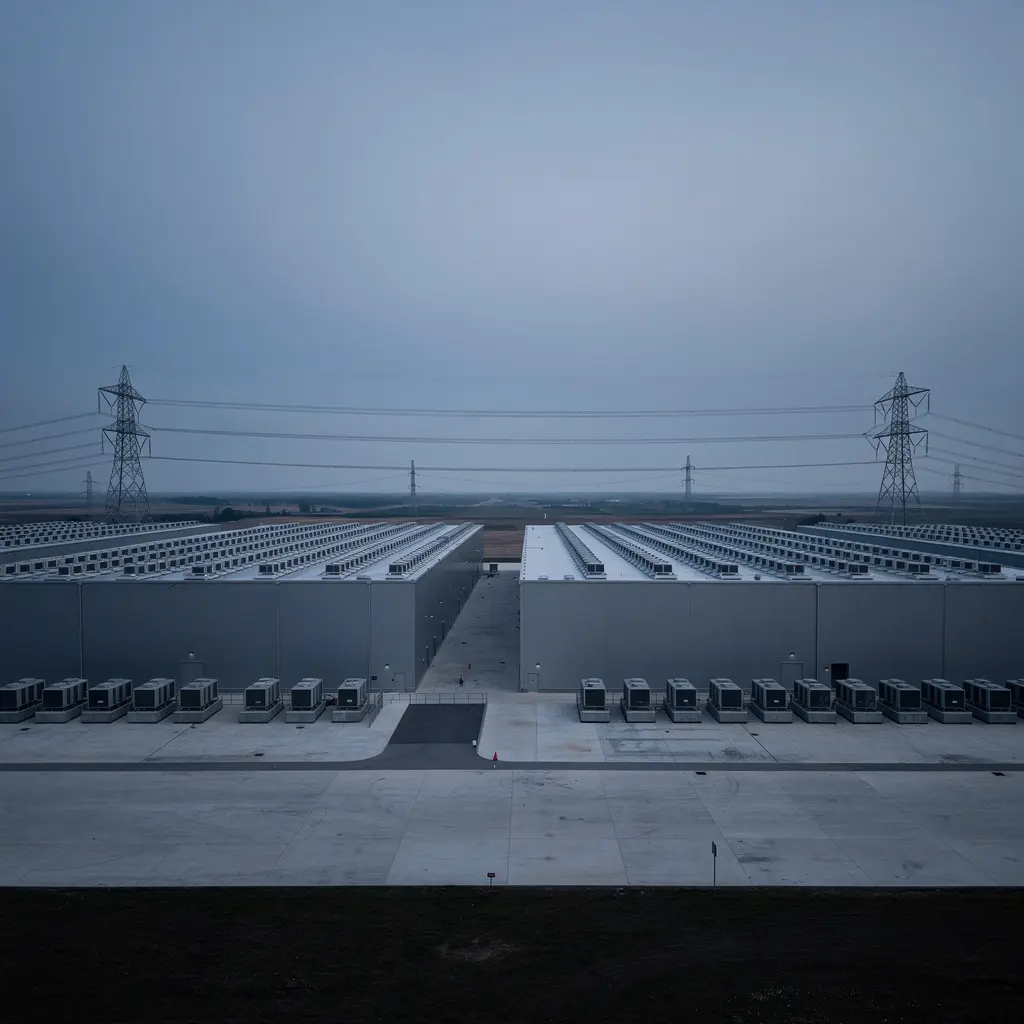
- Capacity delivery is large and disclosed: more than 1.2GW handed to customers across FY2026, with Q1 FY2027 delivery approaching 1GW, against more than 10GW of power and data-centre capacity secured for the next three years.
- A material share of the recent backlog was funded by customers: $75 billion of prepaid or customer-supplied hardware sat inside Oracle's large AI contracts at the FY2026 year-end, which changes who carries the capital cost but not who must deliver the power, the space and the acceptance milestone.
- The open question is timing rather than intent: whether the contracted estate reaches acceptance on the schedule management describes, and which published indicators would show conversion slipping.
Contracted value is not revenue
RPO is a stock of contracted work not yet recognised. It is not cash, not capacity and not a quarter's revenue. Oracle's own reporting makes the size of the gap explicit. RPO stood at $455 billion at the end of Q1 FY2026, up 359% year over year, in a quarter with total revenue of $14.9 billion, cloud revenue of $7.2 billion and cloud infrastructure (IaaS) revenue of $3.3 billion (Oracle Q1 FY2026 results). It then moved to $523 billion at the end of Q2 FY2026, described in Oracle's release headline as up 438% year over year in US dollars, on total revenue of $16.1 billion and IaaS revenue of $4.1 billion (Oracle Q2 FY2026 results); to $553 billion at the end of Q3 FY2026, up $29 billion sequentially, on revenue of $17.2 billion and IaaS revenue of $4.9 billion (Oracle Q3 FY2026 results); to $638 billion at the end of Q4 FY2026, up $85 billion sequentially, on revenue of $19.2 billion and IaaS revenue of $5.8 billion (Oracle Q4 and FY2026 results); and to $664 billion at the end of Q1 FY2027, up $209 billion year over year, on revenue of $19.3 billion, total cloud revenue of $11.6 billion and IaaS revenue of $7.4 billion (Oracle Q1 FY2027 results).
The flow inside that stock is smaller by an order of magnitude. Oracle's Q3 FY2026 release set out quarterly cloud infrastructure revenue of $3,347 million, $4,079 million and $4,888 million for the first three quarters of that year (Oracle Q3 FY2026 results), and the series closed FY2026 at $18.1 billion for the full year, up 77%, against total revenue of $67.4 billion and total cloud revenue of $34.0 billion (Oracle Q4 and FY2026 results). On those figures, $664 billion of RPO is roughly ninety quarters of cloud infrastructure revenue at the Q1 FY2027 rate — a comparison that overstates the distance, because the backlog also covers cloud applications and database services and stretches over multi-year contract terms, but which shows that contracted value and recognised revenue are two different objects.
What has moved fastest is the numerator. RPO grew by $209 billion in the year to Q1 FY2027 while quarterly IaaS revenue grew by $4.1 billion — an annualised addition of roughly $16 billion. The backlog is still compounding several times faster than the revenue stream it is meant to become. That statement is about contracts signed, not about capacity delivered.
What has actually been delivered
The delivery record is the part of the story Oracle does quantify. Management's own commentary after Q3 FY2026 said the company delivered more than 400MW of capacity to customers in the quarter and that 90% of committed capacity was delivered on or ahead of schedule (Oracle Office of the CEO, Q3 FY2026). Q2 FY2026 earnings-call coverage put that quarter's handover at close to 400MW with GPU capacity 50% above Q1 — a figure that comes from call coverage rather than from Oracle's financial statements, and is reported alongside the quarter's release (Oracle Q2 FY2026 results).
At the year-end, the same commentary said Oracle delivered more than 1.2GW of data-centre capacity to customers across FY2026 and that Q1 FY2027 delivery was approaching 1GW, nearly the same capacity as the whole of the prior year (Oracle Office of the CEO, Q4 FY2026). It also gave site-level timelines: the Abilene, Texas site had delivered 42% of its total capacity, with a further 35% due within 90 days and the remainder in the following quarter; delivery at Shackelford, Texas was scheduled to begin in the first half of calendar 2027, with 115MW of power already online more than a month ahead of schedule; and delivery at Doña Ana, New Mexico, Port Washington, Wisconsin and Saline, Michigan was scheduled to begin in the first or second half of calendar 2027 (Oracle Office of the CEO, Q4 FY2026). Those timelines are the clearest public evidence that a large part of the contracted estate was still undelivered at the FY2026 close.
Two operating statistics from the same commentary describe what happens to capacity once it is handed over. Global GPU utilisation was 97.5% in Q4 FY2026; in that quarter 35,000 GPUs from 59 customers came up for renewal, and 49% of those customers renewed for 92% of those GPUs, with most of the remainder resold to other customers in the quarter. Four customers each contracted for more than $8 billion in the same quarter (Oracle Office of the CEO, Q4 FY2026). High utilisation is evidence that delivered capacity is being consumed. The renewal outcome is a small, dated test of whether the demand behind the backlog is sticky, and it is worth watching precisely because it is disclosed in customer counts and GPU counts rather than in contract value.
Who pays for the GPUs
The structure of the contracts is as important as their value. Oracle's FY2026 year-end filing language states that most of the RPO increase in Q3 and Q4 came from large-scale AI contracts in which the customer either prepaid Oracle for the purchase of GPUs or bought and supplied the GPUs itself, and that the prepaid and customer-supplied hardware portions of those large AI contracts then totalled $75 billion (Oracle EX-99.1, FY2026 year-end filing). Management's Q3 commentary described more than $29 billion of AI infrastructure deals signed since the prior earnings call using bring-your-own-hardware and upfront customer payments, and said that through partners the company had secured more than 10GW of power and data-centre capacity coming online over the next three years, with more than 90% of that capacity described as fully funded (Oracle Office of the CEO, Q3 FY2026).
Three consequences follow, and they pull in different directions. First, customer prepayment and customer-supplied hardware reduce the capital Oracle itself must commit to those specific deals, which is why the backlog can grow faster than the company's own balance sheet. Second, they move GPU price and allocation risk toward the customer, so a slip in accelerator supply shows up in someone else's delivery schedule rather than only in Oracle's. Third, they change nothing about the deliverables Oracle still owes: the powered shell, the networking, the cooling, the operations staff and the acceptance milestone that turns a contract into revenue. Management's own framing acknowledges this — that all of it ultimately resolves into capacity delivered to customers and revenue to Oracle (Oracle Office of the CEO, Q3 FY2026). It also means the $75 billion figure describes a subset of the backlog, not the whole of it; the rest of the contracted estate does not automatically arrive with customer funding attached.
"Fully funded" is management language published in commentary, not an audited financial statement, and the same is true of every megawatt figure in this article. Delivered capacity is an operating metric: it measures what has been commissioned and handed over, not what a customer has accepted, consumed or paid for. The distinction matters because a megawatt is a prerequisite for revenue, not a proxy for it.
Financing the distance between the two numbers
Oracle reports capital expenditure on more than one basis, and the two bases tell different stories. Its FY2026 year-end release puts capital expenditures on a trailing-four-quarter basis at $55,663 million alongside a net cash outlay for capital expenditures of $47,726 million, with trailing-four-quarter free cash flow of negative $23,686 million, compared with negative $394 million a year earlier (Oracle Q4 and FY2026 results). The gap between the gross and net figures is customer prepayments and manufacturer financing — the same contract structure described above, operating as working capital rather than as a headline.
The funding plan is disclosed in the same release: $43 billion of debt financing and $5 billion of equity financing raised in FY2026, approximately $40 billion expected to be raised in FY2027, and no expectation of issuing additional debt in calendar year 2026 (Oracle Q4 and FY2026 results). Set against that, FY2026 cloud infrastructure revenue of $18.1 billion versus trailing-four-quarter capital expenditure of $55,663 million is a reminder that the capital is committed on a shorter cycle than the revenue it is intended to earn. That is the normal arithmetic of a build-out phase, not evidence of a problem in itself. It does mean the acceptable range of delivery slippage is narrow, because the cash has already left.
One dated check on the plan is worth recording. At Q1 FY2026, management guided OCI revenue to about $18 billion for FY2026, then to $32 billion, $73 billion, $114 billion and $144 billion over the following four years, noting that most of that five-year forecast was already booked in reported RPO (Oracle Q1 FY2026 results). FY2026 closed with cloud infrastructure revenue of $18.1 billion (Oracle Q4 and FY2026 results) — the first year of that ladder landed within a rounding error of the number given. The forward years are the ones that now depend on capacity, power and permitting rather than on demand.
Where the numbers disagree
Two growth rates were published for the same quarter. Oracle's Q2 FY2026 release headline stated RPO up 438% year over year in US dollars (Oracle Q2 FY2026 results), while earnings-call coverage of the same quarter put it at 433% (Oracle Q2 FY2026 results). Both are attributed here as reported; they are not reconciled in this article. The difference is immaterial to the mechanism and worth flagging only because it shows how quickly secondary figures harden into facts.
Three further boundaries apply to everything above. First, the $55,663 million capital-expenditure figure is a trailing-four-quarter number taken from a free-cash-flow table, not a single-quarter figure, and should never be presented as quarterly capex; single-quarter capex was retrieved only for Q2 FY2026 and Q1 FY2027. Second, Q4 FY2026 single-quarter delivered capacity is not stated directly and can only be inferred from the FY2026 total of more than 1.2GW and the Q1 FY2027 figure approaching 1GW. Third, the Q1 FY2027 release was retrieved in part; details of that quarter beyond the headline figures should be treated as company-reported rather than as fully inspected audited tables. The contracts that name Meta, NVIDIA and other customers are attributed to Oracle's own disclosure of its Q2 FY2026 sequential RPO increase (Oracle EX-99.1, FY2026 year-end filing); the underlying contract terms are not public.
What would falsify this account
The thesis here is narrow: Oracle's contracted backlog is real as contracted value, and its conversion into revenue is gated by delivered, powered, accepted capacity. That thesis fails if conversion turns out to be unconstrained by delivery — for example, if IaaS revenue growth accelerates while delivered megawatts and site timelines stay on plan, which is what the FY2026 delivery record and the Q1 FY2027 approach to 1GW would predict.
It also fails if the backlog proves to be a poor predictor of future revenue for a different reason: contractual structures that permit substitution, renegotiation or deferral on terms the company has not disclosed.
The published signals that would settle it are specific. Quarterly RPO against quarterly IaaS revenue, watched as a ratio rather than as two headlines. Delivery against the disclosed site calendar — Abilene's remaining 58%, and whether the first-half and second-half 2027 start dates at Shackelford, Doña Ana, Port Washington and Saline hold. The prepaid and customer-supplied share of large AI contracts, which fell out as $75 billion at the FY2026 year-end and would rise or fall materially if the mix changes. GPU renewal outcomes, disclosed in customer and GPU counts. Capital expenditure on a single-quarter basis alongside IaaS revenue, so that capex and revenue can be compared on the same clock. Financing raised against the approximately $40 billion indicated for FY2027. And region count, which stood at 147 live customer-facing regions with 64 additional regions planned as of Q2 FY2026 (Oracle Q2 FY2026 results) — a slower-moving measure that shows whether the estate is widening or deepening.
The directory record for the entity at the centre of this analysis is at Oracle Cloud.
Member Briefing
Deeper Profile Context
Sign in with the right membership level to unlock the full briefing and source notes.
Only for Strategic Circle
Strategic Circle
Open to all readers. Unlock profile briefings after joining and signing in.
Join Strategic CircleOnly for Leadership Alliance
Leadership Alliance
For qualified IP-asset owners and management; sign in to unlock alliance briefings.
Join Leadership Alliance