
Summary
- Oracle says its investments cover more than 1.7GW across ten Texas wind projects supplied by Clearway, ENGIE, RWE and Scout. That is a portfolio headline, not evidence that Oracle owns 1.7GW of generation or that all ten projects are new.
- RWE identifies its 433MW component as a virtual power purchase agreement over Panther Creek I, II and III—existing West Texas farms repowered in 2019 and 2021.
- A VPPA is a financial contract. It does not, by itself, deliver the farms’ electrons to Oracle, reserve the ERCOT grid, make wind dispatchable or prove that the matched annual generation equals Oracle’s hourly consumption.
- Renewable-energy-certificate rights can be part of a VPPA, but the reviewed RWE disclosure does not state who owns, transfers or retires the certificates under this contract.
- Oracle’s 2035 carbon-free matching goal, its household equivalence and its avoided-emissions estimate remain a future target and company estimates, not measurements of current Abilene load or system reliability.
The most useful number in Oracle’s Texas wind announcement is not 1.7GW. It is 433MW.
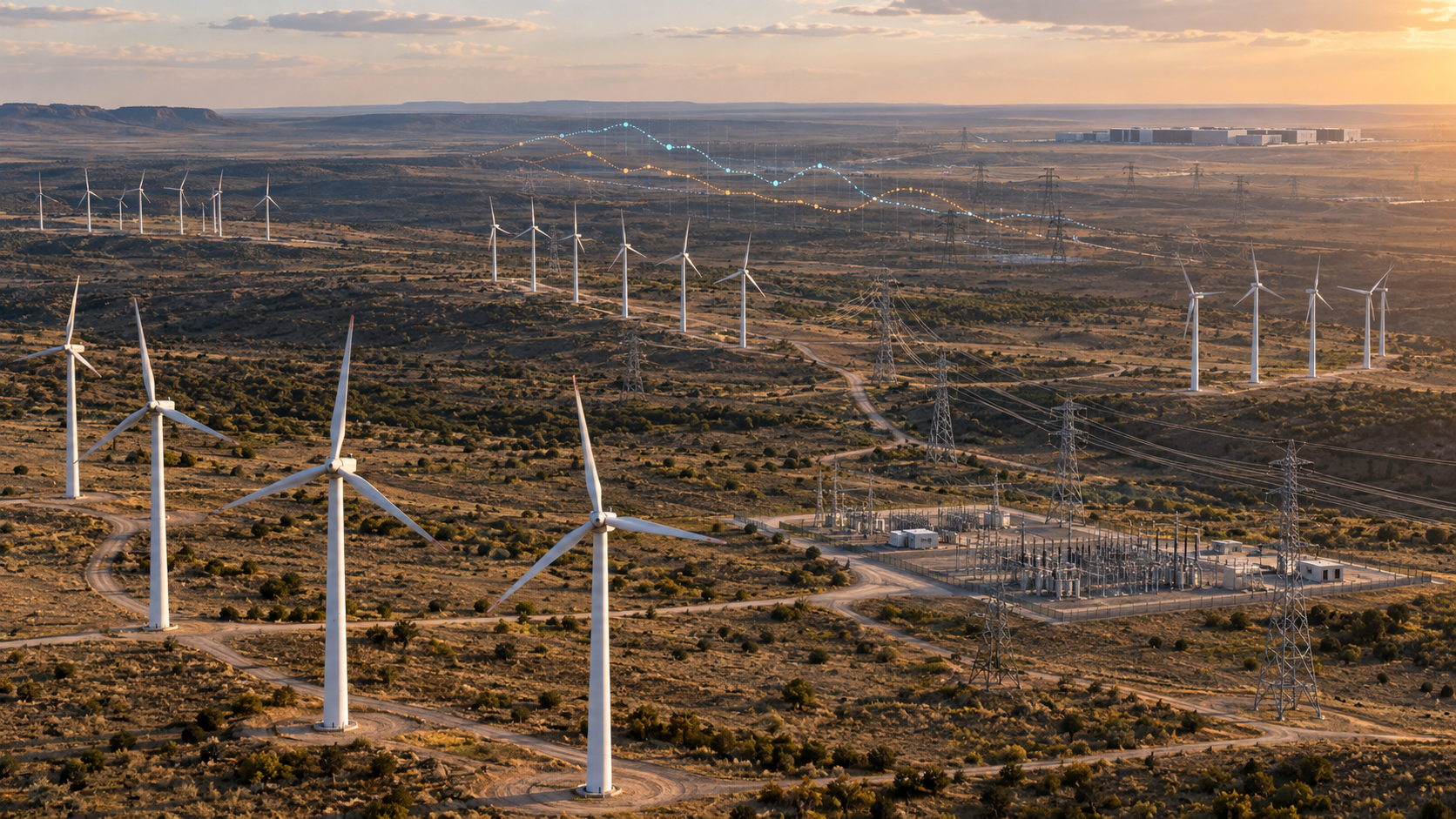
That smaller number comes with a contractual label and an asset history. On 17 September, RWE said it had signed a 433MW virtual power purchase agreement with Oracle covering Panther Creek I, II and III in Sterling, Howard and Glasscock counties. The farms are already operating. RWE says the first two were repowered in the third quarter of 2019 and the third in 2021. The disclosure therefore provides a visible slice of Oracle’s larger claim and establishes that at least part of the announced portfolio is neither an Oracle-owned plant nor newly commissioned generation.
Oracle’s own release says it is making “investments” in more than 1.7GW across ten wind projects from four suppliers. It says the projects will inject electricity into ERCOT, the Texas grid that also powers its Abilene AI data centre, and estimates that their annual output is equivalent to the use of more than 525,000 homes. Those sentences describe scale and corporate purpose. They do not disclose one standard contract across all ten projects, the capital structure of each deal or how much of the portfolio consists of new construction, repowering, existing output or financial offtake.
The RWE component is consequently a boundary marker, not a template for the undisclosed remainder. It proves that 433MW is attached to three existing facilities through a VPPA. It does not prove that every other supplier agreement has the same structure, or that the residual capacity is existing. What it does rule out is the casual reading that the entire 1.7GW headline represents Oracle building, buying or directly powering itself from ten new wind farms.
A VPPA settles value, not a physical route
The US Environmental Protection Agency describes a financial, or virtual, power purchase agreement as an arrangement in which the buyer does not take physical delivery of electricity. The project sells into the wholesale market; the parties settle the difference between a contractual price and a market price, subject to the agreement’s terms. The buyer continues to obtain physical electricity through its ordinary utility or retail arrangements.
That distinction matters in ERCOT. RWE can inject output from Panther Creek into the grid while Oracle consumes electricity at Abilene without any claim that the same electrons travel between the two sites. The grid balances many generators and loads. A financial hedge or procurement claim does not reserve transmission, establish deliverability during congestion, or replace the interconnection and retail-service arrangements that keep a data centre energised.
The contract’s economics are also undisclosed. Neither company gives the VPPA strike price, tenor, settlement hub, shape, volume tolerance, negative-price treatment, curtailment allocation, credit support or termination rights. Without those terms, the market cannot calculate whether the contract will be an asset or liability in a given period, how closely it hedges Oracle’s actual power price, or which party bears particular basis and operating risks.
Certificates are a separate ledger
Environmental attributes should not be silently folded into the capacity number. Renewable energy certificates are the instrument normally used to substantiate renewable electricity claims in the United States. A VPPA may convey certificates, but certificate ownership and retirement depend on the contract.
RWE’s announcement does not state whether the 433MW deal transfers all associated certificates to Oracle, whether certificates are sourced from the same generation, when they are retired or how geographic and temporal matching is handled. That absence is not evidence that certificates are missing. It is a reason to leave the ledger open. The proper receipt would identify the certificates delivered and retired, the reporting period and the claim they support.
Nameplate megawatts do not measure consumed megawatt-hours
The 433MW and 1.7GW figures are capacity quantities. The US Energy Information Administration defines nameplate capacity as the maximum rated output under specified conditions. Electricity consumed over time is measured in megawatt-hours. Converting one into the other requires operating performance and a time interval; matching it to a data centre also requires a load profile.
Oracle has not disclosed Abilene’s current electricity consumption, the centre’s hourly demand, the generation profile assigned to it, or an hourly matching result. The release’s comparison with 525,000 homes is an annual-generation equivalence based on expected output, not a meter reading at the data centre. Its estimate of 1.8 million tonnes of annual avoided emissions similarly uses expected generation and an EPA grid factor. It is a corporate estimate, not a verified ex-post emissions inventory.
Wind output varies with weather. ERCOT’s own operational dashboards distinguish actual and forecast production and show dispatch limits alongside generation. Congestion and curtailment can separate what a farm could produce from what the system accepts. A data centre, meanwhile, demands power according to its own operating pattern. The portfolio may improve the economics of renewable generation and support annual matching, but it does not turn intermittent output into firm, round-the-clock capacity.
The 2035 statement is a goal, not present tense
Oracle says it aims to match 100% of the electricity used by its AI data centres with carbon-free energy by 2035. That wording contains a date, a scope and an accounting verb. It does not say the Abilene site is already operating on 100% carbon-free electricity, nor does it disclose whether future matching will be annual, hourly, regional or backed by storage and firming.
Reliability claims need their own evidence. A VPPA can influence price exposure and support a project’s revenue. It does not control ERCOT dispatch, guarantee wind availability or demonstrate that Oracle has secured the transmission, generation, storage and backup services needed at every hour. ERCOT’s September request for information about large unelectrified data-centre projects illustrates that grid planners are separately examining large-load interconnection. That notice was system-wide and is not evidence about Oracle’s project status.
The same discipline applies to price. Oracle says the portfolio should support stable, predictable electricity costs. That is a company claim. Its effect depends on undisclosed contract prices, settlement points, volumes and the relationship between wind generation and Oracle’s actual load. A VPPA can reduce one exposure while leaving basis, shape, congestion and retail-delivery costs intact.
Read the portfolio as ten contracts, not one power station
RWE’s disclosure turns Oracle’s announcement from a capacity story into a contract-composition question. At least 433MW—less than 25.5% of a portfolio described as greater than 1.7GW—comes from operating, repowered assets under a financial agreement. Because Oracle says “more than” 1.7GW, even that percentage is an upper bound rather than an exact share.
The unresolved portion should be analysed supplier by supplier: which facilities are new, which already operate, which agreements are physical or virtual, which environmental attributes transfer, which market nodes determine settlement, and which dates mark commercial operation or contract delivery. Until those receipts exist, the 1.7GW total is a useful description of contracted or supported capacity across a portfolio. It is not an ownership register, a construction schedule, a dedicated wire, an hourly energy balance or a reliability certificate.
Sources
- Oracle announcement on the Texas wind portfolio
- PublicNow mirror of Oracle’s announcement
- RWE disclosure of the 433MW Panther Creek VPPA
- US EPA guidance on financial power purchase agreements
- US EPA guidance on renewable energy certificates
- US EIA glossary definition of nameplate capacity
- ERCOT real-time system conditions and generation information
- ERCOT notice requesting information on large unelectrified data-centre projects
Member Briefing
Deeper Profile Context
Sign in with the right membership level to unlock the full briefing and source notes.
Only for Strategic Circle
Strategic Circle
Open to all readers. Unlock profile briefings after joining and signing in.
Join Strategic CircleOnly for Leadership Alliance
Leadership Alliance
For qualified IP-asset owners and management; sign in to unlock alliance briefings.
Join Leadership Alliance