Summary
- RFC 1557, published in December 1993, described a Korean plain-text mail body labelled
ISO-2022-KR: begin in ASCII, designate KSC 5601 withESC $ ) C, enter two-byte Korean text withSO, and return to ASCII withSI. - Korean text in the message header took a different route. It used
EUC-KRbytes wrapped in an RFC 1522BorQencoded-word. Decoding the subject and decoding the body were separate jobs.
The subject line had its own customs desk
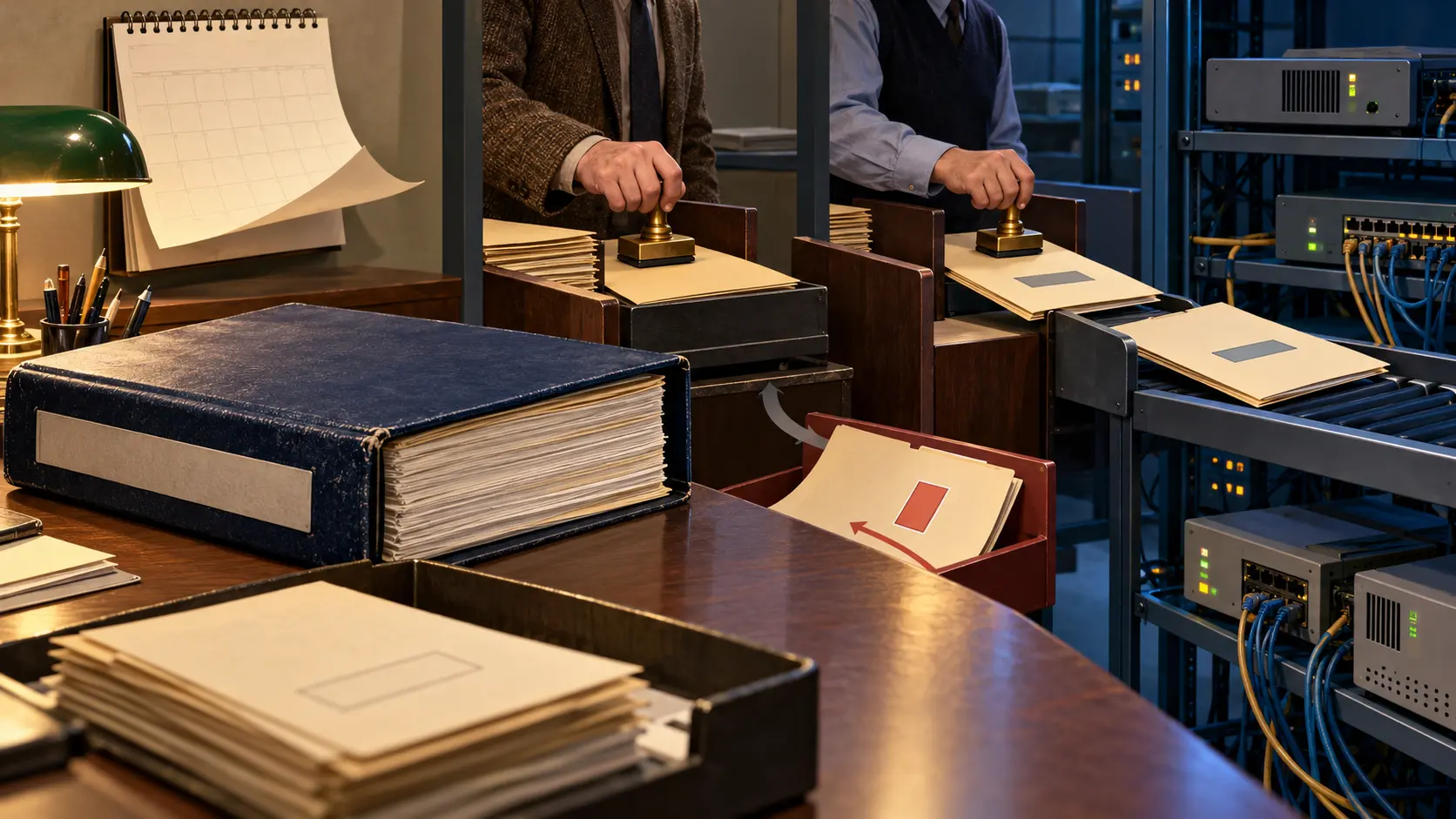
Imagine a 1993 reader opening a message whose subject says, in Korean, that a meeting has moved. Below it, the body carries the new time. One part renders and the other shows a busy collection of punctuation and control characters. The message has not split into two deliveries. Its header and body ask the software to perform two different conversions.
The division comes from mail's older architecture. RFC 822 gave Internet mail a header of structured fields followed by a body. Header fields travelled through software that might fold lines, rearrange addresses or treat punctuation as grammar. The body was a different stretch of text. When Korean characters entered both places, one label pasted across the whole message could not tell each parser what to do.
U. Choi, K. Chon and H. Park set out the arrangement in the December 1993 RFC 1557. They wrote that the method had been specified in 1991 and was in wide use on Korean IP networks. Their memo described plain text. Its most revealing feature is the split: the same reader-visible language wears a seven-bit outfit in the body and an eight-bit character set inside an ASCII-safe wrapper in the header.
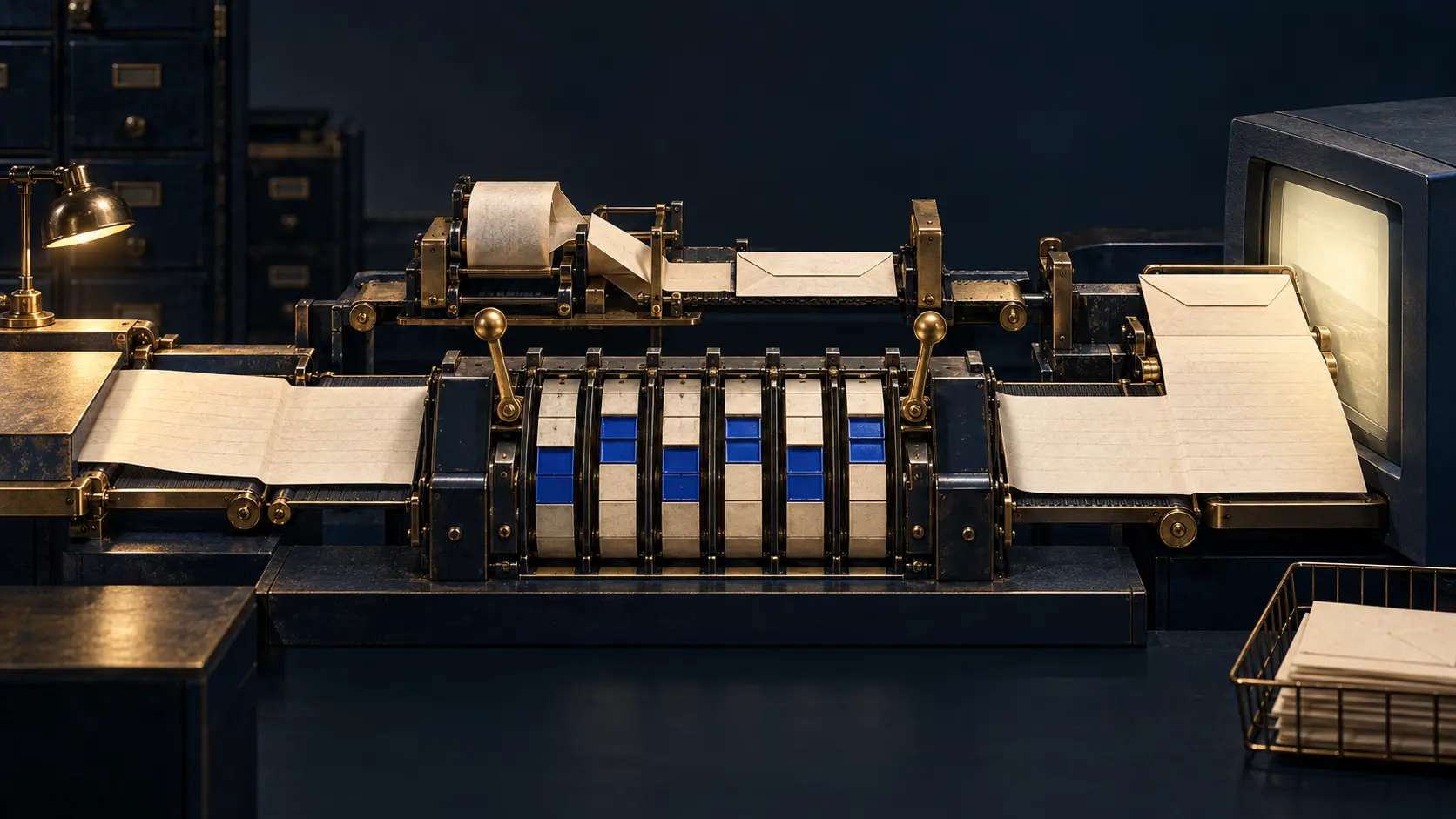
The body starts in ASCII. To introduce Korean characters, the stream designates KSC 5601 with the escape sequence ESC $ ) C; SO then shifts interpretation to pairs of bytes from that 94-by-94 set. SI shifts back to ASCII. KSC 5601 includes Hangul, Hanja and other characters. These small control bytes act like switches on a railway: a pair of identical-looking graphic bytes can be read differently depending on which track the decoder has entered. The Content-Type charset for this body is ISO-2022-KR.
The RFC's explanatory passage places the designation at the beginning of a line before SO. Its formal grammar allows a designator before the sequence of subsequent Korean-bearing lines, and the authors say that formal syntax takes priority if the two descriptions disagree. An archivist should therefore inspect the actual escape sequence and shift state, not impose a fresh-designation-on-every-line rule borrowed from a different encoding. Losing the initial designation can make later bytes harder to interpret even while the surviving text looks orderly.
Because the body scheme uses seven-bit bytes, RFC 1557 says it does not need a Content-Transfer-Encoding header for that reason. The authors also report that Korean mail software of their time did not support adding Base64 or Quoted-Printable over a body already encoded this way. That observation belongs to the 1993 software environment. The visible message format still needs its own body charset so a reader knows which switching grammar it has received.
Now look above the blank line separating header from body. RFC 1557 assigns Korean header text to EUC-KR, whose high-bit bytes represent KSC 5601 characters. Those bytes are then carried as B or Q encoded-words under RFC 1522. The wrapper has a recognizable shape: =?charset?encoding?encoded-text?=. It lets an old header parser encounter printable ASCII while a capable reader reconstructs the Korean words. The header's declared charset is EUC-KR; the body's is ISO-2022-KR. A client that applies the body's decoder to the subject has taken the wrong passport at the customs desk.
There is an elegant historical compromise here. The body gets a stream of explicit switches that fits a seven-bit mail path. The header gets small, self-described ASCII envelopes suited to fields that mail relays may fold or rearrange. They meet only at the reader's screen, where both must produce the same human language. RFC 1557 records the seam in the machinery. The email looks singular to its recipient because two different decoders have done their work.
Member Briefing
Deeper Profile Context
Sign in with the right membership level to unlock the full briefing and source notes.
Only for Strategic Circle
Strategic Circle
Open to all readers. Unlock profile briefings after joining and signing in.
Join Strategic CircleOnly for Leadership Alliance
Leadership Alliance
For qualified IP-asset owners and management; sign in to unlock alliance briefings.
Join Leadership Alliance