Summary
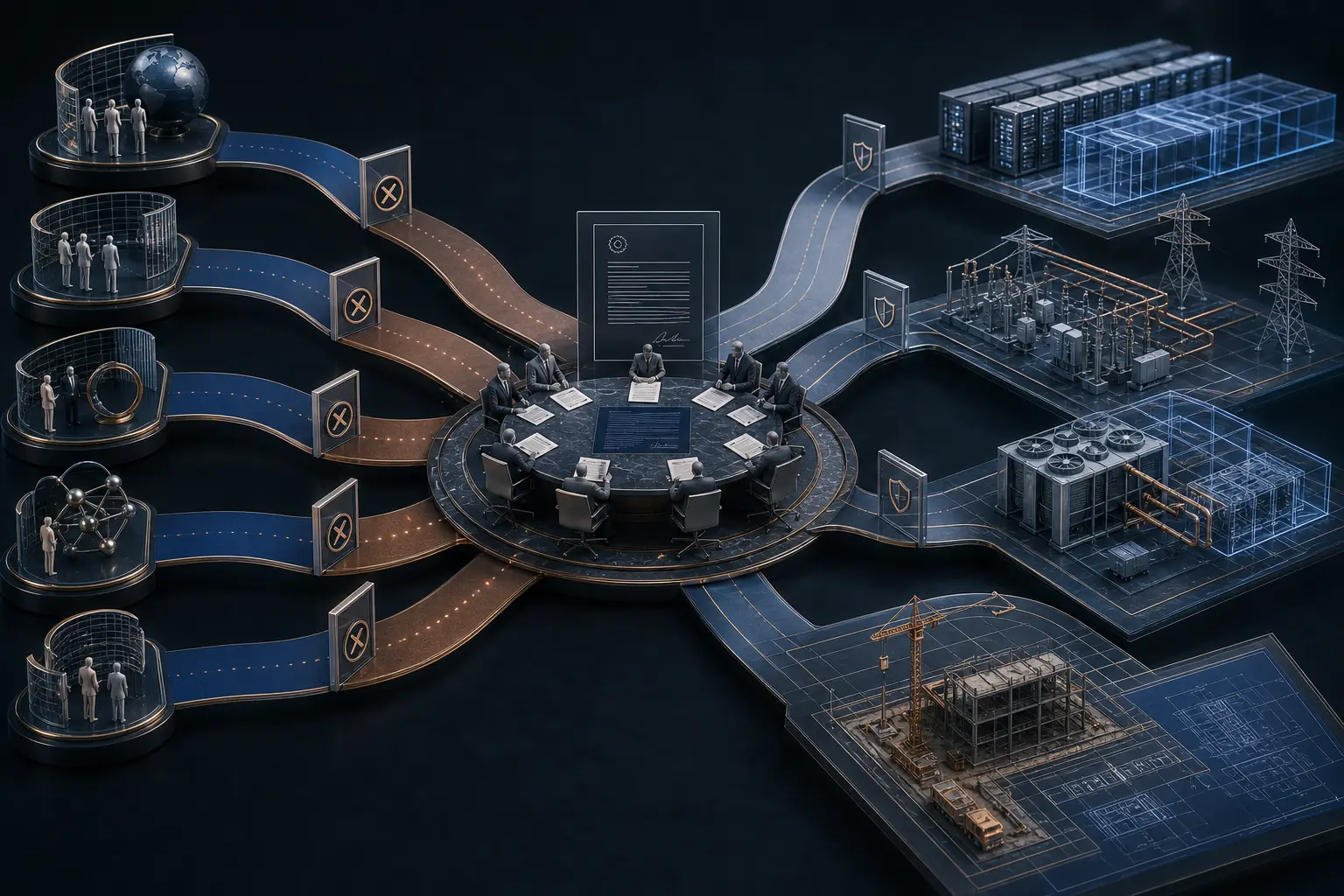
- Selected AI clouds procure NVIDIA data-centre infrastructure, while NVIDIA commits to buy cloud service from them. The commitments totalled US$36 billion at 26 July 2026 and typically run for six years.
- A cloud partner can stop serving NVIDIA and sell the capacity to a third party at a more advantageous rate. The commitment declines as third parties or NVIDIA’s research workloads use capacity.
- The schedule is zero for the rest of fiscal 2027, then US$6 billion, US$8 billion, US$7 billion, US$6 billion and US$9 billion across fiscal 2028 through 2032-and-after. It is not revenue, backlog, debt or cash already paid.
- A separate US$29 billion cloud-service ledger funds NVIDIA’s own open-model and autonomous-vehicle R&D. Combining the two figures would erase the very distinction the filing makes.
One deployment, two commercial legs
The model begins with a hardware purchase. NVIDIA says selected AI-cloud partners have demand and sales pipelines but face the scale of infrastructure required to meet them. The partner procures NVIDIA data-centre products. NVIDIA then commits to purchase cloud service from the same class of partner.
Those legs can reinforce each other, but they are not the same transaction in economic time. Hardware may be ordered, delivered and recognised before an outside workload fully occupies it. The future service commitment absorbs some of that timing risk. NVIDIA is therefore not merely a component supplier waiting for a cloud’s customers to arrive. It becomes a fallback user of the capacity its own products create.
That distinction matters in a quarter when NVIDIA reported US$96.2 billion of revenue, including US$89.0 billion from Data Center, and a 75.0% GAAP gross margin. The company guided fiscal-Q3 revenue to US$108.0 billion, plus or minus 2%. Those numbers establish scale and momentum. They do not identify how much current hardware revenue came from this new model, how much capacity has been energised or how much service expense will follow.
A sale to a participating cloud is consequently not proof of independent end-customer demand. It may be part of a deployment whose residual demand risk NVIDIA has agreed to carry. The missing bridge is product procurement, installation, power, billable capacity, outside utilisation and then service cash flow.
The partner holds the redirection switch
The decisive clause is unusually clear. NVIDIA says an AI cloud can unilaterally stop providing the service to NVIDIA and sell it to third-party customers at more advantageous rates. NVIDIA also says its commitment declines when third parties use the capacity or when NVIDIA uses it for research and development.
The result is not a conventional fixed take-or-pay reading. If an enterprise, model builder or sovereign customer bids more, the partner has a route to substitute that demand for NVIDIA. The outside workload reduces NVIDIA’s remaining obligation. If undisclosed criteria are met, NVIDIA may also share in the revenue the partner earns from the third party.
This valve aligns several incentives. The cloud wants the best utilisation and price. NVIDIA wants more systems deployed, productive capacity for its own research when needed, and independent demand that shrinks the backstop. The third-party customer gains access without NVIDIA having to operate every service directly.
But alignment is not equivalence. The filing does not disclose the revenue-share percentage, hurdle, duration, gross-versus-net basis or collection timing. Nor does it say that NVIDIA controls the redirection decision or retains identical access when market demand is strongest. The partner holds the switch described to investors.
Calling the entire US$36 billion “cancellable” would go too far. The filing establishes substitution through a better-paying third party and reduction through use. It does not publish termination fees, minimum volumes or every project remedy. The safer conclusion is that the headline amount contains a demand-sensitive release mechanism whose value cannot be measured from the total alone.
The calendar puts the test beyond this quarter
No payment is scheduled in the additional-commitments table for the remainder of fiscal 2027. The disclosed amounts begin with US$6 billion in fiscal 2028, rise to US$8 billion in 2029, move to US$7 billion in 2030 and US$6 billion in 2031, then leave US$9 billion for 2032 and thereafter.
That staircase matters more than a single six-year average. Physical projects need finance, sites, power, networking and customers before a service commitment becomes useful capacity. A zero near-term column gives deployment time; the US$21 billion concentrated across fiscal 2028–2030 gives investors a period in which outside demand, NVIDIA R&D use or actual purchase expense should become observable.
The table is a schedule of future commitments, not a cash-flow statement. It cannot show when an invoice will be paid, how a partner’s third-party sale reduces a specific year, or whether NVIDIA receives revenue share in the same period. It also cannot show whether a capacity unit is economically substitutable across locations and workloads. A rack available in the wrong geography, network environment or power envelope is not automatically useful R&D capacity.
US$29 billion belongs to another ledger
The 10-Q first presents an ordinary commitment table totalling US$366 billion. Within it, supply and capacity commitments are US$279 billion. Cloud service agreements are US$29 billion. Uncommenced data-centre leases are US$25 billion, equity commitments US$25 billion and capital expenditure commitments US$8 billion.
NVIDIA explains that the US$29 billion cloud-service line supports research and development for open models such as Nemotron, Cosmos and GR00T, as well as autonomous-vehicle software. The US$36 billion AI-cloud line appears later under additional commitments and has the partner-procurement and third-party-redirection mechanics.
The wording overlaps because both involve cloud service, but the perimeters do not. Adding them into a US$65 billion “cloud bill” would double-count no disclosed item, yet it would merge two legally and economically separate tables. Subtracting one from the other would be equally unsupported. The correct monitoring sheet keeps both opening balances and both reduction rules apart.
The same separation applies to NVIDIA’s US$105 billion PORTS guarantee, US$20 billion of additional third-party data-centre leases and US$500 billion capital-provider MOU target. Those arrangements may be part of the same infrastructure expansion, but they transfer different risks to different parties. A guarantee, a lease, a service purchase and a supplier commitment are not interchangeable merely because all help build AI capacity.
The downside is stated, not hypothetical
NVIDIA’s risk factor removes any need to invent the bear case. If AI clouds do not sell the committed capacity to third parties, NVIDIA has agreed to purchase it. The company says it may lack sufficient demand, operational ability to use or ability to resell all of that capacity. Lower AI-compute demand or pricing may also reduce the revenue share it earns.
This is the loss-bearing layer. The partner’s hardware deployment can succeed operationally while independent demand underperforms commercially. NVIDIA may still obtain R&D value, but that value must be demonstrated through actual workloads rather than assumed from nominal access. If neither third parties nor productive internal work absorb the service, an ecosystem-support mechanism becomes a long-lived operating cost.
Counterparty and execution risk sit beside demand risk. NVIDIA does not name the partners, their concentration, the location or quantity of capacity, or the financial protections around delay and distress. The filing warns more generally that customers and partners can fail to secure capital or infrastructure, miss schedules or face insolvency, while power, permitting and community constraints can obstruct data-centre development.
The disclosure therefore proves a structure, not an outcome. Its attraction is real: NVIDIA can accelerate installation, widen distribution and let stronger outside bids release the backstop. Its risk is equally concrete: product demand can be pulled forward while ultimate capacity demand remains conditional.
Sources
Member Briefing
Deeper Profile Context
Sign in with the right membership level to unlock the full briefing and source notes.
Only for Strategic Circle
Strategic Circle
Open to all readers. Unlock profile briefings after joining and signing in.
Join Strategic CircleOnly for Leadership Alliance
Leadership Alliance
For qualified IP-asset owners and management; sign in to unlock alliance briefings.
Join Leadership Alliance