Summary
- The RIPE Database carries an organisation object, ORG-NGA26-RIPE, for Nscale Glomfjord AS with Norwegian company number 924 469 188, the type label LIR, and an address at Sam Eydes vei 47, 8160 Glomfjord.
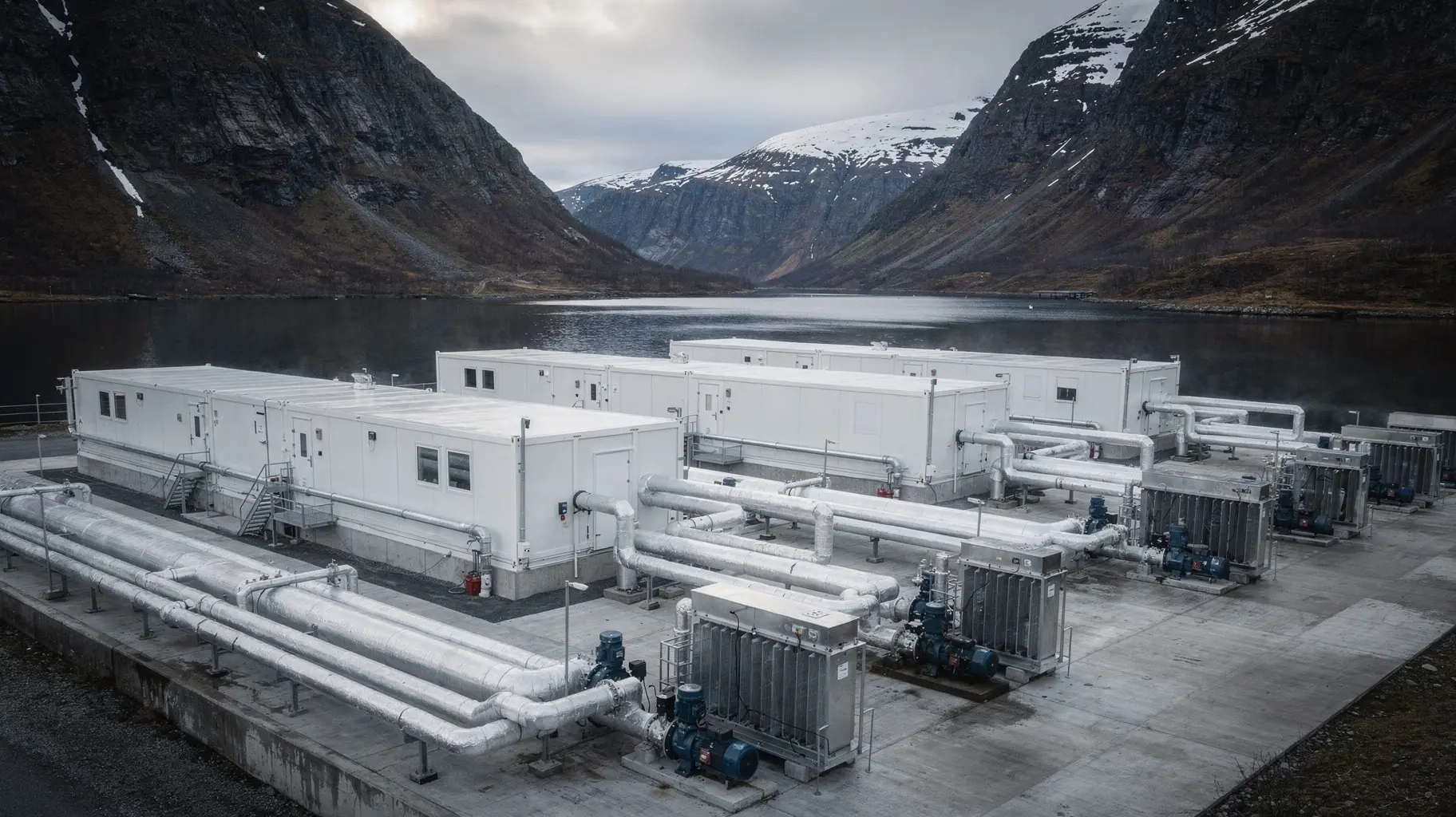
- Reporting by DataCenterDynamics and The Next Web, drawing on Bloomberg, puts 6.4 MW of a planned 30 MW in service on that site and the project roughly six months behind schedule.
- The registry entry is evidence of legal identity and a number-resource relationship. It is not a commissioning certificate, and a late build does not make the registration less real.
Two documents, one street address
The most useful document about Nscale's Norwegian build-out is not a capacity figure. It is a handful of attribute-value pairs that will sit unchanged in a public database until somebody edits them.
The RIPE Database returns an organisation object on a search for nscale: primary key ORG-NGA26-RIPE, org-name Nscale Glomfjord AS, country NO, reg-nr 924 469 188, org-type LIR, and an address split across four lines that ends Sam Eydes vei 47, 8160, Glomfjord, NORWAY (RIPE Database REST search for nscale).
The other document is a construction story. DataCenterDynamics, carrying a Bloomberg report that draws on people close to the project and on public records, says the Glomfjord project is running six months behind schedule and lists the hurdles: construction delays, local regulations, leaks in the cooling system and a transformer fire (DataCenterDynamics on the Glomfjord delay). It puts 6.4 MW of a planned 30 MW in service. The Next Web, working from the same Bloomberg reporting, describes the site as Nscale's flagship and about six months late after cooling leaks and a fire (The Next Web on the Norwegian subcontracting suit).
Same address. Different layer. Almost every bad argument about AI infrastructure comes from letting one layer answer the other layer's question.
What an organisation object actually does
Read the RIPE attributes in order and the record performs three separate jobs, none of them commercial.
It names a legal person. The nine digits 924 469 188 are a Norwegian organisasjonsnummer, the registration number assigned to a company. The AS on the end of the name is a corporate suffix: an aksjeselskap, the Norwegian limited-company form. It has nothing to do with an autonomous system, and anyone who reads AS as network-speak is already in the wrong document.
It fixes a jurisdiction. Country NO and a Glomfjord street address tie this legal person to a municipality on the Norwegian coast, not to a brand, a headquarters city or a customer list.
It types a relationship to number resources. org-type: LIR marks a Local Internet Registry: an organisation the regional registry has authorised to hold and issue blocks of internet numbers in its own name. A Local Internet Registry is an administrative role in a registry system. It is not a service portfolio, a peering policy, a colocation offer or a statement about how much silicon is installed.
An organisation object is also not a company register extract. It records what the registry needs — name, country, number, address — and it stays silent on ownership, directorship and who signs the electricity contract. Nscale describes its facilities as "Purpose-built data centers engineered for AI" with the attributes "Modular", "Liquid cooled" and "Low PUE", and lists Glomfjord among its locations (Nscale corporate site). That is the company's own vocabulary for the site. The registry's vocabulary is narrower and harder to fudge.
The blank where a network would be
A Local Internet Registry label invites an obvious follow-up: does this organisation hold an autonomous system number, an IPv4 allocation, an IPv6 block, a route object? A network needs an autonomous system number before it can announce routes to the rest of the internet, and an allocation is what makes it a holder rather than a name in a directory.
I could not answer that question from the material collected for this article. A targeted lookup of the organisation's inverse resources did not complete, so no autonomous system number or address block can be attributed to ORG-NGA26-RIPE here, and equally none can be ruled out. That is a limit of this retrieval, not a finding about the registry.
Hold the two possible outcomes side by side and the thesis survives either way. An organisation typed LIR that holds allocations is a network operator in the registry's own terms, and still tells you nothing about GPU count, utilisation or whether a single customer workload is running. An organisation typed LIR with no visible allocations is a company that joined the registry system without (yet) publishing a routing footprint, which tells you nothing about whether its halls are full. The registry answers questions about number resources. It was never asked how many megawatts are live.
What the construction reporting says, and who is saying it
The site layer is noisier, and its noise is instructive. The headline number is a schedule slip of about six months. The listed causes are a mix of the mundane and the dramatic: construction delays, local regulation, cooling leaks, a transformer fire.
The causation is contested inside the same report. A source familiar with the project told DataCenterDynamics that the transformer fire happened in December 2025 and destroyed switchgear, that temporary generators carried the cooling load, and that no delay was caused. The cooling leak, the same source said, was resolved within weeks, and the cooling system was finished more than three months before October 2026 without disrupting customers. So the delay is reported and the fire is documented, while the causal link between them is denied by someone close enough to the site to know what the generators were doing.
Keep the quantities straight. A planned 30 MW, with 6.4 MW operational. That is the number worth carrying around, because it is the only figure in the public record that describes delivery rather than intention. Two more details belong to the same reporting: a floating hotel called the Kalmar housing construction workers, and an IPO preparation in which Nscale's own prospectus lists "delays in construction" and "construction site accidents" among risk factors. Those are the company's words about its own exposure, and they are more informative than any press release about ambition.
What no retrieved source settles is what 6.4 MW measures. Grid capacity, IT load, contracted capacity and customer-consumed capacity are four different quantities, and the figure as published does not say which. Anyone who converts it into GPUs, tokens or revenue is inventing a conversion factor.
The slide, in both directions
The mechanism is simple enough to state once. Administrative readiness at the registry layer is durable, public and checkable. Physical delivery at the site layer is reported, contested and lagging. Both carry the same company name and the same street address, so analysts slide between them.
The first slide runs from the registry to the megawatts: a company number, a Local Internet Registry role and a Glomfjord address are treated as proof that the campus is real, funded and running. It is not proof of any of those things. Shell companies register; operating companies register; a registration is a legal fact about an entity, not an engineering fact about a building.
The second slide runs the other way, and it is just as common: a six-month slip, a cooling leak and a transformer fire are treated as evidence that the corporate structure is a fiction or that the numbers are inflated. Nothing retrieved here supports that. A delayed build is normal in industrial construction, and it does not retroactively dissolve a registration that a national company number anchors.
The honest reading is narrower and more useful than either slide. Nscale Glomfjord AS is a Norwegian legal person with a registry identity, and the campus at its address is partially energised and behind its original schedule. An investor who wants to know whether the compute exists should ask about energised IT load and signed offtake. An analyst who wants to know who is accountable should read the registry, the company register and the prospectus, in that order.
The Stavanger suit is a different file
The labour story is real and it is not this story. The Next Web reports that an engineer at Nscale's data centre in Stavanger sued the British AI cloud company, claiming wrongful dismissal and an illegal subcontracting arrangement, with the suit backed by local trade unions, filed on 16 October, and naming subcontractor CloudBrothers. He seeks compensation and a ruling that he should have been classified as an Nscale employee, saying Nscale directed his daily work and shifts.
That is a dispute about employment classification at a different Norwegian site. No retrieved source connects it to Nscale Glomfjord AS, to the organisation object ORG-NGA26-RIPE, or to the Glomfjord build. Lashing it to the megawatt story would produce a satisfying narrative and a false one. Where it belongs is a separate question about how AI capacity is staffed: whether the people who commission cooling systems and pull cable are employees of the company whose name is on the campus, or of somebody three contracts down. That question deserves its own reporting, and it is not evidence about Glomfjord.
The ledger test
Every promised AI campus now arrives with the same furniture: a gigawatt figure, a ribbon, a partner logo, a map pin. Very little of it is falsifiable in the week it is announced. The registry is the cheapest audit trail the industry has, and almost nobody uses it.
Ask four questions of any announced facility and the answers come back in minutes. What legal person is behind it, in which jurisdiction, with which company number, at which street address? Nscale Glomfjord AS answers all four, in public, under ORG-NGA26-RIPE, and the record is short enough to read on a phone. The BTW directory entry for the entity Only for Strategic Circle is the pointer to that reading; the registry itself is the evidence.
Then ask the fifth question, the one the registry cannot answer: how much power is actually being delivered to computing equipment on that site today, and who has contracted to buy what it produces? The reported answer at Glomfjord is 6.4 MW against a 30 MW plan. That gap is the real story — not a scandal, a schedule. It is what building physical infrastructure looks like when the paperwork is already finished and the cooling loop is not.
The company is registered. The campus is unfinished. Confusing those two facts is how an industry talks itself into believing that a filing cabinet is a turbine hall.
Member Briefing
Deeper Profile Context
Sign in with the right membership level to unlock the full briefing and source notes.
Only for Strategic Circle
Strategic Circle
Open to all readers. Unlock profile briefings after joining and signing in.
Join Strategic CircleOnly for Leadership Alliance
Leadership Alliance
For qualified IP-asset owners and management; sign in to unlock alliance briefings.
Join Leadership Alliance