Summary
- NorNed carries 700 MW on TenneT's project page, a reduced maximum transmission capacity of 620 MW dated 17 October 2022 by the Dutch regulator ACM, and a nominal capacity of 683.86 MW in the denominator of ACM's 2024 availability incentive.
- Availability is printed four incommensurable ways across the thirteen documents read for this piece, and the one place it becomes money is that incentive: EUR 400,000 per percentage point against a 95.62% norm, capped at EUR 1,853,631, a cap that binds because 620 MW in every hour of 2024 could reach at most 90.66%.
- Per-link annual energy is printed for COBRAcable alone; NorNed has no annual TWh figure in the reviewed set, and the hours at rating that would join a rating to a delivered quantity are printed by nobody who owns the cable.
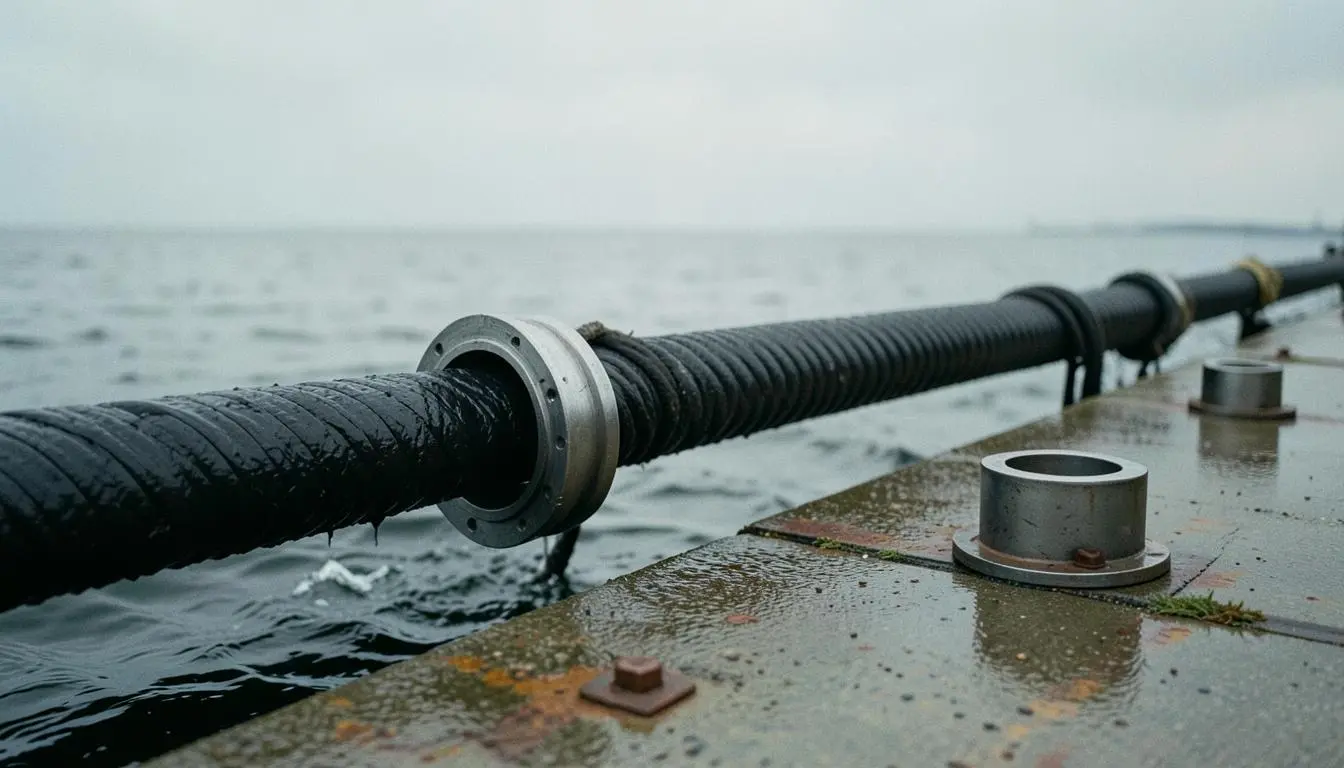
NorNed runs 580 km under the North Sea and has tied the Dutch and Norwegian grids together since 2008. TenneT's project page calls it the longest high-voltage subsea direct current link in the world, states its capacity as 700 MW, names TenneT and Statnett as joint owners, and says capacity and electricity on it are traded through an explicit auction, now run by APX (TenneT, NorNed). That is one capacity.
The Dutch regulator, Autoriteit Consument & Markt, dates a second: as of 17 October 2022 the cable has "a reduced maximum transmission capacity of 620MW instead of 700MW", with restrictions applied after the NorNed outage of 6 May 2022 and measures introduced to cut intraday flow-direction changes (ACM, updated advance communication). Statnett's half-year report for 2026 adds that NorNed "experienced technical challenges resulting in reduced transmission capacity" and that measures were implemented during the first half of 2026 to restore the original 700 MW, without printing a completion date in the excerpt I read (Statnett, half-year report 2026).
ACM's third capacity sits in the annex to its 2024 NorNed bonus/malus decision: a nominal capacity of 683.86 MW, multiplied by the 8,784 hours of calendar year 2024 to produce a denominator of 6,007,026 MW-hours (ACM, NorNed bonus/malus 2024). None of the thirteen documents derives that figure from 700 or from 620. It is printed and left there. Mine, from the two printed numbers: 683.86 divided by 700 is about 0.977, so the incentive's quantity sits roughly 2.3 per cent under nameplate, and 683.86 minus 620 is 63.86 MW.
The incentive is the one page doing arithmetic
The decision fixes a norm of 95.62% of nominal capacity over a calendar year counted as 8,784 hours, and defines relative availability as the sum, hour by hour, of the transport capacity made available to the market, divided by nominal capacity times the hours in the year. With 683.86 MW as nominal capacity, the denominator is 6,007,026 MW-hours. Because NorNed was limited to 620 MW in every hour of 2024, the most it could have made available is 5,446,080 MW-hours, which is at most 90.66%.
The malus is the absolute difference from the norm multiplied by EUR 400,000 per percentage point, capped at EUR 1.2 million in 2004 prices, CPI-adjusted to EUR 1,853,631. Mine: 95.62 minus 90.66 is 4.96 points, and 4.96 times EUR 400,000 is EUR 1,984,000, which clears the cap. The cap therefore binds, and the decision never has to print the available-capacity total it actually measured, because the answer cannot change what is owed. What it prints is a ceiling, not an observation. ACM's separate congestion-income report states the same amount as added to NorNed's revenue and, on its own text, does not print the underlying percentage (ACM, congestion income 2024).
Four percentages, four windows, one word
Availability is printed on four surfaces for four different links, and no reviewed page converts one into another.
TenneT's 2024 integrated report gives a consolidated onshore grid availability of 99.99988% and an offshore grid availability of 97.09%, against 97.90% the year before, and says the offshore result was hit by downtime of the NordLink and COBRAcable interconnectors as well as SylWin1 and Hollandse Kust (zuid Alpha). The inspected passage carries no availability percentage for NorNed, BritNed, COBRAcable or NordLink individually, and no hours at full rating (TenneT, Integrated Annual Report 2024). The 2022 report gives the same measure for three earlier years — 94.08% for 2022, 94.09% for 2021, 94.03% for 2020, against a 95.07% target — and names NorNed among the interruptions that kept the target out of reach, after the cable spent a few months out of service following a cable failure on the Dutch side (TenneT, Integrated Annual Report 2022).
ENTSO-E measures something else and says so. Its technical capacity Emax is the maximum energy a link can physically receive in a year, losses excluded; technical capacity splits into available and unavailable; and the availability percentage it uses is the annual energy ratio EA/Emax, not a share of time, with unavailability hours published in separate charts. On that measure COBRAcable stood at 90% available technical capacity in 2024 and NordLink 2 at 98%, across 26 Nordic and Baltic links — which puts BritNed outside the report's scope (ENTSO-E, HVDC utilisation and availability 2024).
NordLink splits the same way twice. Statnett prints its capacity as up to 1,400 MW across 623 km, taken over from its suppliers on 31 March 2021, while ENTSO-E records two 700 MW monopoles and 1,400 MW bipolar (Statnett, NordLink in operation). A monopole rating and a bipole total are two ways of describing one asset, and neither alone can be called the capacity of this cable.
BritNed's own report moves in calendar years: asset availability of 81.0% for 2024 against 97% in 2023, blamed on an extended planned outage in July and a cable fault on 6 December 2024, with the link back in commercial service after 51 days on 27 January and nine unplanned outages recorded — five bipole, four monopole, at roughly 508 MW and 1,016 MW (BritNed, annual report 2024). NESO runs on financial years and prints 96.29% for 2023-24, in a series that also carries 98.52%, 74.48%, 79.91% and 97.25%, against a capability of 1,000 MW in two 500 MW poles (NESO, system performance report). BritNed's about page adds a fifteen-year average of 92%, with no window stated, beside more than 92 TWh transported over those fifteen years (BritNed, about).
Mine: 81.0% and 96.29% sit 15.29 points apart on different windows, and 92% against 81.0% is 11 points apart on one link. The gaps are printed; the explanation is not.
Energy is printed for one sibling
COBRAcable carries the only per-link annual energy in the reviewed set: 2.3 TWh south to the Netherlands in 2024, printed as 38% of technical capacity, and 1.7 TWh north to Denmark, printed as 28%. Mine: 2.3 divided by 0.38 is about 6.05 TWh and 1.7 divided by 0.28 is about 6.07 TWh, both close to 700 MW times 8,784 hours, or 6.1488 TWh, so the two shares are measured against an annual two-way maximum and 38 plus 28, or 66%, of it was used. The same report puts 85.1 TWh of 131.6 TWh, or 65%, across all covered links, with 11% of technical capacity unavailable — fleet numbers, not a per-link score.
NorNed has no annual TWh figure anywhere in the thirteen documents. BritNed has a fifteen-year cumulative one. So the quotient that turns a rating into a delivered quantity exists for one cable in one table, and for no cable on the page of the party that owns it.
The money closes; the capacity that earned it does not appear
ACM's 2024 congestion report records TenneT gross congestion revenues of EUR 262,283,574, NorNed gross of EUR 75,990,356 rising to EUR 77,843,987 once the EUR 1,853,631 malus is added, and COBRAcable gross of EUR 45,091,210, plus withdrawals including EUR 926,678 for NorNed grid losses, EUR 662,359 for NorNed balancing and reserve power, EUR 1,312,240 for firmness compensation and EUR 14,104,619 for non-nominated long-term transmission rights (ACM, congestion income 2024). The same regulator's earlier estimate for NorNed in 2024 was about EUR 49.7 million, which the final figure superseded (ACM, updated advance communication).
TenneT's interconnectors page prints revenue generated of EUR 1.0 billion for BritNed across 2011-2024, EUR 762 million for NorNed and EUR 211 million for COBRAcable — the latter two with no period, which is why no per-year comparison is made with them (TenneT, interconnectors). BritNed's GBP 130.9 million for 2024, down from GBP 342.9 million, is total company revenue and not congestion income. Mine, and refused as a price: EUR 77,843,987 divided by 6,007,026 MW-hours is about EUR 12.96 per MW-hour, and the same total over 6,148,800 MW-hours is about EUR 12.36. Both are my divisions on printed denominators.
The hour nobody prints
Here is the shape of the record. A rating printed as one symmetric number. An operating maximum dated by the regulator. A nominal capacity used as a denominator. Four availability percentages on four windows, one of them an energy ratio, one a capacity-hours ratio against a norm, two calendar-year or financial-year time measures. Per-link energy for one cable. Money to the euro for two.
The missing document is not a contradiction; it is a conversion. Any page stating, for one named cable and one named year, hours operated at rating — or annual delivered energy beside the rating that produced it — would join the four families of number and could be checked against all of them. ACM's ratio counts the MW put at the market's disposal per hour, so a cable held at 620 MW all year scores 90.66% on capacity however little flowed through it. ENTSO-E measures available energy against a theoretical annual maximum, and excludes BritNed.
TenneT aggregates its offshore links into one percentage and names the cables that dented it, which tells a reader which asset moved the fleet figure without saying by how much.
Whether the 683.86 MW was designed as a control surface or is an accounting residue cannot be settled from the record: nothing derives it, and the cap makes the difference between a measured and an assumed availability immaterial to the amount paid. That is my reading of the documents, not a sentence any of them contains.
What this article read
Every absence here is a count over the thirteen documents linked above, read on 25 November 2026, and it says nothing about an unread page. All thirteen were inspected through provider-supplied text of the exact URL rather than in the publisher's own pagination. Four carried explicit access limits in that retrieval: the ENTSO-E statistics and TenneT's 2024 integrated report were blocked for size and read through indexed text, the ACM congestion report had no readable text layer, and the ACM decision was read as an indexed excerpt.
The 2024 TenneT report was read at filings.xbrl.org and the 2022 report at a TenneT object-storage host; neither URL is on tennet.eu, and both are treated as the company's own filing read at a non-canonical host. The 6 May 2022 outage is dated by ACM alone: I have not read an outage report, a fault investigation or a return-to-service notice for it. No reviewed page states which entity is institutionally entitled to define an interconnector's capacity.
The stake is exact. A lender, a shipper of power or a regulator comparing two cables is comparing a nameplate, an operating maximum, a nominal denominator and a percentage whose window and definition differ by document. Four denominators, one word.
Member Briefing
Read the full trend briefing
Members read the full briefing with the source notes behind every finding.
Strategic Circle
A daily briefing in your language, built from changes we have verified.
Join for USD 20/monthCancel anytime.
Members also get the full research library, a daily briefing on the networks they follow and the private forum.