
Summary
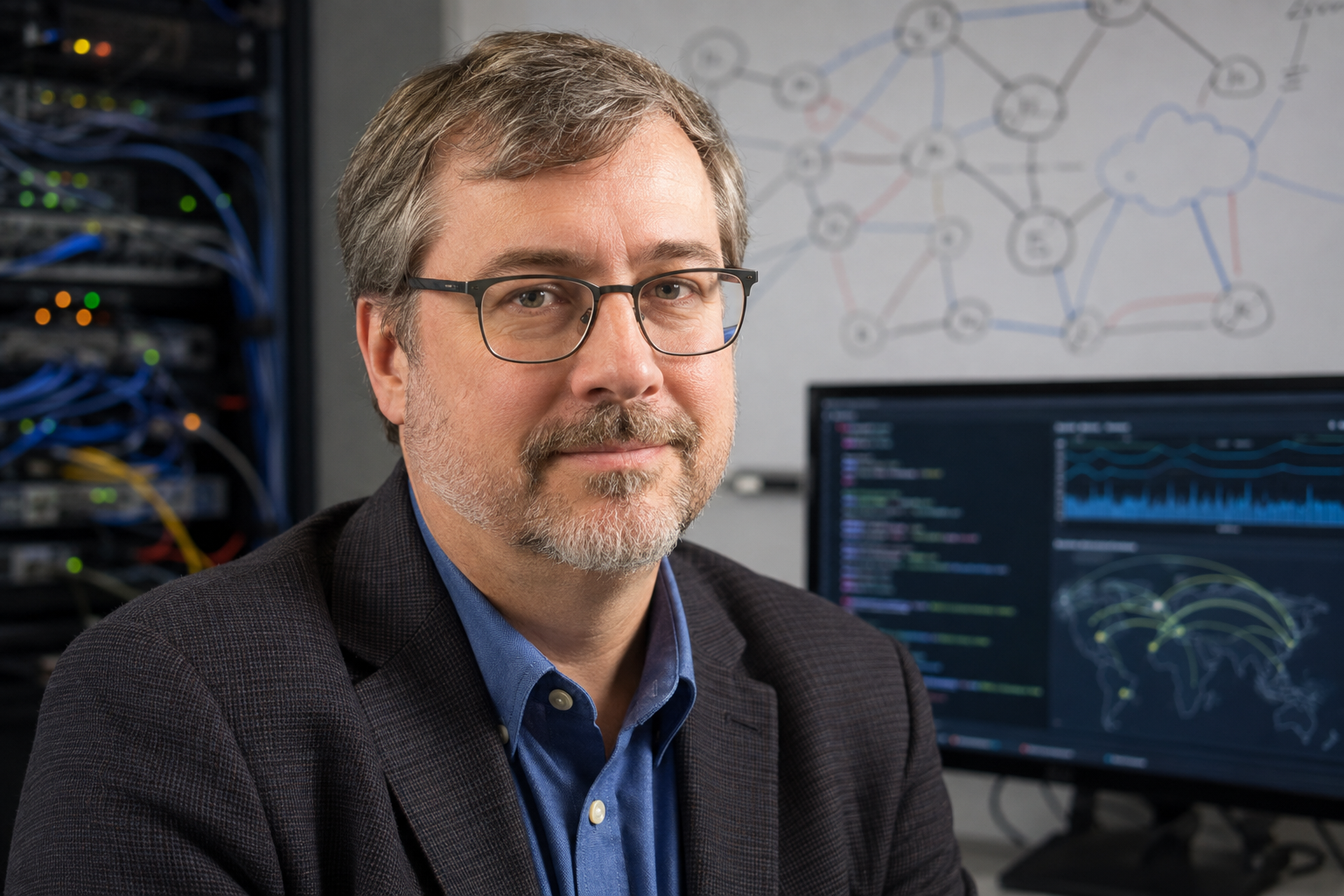
- Nick Feamster is a University of Chicago professor, network measurement researcher, organisation builder, and NetMicroscope co-founder who works to turn invisible internet behaviour into forms usable for accountable decisions.
- rcc reported over 1,000 previously undetected faults across 17 autonomous systems, and the Routing Control Platform contributed to forming a network‑wide control model later linked to SDN.
- Research on spam, broadband, censorship, and smart homes also revealed limits: misclassification due to reputation, dangers of remote measurement, and behaviour inference from encrypted metadata.
- Current machine‑learning research asks whether conclusions can be used efficiently, auditably, and safely in production. The core contribution is collaborative systems that handle uncertainty without eliminating it.
RCC: inspecting combined configurations before deployment
The 2005 paperDetecting BGP Configuration Faults with Static Analysis, co‑authored with Hari Balakrishnan, presented a router configuration checker called rcc. It classified persistent faults into two broad categories. Route validity faults occur when the control plane selects a route that does not correspond to an available data‑plane path. Route visibility faults occur when an available route exists but the necessary router does not learn it. This classification linked configuration commands to results that operators can understand.
rcc parsed configurations from multiple routers and checked network‑wide constraints. The paper analysed 17 autonomous systems, found over 1,000 undetected faults, and reported more than 65 downloads by operators. These are historical author‑reported figures. They do not show that rcc became a universal industry product or how many organisations continued using it. Still, they indicate that it was built for real configurations and reached operators outside the authors' own laboratory.
The operational importance lies in the kind of evidence generated. The checker can show configuration relationships that violate invariants before a fault occurs. This is different from a dashboard that reports packet loss after service degradation. Because it provides a reasoned link between rules and fault classes, it can be used for review, testing, and discussion by multiple teams that have only local views.
The limits are equally important. rcc could only check properties that designers described and that the parser supported. It cannot know undocumented business intent, nor guarantee that there are no vendor bugs or physical failures. It cannot turn a clean configuration into a proof that transient faults will never occur. Even if all written checks pass, the configuration may still violate requirements that no one has expressed.
For this reason, rcc sits at the beginning of the profile. It displayed both the ambition and the moderation that recur later. The ambition is to make infrastructure behaviour computable before harm occurs. The moderation is that correctness is always relative to the observed inputs and the explicit properties. Modern network operation AI faces the same test, but boundaries become harder to see with models that return fluent explanations rather than explicit invariants.
The internet usually knows what it did, but cannot explain why
Packets arrive at their destination or they do not. Video calls freeze, domains return unexpected addresses, mail servers reject connections, smart speakers contact remote services at meaningful moments. Each event leaves traces. Yet the internet has no central ledger that returns a single authoritative explanation. Its behaviour arises from a combination of independently operated networks, vendor‑specific configurations, undisclosed interconnection agreements, home devices, application design, and shifting usage demand.
This structure is valuable because no single operator controls the whole. At the same time, it complicates diagnosis. A router can show the routes it holds but cannot explain all the outcomes of combining multiple policies. A speed test can measure one transfer but cannot cleanly separate the effects of Wi‑Fi, access‑line capacity, latency, interconnection, and application behaviour. A censorship probe can observe a failed request but cannot identify the person or institution responsible. A traffic classifier can assign a label but cannot prove that the label remains correct after the network changes.
Feamster's research career can be read as a series of attempts to narrow these gaps. The target technologies differ, but the method is consistent. First, choose an important but hidden behaviour. Second, find an observation point where that behaviour leaves a measurable signal. Third, express that signal in a form that operators, policy‑makers, and users can query. Finally, verify where that expression fails. The last step is essential: a system that returns confident answers without showing its limits can make infrastructure less accountable, not more explainable.
Feamster owns no optical fibre, operates no public AS, and runs no hyperscale cloud. Yet he is an important figure in digital infrastructure. His work sits in the information layer that surrounds physical assets. It has influenced route inspection, abuse identification, broadband‑quality explanation, censorship documentation, and the introduction of statistical models into network operations. Routers and cables carry traffic; measurement and analysis determine whether anyone can explain that behaviour.
Therefore, the most accurate way to tell this career is neither a list of awards nor a claim that one researcher invented multiple fields. It is the history of an observability programme that, while switching targets, maintained a discipline separating direct observation from inference, and experimental results from operational guarantees.
Multiple institutional roles overlapping in one career
As of the reference date of 3 August 2026, the University of Chicago listed Feamster as Neubauer Professor of Computer Science and Faculty Director of Research at the Data Science Institute. His own current page further describes him as Director of the Network Operations and Internet Security Lab, Co‑Director of the Internet Innovation Initiative, Co‑Lead of netml.io, and Co‑Director of the AI and Policy Pillar. A September 2024 article from the Data Science Institute also used the title Director of Technology Policy. University roles overlap and change, so these are not necessarily contradictory.
However, positions from different points in time should not be compressed into a single permanent title.
The institutional distinctions matter. As a professor, he researches and teaches. In the NOISE Lab and netml.io, he works with students and collaborators on routing, measurement, privacy, and machine learning. Through the Internet Innovation and Internet Equity efforts, he builds evidence for public policy and infrastructure decisions. As co‑founder and CEO of NetMicroscope, he is involved in a private company that seeks to commercialise network quality analysis. His official biography also states that he serves as an expert witness in technology litigation. Each role does not automatically confer the authority of another.
A professor is not a regulator; being a start‑up CEO does not turn university research into a customer endorsement; an expert opinion is not a court’s finding.
This separation also aligns with the substance of his research. Feamster's best work asks which system holds which evidence, and which conclusions that evidence can support. Describing a person requires the same care. His current biography states that he wrote LookSmart's first web crawler and helped design Damballa's first botnet detection algorithm. These are useful, sourced facts that indicate early industry experience. However, they do not prove precise employment periods, sole authorship, equity stakes, or the full product history.
The public record is far richer on professional activity than on private life. No reliable basis has been identified for date of birth, place of birth, nationality, citizenship, family background, compensation, NetMicroscope equity, personal investments, or assets. An evidence‑based profile should not fill these gaps with speculation. This research career has enough substance without embroidering an unsupported celebrity‑style biography.
MIT, web crawlers, and a doctoral thesis that thinks about faults before they happen
Feamster studied at the Massachusetts Institute of Technology from undergraduate through doctoral level. He earned an SB in Electrical Engineering and Computer Science in 2000, an MEng in the same field in 2001, and a PhD in Computer Science in 2005 under Hari Balakrishnan. His doctoral thesis is titledProactive Techniques for Correct and Predictable Internet Routing, which crisply states the aim of the early work: rather than reconstructing causes after a routing fault causes an outage, the network should be made to yield enough structure that important properties can be checked before deployment.
The early work at LookSmart serves as a limited but useful prelude. A web crawler must discover an enormous graph that changes even during observation. It encounters broken links, duplicate pages, inconsistent responses, and unreachable regions. The crawler did not directly turn into the later routing systems, and the sources do not support such a claim. The continuity lies in the method: because a distributed system is not visible from a single local viewpoint, useful knowledge requires systematic collection and an explicit representation of what was found.
The relationship with Damballa added an adversarial component to the same problem. Botnets are designed to hide their membership and control. The official biography says Feamster helped design the company's first botnet detection algorithm. It is not possible to reconstruct the full company team or the use of that algorithm in subsequent products from public material. Still, it shows that his early career spanned academic systems research and a production security company that had to infer malicious coordination from communication traces.
When his doctoral research was taking shape, inter‑domain routing policy was distributed across many devices and organisations. Operators expressed preferences for peering, customer relationships, advertisement control, backup paths, and traffic engineering through commands. Each configuration could look reasonable in isolation, yet the combined network could hide loops, black holes, and unintended routes. The problem was not merely poor protocol implementation. It was the difficulty of reasoning about a distributed programme assembled from many local policies.
This perspective became a lasting feature. Feamster often took, as the unit of study, not the algorithm alone but the operational system around it. By including configuration files, measurement vantage points, data pipelines, interfaces, operator incentives, and even institutional constraints, the research went beyond a single theorem or classifier. At the same time, responsibility grew. If the work touches real operators, households, or censored populations, then deployment and ethics become part of technical quality.
BGP configuration as a distributed programme
The Border Gateway Protocol allows autonomous systems to exchange reachability while retaining their own business and routing policies. This autonomy lets networks with different owners and purposes combine into a single internet. On the other hand, no single engineer designs the overall result. Policy is composed indirectly through advertisements, preference, filtering, and internal route distribution.
Even inside a single autonomous system the problem is large. It can have hundreds of routers and several ways of distributing external routes internally. A route learned at one border must be visible where needed, but not necessarily everywhere. Export policies must prevent customer or peer routes from leaking to the wrong neighbour. When the primary path fails, a backup must appear, yet without creating loops or persistent oscillations. The business intent may be known to the operator, but the executable pieces reside on individual devices.
The early routing research treated these fragments as a programme that could be analysed. This was a pragmatic perspective shift. Router configuration is not merely line‑by‑line text; it becomes input to a network‑wide computation. Correctness can be written as invariants: the selected route should connect to an available forwarding path; available routes should be visible to the routers that need them; advertisement policy should respect intended relationships; internal route distribution should not create persistent inconsistencies.
The analogy with software analysis was powerful because it changed the moment of intervention. Ordinary troubleshooting begins after symptoms appear. Static analysis asks whether a known fault class is already encoded in the configuration—without sending test traffic or waiting for a customer fault report. In networks that carry critical services, moving a defect from the incident‑response queue to the review queue can be worth more than shortening post‑incident diagnosis.
There are, however, limits to the analogy. Network state is more than configuration. It includes active paths, topology, vendor behaviour, transient convergence, hardware tables, failed links, and undocumented business knowledge. A static checker can be perfectly correct about its model yet miss faults outside the model. Feamster's later work returns repeatedly to the distinction between a useful representation and the whole operational world.
The Routing Control Platform moved decision‑making away from individual routers
rcc asked whether a distributed configuration satisfies known constraints. The Routing Control Platform (RCP) asked a different question: why must each router individually reconstruct the information needed for route selection? The traditional iBGP design distributes external routes either through a full mesh or via route reflectors. A full mesh becomes unwieldy at scale. Route reflection improves scalability but can hide routes, produce unexpected choices, and make the outcome harder to reason about.
The RCP paper proposed a logically centralised service that collects external BGP routes and internal topology, selects routes for each router, and conveys the selection through ordinary iBGP. The forwarding devices do not disappear; they continue to forward packets and, at the border, speak the familiar protocols. What changed was the location of the route‑selection logic and the view available to it.
‘Logically centralised’ does not mean a fragile single box. The control service can be replicated and distributed while still presenting a consistent decision‑making function. This distinction is central to later SDN. A controller can operate from a network‑wide view without running every control process on one machine. The engineering problem is not a binary choice between full centralisation and full distribution; it becomes state consistency, fault recovery, and safe interfaces.
RCP also respected installed infrastructure. It did not demand a new forwarding plane or the immediate replacement of all routers. In networks that cannot change devices, contracts, and operational procedures all at once, this deployment choice matters. A research architecture gains practical value when it can enter a production environment through interfaces that operators already understand.
The evaluation used real backbone information, but the provided material does not show a broad survey of production adoption. The defensible claim is that RCP demonstrated a viable architecture and had significant influence, not that it replaced iBGP across the industry. The 2015 NSDI Test of Time Award supports lasting intellectual significance, but it proves neither market penetration nor gives a single paper ownership of all subsequent controller designs.
Major contributions to SDN, but not a single‑inventor story
SDN is often told as a clean break: control moved into software, forwarding became programmable, a new era began. The actual history is more complex. Active Networks, network virtualisation, the 4D architecture, Ethane, RCP, OpenFlow, NOX, and others addressed different pieces of programmability, control separation, and network‑wide management. Feamster is an important contributor, but there is no evidence that he is the sole inventor of SDN.
RCP provided a clear idea: a control service with a broader view computes route decisions and distributes them to existing forwarders. rcc provided a different idea: network policy can be checked against invariants. Together they shifted the operational question from ‘what commands are on this router?’ to ‘what behaviour does the whole control system implement?’ This shift is one of the intellectual foundations of programmable networking.
Feamster later co‑authoredThe Road to SDN, which depicts the field as an accumulation of ideas, not a single invention. This view of history dampens the founder myths that easily grow around infrastructure technology. A field comes into being when multiple research groups, operators, vendors, and standards communities solve adjacent problems and make deployment possible.
The 2017 agenda‑setting paperWhy (and How) Networks Should Run Themselves, co‑authored with Jennifer Rexford, broadened the discussion from controller architecture to continuous operation. It sketched a closed loop in which high‑level intent guides decisions, telemetry shows the outcome, and the system adapts. The provocative title is not evidence that humans become unnecessary. A self‑adjusting network still needs accurate objectives, trustworthy telemetry, safe execution, constrained authority, and a way to stop when the evidence is ambiguous.
Today this agenda reads less like a distant automation vision and more like a design problem for AI‑assisted operations. Language models can propose configurations, summarise incidents, and choose tools. They can also fabricate causes, misinterpret policy, and act with excessive authority. The early routing research sets a high bar for new systems: learned suggestions should be surrounded by explicit checks and observable outcomes, not accepted on the strength of a plausible explanation alone.
Spam research made the surrounding network more important than the message
At Georgia Tech, the observational target shifted from configuration faults to adversaries. Spam campaigns and botnets are built to move: compromised hosts appear and disappear, addresses change, domains are replaced, control infrastructure is dispersed. Content signatures can catch known messages, but the delivery system itself often shows more persistent patterns.
The 2006 SIGCOMM paperUnderstanding the Network-Level Behavior of Spammersanalysed, according to the paper record, more than 10 million spam messages. It examined where senders appeared, how active they were, and how spam related to address space and routing behaviour. The key takeaway is not a single permanent ratio. It is the demonstration that abuse can be studied as infrastructure. Sender populations, paths, timing, and source concentration can reveal coordination that the message body alone does not show.
This method has practical advantages. Network‑level features can be available early in a connection, before the full message is accepted and inspected. That reduces processing and enables defence at scale. Using metadata instead of payload also preserves some content privacy. Yet the same abstraction creates dangers. Residential prefixes mix innocent users and compromised hosts; shared hosting holds benign and malicious domains side by side; addresses change owners. Infrastructure reputation becomes useful only when it includes uncertainty, expiry over time, and a channel for appeal.
The DNSBL counter‑intelligence research turned the attacker's own defensive behaviour into a signal. Botnet operators check whether their hosts have been listed on DNS‑based blocklists. A distinctive query pattern can identify hosts that are likely bots. It is a clever idea that turns the adversary's reconnaissance into evidence, but it remains a heuristic. Queries can have harmless reasons, and additional confirmation was needed before taking disruptive action.
SNARE evaluated senders using spatio‑temporal and network features available early in the SMTP exchange. The evaluation reported roughly 93% accuracy at a low false‑positive rate. That figure belongs to its dataset, threat landscape, and threshold. It is not a property that remains unchanged 17 years later. Attackers adapt, mail infrastructure concentrates, feature distributions shift. The result is evidence that early network signals can support useful classification, not a permanent performance guarantee.
Dynamic DNS reputation extended the same logic from sender to domain. Registration patterns, nameservers, address changes, and name‑resolution behaviour can offer clues that separate malicious infrastructure from stable, legitimate services. A classifier can assign risk even when every payload remains unknown. This approach anticipated later network machine learning: build a representation from metadata, learn decision rules, and confront the operational consequences when the representation is imperfect.
Reputation is not an objective label; it is an operational judgement
Work that clustered HTTP‑based malware by communication behaviour took the method further. Instead of byte‑for‑byte signatures, samples were grouped by how they communicate, creating a network signature. Even when the code changes, the control protocol, destinations, and timing quirks can remain useful. On the other hand, if the representation is too coarse, unrelated traffic gets lumped together.
The distinction between signal and verdict shapes how the system is used. A model can report that an address, domain, or flow looks like known abuse. What happens next is an operator decision. A low‑confidence result might prompt additional observation; a strong result might lead to rate limiting. Blocking an entire prefix or domain imposes costs on innocent users. Technical design therefore includes thresholds, evidence freshness, action scope, and a correction path.
The early activity at Damballa and patents assigned to the Georgia Tech Research Corporation show that this research had commercial and intellectual property contexts. The patents list Feamster as an inventor, alongside David Dagon, Wenke Lee, and others, of methods for detecting and responding to attack networks. Patents create an official record of inventorship and assignment, but they do not prove sole invention, production adoption, licensing revenue, or the validity of all claims in every jurisdiction.
The larger contribution is treating reputation as an infrastructure problem, not an abstract accuracy score. What the defender needs is a classifier that runs quickly enough, within available line performance, using data that can be collected lawfully, and that can manage its errors. A paper can optimise one part of the chain. A production system must carry the whole chain for years while the adversary changes.
This is the link between the security research and the current machine‑learning work. Later projects address feature‑extraction cost, drift, privacy, and deployment more explicitly. The underlying question is the same: when converting a network signal into a decision, what evidence makes the decision trustworthy enough to affect real traffic?
Measuring from the gateway changed the broadband observation point
‘The internet is slow’ is an easy complaint, but diagnosis is hard. A constrained access line, poor Wi‑Fi, competing home devices, congested interconnection, a distant server, application latency, or a test that cannot generate enough traffic can all produce the same phrase. A measurement from a laptop is affected by its software and local network; a measurement from the ISP core misses what the home sees.
The gateway‑based approach placed controlled measurement at the boundary between the home and the ISP. The 2011 SIGCOMM study used long‑term data from about 4,000 gateways across eight ISPs, and a larger deployment exceeded 4,200 gateways. It examined throughput, latency, access technology, and traffic‑shaping behaviour. The gateway’s value lies in its analytical position: it can observe the access service while avoiding some of the uncontrolled variation of ordinary end‑host devices.
Even from this position, answers are not automatic. The home gateway shares the local environment with devices and Wi‑Fi. The measurement server also has a path and capacity. Tests can interfere with household traffic or run at unrepresentative times. The method improved causal attribution, but it did not create a complete view of the user experience.
BISmark turned the gateway approach into a reusable testbed. The 2014 USENIX ATC paper described a back‑end that could deploy measurements and applications onto dedicated routers. At the time of the paper, the system was installed in hundreds of homes across roughly 30 countries and used by researchers at nine institutions. These are point‑in‑time figures, but they show activity beyond a single dataset.
Maintaining a home testbed is infrastructure work in itself: shipping and supporting hardware, dealing with devices that users unplug, managing ageing firmware and drifting clocks. Consent must remain understandable; data schemas and collection pipelines must survive network and application evolution. A public system is evidence not only of measurement design but also of organisational building.
The broadband research also shows why method matters in policy. A controlled gateway result is not interchangeable with a browser test, an ISP counter, or an advertised service tier. Each measures a different cross‑section of the path. The more clearly the measurement position and its limits are shown, rather than hidden behind a single speed number, the more defensible public decisions become.
As access lines became faster, speed alone could no longer explain the experience
Early broadband policy centred on whether operators delivered the advertised speed. That question remains important where access capacity is scarce. Once lines become fast enough, however, latency, Wi‑Fi, content delivery, and application design dominate the experience, and speed alone loses explanatory power.
A study examining more than 5,000 broadband networks analysed web‑performance bottlenecks and showed that, beyond a study‑specific range, raw access throughput ceases to be the only constraint. If round‑trip time, entity dependencies, and server behaviour determine completion time, a faster tier will not feel faster. The specific thresholds should not be universalised. The lasting conclusion is that as access improves, quality becomes multidimensional.
Reliability adds another dimension. Even with a high median speed, brief outages can impose serious losses on a household. Video calls, exams, and telehealth break on interruptions that disappear into monthly averages. A one‑off test cannot capture failure frequency, duration, or time of day; long‑term measurement becomes necessary.
Encrypted DNS research showed similar trade‑offs. Choice of resolver and protocol affects latency, privacy, and reachability. Across the measurement panel, no single configuration was best for all users and networks. Security or privacy improvements that carry a performance cost in one setting may not in another. A single benchmark should not be turned into a universal prescription.
COVID‑era measurements showed how rapidly the operating environment can change. Across the participating ISPs, traffic and interconnection demand surged, and capacity additions and usage‑pattern shifts followed. The results are restricted to the measurement networks, but they illustrate that planning that relies only on stable historical averages can fail during a societal shock.
Here broadband measurement turns into experience‑quality engineering. Operators need to connect low‑level signals—throughput, latency, loss, outages, interconnection—to video stalling or conference quality. That connection later became the product hypothesis of NetMicroscope. Academic results do not prove every commercial claim, but the technical lineage is direct.
Interconnection measurement turned a commercial dispute into a shared‑data problem
The path between a home and an application crosses multiple operational boundaries. Access providers exchange traffic with content networks directly, through internet exchange points, or via transit. Congestion can occur on a single link, in one direction, for a single period. Public debates about ‘interconnection’ can therefore mix several technically distinct conditions.
The Interconnection Measurement Project asked participating ISPs to place a common measurement tool on their interconnection links. For the June 2021 peak period, it reported roughly 2,900 links, about 31% utilisation, and evidence of capacity augmentation. These aggregate results do not prove that no user path experienced congestion. Link averages can hide brief spikes, individual paths, and localised faults. The value lies in the attempt to give multiple parties a common method and vocabulary.
Common measurement reduces one conflict while creating others. Agreement is needed on which links to include, how to sample utilisation, how to protect non‑public data, and which summaries can be published. Operators have commercial reasons to limit disclosure; researchers need enough detail to verify claims without exposing customer relationships or confidential topology.
Feamster's role in this activity is accurately described as building measurement capability and institutional cooperation. He did not regulate interconnection contracts, nor did he compel participation. It is an example of research moving from home‑gateway instrumentation to an evidence system shared with operators. The technical problem and the governance problem could not be separated; useful data required cooperation from the organisations that control the links.
Internet equity broadened performance to access, affordability, and reliability
Even where a line reaches a neighbourhood, the price can be too high. Even when a household subscribes, the service can be unreliable. Even when an operator meets the advertised speed, Wi‑Fi, building wiring, and device quality can prevent productive application use. Treating the digital divide as a single coverage map erases these differences.
The University of Chicago’s Internet Equity Initiative combines availability, infrastructure, affordability, adoption, performance, and reliability. Portals and projects connect network measurement to demographic and policy data. Home devices in Chicago provide direct evidence of service performance, and public datasets enable comparisons across places and populations.
The methods can reveal patterns but do not explain every cause. Geographic differences can be associated with income, building type, provider competition, subscription tier, equipment, and historical investment. Demographic overlays support inquiry; they do not prove causation. The same distinction needed in the early routing research applies here: a representation makes a question testable, but it is not a substitute for missing variables.
In 2025 the University of Chicago reported that the Internet Innovation collaborative work had provided measurement and analysis for the Illinois statewide broadband plan, which relates to 175,000 unserved homes, businesses, and community anchor institutions. It is an important institutional claim, but it includes the Illinois Broadband Lab, state authorities, and other partners. It does not mean that one professor connected 175,000 locations, nor is it proof that all planned construction is complete.
The progression from gateway tests to internet equity shows how the audience for measurement has changed. Operators use it for line diagnostics, cities for targeting support, and states for challenge processes in funding allocations. The further measurement moves into public decisions, the greater its impact, and the more important transparent definitions, versioned data, and uncertainty explanation become.
Censorship research turned observability into a human‑safety problem
Censorship is hard to measure for the same structural reasons that routing is hard to explain. The observer sees an outcome produced by multiple systems. A failed domain resolution can be caused by a national filter, a local firewall, an ordinary DNS failure, a server outage, or route instability. A connection reset can come from injection, from an endpoint, or from a middlebox that has nothing to do with political control. The signal almost never arrives as a signed statement from the responsible party.
The stakes, however, are different. Measurement can expose people. Researchers seek vantage points inside censorship networks, but collaborators face retaliation risk. Remote methods can reduce the need to recruit local entities, yet they may involve users, websites, and systems that did not consent to the experiment. In this domain, the safety model is part of the measurement architecture.
Feamster's research in this area began with Infranet in 2002. It treated censorship as a circumvention problem: cooperating web servers hid upstream messages in ordinary‑looking HTTP requests and embedded downstream data in images. The assumptions about the web and surveillance are dated, but they introduced a long‑lasting idea: censorship is also a contest over which communication patterns can be distinguished from normal traffic.
Later research moved from helping people get around blocks to measuring the blocks themselves. Measurement at scale, and with repeatability, can document filtering that governments and providers do not disclose. It also created harder ethical boundaries: a measurement system can produce evidence for the public while imposing risk on the individual devices that generate the signal.
This tension is not a side‑path in the career. It is the clearest example of how making the internet explainable can harm people who did not ask the question. The ethical quality of a censorship measurement depends not only on statistical accuracy, but on target selection, consent, rate limiting, data retention, disclosure, and the possibility of retaliation.
Encore showed that scale can outrun consent
Encore used browser cross‑origin requests to test whether selected web resources were reachable from different networks. Participating sites caused visitors' browsers to issue requests, and researchers inferred blockages. The design gained scale without installing dedicated software in each country.
The same mechanism created a serious ethical controversy. People who visited unrelated pages could become measurement points without understanding the experiment. Requests to sensitive domains might be visible to a censor. Third‑party sites could appear to be probing targets they did not choose. The people bearing the risk were not the same as the researchers receiving the data.
The independent paper *No Encore for Encore?* raised problems with informed consent, transparency, user safety, and harm to third‑party sites. At the same time it documented contact with Feamster and design changes. The critique should not be inflated into a finding of research misconduct, but neither should it be shrunk into a footnote that subsequent work erased. It revealed real design risks in a system with a legitimate public purpose.
Feamster and Ben Jones later published *Can Censorship Measurements Be Safe(r)?*. As the title suggests, they treat safety as a continuous quantity, not a binary certification. Coverage, repeatability, and accuracy compete with the exposure of collaborators, targets, and third parties. A measurement that reaches many networks becomes less acceptable if it cannot bound the risk per person.
This episode changed the intellectual content of the research. Ethics ceased to be a review added to the outside of a technical method. The threat model must include the person generating the traffic, the organisation hosting the test, and the authority that may observe it. It remains a lasting lesson for all infrastructure measurement in an era when browsers, home devices, and AI agents become distributed sensors.
Augur, Iris, and subsequent systems tried to broaden observation without hiding the risk
Augur tried to infer connectivity between remote points from TCP/IP side channels, without a conventional vantage point at both ends. The paper reported validation across roughly 180 countries over 17 days and included design choices intended to avoid involving individual users. Geographic coverage grew, but the inference depends on OS behaviour, address selection, filter asymmetry, and statistical assumptions.
Iris focused on DNS manipulation. By sending recursive queries to resolvers from multiple locations and comparing responses, one can find anomalous results. DNS returns structured evidence, but legitimate systems also cache, redirect, localise, and filter. A response difference is a starting point for attribution inquiry, not proof that a particular government office issued a rule.
The test list can itself create bias. Searching only for globally famous political websites misses topics that are specific to a local language or culture. A 2018 study used natural language processing and search to discover 1,125 sites that were not in what was then the largest China‑focused blocklist. The research improved coverage, but lists remain point‑in‑time artefacts because domains, content, and policy change.
GFWeb at USENIX Security 2024 examined HTTP/HTTPS filtering by China's Great Firewall over 20 months. The paper reported testing 1.02 billion domains and finding hundreds of thousands of pay‑level domains affected by multiple filter mechanisms. This is not a count of affected people. The value lies in showing that different protocols exercise different parts of the filter apparatus and that a single method can undercount.
A study on Turkmenistan tested 15.5 million domains, identified 122,000 censored domains, and reported estimating broad over‑blocking rules that affect millions more. It also examined circumvention. Publishing a circumvention technique can help users while also teaching the censor what to block next. The timing of disclosure and local knowledge become engineering decisions with human consequences.
Feamster’s record in this area is substantial, but it should be represented as collaborative work. He co‑authored systems, helped build a research community, and still teaches Internet Censorship and Online Speech. He is not, however, the sole founder of every related measurement platform, nor should credit for Geneva be assigned merely because the researchers and topics overlap. Matching papers to roles is more accurate than sweeping inventor labels.
Measurement ethics became part of technical correctness
Censorship research makes a broader point about observability. A statistically powerful measurement is not a technical success if it cannot be run responsibly. Consent, target selection, query frequency, data minimisation, and publication practice determine whether the measurement can be repeated without causing unacceptable harm.
This is not a demand to eliminate all risk. With an adversary that is a hostile state or a network operator, perfect safety may be impossible. What is required is to make the risks explicit, show who bears them, and weigh them against the expected public benefit. The most exposed person must not disappear behind a global count of domains.
The same principle applies beyond censorship. Broadband probes reveal home behaviour; IoT tools collect device metadata; security assessments can lead to denial of service; synthetic data may memorise traces that should be protected. Every measurement system creates another piece of infrastructure, with its own users, authority, and failure modes.
That Feamster’s career contains a documented controversy is an analytical asset, not a flaw. Encore demonstrates the trajectory: a method was criticised, modified, and led to more explicit safety research. The later safeguards should not rewrite the original risk, but the learning can be fairly credited. A precise profile acknowledges the learning while preserving the conflict that made it necessary.
Smart homes showed what encryption does not hide
Encryption protects payload contents, but delivering traffic still requires timing, packet sizes, direction, and destinations. Smart plugs, cameras, televisions, and voice assistants connect to predictable services at characteristic times and rates. Even an observer who cannot read the content can infer that a device activated, streamed video, or reported an event.
A Smart Home Is No Castledemonstrated this side channel, andSpying on the Smart Homebroadened the analysis to evaluate traffic‑shaping defences. The latter reported that, in a test environment, a constant‑rate defence with roughly 40 kB s⁻¹ overhead could conceal activity. That figure is not a universal privacy price; the trade‑offs change with device mix, threat model, line capacity, and the required level of concealment.
The work corrected simplifications about consumer privacy. ‘Encrypted in transit’ may be true, yet behaviour can still leak through metadata. Privacy disclosures that describe only content omit a significant risk. Shaping and padding consume bandwidth, power, and latency, and households—not manufacturers—may bear those costs.
The practical question is not only whether traffic analysis is possible in a lab. It is who can observe the home, which inferences are reliable enough, and who can change the design. An ISP, a Wi‑Fi neighbour, the device manufacturer, and a cloud operator have different views. Measurement identifies leaks, but consumer protection requires decisions about defaults, disclosure, redress, and liability.
IoT Inspector became a consumer tool and also research infrastructure
IoT Inspector moved smart‑home research from a controlled experiment to an open‑source tool that users could run on their home networks. Entities could select devices, see where they connected, and, if they consented, contribute labelled metadata to the research. The 2020 paper recorded thousands of users and tens of thousands of devices across many vendors and product categories.
Later reports contain different device counts: 44,956, 54,094, more than 55,000, roughly 63,000. They differ because the collection windows and aggregation methods differ. Picking only the largest figure without a date turns a changing dataset into false precision. What matters is that the system operated at a scale where user support, label quality, privacy, and software maintenance became first‑class research problems.
A consumer‑facing inspection tool also exposes ambiguity. Domains are shared across cloud customers; device labels can be wrong; a connection to a tracker does not, by itself, explain what data moved or the harm. Showing where connections go improves visibility but does not necessarily give an actionable remedy.
The team's operational retrospectives discussed incentives, consent, data minimisation, and long‑term maintenance. This record shows that a public research platform can take on obligations resembling those of a service operator: it stores potentially sensitive evidence, relies on entity understanding, and must continually communicate what its findings do and do not prove.
Related research on medical IoT, connected toys, and user awareness broadened the focus to consumer protection. Results should be tied to the products, versions, and dates tested. Firmware updates, vendor fixes, and deployment differences can change them.
Network machine learning is a pipeline, not a single classifier
Machine learning entered Feamster's work through spam and reputation research, long before the generative‑AI wave. The later netml.io made the surrounding pipeline explicit. A classifier depends on the packet representation, label acquisition, where features are extracted, how fast it runs, drift detection, and what happens after a decision.
nPrint represented packets in a standard, bit‑level form, and nPrintML combined that representation with automated modelling. The aim was not to prove one representation optimal for all tasks. It was to reduce hidden variation in feature design and make method comparisons more reproducible.
Traffic Refinery addressed the cost of generating features at line rate. If feature extraction drops packets, exhausts the CPU, or returns an answer after the decision deadline, a high‑accuracy model delivers poor operational quality. LEAF examined concept drift—the shift in statistical relationships as applications, devices, and networks change. Production models need retraining criteria, rollback, and per‑setting error monitoring.
CATO co‑optimised predictive performance and system performance. The NSDI 2025 evaluation reported, under specific experimental conditions, reducing inference latency by up to 3,600× and increasing loss‑free throughput by up to 3.7×. These are not universal production guarantees. The conceptual importance lies in the point that statistical accuracy and packet‑processing cost should be optimised together.
Current research extends to low‑cost classification, queue control, probe selection, L4S field measurement, and language‑model‑based misconfiguration analysis. The 2005 doctoral thesis relied on explicit invariants. A 2026 language model estimates problem likelihood from examples and text. It can handle cases that are hard to formalise, but unless its suggestions are checked against observed state, it risks replacing proof with plausibility.
Synthetic traffic tries to share useful data without exposing real networks
Real traffic traces are hard to share. They can reveal communication partners, users, devices, organisational structure, and proprietary applications. Labels are expensive, and traces become stale quickly. Synthetic data promises an alternative that preserves useful properties without releasing the original records.
NetDiffusion used diffusion models and protocol constraints to generate packet‑level traffic. NetSSM added state and multi‑flow awareness. GATEAU, led by Feamster and Francesco Bronzino, frames the challenge broadly: privacy, collection cost, and the scarcity of labelled data. It seeks a middle ground between technically valid but unrealistic random packets and real traces that cannot be safely distributed.
A generated trace can also fail. It may preserve marginal statistics while losing correlations needed for a downstream task. It may memorise sensitive examples. It may satisfy protocol syntax without reproducing congestion, session state, or user behaviour. A classifier trained on it may then fail on real traffic.
A 2026 privacy‑quality trade‑off study measures risk rather than assuming ‘synthetic means anonymous’. That is the right benchmark. Privacy should be tested against realistic attacks, and utility on the intended downstream task. Synthetic traffic is a research tool, not a certificate that the original network has disappeared.
NetMicroscope tests whether measurement research can become a business
NetMicroscope is the clearest example of moving Feamster's broadband and machine‑learning research toward commerce. The company lists Feamster as CEO and co‑founder, and Francesco Bronzino as CTO and co‑founder. University commercialisation materials state that it was founded in 2021, with a remote team centred on Chicago and Lyon.
The product hypothesis is that combining throughput, latency, loss, device state, and application signals can estimate the quality a user perceives. An operator may know that a line is up but not why video degraded. NetMicroscope describes using machine learning to infer application experience and identify problems before complaints.
The confirmable financial evidence is limited. In January 2024, the George Shultz Innovation Fund awarded $200,000 for product, market, team, and IP development. The company also participated in I‑Corps and the Compass accelerator. These are meaningful signals of early commercialisation, but they do not show valuation, total funding, revenue, customer count, retention, market share, or profit.
The boundary between academic and corporate work requires ordinary scrutiny, not speculation. Traffic‑classification papers may overlap with a commercial product. Affiliations, funding, data access, licensing, and IP ownership should be disclosed. The provided material does not show that BISmark, nPrint, or all university code were exclusively transferred to the company.
The conclusions available from NetMicroscope are therefore modest. It is testing whether years of measurement research can be turned into an operational service that customers pay for. The public evidence confirms the founders, the product direction, and a university award, but it is limited public evidence to assert commercial dominance.
Education turned the research flow into an infrastructure curriculum
Feamster's teaching timeline runs alongside his research. At Georgia Tech he taught internet architecture, security, and next‑generation networks, later also offering an SDN course. At Princeton he connected networking to information security and technology policy. His current Chicago courses include Machine Learning for Computer Systems, Internet Censorship and Online Speech, and Security, Privacy, and Consumer Protection.
In 2020 he co‑authored the sixth edition of Andrew Tanenbaum'sComputer Networks. His teaching page also states that he created the computer networking course for Georgia Tech's Online Master of Science in Computer Science and served as its first instructor. The online course expanded teaching beyond a single campus cohort, but in the absence of independent programme records, the claim of creation should be attributed to his own account.
The 2026 Quantrell Award provides independent institutional evidence that teaching is a central activity. The university announcement highlighted open‑ended problems, collaborative reasoning, and practice‑facing exercises. The student comments are qualitative, but they show that publications and a start‑up alone do not define the career.
Organisational building broadened the reach further. Feamster directed the Princeton Center for Information Technology Policy, and later co‑led efforts at Chicago that connect measurement, public policy, and data science. Workshops on free and open communications built a community that discusses ethics and measurement design together.
A fair account must keep the collaborators visible. Many systems were implemented and driven by students and junior researchers. IoT Inspector, the censorship measurements, the broadband testbeds, and the ML systems are multi‑author efforts. A professor can set direction and build institutions, but he does not become the sole author of every result.
Policy research supplies evidence but does not exercise regulatory authority
Feamster's public‑policy roles are rooted in measurement. According to the University of Chicago, he has worked with organisations including the Federal Communications Commission and the City of Chicago. The Internet Equity and broadband research can provide evidence on availability, affordability, reliability, and performance. It does not decide subsidy eligibility, regulate prices, or order operators to change their networks.
This boundary matters because technical evidence acquires authority when it enters a government decision. A speed test can support a challenge process, but the legal standard is set by a different body. An interconnection map can reveal utilisation, but contractual and routing decisions lie outside the map. Censorship data can document interference, but it does not complete the legal or political analysis.
Current AI‑privacy research extends the same problem to a new ecosystem. A Google Privacy Faculty Award supports work on privacy risks from third‑party integrations of language models. The user sees a single screen, but prompts, context, and inferred attributes move across plugins, APIs, and remote services. The structure resembles the smart home: one visible product orchestrates multiple hidden data relationships.
The 2026 publication list also includes implicit LLM inference—the problem that a model can derive sensitive attributes even when the user never provides a conventional identifier. Stripping names and account numbers does not prevent health, political, or demographic inference from ordinary conversation, which complicates data minimisation.
The policy value lies in making the boundaries of the evidence visible. A model, a dataset, or a professor can inform a decision but does not own it. Good institutional use requires transparent methods, error estimates, versioned data, and a clear separation between what the measurement shows and what an authorised body does.
What this career has made visible, and what remains hidden
Across routing, spam, broadband, censorship, smart homes, and machine learning, Feamster's projects have turned diffuse operational problems into evidence systems. rcc mapped configuration to invariants; RCP gave route selection a wider view; reputation inferred coordination from metadata; the gateway isolated part of broadband performance. Censorship systems compared remote signals; IoT Inspector connected device traffic to user labels; netML linked representations to deployment cost and drift.
None of this has made the internet fully understandable. Passing a configuration check does not remove physical failures. A reputation score does not prove guilt. A speed measurement does not explain affordability. A DNS anomaly does not identify a government office. Encrypted metadata does not reveal every device action. A synthetic trace does not guarantee privacy. A language model does not become correct merely by returning a coherent diagnosis.
These limits are not a reason to dismiss measurement; they are a reason to design the operational system that surrounds it carefully. Useful evidence should show provenance, freshness, scope, and uncertainty. High‑consequence actions need review, challenge, and recovery. Researchers should distinguish among paper reports, institutional reports, and independent reproduction; corporate claims should not inherit the authority of an academic paper without separate evidence.
Feamster's lasting contribution is the repeated construction of an intermediate layer between opaque infrastructure and consequential decisions. He has helped operators, researchers, users, and public bodies ask better questions of systems that were not built to explain themselves. What he has produced is not complete certainty; it is a more disciplined way of describing what is observed, what is inferred, and where judgement must begin.