
Summary
- NEXTDC's price-sensitive ASX update was released at 22:32 UTC on 20 July. New customer wins added 73MW, or 11%, taking pro forma contracted utilisation to 740MW from the 20 April update.
- Billing utilisation at 30 June was 175MW, leaving exactly 565MW in the forward order book: contracted, but not yet billing.
- Calculated from those capacity figures, about 76% of contracted MW was forward and 24% was billing. These are capacity shares, not revenue shares or completion probabilities.
- NEXTDC expects conversion into billings, revenue and EBITDA over FY26-FY30. FY26 net revenue, underlying EBITDA and capex guidance did not change.
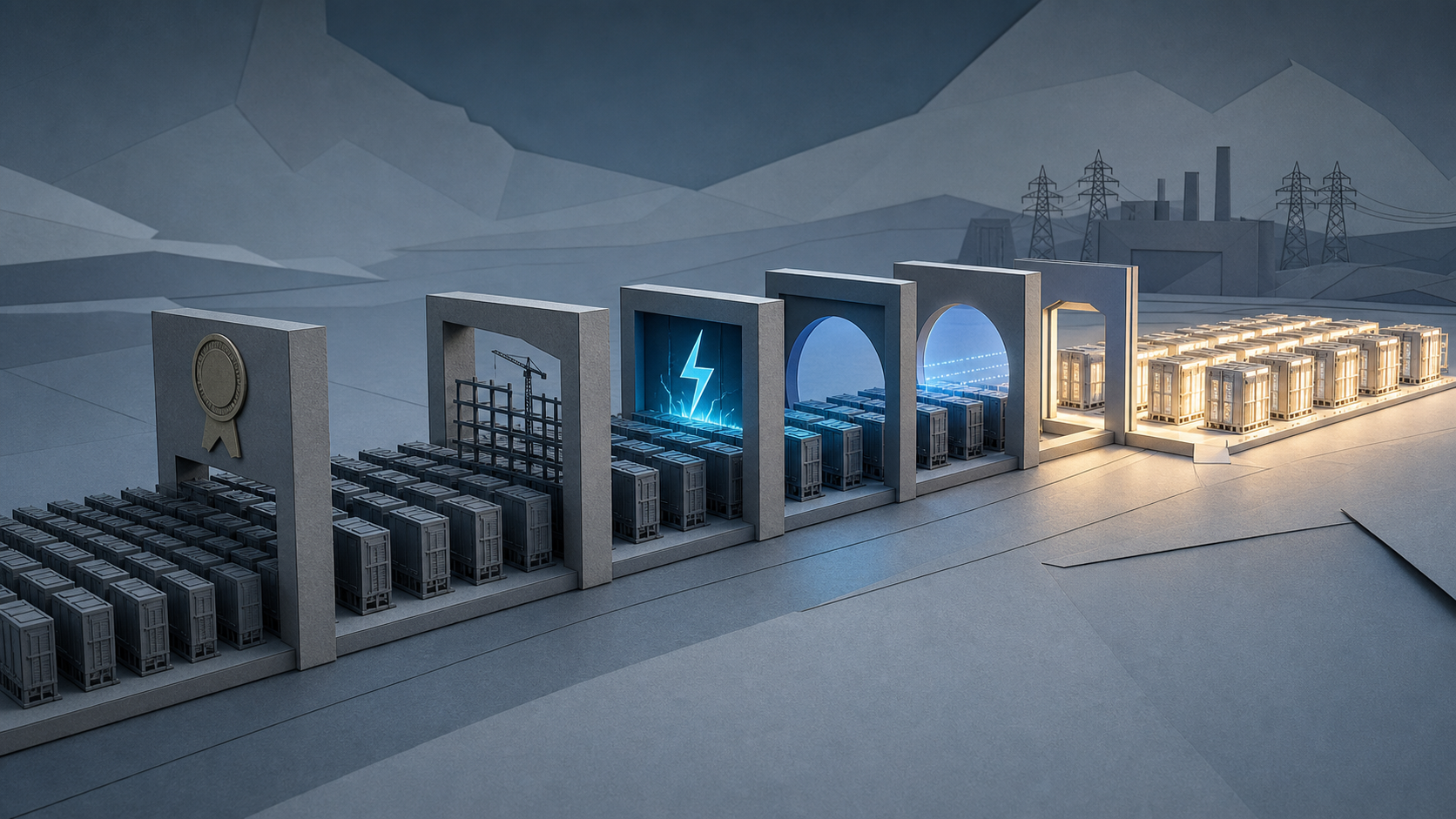
A contracted megawatt passes through more states than a sales announcement suggests. It must be assigned to a site, matched with power, designed, built, equipped, commissioned, accepted and placed on bill. NEXTDC's 73MW increase is credible evidence that customers want more capacity. It is also a larger future delivery obligation.
The arithmetic makes the boundary visible. At 30 June, 740MW was contracted on a pro forma basis and 175MW was billing. The difference is 565MW, precisely the forward order book disclosed by the company. Roughly three quarters of contracted capacity was therefore not yet billing.
A ladder from signature to earnings
The first rung is the customer contract. It reduces the risk that newly built capacity will lack a committed buyer. NEXTDC says the latest wins add 73MW, an 11% increase from the position described in its 20 April update, taking the total contracted measure from 667MW to 740MW.
The second rung is site allocation and power. The ASX notice does not identify the customer, data-centre location or electricity source for the new block. Without that detail, readers cannot know whether the 73MW is concentrated in one campus, spread across facilities or dependent on a new power connection.
The third rung is construction and energisation. Buildings, substations, cooling, network access and customer halls must reach technical readiness. The fourth is commissioning and customer acceptance: equipment is tested against contractual conditions before service begins. The fifth is billing, followed by recognised revenue and EBITDA under the agreement's commercial terms.
The release gives no price, term, cancellation right or delivery schedule for the new 73MW. It therefore cannot support a calculation of backlog revenue, annual contract value or project capex. Megawatts measure a capacity commitment, not cash.
The 565MW gap is protected demand and execution liability
Forward orders are economically useful because they protect part of the demand case before completion. A developer with signed capacity can plan capital against clearer customer needs than one building speculatively. That can support financing decisions and the sequencing of campuses.
Yet the same 565MW creates execution exposure. NEXTDC must provide a large multiple of its current billing base over several years. Delayed grid connections, equipment lead times, construction overruns or failed acceptance can postpone the date when contracted capacity becomes billable. If contracts allow termination, repricing or delay remedies, the risk may also feed back into demand; those terms are not disclosed here.
The calculated 76% forward and 24% billing shares should not be mistaken for revenue composition. Pricing per megawatt may vary by site, customer, power density, fit-out and contract date. Nor is 76% a probability that the projects will finish. It simply divides capacity states using the published numbers.
Unchanged FY26 guidance limits the immediate earnings signal
NEXTDC expects the order book to convert to billings, revenue and EBITDA over FY26 through FY30. That multi-year range is important. It says the company does not expect all newly contracted megawatts to become an immediate FY26 earnings event.
Management left FY26 net revenue, underlying EBITDA and capex guidance unchanged. The absence of an upgrade does not make the 73MW unimportant; it locates its likely financial effect beyond, or across, the current year and leaves delivery timing to future updates.
The April comparison adds capital context. Then, NEXTDC reported 667MW contracted and 544MW forward, supported by a disclosed A$2.2bn capital plan. It also guided to FY26 capex of A$2.7bn-A$3.0bn. The July release does not allocate a portion of those amounts to the new 73MW and should not be used to invent one. Earlier contracted-EBITDA estimates likewise should not be mechanically raised by the new capacity.
Delivery evidence now matters more than another contract headline
The next useful disclosure would identify which sites carry the new demand and the milestones to power them. Grid connection dates, construction completion, commissioning and customer acceptance would map the physical progress. A movement from forward order book to billing utilisation would show commercial conversion. Updated capex and revenue guidance would reveal the financial consequence.
Investors should also watch the denominator. If NEXTDC signs more capacity faster than it converts the existing book, contracted MW can keep rising while the forward share remains high. That may demonstrate durable demand, but it also increases the amount of capital and execution required before the sales ledger becomes an earnings base.
NEXTDC has removed uncertainty from one end of the chain: customers have contracted for substantially more capacity. It has not removed uncertainty from the middle. The decisive work between FY26 and FY30 is to turn 565MW of future commitments into powered, accepted and billed service without letting delivery cost or timing erode the value of those contracts.