
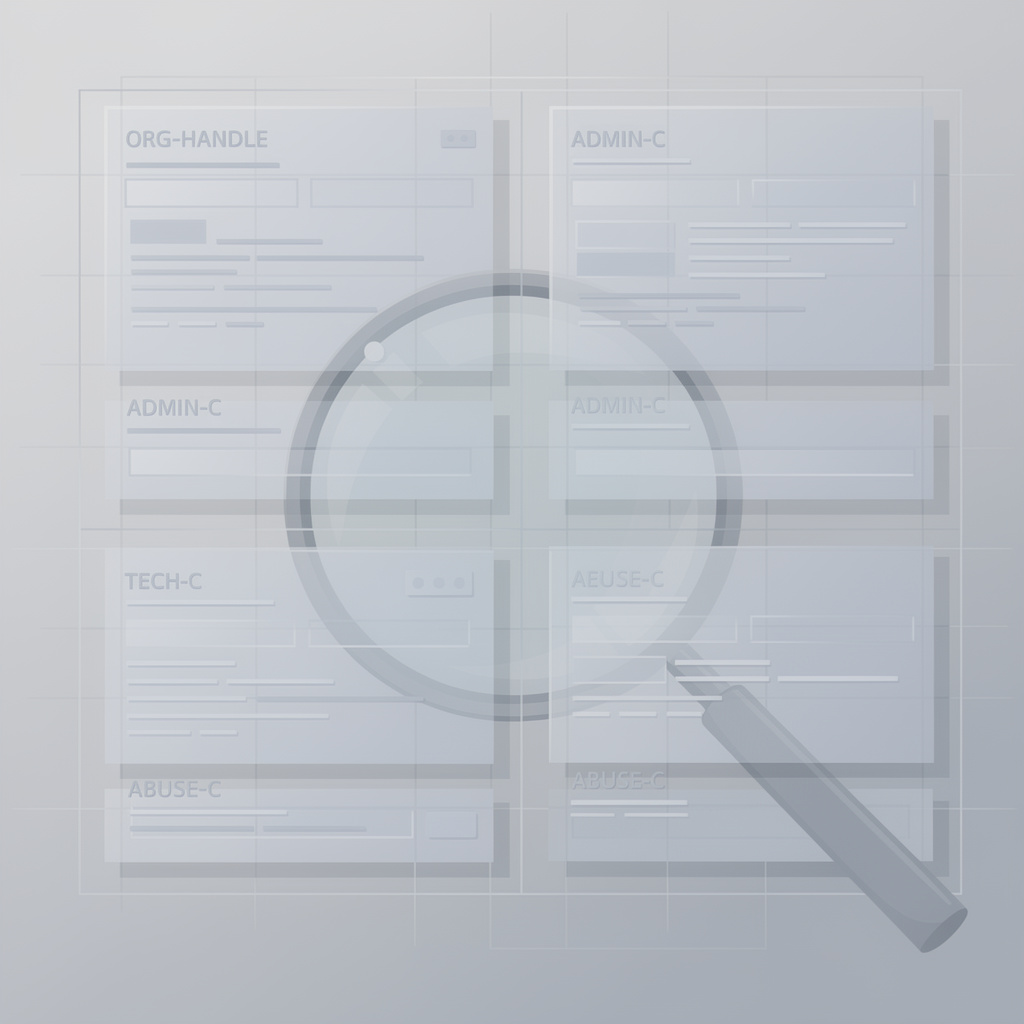
Summary
- The primary APNIC whois record for organisation ORG-NGN2-AP confirms NEXGENET COMPANY LIMITED as a LIR in Myanmar, with a company-domain mailbox as the single documented contact channel https://wq.apnic.net/apnic-bin/whois.pl?form_type=advanced&searchtext=ORG-NGN2-AP.
- The role object NCLA4-AP, titled "NEXGENET COMPANY LIMITED administrator", is self-referential: it names itself as both administrative and technical contact, so no individual appears anywhere in the chain https://wq.apnic.net/apnic-bin/whois.pl?form_type=advanced&searchtext=NCLA4-AP.
- APNIC's abuse role AN3144-AP carries a validation remark for the mailbox dated 7 July 2026 — machine evidence that the address is technically maintained, not evidence that any person answers it https://wq.apnic.net/apnic-bin/whois.pl?form_type=advanced&searchtext=AN3144-AP.
- A competing organisation, SMART & SHINE COMPANY LIMITED (ORG-SSCL4-AP), is registered at the same Thuzitar Road building, uses NEXGENET's role object as its own admin-c and tech-c, and contacts via a mailbox on a third domain https://wq.apnic.net/apnic-bin/whois.pl?form_type=advanced&searchtext=ORG-SSCL4-AP.
- Public mirrors of AS152663 still disagree about its holder; the embedded whois on one major mirror renders the NEXGENET identity with a 2026-07-02 stamp while the page title still reads SMART & SHINE https://bgp.he.net/AS152663.
- No evidence dated after 29 September 2026 resolves who, at a human level, answers the validated mailbox.
The registry record, read first-hand
Prior coverage of this target — including BTW's own briefings of 27–29 September 2026 — had to reconstruct NEXGENET COMPANY LIMITED's accountability surface through third-party mirrors, because the authoritative APNIC RDAP endpoint for AS152663 could not be read directly https://btw.media/en/nexgenet-as152663-holder-divergence-briefing. This investigation obtained the text of the primary APNIC whois records for the organisation object, the role object, the abuse role and the competing organisation. That changes the evidentiary footing of several earlier claims, and it surfaces one detail none of the prior coverage could confirm.
Start with the hub object. ORG-NGN2-AP is registered as an organisation of org-type LIR, named NEXGENET COMPANY LIMITED, country MM, at No. 838-839 Thuzitar Road, corner of Thuzitar 8 Street, North Okkalapa Township, Yangon. Its only documented contact channel is a company-domain mailbox; its listed phone number is recorded in the registry entry; it is maintained by APNIC-HM and carries a last-modified stamp of 2023-09-05T02:19:16Z https://wq.apnic.net/apnic-bin/whois.pl?form_type=advanced&searchtext=ORG-NGN2-AP. The stamp matters: the organisation object has not been touched by its maintainer in roughly three years. Registry currency is not the same as operational liveness, but a three-year-old organisation record sets the tone for everything around it.
Next, the role object that concentrates control. NCLA4-AP is titled "NEXGENET COMPANY LIMITED administrator" — the same string as this directory entry — and it lists itself as its own admin-c and tech-c. Its e-mail is the same company-domain address; its phone number differs from the organisation object's number; it is maintained by MAINT-NCL-MM with a last-modified stamp of 2023-05-03T06:31:01Z https://wq.apnic.net/apnic-bin/whois.pl?form_type=advanced&searchtext=NCLA4-AP. Self-reference is the structurally important fact. In a registry, admin-c and tech-c are the accountability anchors for every object that references them. When a role object names only itself, the chain of responsibility terminates at an abstraction rather than at a person. No name, no role title, no alternate channel — just the same mailbox, reachable through the same domain.
What a validation remark proves, and what it does not
APNIC's abuse tooling generates a derived role object from each LIR's IRT object. For this cluster, that object is AN3144-AP, labelled "ABUSE NCLMM", generated from IRT-NCL-MM and maintained by APNIC-ABUSE https://wq.apnic.net/apnic-bin/whois.pl?form_type=advanced&searchtext=AN3144-AP. Three details in this record deserve attention.
First, the validation remark: the listed mailbox was validated on 2026-07-07, with a matching last-modified stamp of 2026-07-07T13:18:17Z. This is the freshest dated signal anywhere in the accountability chain. Second, the phone field is a zero-filled placeholder for the telephone field — the abuse role offers no telephone channel at all. Third, AN3144-AP names NCLA4-AP as its admin-c and tech-c, closing the circle back to the self-referential role object.
What the validation remark establishes is narrow but real: APNIC's systems tested the mailbox on 7 July 2026 and recorded success. It is machine-validation metadata. It does not establish that a human reads the mailbox, how quickly any message would be answered, or with what authority the recipient could act on a routing incident, a takedown request or an abuse report. For the network-resource questions that matter to operators — is there someone who can be reached, who can act — the record remains silent.
The competing organisation at the same address
The detail this run confirms beyond prior coverage concerns SMART & SHINE COMPANY LIMITED. APNIC holds a separate organisation object, ORG-SSCL4-AP, for that company, with org-type OTHER, country MM, and a last-modified stamp of 2024-03-27T08:49:08Z https://wq.apnic.net/apnic-bin/whois.pl?form_type=advanced&searchtext=ORG-SSCL4-AP. Its address — Level2, Room 201, #838 Thuzitar Rd, N Okkalapa Tsp — is the same building as NEXGENET's registered address. Its e-mail, on a third domain (crystalshine.biz), is unrelated to nexgenetwork.com. And its admin-c and tech-c are both NCLA4-AP: the role object that belongs to NEXGENET.
So the same self-referential role object anchors accountability for two differently named organisations, at the same physical address, with contact mailboxes on two different domains. SMART & SHINE's own contact address is not the validated mailbox; the validated mailbox belongs to the other organisation sharing that role object.
This matters because ORG-SSCL4-AP is not the losing side of a mirror artefact. It exists as a first-class registry object in APNIC's own whois. The holder question for AS152663 is therefore not merely a disagreement between third-party databases — it is a contest between two organisations that both have live registry presence, mediated by a single shared role object.
The holder divergence, mirrored
The competing renderings of AS152663 remain visible in public mirrors. On one major routing statistics site, the page for AS152663 still carries the title SMART & SHINE COMPANY LIMITED while its embedded whois block renders as-name NCL-AS-AP, description NEXGENET COMPANY LIMITED, org ORG-NGN2-AP, admin-c/tech-c NCLA4-AP, abuse-c AN3144-AP, with a last-modified stamp of 2026-07-02T06:52:24Z https://bgp.he.net/AS152663. A second mirror carries the same NEXGENET rendering and the same 2026-07-02 stamp http://iad.robtex.com/as/AS152663.html. Other mirrors continue to show ORG-SSCL4-AP with the 2024-03-27 date.
The page itself is internally inconsistent — title says one thing, embedded whois says another — and the authoritative APNIC RDAP record for autnum 152663 remained unreadable in this investigation, as it was for prior coverage. What the primary-record reads do add is structural context: the divergence is not noise, it is a contest between two real registry objects that share one role object and one building.
The routing facts around AS152663 are, by contrast, unambiguous. It has not been visible in the global routing table since 11 September 2024; its only documented route is an IPv6 prefix maintained by a third-party maintainer; it has exactly one observed IPv6 peer — AS151210, NEXGENET's own ASN https://bgp.he.net/AS152663. A network absent from the routing table for over two years still occupies registry accountability attention through its holder dispute.
What the routing record proves about the live network
AS151210, by contrast, behaves like a functioning network: upstream and downstream relationships and prefix announcements are observable in public routing data, and it carries the IPv6 allocations that AS152663's single route references https://bgp.he.net/AS151210. The third registered ASN in the cluster, AS153311, sits behind the same role object with a far thinner operational footprint https://bgp.he.net/AS153311. Prior BTW research has already established the core asymmetry — one network that demonstrably moves traffic, two that largely do not — and the primary-record reads here confirm rather than overturn it https://btw.media/en/nexgenet-as152663-holder-divergence-briefing.
The accountability question, stated precisely
Assembling the primary records yields a chain that can be stated in one sentence: three autonomous systems and two differently named organisations converge on one self-referential role object and one company-domain mailbox, whose only dated proof of life is a machine-generated validation remark from 7 July 2026.
Against that chain, three questions remain open. Who, if anyone, reads the validated mailbox — and with what authority to act? Which of the two organisations sharing NCLA4-AP currently holds AS152663 — a question the registry's authoritative endpoint still refuses to answer for outside readers? And what would constitute proof of remedy: not another validation stamp, but a named contact, a response, or an observed incident resolved through the mailbox?
For boards and network operators who encounter this cluster — as peers, upstreams or victims of prefix misuse — the practical takeaway is unchanged by the fresher evidence: the accountable surface is an abstraction. The validation date tells you the abstraction is being maintained. It does not tell you there is anyone behind it.
Member Briefing
Deeper Profile Context
Sign in with the right membership level to unlock the full briefing and source notes.
Only for Strategic Circle
Strategic Circle
Open to all readers. Unlock profile briefings after joining and signing in.
Join Strategic CircleOnly for Leadership Alliance
Leadership Alliance
For qualified IP-asset owners and management; sign in to unlock alliance briefings.
Join Leadership Alliance