
Summary
- Public delegation, registry-agreement, DNSSEC, RDAP, and compliance records establish a real
.gdnregistry control surface operated by the exact directory company while preserving clear limits on authority and evidence. - Documented RDDS failures and later cure status separate technical capability from longitudinal reliability; the source set does not establish named customer production outcomes, private benchmarks, or proprietary architecture.
Joint Stock Company "Navigation-information systems" is the sponsoring organisation and contracted registry operator recorded for the .gdn generic top-level domain. That role is narrow but consequential. The company does not own the Domain Name System, and delegation does not make it sovereign over the namespace. It is responsible for operating a defined registry control surface inside a larger system of root-zone records, authoritative name servers, registration-data services, registrars, security metadata, contractual obligations, and emergency continuity arrangements.[1][2][3][4]
The public evidence supports three different conclusions, and they should not be collapsed. First, it shows capability: .gdn has a current delegation record, authoritative name servers, DNSSEC material, WHOIS and RDAP endpoints, and a registry agreement. Second, it provides evidence about product reliability, including two documented periods when the Registration Data Directory Service failed badly enough to trigger formal breach notices in 2021 and 2022. ICANN's public notices index says both breaches were later cured.[8][9][10][11] Third, it does not establish a customer production outcome. There is no verified customer case study, private benchmark, revenue result, or independently measured long-term availability result in the source set.
That separation matters because a registry can appear simple from the outside. A domain is registered, a DNS query resolves, and an RDAP response returns structured data. Underneath those outcomes sits recurring work: keeping records coherent, maintaining name-server and security-key lifecycles, monitoring service-level thresholds, coordinating technical and contractual contacts, correcting output formats, paying fees, preparing for emergency transition, and deciding what to do when automation and observed reality disagree. The costs are not limited to servers or software.
They include supervision, integration, maintenance, evidence retention, and exception handling.
The strongest technology story is therefore not a promotional claim about a registry platform. It is a study of accountability. Public records identify an operator and expose several running surfaces. Incident records show where those surfaces failed. Cure records show that failure did not become permanent termination. The remaining question is how an accountable organisation continuously connects the ledger of delegated authority to the systems that users and registrars actually depend on.
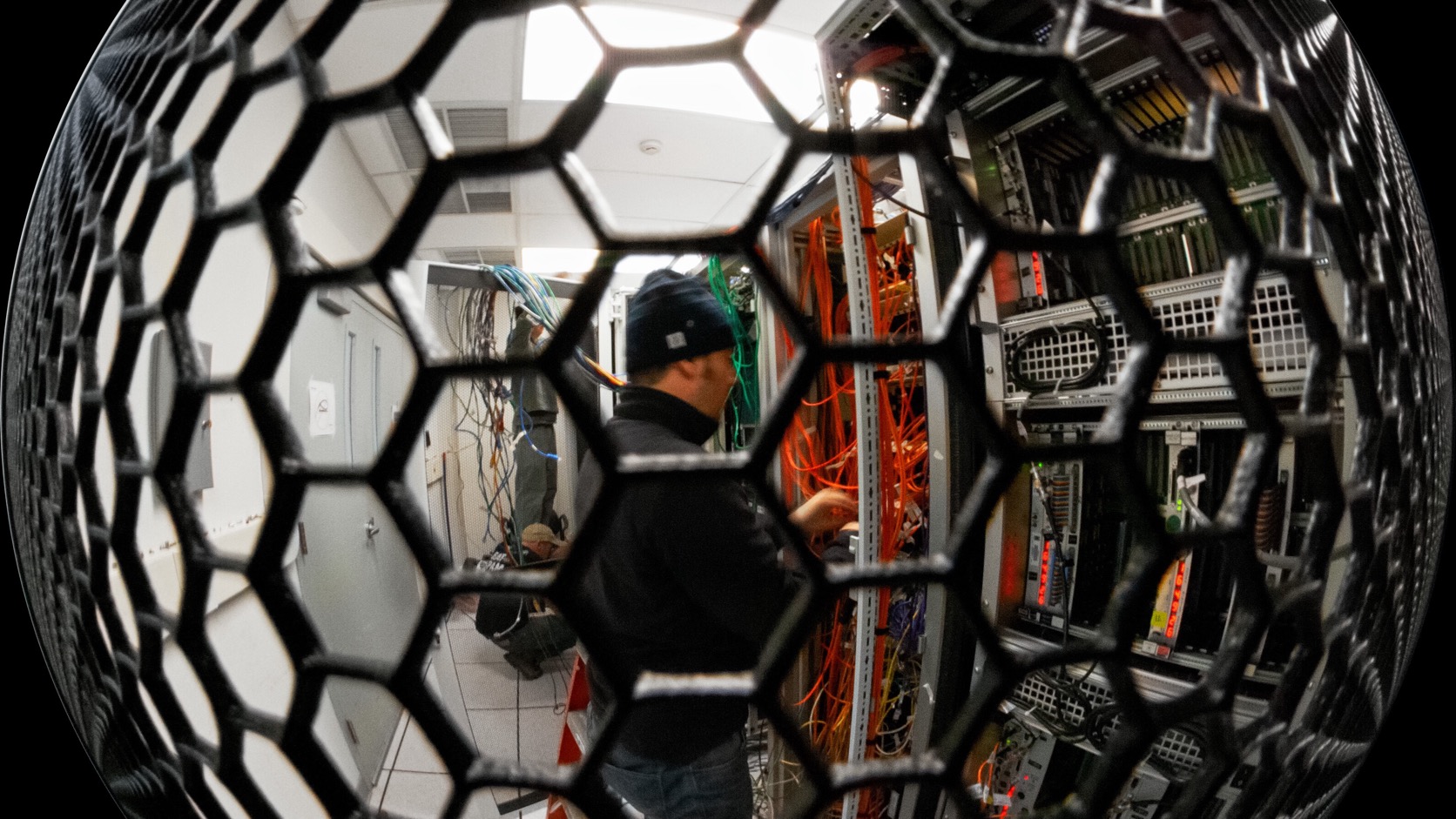
Image note: The accompanying licensed photograph shows an engineer working inside the Gemini South data center. It illustrates the physical maintenance and supervision behind network services. It does not depict Joint Stock Company Navigation-information systems, GDN Registry,
.gdninfrastructure, their personnel, or a facility associated with the registry.
The company in the public infrastructure record
The clearest identity evidence comes from the Internet Assigned Numbers Authority. IANA's current delegation record for .gdn names Joint Stock Company "Navigation-information systems" as the sponsoring organisation. It gives a Dubai Internet City address, lists GDN Registry FZ LLC for the administrative and technical contacts, identifies three authoritative name servers, and points users to www.nic.gdn, whois.nic.gdn, and rdap.nic.gdn for registry information.[1] The same record says it was last updated on 5 May 2026, while the delegation itself dates to 2014.
The IANA delegation report adds the historical decision boundary. In February 2015, the proposed sponsoring organisation matched the approved contracted party, contacts were confirmed, and the proposed technical configuration passed the minimum conformance requirements for addition to the root zone.[2] That was a delegation-readiness result, not a permanent reliability certificate. It established that the applicant, authority record, contacts, and technical proposal met the required conditions at that point in time.
ICANN's current registry-agreement page independently identifies the same company as the operator of .gdn. It records a base, non-sponsored agreement dated 31 July 2014 and exposes the underlying contract and related notices.[3] ICANN explains on that page that registry operators maintain the master database of domain names registered under a particular generic top-level domain. That description is useful because it establishes a registry as a recordkeeping and operational function. It does not imply ownership of the DNS root, general regulatory power, or control over every system involved in a domain's use.
The naming boundary requires care. GDN Registry FZ LLC appears in current administrative and technical contact records, while the sponsoring organisation and contracted operator are recorded as Joint Stock Company "Navigation-information systems".[1][5] Those records support a relationship in the registry contact surface. They do not, by themselves, prove that the two names are legally interchangeable in every context. A responsible article keeps the exact directory company object at the center while reporting GDN Registry FZ LLC as the contact and operating identity found in public records.
The company name can also mislead if read without infrastructure context. Nothing in the reviewed sources supports a claim that this article is about navigation software, satellite positioning, transport routing, or a broader information-systems product line. The verifiable object is the company's .gdn registry role. The article therefore confines itself to that role and the technology, reliability, and governance questions that the public registry record can support.
A registry is a control surface, not just a database
Calling a registry a database is accurate but incomplete. A registry maintains authoritative records about domain registrations, yet those records matter only when they connect correctly to other systems. At the top of the chain, the root zone delegates .gdn to authoritative name servers. Registrars submit registration transactions under contractual and technical rules. WHOIS and RDAP provide public registration-data access. DNSSEC material connects cryptographic trust from the parent zone to the delegated zone. Contacts receive operational and compliance notices. Escrow and emergency transition mechanisms limit the damage that could follow a severe operator failure.[1][3][4]
Each element is a control surface because a change can alter what the Internet observes. A nameserver change can redirect or impair delegation. A DS record change can affect validation. A registry-data error can make a registration appear incorrect or unavailable. A malformed RDAP or WHOIS response can block automated consumers even if the underlying domain database remains intact. An unreachable contact can delay a corrective action. A missed fee or compliance obligation can become a contractual incident even when DNS queries still resolve.
The current public state provides a bounded view of those controls. The .gdn delegation names ns1.nic.gdn, ns3.nic.gdn, and ns4.nic.gdn, with IPv4 and IPv6 addresses in the IANA record.[1] A capture-time DNS check returned all three names, an SOA record, two DS records, and DNSKEY material. The registry RDAP landing page responded, and a query for nic.gdn returned an RDAP object.[6][7] These are useful observations because they show running services and security metadata rather than a plan alone.
They are not proof of longitudinal reliability. One successful request does not show how the service performed yesterday, from another region, under load, during maintenance, or when a dependency failed. A returned DNSKEY does not prove every key-management step is well controlled. A syntactically valid RDAP object does not prove every record is accurate or every registrar transaction is reflected on time. Capture-time evidence should be preserved as a timestamped observation, not converted into an unsupported uptime score.
This distinction is especially important for technical company research. Product descriptions commonly mix functions, qualities, and outcomes. A function says the service can answer RDAP queries. A quality claim says it answers correctly and consistently over time. An outcome claim says a particular customer avoided an incident or improved a business process because of that service. The public .gdn evidence establishes functions, gives some positive present observations, and documents historical reliability failures. It does not provide named customer outcomes.
Capability: what the records show the system can do
The registry agreement defines a broad capability envelope. It covers operation of the TLD, access to registration data, data escrow, service levels, DNSSEC, reporting, emergency transition, registrar relationships, reserved names, and consensus-policy obligations.[4] The existence of those clauses does not prove flawless implementation. It does identify the systems and control categories for which an operator must be prepared.
The visible delegation demonstrates authoritative DNS capability. Root-zone records direct .gdn queries toward a defined set of name servers. Multiple server names and address families create the basis for redundancy, although the public record alone does not reveal physical diversity, provider diversity, routing policy, capacity, or common dependencies. Redundancy should therefore be treated as a design feature to verify, not an automatic guarantee of independent failure domains.
The DS and DNSKEY observations demonstrate a DNSSEC surface. DNSSEC allows resolvers to validate signed DNS data through a chain of trust. Operationally, that introduces key generation, storage, signing, rollover, parent-child coordination, monitoring, and recovery work. The security feature creates value only when those steps remain correctly ordered. A stale, missing, premature, or mismatched record can turn a security control into an availability problem for validating users.
WHOIS and RDAP demonstrate registration-data capability. RDAP provides structured responses designed for machine consumption and internationalised access patterns, while WHOIS is the older text-oriented service. The current .gdn IANA record lists both surfaces.[1] The registry's RDAP endpoint provides a search interface and returns a structured response for a domain query.[6][7] That present response is important in light of the 2021 and 2022 compliance records, which involved registration-data availability, output conformance, and RDAP implementation.[9][10][11]
Contacts and agreement records demonstrate accountability capability. They create a public route for identifying the sponsoring organisation and operational contacts. The capability is easy to underestimate because a contact record looks administrative. During an incident, however, the ability to reach an authorised, technically informed person can determine whether a diagnosis becomes a safe change. Contact accuracy, role clarity, escalation coverage, and handover procedures are operational assets.
Finally, the contract defines continuity capability. Emergency back-end registry operation exists to preserve critical registry functions if ordinary operation fails severely. It is a last-resort mechanism rather than a substitute for normal reliability. Preparing for such a transition requires data escrow, accessible records, clear authority, and technical interoperability. The possibility of emergency transition makes a key point visible: continuity depends on portability and evidence, not only on keeping the current stack running.
Reliability: where the public record becomes more demanding
Reliability is not the same as capability. A system can support the required functions and still fail to meet availability, format, or operational obligations. The formal notices involving .gdn provide unusually concrete evidence of that difference.
ICANN's 8 April 2021 notice stated that the registry's Registration Data Directory Service experienced intermittent downtime from 28 March to 2 April 2021. According to the notice, the service exceeded monthly service-level requirements and an emergency threshold. ICANN also cited failure to provide domain-name data in the specified response format. The attachment said the total downtime reached 172.9 percent of the emergency threshold and noted earlier escalated compliance notices concerning RDDS downtime in 2018 and 2019.[9]
Several failure modes are visible in that record. The first is availability failure: probes could not obtain the required service for long enough to cross contractual thresholds. The second is conformance failure: a response can exist but still be operationally wrong if its structure does not satisfy the expected format. The third is recurrence: corrective work that resolves one incident may not prevent a later event. The fourth is escalation risk: sufficiently severe or prolonged failure can move the service toward emergency transition.
The 29 April 2022 notice records another RDDS outage, this time between 22 and 24 April 2022, again crossing an emergency threshold. It also identified overdue fees and failure to demonstrate implementation of an RDAP service.[10][11] The combination is instructive. Technology operations, contractual administration, and evidence of implementation were not separable from the operator's compliance posture. A service can be technically recoverable while the organisation still needs to prove remediation, meet reporting expectations, and resolve nontechnical obligations.
ICANN's notices index says the 2021 breaches were cured on 5 May 2021 and the 2022 breaches were cured on 9 June 2022.[8] That fact must remain beside the incidents. Historical failures are relevant evidence about the work and risks of registry operation, but they should not be presented as an unresolved current accusation. The current agreement listing, updated IANA record, DNS material, and responding RDAP service all support the narrower conclusion that .gdn remains delegated and the public service surface is currently observable.[1][3][6][7]
The incidents also show why a single present-day test cannot close the reliability question. A service may be working now and still have a history that warrants stronger monitoring, clearer recurrence controls, or deeper independent evidence. Conversely, a past breach does not prove present failure. Reliability analysis needs a time series: service-level data, incident recurrence, remediation validation, change outcomes, and current observations. The public record provides pieces of that series, not a complete performance study.
Customer production outcomes: the evidence that is not available
Technology-company articles often move too quickly from infrastructure capability to customer benefit. That move is not justified here. The reviewed sources do not identify a registrant, registrar, enterprise, or application that achieved a measured production result because Joint Stock Company "Navigation-information systems" operated .gdn.
A domain registry can enable registrations and resolution, but that is a system-level function. To make a customer outcome claim, the evidence would need to connect a named user's goal, baseline, implementation, operating conditions, and measured result. Examples might include a registrar reducing failed transactions, a registrant improving availability, or an incident response restoring a critical domain within a documented period. No such verified case appears in the source set.
The absence should be explicit rather than filled with plausible marketing language. It would be easy to say that .gdn gives brands a global identity, improves trust, or enables growth. Those statements may sound reasonable, but they are not established customer outcomes. A top-level domain can be available without producing a particular commercial result. Registration volume, renewal behaviour, abuse rates, end-user recognition, and application value all require separate evidence.
This boundary improves the article rather than weakening it. It directs attention to what can actually be learned: how a registry's public obligations map to running systems, where reliability failed, what remediation had to address, and which operating costs remain even after recovery. It also prevents a technical capability from being converted into an implied endorsement of the company or namespace.
Supervision cost: automation still needs an accountable observer
Registry systems are highly automatable. DNS zones can be generated, signed, and published by software. RDAP responses can be built from structured records. Monitoring probes can test availability and latency. Deployment systems can repeat changes across environments. Automation is essential at registry scale, but it does not eliminate supervision.
Supervision begins with deciding what should be true. A monitor needs the correct endpoint, protocol, threshold, query set, expected schema, and escalation owner. If a test checks only that a TCP port opens, it may miss a malformed registration-data response. If it checks one domain, it may miss a class of records. If the expected schema is stale, a correct service may look broken or a broken service may pass. Human and organisational judgment enters before the first probe runs.
Supervision also interprets disagreement. A failed RDAP request could reflect the registry service, DNS resolution, routing, TLS, a client defect, a rate limit, or a monitoring vantage point. The next action depends on which layer is failing and who has authority to change it. Automatically restarting a component may hide evidence or worsen a state-transition problem. Escalating every anomaly wastes attention and creates alarm fatigue. The cost lies in maintaining a diagnostic model and assigning decisions to people who understand the control surface.
The documented .gdn incidents show that contractual thresholds matter alongside engineering symptoms.[9][10] Operators need monitoring that can map observed downtime to service-level requirements and emergency thresholds. They also need evidence that survives after the service recovers: timestamps, probe results, change history, corrective actions, and prevention commitments. Recovery without evidence may restore users while leaving the operator unable to demonstrate compliance or learn from recurrence.
Finally, supervision must cover the supervisor. Contacts change, on-call rosters age, dashboards lose ownership, certificates expire, and dependencies move. A control that worked during the last incident can become ceremonial if nobody tests the path. Continuous readiness therefore includes contact exercises, access reviews, runbook validation, and independent checks that monitoring itself remains complete.
Integration cost: the registry crosses organisational boundaries
The .gdn control plane is not one application owned by one team. IANA maintains delegation records. ICANN publishes and enforces the agreement. The registry operator maintains registration data and services. Registrars submit transactions. DNS operators serve authoritative data. Resolvers and applications consume it. Escrow and emergency providers may need to assume bounded functions during a severe failure. Administrative and technical contacts may carry different organisational names.[1][3][4][5]
Integration cost arises where those roles meet. A nameserver change needs accurate data, authorised submission, root-zone processing, technical readiness, and post-change observation. A DNSSEC rollover needs coordination between child-zone keys and parent DS records. An RDAP change needs registry data, protocol-conformant output, TLS and network reachability, client compatibility, and accurate service discovery. A contact change needs identity verification and propagation across records.
Each boundary can fail while the individual components appear healthy. A registry database may contain correct data that the RDAP formatter exposes incorrectly. A new key may be valid but published in the wrong sequence. A server may be reachable directly while delegation points elsewhere. A monitoring platform may report success from one network while users in another region encounter a routing issue. Integration testing must therefore follow end-to-end paths and compare authoritative records with observed behaviour.
Organisational integration adds another layer. The sponsoring organisation remains accountable in the delegation and agreement records, while GDN Registry FZ LLC appears in contact roles.[1][5] Public evidence does not reveal the full division of labour. Internally, that division must be precise: who approves changes, who operates systems, who speaks to ICANN, who receives security reports, who can access escrow, and who owns incident communications. Ambiguity turns a technical event into a coordination delay.
The cost cannot be measured from the public record in money or staff hours, so this article does not invent figures. It can still identify the work categories. Integration requires inventories, interfaces, credentials, role maps, change windows, test cases, escalation routes, and retained evidence. Those assets need maintenance even when registration traffic is quiet and no incident is visible.
Maintenance cost: continuity is accumulated ordinary work
Registry reliability is often discussed through exceptional events, but continuity is mostly produced by ordinary maintenance. Name servers and network paths need updates. Operating systems, libraries, DNS software, databases, and web services require patching. Certificates and keys have lifecycles. Hardware fails. Capacity assumptions change. Abuse and registration policies evolve. Contract and protocol requirements are amended. Contacts, accounts, and vendor relationships change.
Every maintenance action can affect a public control surface. A routine software upgrade may change RDAP output. A database migration may alter event timestamps or status values. A TLS renewal can fail on one endpoint. A DNSSEC rollover can create a validation outage if parent and child states are not coordinated. A network change can impair one address family while leaving the other operational. Safe maintenance therefore needs staged execution, rollback criteria, and independent observation.
The recurrence described in the 2021 and 2022 notices makes prevention a central question.[9][10] Corrective action is not only restoring service. It is changing the conditions that allowed failure to recur. That may involve architecture, monitoring, process, staffing, supplier controls, or testing, but the public notices do not disclose the exact remediation design. The evidence supports a requirement for preventive measures, not a claim about which measures were implemented.
Maintenance also includes documentary coherence. The current IANA record, ICANN agreement listing, registry contacts, service endpoints, and DNS state should describe the same operating reality.[1][3][5] When they diverge, users and responders may follow a stale route. Periodic comparison of authoritative records is therefore part of technical maintenance, even though it resembles administrative review.
The broader lesson is that quiet infrastructure is not free infrastructure. A top-level domain may receive little public attention when it works. That silence reflects accumulated work: changes completed without visible breakage, exceptions handled before escalation, credentials renewed, records reconciled, and recovery paths kept usable. The value appears as absence of failure, which makes the labour easy to overlook.
Exception handling: where operating models are tested
Routine flows are the easiest part of a registry to automate. A valid registration request enters, policy checks pass, data is written, and the result appears in DNS and registration-data services. The operating model is tested by exceptions: contradictory records, partial outages, malformed responses, lost authority, suspected abuse, stale contacts, failed key changes, unpaid fees, or monitoring that disagrees with user reports.
Exception handling starts with classification. Is the event a data problem, availability problem, security problem, compliance problem, or several at once? The 2021 notice combined availability and response-format issues.[9] The 2022 notice combined RDDS downtime, RDAP evidence, and fee obligations.[10][11] Treating each incident as a single server failure would miss the organisational and contractual work needed for complete resolution.
The next requirement is authority. Diagnosis does not grant permission to alter root-zone data, keys, registry records, or contractual contacts. Emergency access should be strong enough to support recovery but constrained enough to prevent an improvised change from becoming a larger incident. Operators need preassigned decision rights, separation where appropriate, and an auditable path from observation to approval to execution.
Evidence is the third requirement. During an outage, restoring service is urgent. After restoration, the organisation must reconstruct what happened, show when thresholds were crossed, explain corrective action, and verify prevention. Logs that disappear with a restarted system, clocks that disagree, or changes made outside the normal path can block that reconstruction. Evidence retention is therefore part of resilience rather than an after-the-fact reporting task.
The fourth requirement is recurrence control. A closed incident can create false confidence if the fix addresses only the immediate symptom. The public .gdn record mentions repeated RDDS downtime across multiple years.[9][10] That history makes recurrence itself a failure mode. A mature review asks whether the detection, diagnosis, architecture, maintenance process, or organisational boundary that enabled recurrence has changed and how the change will be tested.
DNSSEC and security metadata: protection with operational risk
DNSSEC is a useful example of a technology whose security value depends on disciplined operations. The current .gdn delegation exposes DS records, and DNS queries return DNSKEY material. Those records support a chain in which validating resolvers can verify signed data. The capability helps detect certain forms of DNS data tampering, but it does not secure every registry function, stop abuse, or guarantee availability.
The operational burden includes generating and protecting keys, signing zones, publishing DNSKEY records, coordinating DS data with the parent, monitoring validation, planning rollovers, and recovering from mistakes. Automation can perform much of the sequence. Supervisors still need to know which state is expected at each point, how long caches may retain old data, and when rollback is safe.
A key rollover illustrates integration risk. Publishing a new key, changing the parent DS, removing an old key, and waiting for cached data are related actions with different propagation paths. If the sequence or timing is wrong, validating resolvers may reject data that nonvalidating resolvers still accept. That split can create confusing partial failure. A simple reachability monitor may report success while security-aware users fail.
The public records do not show the company's private key-management architecture, ceremonies, hardware, staffing, or rollover history. It would be improper to infer those details from the presence of DS and DNSKEY records. The supported conclusion is narrower: .gdn participates in DNSSEC, and that participation creates a security control whose reliability depends on continuous lifecycle management and parent-child coordination.
This is another reason to distinguish capability from reliability. The record proves the control is present. Reliability requires evidence that changes remain correct over time. Customer outcomes would require evidence that a named user benefited under defined conditions. Only the first conclusion is directly established here.
RDAP as a test of structured operational truth
RDAP turns registry data into a structured service that software can query. That makes it a useful reality test. A response must not merely arrive; it must carry the expected fields, status, events, nameservers, links, and notices in a form clients can process. Structured output reduces some ambiguity of older text protocols, while increasing the importance of schema conformance and semantic consistency.
The current .gdn RDAP service exposes a search page and returns an object for nic.gdn.[6][7] That observation shows a functioning public endpoint at the time of review. It also provides a concrete object for comparing registry status, event dates, nameservers, and notices against other authoritative records.
The compliance history shows why this matters. In 2021, ICANN cited registration-data response-format problems alongside downtime.[9] In 2022, ICANN cited failure to demonstrate implementation of RDAP in addition to another RDDS outage.[10][11] Availability and conformance are separate dimensions. A service that returns the wrong structure can fail automated consumers. A well-formed service that is frequently unavailable can also fail its purpose.
RDAP therefore creates several maintenance costs. Implementations must track protocol and policy requirements. Data mapping must stay aligned with the registry database. Error responses and redaction behaviour need testing. TLS, DNS, routing, and service discovery need monitoring. Clients may expose interoperability problems that simple server tests miss. Changes require representative fixtures, not only a health endpoint.
The service also illustrates the limits of public testing. A reviewer can query a few objects and inspect responses. That does not authorise claims about the full dataset, peak capacity, global latency, access controls, abuse handling, or historical uptime. The right conclusion is a bounded one: current public RDAP functionality is observable, past failures are documented, and long-term reliability needs a broader evidence set.
Continuity and portability: planning for the operator to fail
Critical infrastructure governance becomes concrete when it plans for ordinary ownership or operation to fail. Registry agreements include data escrow and emergency transition mechanisms because domain holders should not lose essential registry functions solely because one operator becomes unable to provide them.[4][9][10]
Portability begins with data. Registration records must be complete, current, interpretable, and available through an authorised transition process. It extends to zone generation, DNSSEC state, registrar interfaces, service endpoints, abuse contacts, billing status, policies, and operational knowledge. A database copy without the surrounding semantics and procedures may be insufficient for safe continuity.
The 2021 notice said the prolonged RDDS failure could have led to emergency transition, although that did not occur because service was restored.[9] The 2022 notice again tied downtime to an emergency threshold.[10] These facts show that continuity arrangements are not abstract contract language. They define an escalation boundary when ordinary service fails severely enough.
Emergency transition is still a fallback. It cannot replace routine maintenance, incident prevention, or a credible operator. Transition itself introduces risk: stale data, incomplete credentials, mismatched service behaviour, unfamiliar dependencies, and hurried decisions. The most effective continuity work happens before a crisis, when records can be tested, roles clarified, and recovery assumptions challenged without production pressure.
For leadership, the key question is not whether an emergency provider exists. It is whether the organisation can produce the evidence and portable assets needed for that provider or another authorised operator to preserve critical functions. That includes knowing which systems are essential, which records establish authority, which dependencies are shared, and which changes are irreversible.
A practical evaluation framework
The company and .gdn can be evaluated without inventing a score. The first layer is record integrity. Compare the directory company object, IANA sponsoring organisation, ICANN operator, contact identities, nameserver data, RDAP service, and agreement status. Differences should be explained rather than silently normalised.[1][3][5]
The second layer is running-code evidence. Observe authoritative DNS, DNSSEC material, WHOIS or RDAP service discovery, representative RDAP responses, TLS, and error behaviour from defined vantage points. Preserve timestamps and scope. A pass means the selected path worked at that time, not that the system has perfect availability.[6][7]
The third layer is reliability history. Track formal incidents, service-level breaches, recurrence, remediation commitments, cure status, and subsequent observations.[8][9][10][11] Historical failure should influence the questions asked without becoming a claim of current failure.
The fourth layer is operating control. Examine monitoring coverage, ownership, change approval, rollback, evidence retention, access, contact freshness, DNSSEC lifecycle, schema conformance, and vendor boundaries. Much of this information is private, so a public article can identify the controls that matter without pretending to audit them.
The fifth layer is production outcome evidence. Ask for a named user, baseline, implementation conditions, measured result, and independent corroboration. If those elements are absent, keep the conclusion at capability or reliability. Do not promote availability of a namespace into a customer-success claim.
The sixth layer is continuity readiness. Determine whether data, authority, security state, operational knowledge, and service interfaces are portable. Test contact and escalation paths. Review which failures trigger emergency action and which assets would be required to recover. Continuity is a property of prepared evidence and executable procedures, not a paragraph in a contract.
This framework is intentionally reality-based. It treats the registry record as a ledger of responsibility, not a grant of sovereignty. It prefers observable service behaviour to promotional description. It recognises that unique names require accurate records, security metadata, and operational continuity. And it keeps advocacy separate from evidence.
Strategic conclusion
Joint Stock Company "Navigation-information systems" matters as a technology-company research object because public infrastructure records place it at a precise control point. It is the recorded sponsoring organisation and registry operator for .gdn. The delegation, agreement, current DNS material, and responding RDAP service establish a functioning capability surface.[1][2][3][6][7]
The same public record prevents an easy promotional conclusion. RDDS failures in 2021 and 2022 crossed contractual thresholds, and the notices identify availability, response-format, RDAP, fee, recurrence, and emergency-transition concerns.[9][10][11] ICANN later marked those breaches cured.[8] The evidence therefore supports neither a claim of flawless reliability nor a claim of present unresolved failure.
What remains visible is the operating burden. Supervision turns monitoring into authorised decisions. Integration keeps delegation, DNSSEC, registry data, contacts, and external organisations aligned. Maintenance prevents ordinary change from becoming an outage. Exception handling preserves evidence and authority when routine automation stops being enough. Continuity planning makes data and operational knowledge portable before a crisis.
No verified customer production outcome is available in the reviewed sources. That absence should remain explicit. The value of the research lies elsewhere: in showing how a seemingly narrow registry function becomes dependable only when public records, running services, organisational responsibility, and recovery mechanisms continue to agree.
The .gdn label is short. The control surface behind it is not. Its reliability depends less on the appearance of authority than on the continuous work of keeping records accurate, services observable, failures repairable, and responsibility unambiguous.
Sources
[1] IANA, ".gdn Domain Delegation Data": https://www.iana.org/domains/root/db/gdn.html
[2] IANA, "Delegation Report for .gdn": https://www.iana.org/reports/c.2.9.2.d/20150211-gdn
[3] ICANN, ".gdn Registry Agreement": https://www.icann.org/en/registry-agreements/details/gdn
[4] ICANN, ".gdn Registry Agreement text, 31 July 2014": https://itp.cdn.icann.org/en/files/registry-agreements/gdn/gdn-agmt-html-31jul14-en.htm
[5] ICANN, "Registry Listings": https://www.icann.org/en/contracted-parties/registry-operators/resources/listings
[6] GDN Registry, "RDAP Service": https://rdap.nic.gdn/
[7] GDN Registry, RDAP record for nic.gdn: https://rdap.nic.gdn/domain/nic.gdn
[8] ICANN, "Notices of Breach, Suspension, Termination and Non-Renewal": https://www.icann.org/compliance/notices
[9] ICANN, "Notice of Breach of Registry Agreement," 8 April 2021: https://www.icann.org/uploads/compliance_notice/attachment/1157/hedlund-to-saleem-8apr21.pdf
[10] ICANN, "Notice of Breach of Registry Agreement," 29 April 2022: https://www.icann.org/uploads/compliance_notice/attachment/1185/hedlund-to-saleem-29apr22.pdf
[11] ICANN, "Contractual Compliance Report," April 2022: https://www.icann.org/en/system/files/files/contractual-compliance-report-30apr22-en.pdf
[12] Wikimedia Commons, "Data Center Fish Eye View," International Gemini Observatory/NOIRLab/NSF/AURA/Manuel Paredes, CC BY 4.0: https://commons.wikimedia.org/wiki/File:Data_Center_Fish_Eye_View_%28noirlab-racks-155%29.jpg
Image attribution
International Gemini Observatory/NOIRLab/NSF/AURA/Manuel Paredes, "Data Center Fish Eye View," cropped and resized, licensed under CC BY 4.0. The image is generic infrastructure context and does not depict the company, registry, facilities, systems, or personnel discussed in this article. No endorsement is implied.
Member Briefing
Deeper Profile Context
Sign in with the right membership level to unlock the full briefing and source notes.
Only for Strategic Circle
Strategic Circle
Open to all readers. Unlock profile briefings after joining and signing in.
Join Strategic CircleOnly for Leadership Alliance
Leadership Alliance
For qualified IP-asset owners and management; sign in to unlock alliance briefings.
Join Leadership Alliance