Summary
- Nashville's Metro Council passed a data-centre zoning package and a temporary moratorium on specified new permitting activity.
- Data centres above 500,000 square feet are barred under the reported framework; smaller proposals require a special exception and public hearing.
- New facilities are channelled toward heavy-industrial areas, with a half-mile buffer from homes, schools, parks and other sensitive uses.
- The rules constrain on-site emitting generation such as gas turbines and require closed-loop cooling, while renewable on-site generation is not banned.
- Operating facilities are unaffected; DC BLOX's claimed vested rights remain unresolved, and a separate zoo-adjacent eminent-domain measure only passed second reading before returning to committee, so it was not finally enacted.
Nashville has not decided that every data centre is unacceptable. It has decided that a proposed facility's scale, location, electricity equipment and cooling system should determine whether and how it can be permitted.
That distinction matters economically. A blanket ban would remove the development option. A conditional zoning system leaves it open, but transfers more compatibility costs and approval risk to the developer before land, power and financing can be treated as secure.
Size now changes the legal path
The reported framework sets a hard ceiling at more than 500,000 square feet. Projects below that threshold are not automatically allowed. They enter a special-exception process that includes a public hearing.
This creates two different constraints. The largest format loses a route to approval, while a smaller project carries discretionary timing and outcome risk. A developer may respond by reducing the building envelope, dividing a campus, choosing another jurisdiction or accepting a longer approval schedule. Whether any redesign is permissible will depend on how the final rules aggregate related facilities and sites.
Public review also changes financing. Land control, utility interconnection and equipment orders may precede a final hearing, yet lenders and customers cannot assume approval. A project must price the possibility of new conditions, delay or denial.
Land-use buffers narrow the feasible map
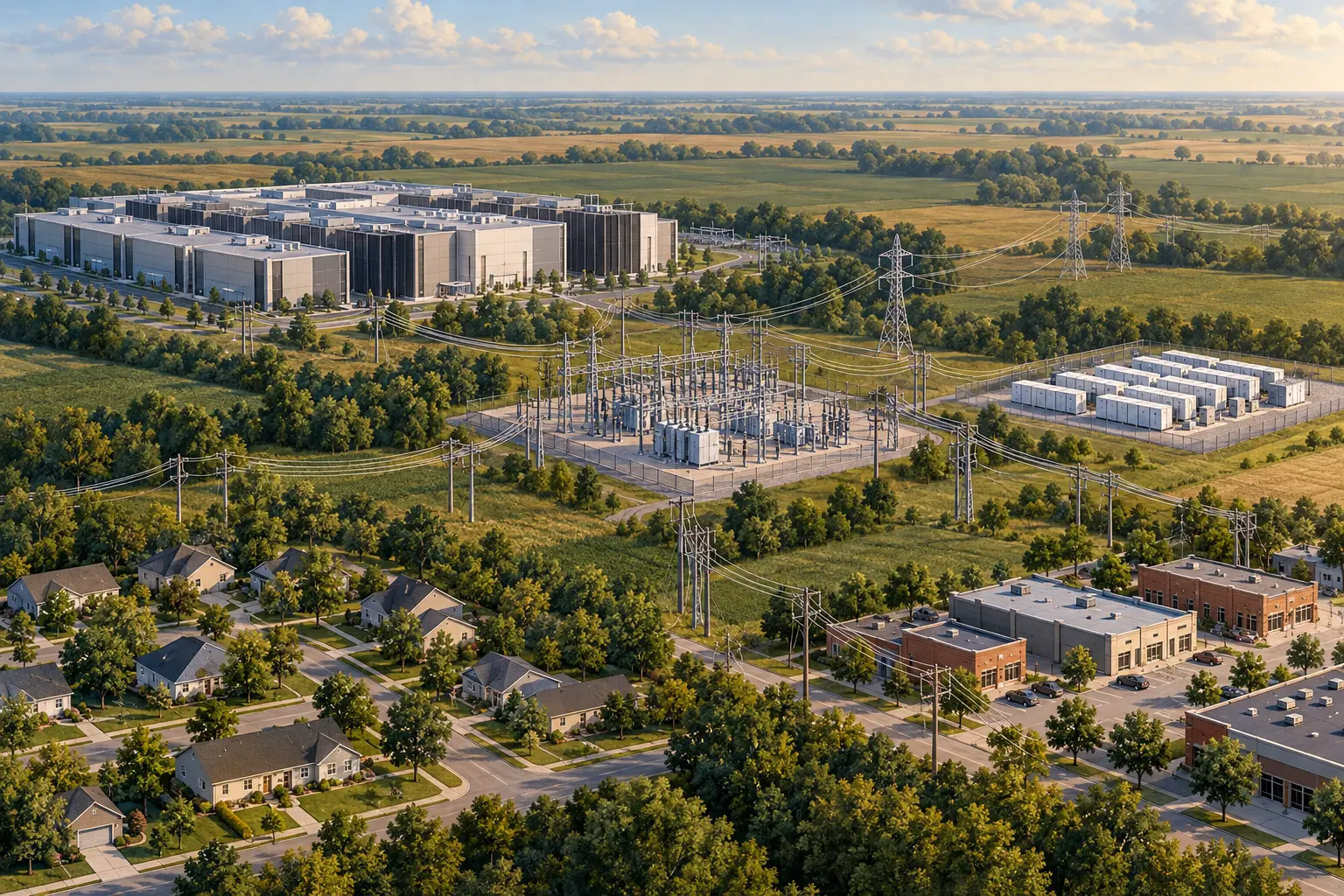
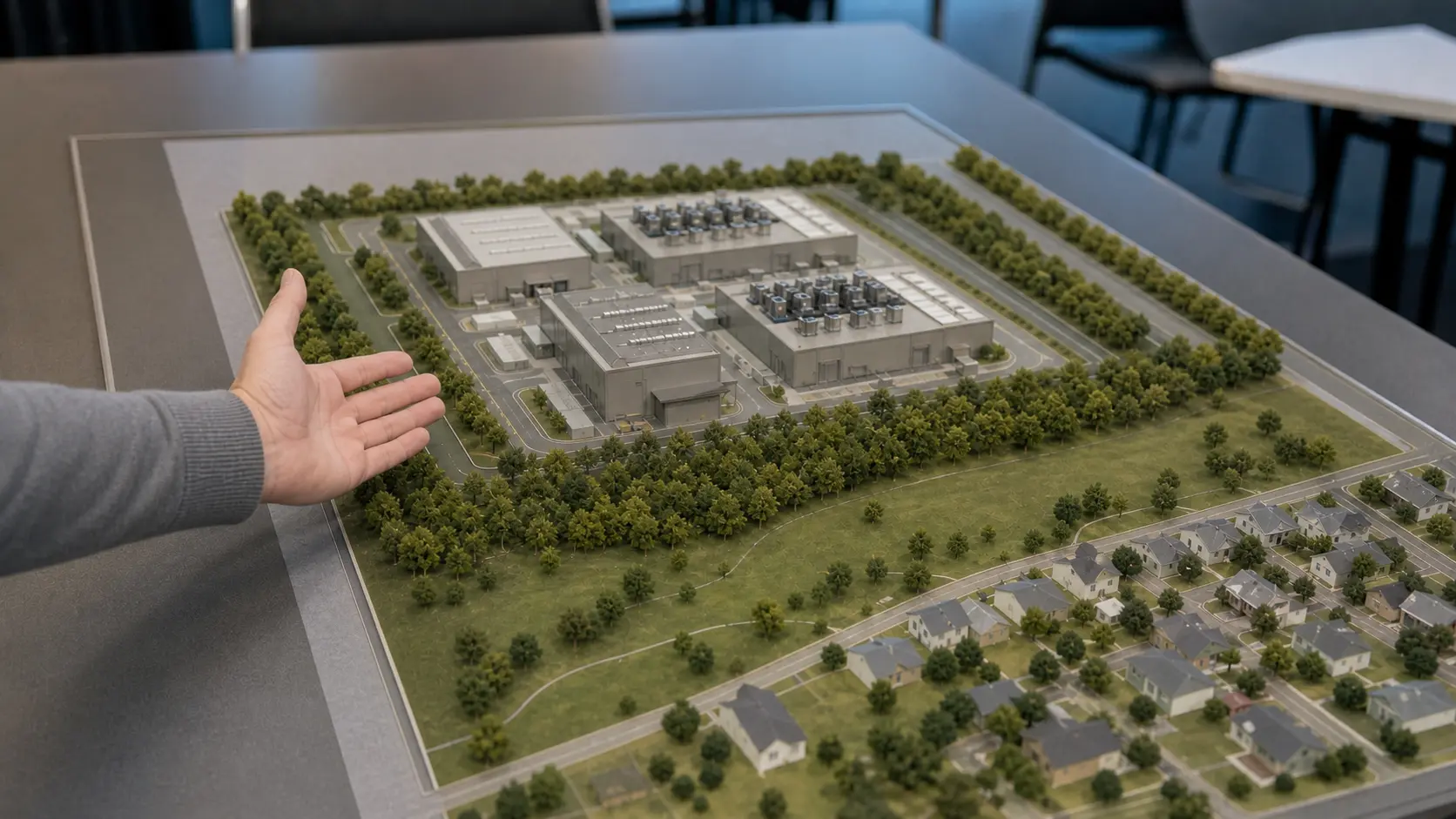
New data centres are directed toward heavy-industrial areas and separated from homes, schools, parks and other sensitive uses under the reported package. The purpose is to place noise, large buildings, substations and continuous industrial activity away from community uses.
The policy does not make every industrial parcel buildable. A candidate site still needs suitable acreage, transmission access, water design, roads and a workable distance from protected uses. Those filters can leave a much smaller inventory than the zoning label suggests.
For residents, the buffer and hearing create a formal place to raise noise, visual, traffic and utility concerns. For developers, they turn community compatibility from a later negotiation into an early site-selection variable.
Power and water equipment become planning questions
The package restricts on-site emitting generation, including the gas-turbine approach that can accompany very large computing loads. Renewable on-site generation is not described as prohibited. The distinction matters: the rule targets local emissions and industrial compatibility rather than every form of power supply.
Limiting gas generation may increase dependence on the utility interconnection, batteries, renewable supply or other compliant resilience designs. It can also change construction sequence and the ability to serve load before full grid capacity arrives.
Closed-loop cooling is required under the reported framework. Recirculation can reduce ongoing withdrawal relative to once-through systems, but it is not the same as zero water. Initial fill, treatment, maintenance and losses remain. Developers will still need to disclose design assumptions rather than treating the phrase as a complete environmental answer.
The moratorium is a bridge, not the permanent rule
Metro Council also approved a temporary moratorium on specified permit processing. Operating data centres are excluded and are not required to close. The pause is intended to control new activity while the new system takes effect.
Local reporting described a particular end point, but the final enacted substitute text has not been reconciled in the evidence used here. An exact expiry should therefore not be presented as settled law. The durable fact is that the pause is temporary, not a permanent prohibition.
Applicants and officials need the enacted text to determine which permit types, filing dates and transition cases fall inside it. That boundary is particularly important for projects already in the pipeline.
DC BLOX will test the transition
DC BLOX has argued that its proposed project near the Nashville Zoo holds vested rights under the earlier process. The council's action does not resolve that claim. A vested-right dispute can turn on the status of applications, approvals, spending and the legal effect of later rules.
A separate measure involving eminent domain near the zoo advanced but was returned to committee and was not finally enacted. The city has therefore not seized the project land through that proposal.
The next evidence is legal and administrative: enacted substitute text, permit guidance, treatment of pending applications and any court or board determination. Existing sites remain open; new sites face a more demanding operating system; the contested project sits between those categories.
Nashville's decision is best understood as cost allocation through land-use law. The city has made scale, neighbourhood distance, emissions and cooling part of the price of development. Whether that produces smaller projects, different locations or litigation will be learned from the first applications, not from calling the package either a welcome mat or a total ban.