
Summary
- An IDRC evaluation says CIUEM was Mozambique’s only Internet point of presence when the school project was conceived, so provincial schools depended on the Maputo centre for connectivity and, at times, repair.
- The 1998–2001 initiative began with a ten-institution plan and grew into a school network, but the evidence shows the practical costs of centralized support rather than nationwide or continuous access.
The Internet para as Escolas project was officially launched in Maputo on 4 September 1998. The initiative joined the Centre of Informatics at Eduardo Mondlane University (CIUEM), the Ministry of Education, the International Development Research Centre (IDRC), the World Bank’s World Links for Development programme and other partners. Its goal was broader than putting a computer lab in a school: planners wanted email, Internet use, teacher training and shared learning materials to become part of secondary education. The network was a pilot toward a national school system, not proof that Mozambique’s schools were already online.
The first phase was ambitious but bounded. An IDRC evaluation says ten institutions were to be covered from an intended group of 24: five secondary schools, two medium-level institutes and three teacher-training colleges across Beira, Maputo, Matola, Nampula and Quelimane. The plan estimated about 5,000 teachers and learners and anticipated 11 lab computers plus one computer for email and Internet at each site. The evaluation says three schools were networked in the first start-up year, alongside site preparation, software installation and training in four provinces.
These were staged targets, not a record of ten simultaneous working connections.
The geography shaped the operating model. When planners conceived the project, CIUEM was the country’s only point of presence (POP), the IDRC evaluation says. Schools in the provinces therefore used the Maputo university centre as their Internet connection point. The report calls this an expensive arrangement. A POP is a network attachment point; it does not by itself tell us how many students used the service, how often a school was connected or what each institution paid. But a single hub made remote sites dependent on a centre far from their classrooms.
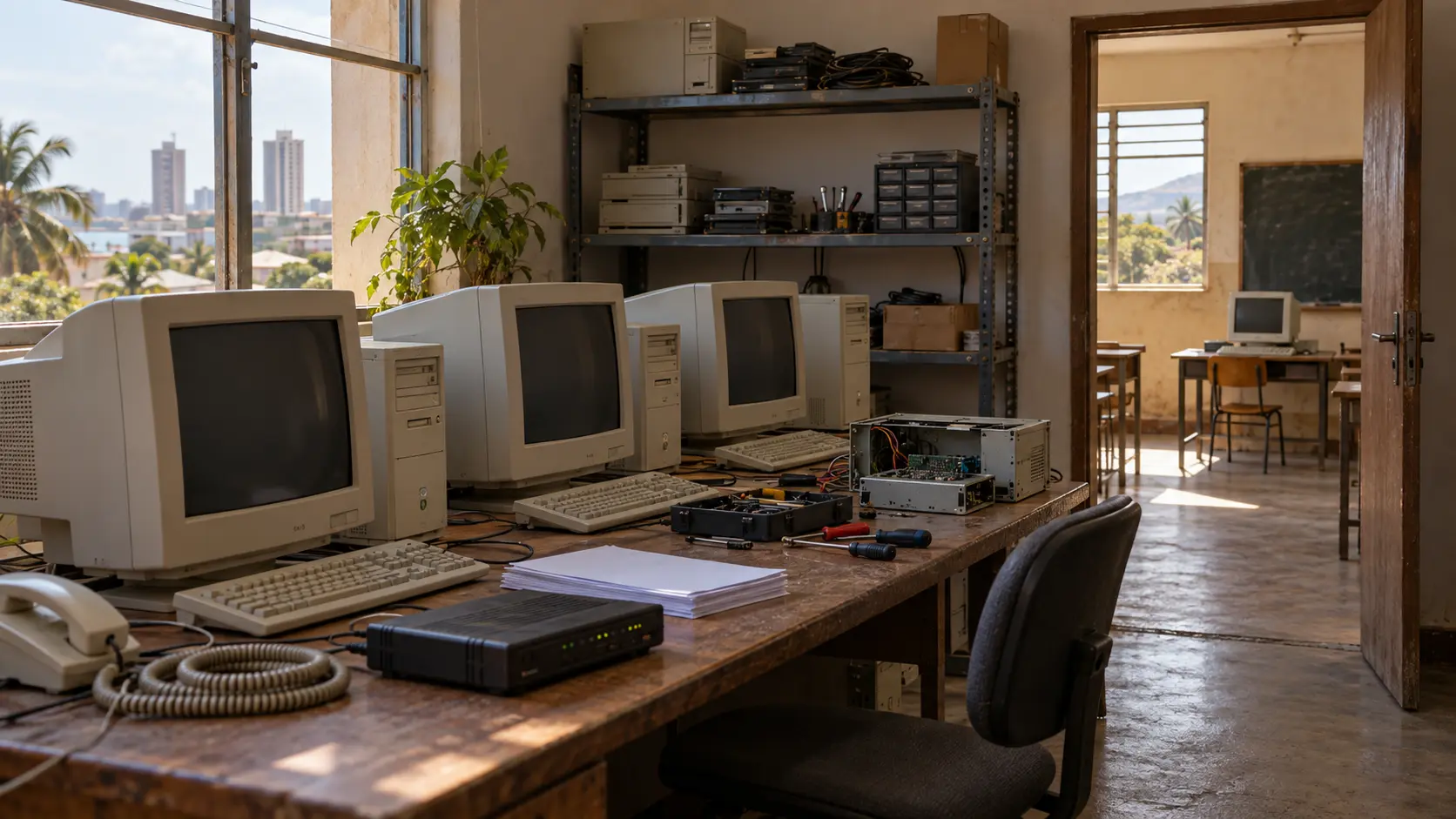
That dependency reached beyond the data path. The evaluation says provincial schools had few local ICT specialists, so CIUEM technicians sometimes flew from Maputo to handle even minor problems. Schools also faced telephone lines that did not work or had been cut, unreliable electricity and rooms that needed refurbishment before equipment could be installed. In Nampula, the report describes recurrent citywide power failures. Training teachers to handle basic issues was part of the model, but complex faults still travelled back to the university team. A connection could be provisioned while remaining fragile in day-to-day use.
Equipment and project management added separate failure points. The World Bank donated about 125 used 486 computers; the evaluation says roughly 100 initially worked, but they were incompatible with newer software and frequently broke down. IDRC and the World Bank also funded new computers, while other partners supplied equipment or connectivity to particular schools. Meanwhile, a multi-stakeholder steering committee had no full-time staff behind it. The evaluation records unpaid committee work, different lines of accountability and irregular communication.
It does not reduce the project’s difficulties to one cause: old equipment, electricity, phone lines, scarce skills and management all constrained use.
The later account by project designer Generosa Cossa and Johannes Cronjé describes CIUEM managing the project from 1998 to 2001 and reports that it had grown to 13 networked schools before becoming a national programme run by the Ministry of Education in 2001. The IDRC evaluation, based on interviews, questionnaires and six site visits in 2000, is an earlier snapshot: it says only three schools were networked in the initial year and notes substantial difficulties. These accounts describe different points in the project’s life. Neither establishes broad household access or measured learning gains.
The main historical change was not a single national “arrival” date. A university POP made the first school network possible across a thin provincial infrastructure, while concentrating connectivity and technical support in Maputo. The evaluation’s most useful measure is therefore operational: whether a school had a working telephone and power supply, someone nearby who could maintain its computers, and a reliable path to CIUEM. A list of connected schools captures only part of that system.
Cossa and Cronjé, “Computers for Africa” (2004); IDRC, “Internet para as Escolas in Mozambique”; Inderscience publisher record; ResearchGate article record
Member Briefing
Deeper Profile Context
Sign in with the right membership level to unlock the full briefing and source notes.
Only for Strategic Circle
Strategic Circle
Open to all readers. Unlock profile briefings after joining and signing in.
Join Strategic CircleOnly for Leadership Alliance
Leadership Alliance
For qualified IP-asset owners and management; sign in to unlock alliance briefings.
Join Leadership Alliance