
Summary
- Madison County Connect has moved from construction into service: the county and Empire Access said the first customers were connected on 14 October 2026, while the build is still expected to run into early 2027.
- Public records describe a $31.2 million programme, but the ConnectALL phase changes between the state’s 2025 fact sheet and the county’s current page, and the operator’s nearly 389-mile figure does not match the county page’s 406 miles of listed phases.
- The useful next measure is not another milestone announcement. It is an address-level ledger linking funded scope, construction acceptance, serviceable locations, orders, completed installations and the network capacity reserved for other providers.
A first customer is a change in state, not a completion certificate
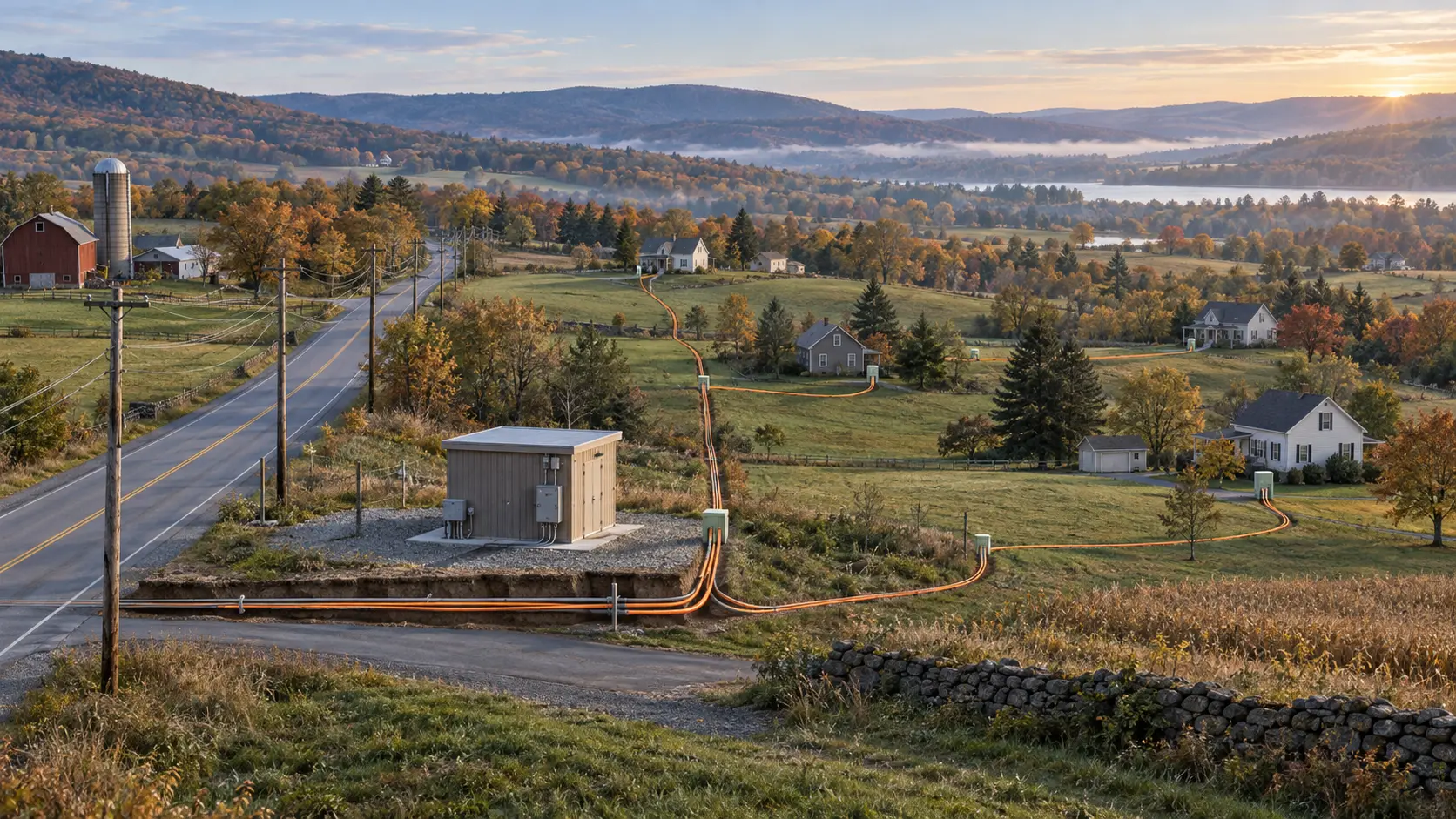
On 14 October, Madison County and Empire Access announced the first customers connected to Madison County Connect, a county-owned fiber network operated by Empire. The operator said the nearly 389-mile build was nearing completion and that more locations would become serviceable as final construction and activation continued. The county’s project page still places overall completion in early 2027. Its current account says some customers can check addresses and order service, while construction and hut activation continue.
That combination matters. The first live connection is stronger evidence than a planned route, a grant award or a construction-start photo: at least one end-to-end path has passed through enough of the system to carry a paying customer’s traffic. But a working path does not establish that the rest of the route is built, that all huts are energized, that every intended address has passed testing, or that a customer can order at a stated price. Those are separate operating states.
The distinction is familiar in network engineering. A cable on a map is not a tested link; a tested link is not necessarily an available service; an available service is not a completed installation. Each transition has a responsible party and a record that can be checked. Public broadband projects need the same discipline because their outputs are funded in several units at once: dollars, route miles, locations passed, locations eligible, and customers actually connected.
The public numbers are snapshots, not yet one reconciled baseline
Madison County’s current project page lists a $31,212,008 total. It assigns $18,639,100 to the USDA ReConnect phase, with $12,782,006 from USDA, $3,385,387 from the county and $2,471,707 from Empire. The page describes that initial phase as 269 miles, reaching 1,087 unserved households, 50 farms and 30 businesses, while also bringing 100/100 Mbps service to 6,504 other homes and businesses. It then lists a New York ConnectALL award of $12,572,908 for 137 additional miles and 2,637 additional homes and businesses.
The arithmetic of the current funding summary is coherent: $18.639 million plus $12.573 million is $31.212 million. The scope figures, however, need dates and definitions beside them. New York’s September 2025 ConnectALL fact sheet listed $9,998,562, 120 miles and 2,647 locations for its Madison County component, and said 20% of network capacity would be reserved for additional service providers. The later county page gives a larger award and route, but a slightly smaller location count. That could reflect an award revision, a changed scope or a different counting rule; the public documents cited here do not say which.
There is another gap to reconcile. The two phases on the current county page add to 406 miles, while Empire’s October 14 release describes a nearly 389-mile network. Route miles can differ from funded construction miles, phase boundaries or the operator’s measured route. Nothing in the available records establishes the reason. A dated scope-change table would let residents distinguish a real redesign from a harmless difference in measurement.
These are not allegations of impropriety. They are the ordinary accounting questions that become important when a public network moves from capital expenditure to operations. A sound report would state the effective date, whether a number is planned, built or accepted, how a “location” is counted, and which organization owns the underlying record.
The control surface is split across county, state, funders and operator
The county’s 2022 engineering solicitation describes a fiber-to-the-premises network that the county would own and Empire would operate and maintain. It assigns engineering work such as permitting, pole make-ready, testing, construction quality assurance and as-built records. A 2022 county resolution authorizes an operating agreement with Empire Long Distance and describes a minimum ten-year arrangement with revenue sharing. The resolution points to a contract form held by the county clerk; the resolution alone does not disclose all performance terms.
That division creates a practical accountability map. The county is positioned to report what it owns, what was accepted and what public funds bought. Empire controls retail ordering, installation and customer service, and can report addresses that are serviceable, orders received and completed connections. ConnectALL and USDA can report grant obligations and eligible outputs. Contractors hold construction and testing evidence. If the public sees only a single combined “progress” percentage, it cannot tell whether the bottleneck is construction, permitting, hut activation, address qualification or installation scheduling.
The state fact sheet’s 20% capacity reservation is especially consequential. It is evidence of a design intention to leave room for additional providers; it is not evidence that another provider has taken wholesale service, that the reserved capacity is technically available at every point, or that wholesale terms are commercially usable. Those questions determine whether county ownership creates a platform for future retail choice or simply a different owner of a single-provider service.
Prices and address checks are the reader-facing test
The county’s October 2026 page lists residential symmetrical tiers of 500 Mbps for $60 a month, 1 Gbps for $75 and 2 Gbps for $90. Those published prices are useful, but they do not by themselves show affordability, take-up or coverage. The same page directs residents to check an address with Empire because service is arriving in stages. The decisive denominator is therefore not the county’s population or the number of miles of fiber; it is the number of intended addresses that can place an order now, split by phase and service area.
For residents, the questions are concrete: Does the address qualify today? What installation charge, equipment fee, contract term or promotional expiry applies? How long between an order and a completed installation? For public overseers, the corresponding questions are whether eligible locations receive the promised minimum service, how many remain unserved, and whether complaints or failed installations cluster by town or contractor.
The county’s first-customer milestone deserves recognition precisely because it is measurable. The next update should preserve that evidentiary standard and go further: publish the scope version, route miles built and accepted, huts energized, addresses serviceable, orders placed, installations completed, and the remaining schedule. Keep grant commitments and retail outcomes in separate columns. Show how the 20% wholesale reservation is defined and what a provider must do to use it.
This is the running-code test for infrastructure policy: the promise matters when the system is installed, validated and used. A county can own the cable and a provider can sell the service, but residents experience neither ownership nor a grant award. They experience an address that qualifies, a price they can understand and a connection that works. Madison County has crossed the first customer threshold. The public record should now make the path from funded miles to usable service just as visible.
Sources
- Madison County Connect project page (updated 7 October 2026; accessed 14 October 2026)
- Empire Access first-customer announcement (14 October 2026)
- New York ConnectALL 2025 Treasury Report and project fact sheet
- Madison County engineering solicitation
- Madison County operating-contract resolution
Member Briefing
Deeper Profile Context
Sign in with the right membership level to unlock the full briefing and source notes.
Only for Strategic Circle
Strategic Circle
Open to all readers. Unlock profile briefings after joining and signing in.
Join Strategic CircleOnly for Leadership Alliance
Leadership Alliance
For qualified IP-asset owners and management; sign in to unlock alliance briefings.
Join Leadership Alliance