• London planning authorities would identify suitable data-centre locations using electricity, water, land, clustering and heat-recovery criteria
• Projects outside identified areas would need to justify their location and infrastructure impacts, while consultation runs until 15 October 2026
The fact
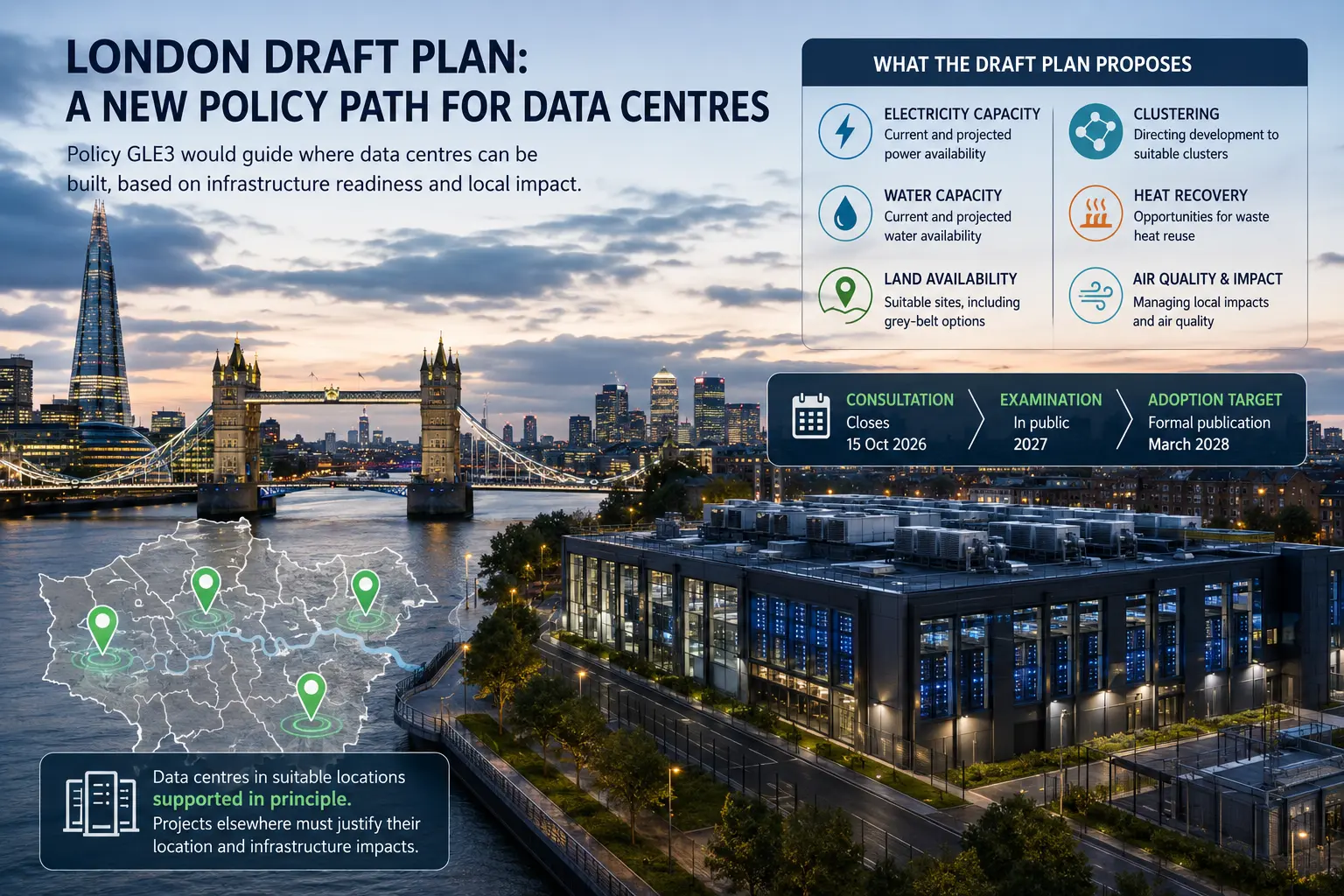
The Greater London Authority published its draft London Plan on 16 July with a dedicated policy for data centres. The London Plan sets the strategic planning framework for the capital and forms part of the development plan used by London boroughs. Policy GLE3 asks planning authorities to identify suitable data-centre locations using criteria that include current and projected electricity and water capacity, opportunities for clustering and heat recovery, land availability and, where relevant, air-quality impacts.
Data-centre proposals in identified locations would be supported in principle. If no suitable locations can be found locally, authorities should first work with neighbouring areas before considering grey-belt land or sites at the edge of Broad Locations for Growth. Proposals elsewhere would have to justify their location and address infrastructure impacts, including disruption from electricity connections. All proposals would also have to demonstrate heat-recovery infrastructure and electricity and water efficiency measures.
Consultation closes on 15 October 2026, with examination planned for 2027 and formal publication scheduled for March 2028.
The assessment
GLE3 would write power and water directly into the location test for data centres. For developers, that would tie site selection more closely to evidence on utility capacity, heat-recovery opportunities and competing land needs before a proposal reaches detailed planning. The policy does not add grid or water capacity. A location could be identified as suitable while an individual project’s connection still depends on available capacity and delivery timelines. The draft therefore gives planning authorities a framework for screening locations, not a guarantee that the required infrastructure will be available when a project is ready.
For BTW readers, GLE3 would make location a clearer planning filter. Projects outside identified areas would have more to justify, while projects inside them would still need real infrastructure behind the designation. The policy’s practical value will depend on how closely mapped suitable locations match power, water and heat-recovery conditions on the ground.
What to watch
Watch whether consultation changes the electricity, water, heat-recovery or grey-belt tests in GLE3. The first local-plan updates will show how planning authorities define suitable locations and what evidence they expect from developers. Planning decisions for projects outside those areas will then show how the location-justification requirement works in practice.