
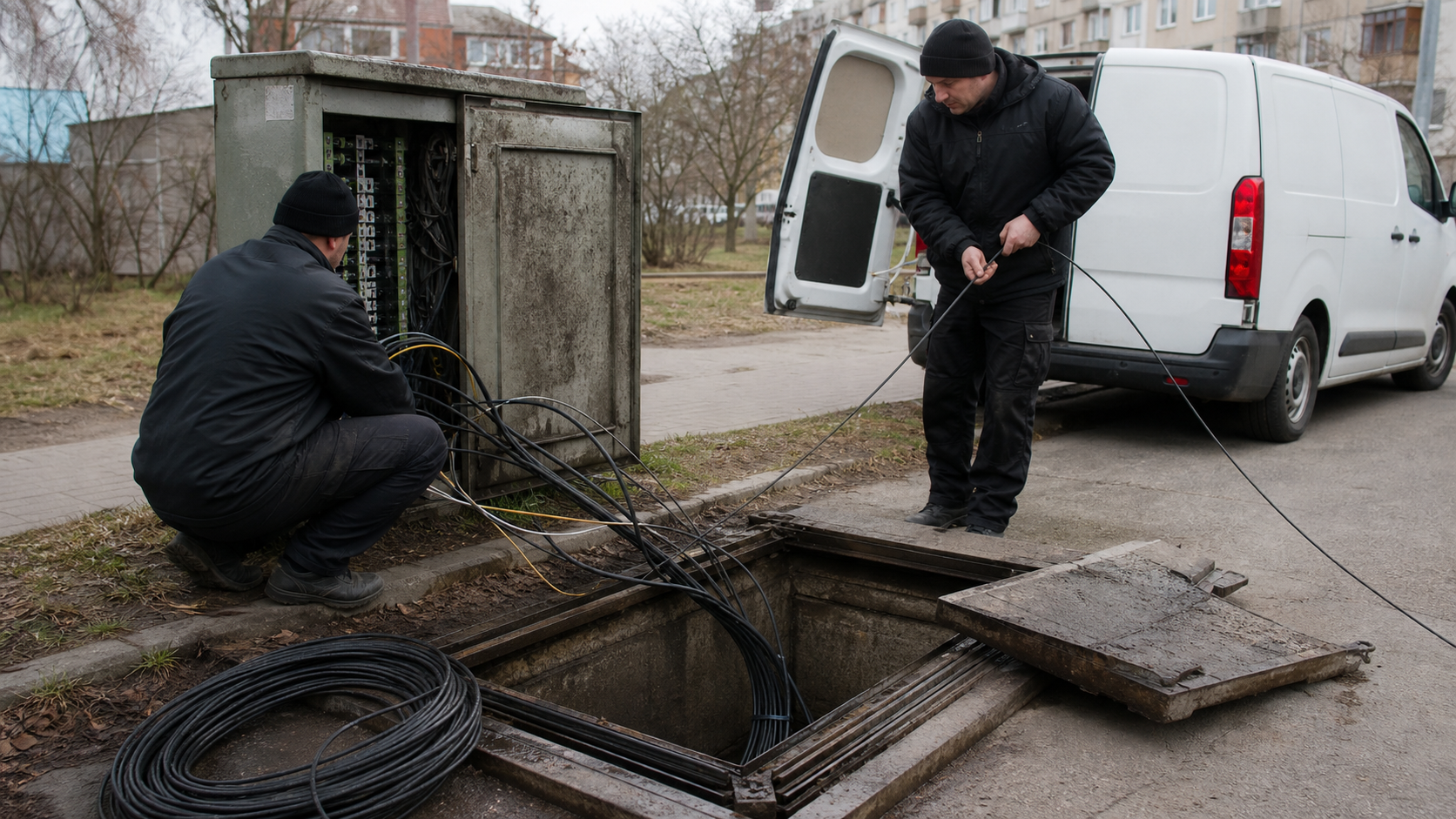
Summary
- LLC Balttelecom is not economically interesting because it is large. It is interesting because it is small, local and exposed. The public evidence points to a Kaliningrad fixed-access business under the SOVAtelecom brand, with home internet prices clustered around 550 to 850 roubles a month for apartment service, higher prices for private-house connections, and business service claims around dedicated support, up to 1 Gbit/s access, voice, Wi-Fi hotspot, structured cabling, IT outsourcing and co-location. The conclusion is blunt: Balttelecom can be a good local cash business if it keeps take-up dense, outages low and support labour efficient, but it does not have much room for underused plant, wholesale-price shocks or slow renewal capital.
- The routing evidence makes the company real but also shows its limits. AS35239 originates two IPv4 prefixes, about 9,216 IPv4 addresses, and no IPv6 prefix in the public sources reviewed. Public BGP views identify MegaFon and Rostelecom as upstreams, and those names matter because each is also a national retail competitor. Balttelecom therefore buys or depends on large-network reachability from firms whose broader market position can also discipline its retail pricing.
- The disclosed price book is not a licence to infer subscriber count. A 650 rouble monthly tariff, a 550 rouble entry tier and a promotional 100 rouble first-quarter offer tell us the unit revenue problem. They do not disclose churn, traffic consumption, contention ratio, wholesale transit costs, cable-repair cost, building-by-building take-up, router subsidies or business customer concentration. Any serious judgment has to treat those missing figures as the core due diligence gap, not as details to be guessed.
- The facts that would change the judgment are operational, not rhetorical: active billed ports by building, churn after promotions, peak-hour utilisation by uplink, wholesale capacity contracts, average revenue per user by service type, repair truck rolls per 100 subscribers, age of access switches and optical plant, exposure to one or two business customers, and proof that the company has a credible IPv6 and route-diversity plan.
Start With One Active Port
The cleanest way to read LLC Balttelecom is to begin with one live access port in Kaliningrad. A port is not an abstract customer relationship. It is a physical and accounting claim on scarce things: a cable path into a building or house, an optical or Ethernet handoff, a switch port, a share of upstream capacity, a share of support labour, a billing relationship, a fault-response obligation, a future replacement obligation and a local reputation promise. If the port is billed every month and stays connected long enough, the economics can work.
If it is connected after a discount, consumes support time, churns before acquisition cost is recovered, or sits on a low-density route, it becomes a small loss with a cable attached.
Balttelecom's public consumer price book gives the first boundary. Its apartment internet plans include a 30 Mbit/s tier at 550 roubles per month, 60 Mbit/s at 650 roubles, 90 Mbit/s at 750 roubles and 100 Mbit/s at 650 roubles. It also advertises a 100 Mbit/s promotional plan at 100 roubles per month for the first three months and 850 roubles thereafter, with an annual repeating pattern and a minimum one-year contract. The arithmetic is important. If the customer remains for the year, that promotional plan averages 662.50 roubles per month across the first twelve months.
If the customer churns soon after the low-price period, the operator has effectively rented scarce connection capacity for almost no contribution during the months when connection, support and onboarding costs are most likely to be concentrated.
That is why the central question is not whether 100 Mbit/s for 650 or 850 roubles looks cheap or expensive in isolation. The relevant question is whether the port produces a positive monthly contribution after the avoidable costs attached to that subscriber and after a rational reserve for the fixed assets that made the port possible. At 650 roubles, there is not much room for waste. Some costs vary with the subscriber: payment processing, support calls, customer-premises visits, traffic-driven upstream usage and, where bundled or rented, equipment.
Other costs are fixed or step-fixed: the node, building access, cabinet power, switch replacement, monitoring, software, licences, accounting, customer service and emergency repair capability. The access operator survives by spreading the fixed part over enough stable ports.
The same issue is visible in the private-house offer. Balttelecom advertises 30 Mbit/s private-house internet at 850 roubles, 60 Mbit/s at 975 roubles and 100 Mbit/s at 1,350 roubles, while warning that connection cost depends on distance from its communications node. That price spread is rational. A private-house drop is a different asset from an apartment port in a multi-dwelling building. It may require longer cable, more field time, more weather exposure, less efficient maintenance routing and weaker nearby density. If a private-house subscriber pays 1,350 roubles and stays for years, the line may be attractive.
If the company prices the line like a dense apartment port or absorbs too much one-off construction cost, the extra headline revenue can disappear into the first installation and the first fault.
The public record therefore supports a practical conclusion. Balttelecom's value is not in owning a famous brand or a national-scale network. Its value, if durable, is in local utilisation: a good number of paying ports per building, a low fault rate, enough business accounts to lift average revenue, and enough route diversity that upstream or outage risk does not destroy the service promise. Everything else is secondary.
Identity And Control Boundary
The company should be kept inside a tight identity boundary. The public SOVAtelecom site identifies the operating brand with ООО "Балттелеком" and presents the service as a Kaliningrad provider. The company address appears as Tchaikovsky Street 2 in Kaliningrad. The RIPE membership page for LLC Balttelecom also gives Tchaikovsky 2, Kaliningrad, and lists the company as a Russian LIR. Corporate-profile mirrors identify the current legal entity as OGRN 1163926071495 and INN 3906992494, registered in July 2016, with the main activity described as wired telecommunications.
They identify the general director as Andrey Alexandrovich Chvanov and the founder/shareholder as Vitaly Borisovich Tarasov, though the exact employee count differs across mirrors.
That evidence is enough to treat LLC Balttelecom as the directory entity under review. It is not enough to treat every older use of the BaltTelecom name as the same business without qualification. The company's own "about" page says the Balttelecom group was founded in 1998 and provides telecom services in Kaliningrad and Kaliningrad Oblast. Some older telecom press references use the BaltTelecom name in connection with earlier Russian carrier structures and broadband-market entry. Those references can help explain why the brand may have a longer local history than the current LLC registration.
They should not be used to assume current ownership, current contracts or current balance-sheet continuity unless a primary corporate document proves the chain.
That distinction matters for economic analysis. A regional ISP can inherit brand goodwill, routes, ducts, building relationships or customers from predecessor companies; it can also inherit none of them formally. If the current LLC owns or controls the operating network assets, the valuation question is asset utilisation. If some assets, customer lists or support resources sit in affiliated entities, the economics depend on transfer pricing and related-party arrangements that are not visible in the public record. The public pages do not give a consolidated group structure or audited segment accounts.
The article therefore treats Balttelecom as an operating local access provider visible through SOVAtelecom pages, RIPE/BGP records and current corporate mirrors, while keeping older references and possible affiliated history as context rather than proof.
The corporate mirrors do, however, add one useful dimension: scale. Public profiles show the company as a microbusiness in some databases, with employee counts reported around the mid-teens, and show 2025 revenue in the low-60-million-rouble range, with 2024 revenue around 52.1 million roubles in some mirrors. The mirrors are not a substitute for audited accounts, and one public profile reports a slightly different 2025 revenue figure from another. Still, the range is consistent with a small local operator, not a national network. If annual revenue is roughly 62.8 million roubles, monthly revenue is roughly 5.2 million roubles.
If that monthly revenue were made only of 650 rouble residential subscriptions, it would equal about 8,000 residential-equivalent subscriptions. If it were made only of 850 rouble subscriptions, it would equal about 6,150 residential-equivalent subscriptions. That is not a subscriber count. It is a scale check, and it warns against both exaggerations: the company is not a trivial shell, but it is also not a large carrier.
Control also matters because the operator sells local trust. Its contact pages show separate sales, subscriber and technical-support lines, and technical support hours described as daily. The Google Play listing for the SOVAtelecom app names ООО Балттелеком and describes a customer account app for balance, account state and payment. This is the ordinary machinery of a retail ISP: billing, support, payments and faults. That machinery has economic value only if it reduces churn and support cost. A regional provider that answers the phone and fixes local faults quickly can defend a price that looks unremarkable against national offers.
A regional provider that loses that service edge is left competing on scale economics it does not have.
The Price Book Says More Than The Marketing
Balttelecom's price book says the company understands segmentation. Apartment internet, private-house internet, telephone service, local network work, video surveillance, business internet, voice, virtual PBX, IT outsourcing, structured cabling, public Wi-Fi hotspot and co-location are all presented as service lines. The economics of those lines differ sharply. The common mistake is to treat them all as "telecom revenue." They are not. A 650 rouble apartment internet plan is a recurring-access product. A private-house connection may include construction economics.
A business internet circuit may sell assurance, speed, routing and account management. Structured cabling and IT outsourcing are labour-and-project businesses. Co-location is a power, space, cooling and connectivity business. Voice and virtual PBX attach margin to existing access if managed well, but they can also drag support complexity behind them.
The home tariff ladder is revealing. The 30 Mbit/s plan at 550 roubles implies about 18.33 roubles per advertised Mbit/s per month. The 60 Mbit/s plan at 650 roubles implies about 10.83 roubles. The 90 Mbit/s plan at 750 roubles implies about 8.33 roubles. The 100 Mbit/s plan at 650 roubles implies 6.50 roubles. The promotional 100 Mbit/s plan is 1 rouble per advertised Mbit/s during the first three months, then 8.50 roubles thereafter, with a first-year average of 6.625 roubles. Those ratios should not be mistaken for network cost per Mbit/s, because access plans are contended and advertised speed is not the same as paid upstream capacity.
But the ratios show the commercial direction: higher-speed plans are priced to protect share and reduce the psychological gap with national competitors rather than to collect proportionally higher revenue.
The private-house ladder points the other way. A 30 Mbit/s private-house plan at 850 roubles is 28.33 roubles per advertised Mbit/s. A 60 Mbit/s plan at 975 roubles is 16.25 roubles. A 100 Mbit/s plan at 1,350 roubles is 13.50 roubles. The lower speed still has a high monthly charge because the cost is not really the Mbit/s. It is the access path. The company says connection cost depends on distance from its node, which is exactly the correct variable. For a dense apartment building, one feeder and one access switch may support many apartments. For a private house, the incremental drop may be its own construction decision.
Low utilisation in that segment hurts more because there are fewer neighbouring ports over which to spread the same trip, cable and repair capability.
The business page is not a tariff sheet, and that is also informative. It advertises internet up to 1 Gbit/s, channel/node redundancy, qualified local technical support, an individual specialist and flexible tariffs shaped to business needs. That is not commodity household pricing. It is a service-assurance pitch. For Balttelecom, the business segment can improve the economics if it raises average revenue per port and uses the same metro footprint more intensively.
A building with a few business customers, a managed Wi-Fi hotspot, a virtual PBX and a standard internet circuit is economically different from a building with only low-price residential ports. The danger is that business service also raises the promised service level. If the customer pays for "individual" support and redundancy, the operator must staff and engineer for that promise.
The telephone tariffs are small but useful. The public table shows 200 roubles for a per-minute plan, 250 roubles for a combined plan with 200 local minutes, and 350 roubles for unlimited local connections, with extra per-minute charges for local and mobile destinations. Voice can be a retention product, especially for older households or small offices, and it can preserve revenue where the access line already exists. It is unlikely to be the growth engine. The strategic value is bundle stickiness, not standalone scale.
Pricing relative to the local market is uncomfortable. Public aggregator pages show Rostelecom offers in Kaliningrad beginning around 550 roubles for 200 Mbit/s in some listings. Beeline-facing tariff pages and aggregators show lower promotional prices and faster headline tiers, including 100 Mbit/s and 1 Gbit/s products depending on address and bundle. MTS markets bundled fixed, TV, mobile and media products. DomInternet's Russia-wide price analysis placed the national average home-internet tariff at 678 roubles in May 2026 and listed federal-provider averages that make 650 roubles look ordinary rather than premium.
Against that backdrop, Balttelecom cannot simply charge a high local monopoly price across the city. It has to win on address-specific availability, installation responsiveness, support quality, private-house practicality, business relationships or local network services.
That is the key strategic point. The price book is not bad. It is rational for a small regional provider. But the price book leaves little room for lazy economics. A 650 rouble monthly plan can work in a dense building with low churn and few faults. It can fail in a building with weak take-up, heavy support calls and high peak-hour usage. A 1,350 rouble private-house plan can work if construction contribution is real and the customer stays long enough. It can fail if the installation consumes the lifetime margin. A business circuit can be attractive if support is disciplined and the service is priced for assurance.
It can become a bespoke support burden if "flexible tariffs" turn into underpriced custom work.
Contribution Math Without Invented Costs
The public record does not disclose Balttelecom's transit bill, traffic mix, customer count, churn, capex schedule or gross margin by product. That means the correct unit-economics analysis is a framework, not a fake income statement. Start with monthly billed revenue per active port. Deduct direct customer taxes and statutory charges where applicable, payment and billing costs, upstream and interconnection costs, customer support time, truck rolls, customer-premises equipment subsidy or maintenance, and a reserve for switch, fibre, power and node replacement. What remains is contribution to overhead and profit.
The company only has a defendable business if that contribution is positive across a realistic subscriber lifetime.
For the apartment product, the sensitivity is churn and support intensity. Suppose a customer enters through the 100 rouble promotional plan. The first three months produce only 300 roubles of gross billed revenue. The annual contract language helps, but contract terms are only as valuable as enforcement, customer willingness to pay and collection practicality. If the subscriber remains for twelve months, the plan produces 7,950 roubles in the year. If the subscriber stays into later years under the repeating annual scheme, the port may be fine.
But if the subscriber leaves, moves, stops paying or consumes repeated support during the promotional period, the economics are poor. The company therefore needs either very low churn after promotional onboarding or a low-cost connection process that can tolerate some churn.
For the standard 650 rouble 100 Mbit/s apartment product, the challenge is different. The price is not a giveaway, but it is not a large cushion. A single unnecessary field visit can absorb several months of operating contribution if technician time, travel, parts and scheduling are counted honestly. A faulty router blamed on the provider, poor in-apartment Wi-Fi design, old building wiring or payment friction can all create support cost without increasing revenue. Balttelecom's own site tells customers that Wi-Fi is less reliable than wired local networking and that local-network planning can be done by SOVAtelecom specialists.
That message is commercially useful. If the provider can move customers toward properly wired apartments or paid local network services, it reduces repeat Wi-Fi complaints and turns a support problem into billable work. If customers continue to treat every Wi-Fi issue as an ISP fault, the low monthly access price bears too much labour.
For private houses, the sensitivity is take-up against route length. The company's statement that connection cost depends on distance from its node should be read as an economic warning, not just a customer note. A private-house subscriber can pay double a low apartment plan and still be less attractive if the line is long, exposed, slow to install and expensive to maintain.
The right question is not "how many private houses can be connected?" The right question is "how many private houses can be connected along the same route, with enough upfront contribution or minimum term to recover build cost?" If one house at the end of a line takes service, the line is fragile economically. If a cluster of houses takes service, the same construction becomes a neighbourhood asset.
Business services can change the contribution curve. A business that buys access, voice, Wi-Fi hotspot compliance, structured cabling and IT outsourcing may generate higher monthly and project revenue from the same local footprint. The business page's claim of a dedicated support contact is meaningful here. Business customers pay for lower transaction cost: one person to call, a predictable repair process, and a provider that knows local buildings. The danger is concentration. The company says it builds communications facilities for major mobile operators, including fibre, low-current networks and base-station integration.
If that is an ongoing material revenue line, losing one national-operator customer could matter. The public record does not disclose contract values, current customers, durations or margins, so the claim should be treated as a possible upside and a concentration risk at the same time.
The public financial mirrors allow a rough cross-check. If 2025 revenue was about 62.8 million roubles and net profit about 16.0 million roubles, the implied net margin is around 25 percent. That looks strong for a small access operator, but the number should be handled cautiously because mirrors can differ, accounting classifications can hide one-off items, and the article has not reviewed the original filed statements. The same mirrors show 2024 revenue around 52.1 million roubles and net profit around 4.7 million roubles, implying a much lower margin in that year. The change may reflect pricing, mix, costs, accounting or one-off effects.
It is a useful signal, not a clean trend. The economic conclusion should not rest on the profit percentage. It should rest on the operator's ability to maintain cash contribution while replacing assets.
There is also a useful address-space cross-check. AS35239 is reported with about 9,216 IPv4 addresses and no public IPv6 allocation in several network-data sources. If one tried to map those IPv4 addresses directly to customers, the result would be misleading because NAT, static addresses, business customers, infrastructure, hosted equipment and address management all intervene. But the address count is consistent with a small ISP scale and with the revenue-equivalent thought experiment. It suggests a network large enough to matter locally but not large enough to absorb repeated strategic mistakes.
The practical unit-economics verdict is therefore conditional. At dense apartment take-up, with efficient support and stable upstream costs, the monthly tariffs can work. At low utilisation, heavy churn or custom support leakage, they are fragile. For private houses, the higher tariff is only attractive where construction contribution and route clustering are disciplined. For business services, the upside is higher revenue per relationship, but only if service-level promises are priced and concentration is controlled.
Network Evidence: Real, Narrow, And Dependent
The network evidence is stronger than the corporate storytelling. AS35239 is visible across multiple BGP and IP-information sources as BALTTELECOM-AS, registered to LLC Balttelecom in Russia. Public views show two originated IPv4 prefixes: 78.155.160.0/19 and 178.237.60.0/22. The combined address space is 9,216 IPv4 addresses. Public sources consistently show zero IPv6 prefixes originated. The RIPE membership listing identifies LLC Balttelecom as a member and provides the Kaliningrad address and contact details. The BGP tools show the autonomous system as active and allocated under RIPE.
That matters because the first question for a local ISP is whether it has a real network surface. Balttelecom does. It is not merely reselling a website without resource evidence. Its reverse-DNS and prefix records point to named Balttelecom infrastructure, and public routing records show the company announcing its own address space. IPinfo also describes the network as an ISP/consumer network and reports a day/night activity rhythm, a pattern consistent with an eyeball access provider rather than a pure hosting or transit network.
Cloudflare Radar's traffic page reports a desktop-heavy split and separates human and bot traffic for AS35239. Those signals are not audited subscriber data, but they support the interpretation of a real user-access network.
The second question is route diversity. Public BGP views identify MegaFon and Rostelecom as upstreams, while some sources differ on the exact peer count or visible adjacency at a given observation point. The RPSL object visible through BGP tools includes import/export policy for MegaFon and Rostelecom and a peering remark for Ekran. CIDR Report, observed from its own vantage, sees an upstream adjacency through MegaFon. This divergence is not surprising. BGP visibility depends on collectors and timing.
The safe conclusion is that Balttelecom has publicly visible upstream relationships with at least the national networks shown in the RPSL policy and common BGP views, but the public evidence does not prove the commercial terms, capacity, redundancy, physical path diversity or failover performance.
That is a serious distinction. Having two upstream names in a routing object is not the same as having two physically independent, capacity-rich paths that survive fibre cuts, maintenance windows, sanctions-related equipment shortages or upstream policy changes. Kaliningrad is Russia's westernmost region and a geographically distinctive market. A local operator in that region needs backhaul and transit resilience, not just a local access footprint.
The sources reviewed do not disclose whether Balttelecom's upstream routes are physically diverse, whether they leave the region on independent ducts or transport systems, whether one provider is primary and the other backup, or whether peak traffic can be shifted without customer-visible degradation.
The lack of visible IPv6 also deserves attention. It does not mean the current business fails; many smaller access providers have delayed IPv6 for years while relying on IPv4, NAT and private addressing. But the absence of public IPv6 origination is a strategic lag. IPv4 scarcity does not immediately break a local Russian ISP with an existing allocation, but it shapes customer experience, business service capability, technical debt and future interconnection posture.
A buyer, lender or strategic partner should ask for the IPv6 plan, not because IPv6 is fashionable, but because delayed transition can expose weak network engineering, old customer-premises equipment and underfunded core upgrades.
The network surface therefore supports a middle conclusion. Balttelecom has a real AS, real IPv4 resources and visible local access indicators. It is not a network of national scale, and it does not show obvious downstream wholesale depth. Public sources commonly show no downstream AS customers. That means the company's economics are mainly access and local services, not transit resale. The network must earn money from households, small businesses, local enterprise services and construction/support work, not from a broad wholesale customer cone.
Capital, Repair And The Cost Of Staying Current
The hardest cost in a small fixed-access operator is not the initial excitement of connecting a subscriber. It is the dull requirement to keep the network current while prices remain ordinary. Switches age. Power systems fail. Customer-premises equipment becomes obsolete. Fibre gets cut. In-building cabling is damaged by renovation. Support staff must be retained even when no new high-margin project is being sold. Billing systems and payment channels must keep working. Regulatory paperwork must be answered. None of these obligations cares that the entry apartment tariff is 550 roubles.
Balttelecom's own site points to this reality indirectly. It offers local network work for apartments and warns that Wi-Fi can be unstable because radio conditions are affected by neighbouring routers, walls and appliances. That is technically plain and economically important. In many broadband businesses, a large share of customer dissatisfaction is not caused by the operator's external network. It is caused by in-home Wi-Fi, cheap routers, bad placement or old devices. But customers do not separate those causes cleanly. They call the ISP.
If the ISP rolls a technician or spends long support time diagnosing a customer-side problem for no fee, the access port loses contribution. If the ISP can sell a proper wired local network or paid configuration, it can improve customer experience and recover labour cost.
The same principle applies to video surveillance and Wi-Fi hotspot services. They look like adjacency products, but they are operational promises. A camera service adds installation, support and cloud/archive expectations. A public Wi-Fi hotspot service adds user-identification, landing-page and compliance expectations. A co-location service adds power, cooling, uptime and physical-access obligations. These products can raise average revenue if they are standardized and priced well. They can damage a small operator if every sale becomes a custom engineering project with residential-style margins.
Capital renewal is the central unresolved question. Public corporate mirrors show a company with tens of millions of roubles in annual revenue and, in some sources, capital around 61 million roubles. That suggests a business with some retained resources. It does not show whether the network is underinvested, fully modernized or dependent on assets inherited from earlier affiliated structures. The current website advertises apartment access up to 100 Mbit/s in the home tariff table and business internet up to 1 Gbit/s.
Meanwhile, national competitors and aggregators show 200 Mbit/s, 500 Mbit/s and 1 Gbit/s consumer offers in the broader Kaliningrad market. If Balttelecom's dense residential footprint remains capped at lower advertised speeds while competitors upgrade buildings to faster fibre tiers, its price-defense problem will intensify. If the 100 Mbit/s table is merely the public retail selection while business and specific buildings can go faster, the risk is lower. The public record does not settle it.
The renewal problem is not only speed. It is also operational tooling. A small ISP can defend itself with better local support, but only if support is efficient. Customer portals, balance visibility, payments and account status matter because they reduce calls. The SOVAtelecom Android app is therefore small evidence of process investment, not just a convenience. Its public listing reports low download scale, which is consistent with a small subscriber base or weak app adoption. Either way, the operator cannot assume that digital self-service has solved support load.
Payment friction on the website, including notices about temporary online card-payment problems, is a warning sign because payment inconvenience can become churn or call-centre cost even when the network works.
The capital conclusion is again conditional. Balttelecom may be profitable enough to renew its plant if management keeps projects disciplined and uses business services to lift margin. But a small access operator can look healthy in a good accounting year and still be exposed if the next upgrade cycle requires replacing access switches, customer routers, monitoring systems and backhaul capacity at once. The due diligence item is a capex schedule by network layer: access, aggregation, core, power, customer equipment, tools and building entry rights.
Suppliers, Upstreams And Risk Transfer
The supplier structure is strategically awkward. Public BGP data identifies MegaFon and Rostelecom as upstreams or routing counterparts. Both are also national operators with retail or enterprise alternatives in the broader market. That dual role is common in telecom and not automatically abusive, but it changes bargaining power. Balttelecom needs reachability, backhaul and potentially wholesale services from large networks. Those large networks can also compete for households and businesses directly. In effect, the local operator buys scale from companies that can pressure its retail proposition.
This is where risk transfer becomes the right lens. A national operator can transfer some local cost and nuisance to the regional provider: building-level support, small-account billing, in-home Wi-Fi complaints, local construction headaches and low-volume customer management. The regional provider can, in return, buy upstream scale and focus on local relationships. That bargain works if the wholesale input price is stable and the local provider is genuinely better at local execution. It fails if wholesale costs rise, national bundles become too cheap, or the regional provider loses its support advantage.
Balttelecom's website tries to claim the local-execution side of that bargain. It emphasizes local technical support, an individual specialist for business customers and practical services such as structured cabling, Wi-Fi hotspot and IT outsourcing. The "about" page also says the group builds communications facilities for the "Big Four" mobile operators, including fibre links, low-current systems and base-station integration. If true and current, that experience can be valuable. It means the company may understand local construction, permitting, building access and mobile-operator standards.
It could also mean the company has revenue concentration around a small number of powerful customers. Without contract disclosure, both interpretations remain open.
Supplier risk is not just upstream. Equipment matters. The public sources do not identify Balttelecom's switch vendors, router suppliers, optical equipment, monitoring stack or spare-parts inventory. For a Russian regional operator, equipment renewal and replacement can be complicated by import availability, currency movement and support-channel changes. The article does not need to invent vendor exposure to make the point.
It is enough to say that a small operator with ordinary rouble tariffs is vulnerable if replacement equipment becomes more expensive or slower to obtain while customers still compare the monthly bill against large operators' bundles.
The company also bears regulatory and payment-process risk. Corporate mirrors show several communications licences, and some search snippets report licence-status events, including suspensions of activities under particular licences in January 2025 on one provider mirror. Those snippets need cautious handling because licence databases and mirrors can be hard to interpret without the official current record for each service line.
Separately, a 2025 appellate court record describes a Ministry claim against LLC Balttelecom for unpaid universal-service reserve deductions and penalties, with debt of 73,046.97 roubles and penalties of 54,316.49 roubles at the claim stage. That amount is not existential next to tens of millions of roubles in annual revenue, but it is analytically useful: even small operators sit inside recurring fiscal and regulatory obligations, and weak compliance discipline can turn small payments into legal cost and management distraction.
The supplier conclusion is that Balttelecom cannot eliminate dependency. It can only price and engineer around it. A strong position would show at least two economically real upstreams, physical route diversity, spare capacity, written service-level commitments, limited single-vendor exposure, clean licence status and disciplined regulatory payments. The public record proves only part of that.
Customer Concentration And The Local-Service Bet
Customer concentration is the least visible and most important risk. Residential access looks diversified because each household is small. But the economics of a local ISP are often concentrated by building, route and service cluster. Ten apartment buildings with high take-up can be a business. Fifty buildings with low take-up can be a maintenance liability. A few business accounts can materially improve revenue. A few lost building relationships can damage utilisation. A few mobile-operator construction contracts can make annual results look better than recurring access economics really are.
Balttelecom's public pages suggest three customer groups. The first is households in apartment buildings. The second is private houses, where connection cost depends on distance from the node. The third is business customers buying access, voice, virtual PBX, IT services, Wi-Fi hotspot, structured cabling or co-location. These groups should not be blended. The household segment is volume and churn management. The private-house segment is route economics. The business segment is relationship pricing and support discipline.
For households, the key metric is not total advertised coverage. It is active take-up per serviceable address. A small provider can make money in a building where it has a high share and low fault rate even if a national competitor also exists. It can lose money in a building where it maintains equipment and access rights for a handful of price-sensitive customers. The public record does not disclose building count, home-pass count or subscriber density. Review pages contain hints that in some buildings SOVAtelecom may be one of few available options, but reviews are not coverage data.
The serious question is building-level contribution by cohort.
For private houses, the key metric is payback period by route. The website's distance-based connection-cost note implies management understands that construction cannot be socialized blindly. A private-house product may be strategically useful in Kaliningrad Oblast because national operators may not prioritize every low-density location equally. But the operator should avoid becoming a custom construction company funded by monthly access fees. If the customer pays enough upfront connection charge and accepts a minimum term, private-house access can create high-loyalty revenue.
If not, it is an attractive-looking tariff with hidden capex leakage.
For business, the key metric is customer lifetime margin after support. Balttelecom's business promise is local, responsive and flexible. That can be valuable for small businesses that cannot command attention from national operators. It also risks becoming a service desk for underpriced complexity. Virtual PBX, Wi-Fi hotspot and IT outsourcing can attach margin when standardized. They become dangerous when each client requires custom configuration, compliance explanation, hardware troubleshooting and after-hours urgency.
The phrase "individual specialist" should be priced as a premium support feature, not absorbed as a marketing cost.
The potential mobile-operator construction line is a separate concentration issue. Building fibre and base-station links for MegaFon, Beeline, MTS or Tele2 can be a credible local contracting business. It can also put Balttelecom in a supplier position to larger companies with procurement power. If those contracts are occasional projects, they may help utilize labour and create relationships. If they are a large share of revenue, the company needs to show contract duration, margin and receivable discipline. Public sources do not provide that.
This makes the due diligence simple. Ask for revenue by segment, top-ten customer share, largest-building contribution, churn by acquisition cohort, private-house payback by route, business gross margin after support time, and revenue from construction projects separated from recurring access. Without those numbers, Balttelecom can only be judged as a plausible small local operator with attractive local-service options and hidden concentration risk.
Competition And Substitutes
Balttelecom competes in a market where national operators can use scale, bundles and brand. Rostelecom appears in Kaliningrad tariff listings with 200 Mbit/s plans from about 550 roubles and broader xPON/FTTB claims. Beeline-facing pages and aggregators show home-internet offers with promotional pricing, bundles and speeds that can reach 500 Mbit/s or 1 Gbit/s depending on the page and address. MTS promotes fixed, mobile, TV and media bundles under one account. Local provider directories list multiple operators in Kaliningrad, including national and regional names. The competitive message is clear: Balttelecom is not alone.
The substitute is not only another fixed line. Mobile broadband and fixed-mobile bundles can discipline prices even where they do not fully replace a stable wired connection. A household that uses streaming, gaming, remote work and multiple devices still benefits from fixed broadband, but the willingness to tolerate poor fixed service declines when mobile data is abundant and bundled. National operators can also attach mobile minutes, TV, cinema services, smart-home devices and discount mechanics. A small ISP cannot easily match the bundle stack.
It must make the fixed line boringly reliable or locally convenient enough that the customer does not care.
The 650 rouble SOVA 100 NEW plan is therefore a defensive price, not a premium price. It sits near national average home-internet pricing and near the entry offers from larger rivals. The 550 rouble 30 Mbit/s plan is cheaper but much slower. The 750 rouble 90 Mbit/s plan is odd next to the 650 rouble 100 Mbit/s plan unless there are address, technology, legacy or promotional distinctions not visible in the public table. A competitor with 200 Mbit/s at 550 roubles can make a 30 Mbit/s plan look weak unless the address has no practical alternative or the customer values local support.
That is why coverage reality matters more than city-level tariff comparison. Telecom competition is address-specific.
There is one defensible niche: local complexity. National operators are good at standardized mass-market offers. They are often less loved for bespoke small-business support, unusual private-house construction, in-building troubleshooting or fast local escalation. Balttelecom's site leans into that niche. It offers local networking, structured cabling, IT outsourcing, business support and public Wi-Fi identification. Those services are not side ornaments. They are the answer to scale disadvantage. The small operator can survive if it solves annoying local problems that a national call centre treats as exceptions.
But local complexity is a double-edged asset. It must be charged. The worst version of a regional ISP is one that uses local technicians to rescue every customer-side issue while charging commodity access prices. The best version standardizes local service packages: paid in-home wiring, paid business Wi-Fi, paid virtual PBX, paid managed router, paid construction contribution, explicit service windows and clear responsibilities. The public pages show the product categories. They do not show whether the pricing architecture enforces cost recovery.
The market-price conclusion is that Balttelecom has no obvious room to raise mass-market residential prices without a service or coverage reason. Its best economic defence is not headline speed. It is dense local coverage, private-house selectivity, business-service attachment and support reputation. If national operators improve local support while maintaining faster bundles, the defence weakens. If national operators ignore small local pain points, Balttelecom has room to earn.
Regulation, Compliance And Public Obligations
Telecom is not a normal local-service business. Even a small operator sits inside licensing, data, payment and public-network obligations. Balttelecom's privacy policy identifies ООО "БАЛТТЕЛЕКОМ" as the personal-data operator and frames processing under Russian personal-data law. The public offer describes the operator as providing communications services through the SOVAtelecom site and reserves rights around service price changes and customer information. The Wi-Fi hotspot marketing refers to Russian requirements for identifying users on public Wi-Fi and presents compliance as part of the service value.
These documents show the company is not only selling bandwidth; it is assuming regulated duties.
The universal-service reserve issue is a concrete example. Russian communications law requires operators of public communications networks to make mandatory non-tax payments into the universal-service reserve, with penalties for late or incomplete payment. A Balttelecom-specific appellate record shows the Ministry of Digital Development pursuing the company for unpaid deductions and penalties. The amounts described in the case are small relative to reported annual revenue, but the case should not be ignored. Small compliance failures can signal administrative overload, cash-timing pressure or simply imperfect back-office discipline.
None of those is catastrophic. Each is relevant when a company's advantage is supposed to be local operational quality.
Licence-status evidence should be treated carefully. Corporate mirrors list communications licences and some public snippets describe licence events. Without a current primary regulator extract for each licence, the prudent position is not to declare a broad licensing problem. The prudent position is to list licence continuity as a must-check item before any reliance on future service lines. If a licence for a specific service is suspended, expired or narrowed, the revenue attached to that service may be at risk.
If all relevant licences are current and the snippets reflect administrative history rather than current restriction, the risk is lower. The public record reviewed does not settle every line cleanly.
Payments are a more ordinary but still important operating issue. The SOVAtelecom site has carried notices about online card-payment problems and alternative bank-app payment methods. Large operators can absorb payment-channel inconvenience with bigger call centres and wider payment networks. A small operator suffers more quickly because every payment question can become a support interaction and every failed payment can become churn. The Android app suggests an attempt to make balance and payment self-service easier. The small download count visible in the app store, however, is not enough to prove high digital adoption.
Regulation therefore feeds back into unit economics. Compliance staff, filings, personal-data procedures, licence tracking, Wi-Fi user identification, payment support and court-response capacity are overhead. They must be funded by the same monthly port contribution as the network. That does not make Balttelecom unattractive; it makes density and discipline more important.
Unofficial Market Signals
Reviews and provider directories are weak evidence, but they are not useless. Public review pages show a mix of favourable and negative SOVAtelecom comments. Some users praise stable speed, quick connection and human support. Others complain about service quality, speed, evening performance, paperwork or lack of alternative provider availability in a building. The sample is small, self-selected and sometimes old. It should not be converted into a customer-satisfaction score.
It should be used as a clue about the operator's actual battleground: installation speed, support responsiveness, building-level availability, Wi-Fi confusion and perceived value.
The most economically useful review signal is the claim that the provider can be the only practical option in a building. If true in enough buildings, Balttelecom has micro-monopoly pockets. Those pockets can be profitable if the company maintains service quality. They can also be fragile if a national operator enters the building, because customers who stayed for lack of choice may churn quickly. That is why building exclusivity or practical availability should be mapped. A city-level competitor list does not tell the story. The story is stairwell by stairwell.
Provider aggregators also show SOVAtelecom in the local competitive set, with tariff summaries and contacts. These pages are imperfect, but they indicate that the brand is visible enough to be compared by consumers. Visibility helps acquisition. It also makes the price comparison harsher. A consumer scanning a table sees speed and roubles before reading support claims. If Balttelecom wants to defend a slower plan at a similar price, it needs either address availability, service quality or a bundle that the table does not capture.
Historical press references should be handled with special caution. An older Telia press release described a BaltTelecom capacity deal in early-2000s Russia, and an older Russian news snippet referred to Balttelecom entering the Kaliningrad broadband market. These sources are useful mainly as brand-history context and as a warning against careless identity assumptions. They do not prove the current LLC's ownership, obligations or customer base. The current analysis should rest on current SOVAtelecom pages, current AS35239 evidence and current corporate profiles.
The unofficial-signal conclusion is conservative. The company appears to have real users and local brand memory. The public reputation evidence is mixed and too thin for a numerical rating. The economic lesson is still clear: local support is central to the proposition, and any deterioration in support quality would attack the company's main defence against larger substitutes.
Explicit Conclusion
The judgment is that LLC Balttelecom is a plausible, economically coherent regional ISP only if it is managed as a density-and-support business rather than a generic bandwidth reseller. Its public evidence shows real infrastructure, real tariffs, real customer-facing processes and a local service catalogue that could lift margin beyond commodity apartment internet. But the same evidence shows a narrow network footprint, ordinary residential pricing, reliance on national upstreams, no visible public IPv6 origination, limited disclosed scale and unresolved concentration risk.
The strongest version of the business is straightforward. Balttelecom owns or controls useful local access routes in Kaliningrad; it has high take-up in specific buildings; it prices private-house construction rationally; it attaches paid local network, business voice, Wi-Fi, structured cabling and IT support services; it keeps churn low with human support; it maintains two real upstreams with physical diversity; and it renews equipment from retained cash before service quality falls. In that version, a 650 to 850 rouble residential tariff is not a problem because the plant is dense and the support load is controlled.
The business customer base adds margin without consuming bespoke labour disproportionately. The operator remains small but cash-generative.
The weak version is just as clear. Balttelecom discounts customers onto low-contribution plans, faces national operators with faster bundles, maintains underused access equipment across too many low-density addresses, absorbs Wi-Fi and in-home support for free, lacks physical route diversity, delays IPv6 and renewal capex, and depends on a few larger business or construction customers whose contracts are not secure. In that version, the company may still show revenue, but the economics are fragile. The port count exists; the contribution does not.
The current public record does not allow a final investment-grade answer between those versions. It does allow a disciplined operating conclusion: keep access utilisation ahead of fixed network cost. That means no route should be built without a realistic take-up thesis, no private-house extension should be priced without construction recovery, no business support promise should be sold without margin, and no promotional plan should be treated as success until the customer remains after the discount period. The company can be small and healthy. It cannot be small, underutilised and casual about support cost.
The facts that would change the judgment are specific. First, active billed access ports by building and technology would show whether the access network is dense or scattered. Second, churn by acquisition cohort would show whether promotional pricing creates durable customers or temporary revenue. Third, peak-hour traffic by upstream and the commercial terms of MegaFon and Rostelecom capacity would show whether wholesale cost is stable. Fourth, capex backlog by access switch, fibre route, power system and customer-premises equipment would show whether reported profit is funding renewal or borrowing from the future.
Fifth, business revenue by customer and product would show whether "business services" is high-margin attachment or concentrated custom work. Sixth, current licence status and payment compliance would show whether the universal-service reserve dispute was an isolated small matter or part of a pattern. Seventh, an IPv6 deployment plan would show whether the network is being operated for the next decade or merely harvested.
Until those facts are disclosed, the fair conclusion is neither promotional nor dismissive. LLC Balttelecom appears to be a real Kaliningrad operator with a defensible local niche. Its economics are probably acceptable where it has dense buildings, rational private-house pricing and paid business services. They are vulnerable wherever it competes only on headline monthly price against larger networks. The company does not need to become a national operator. It needs to make every active port earn its keep.
Sources
- https://sovatelecom.ru/
- https://sovatelecom.ru/home
- https://sovatelecom.ru/intro
- https://sovatelecom.ru/news
- https://sovatelecom.ru/offer
- https://sovatelecom.ru/terms
- https://sovatelecom.ru/docum/%D0%94%D0%BE%D0%BC%D0%B0%D1%88%D0%BD%D0%B8%D0%B9%20%D0%B8%D0%BD%D1%82%D0%B5%D1%80%D0%BD%D0%B5%D1%82.pdf
- https://sovatelecom.ru/docum/%D0%98%D0%BD%D1%82%D0%B5%D1%80%D0%BD%D0%B5%D1%82%20%D0%B2%20%D1%87%D0%B0%D1%81%D1%82%D0%BD%D1%8B%D0%B9%20%D0%B4%D0%BE%D0%BC.pdf
- https://sovatelecom.ru/docum/%D0%A2%D0%B0%D1%80%D0%B8%D1%84%D1%8B%20%D0%9C%D0%93%D0%9C%D0%9D.pdf
- https://sovatelecom.ru/docum/%D0%9B%D0%BE%D0%BA%D0%B0%D0%BB%D1%8C%D0%BD%D0%B0%D1%8F%20%D1%81%D0%B5%D1%82%D1%8C.pdf
- https://play.google.com/store/apps/details?id=client.org.sovatelecom.ru
- https://www.ripe.net/membership/member-support/list-of-members/ru/balttelecom/
- https://bgp.tools/as/35239
- https://ipinfo.io/AS35239
- https://www.cidr-report.org/cgi-bin/as-report?as=AS35239&view=2.0
- https://whois.ipip.net/AS35239
- https://www.iplocate.io/AS35239
- https://bgp.gibir.net.tr/as/35239/tr
- https://radar.cloudflare.com/traffic/as35239/
- https://radar.cloudflare.com/routing/as35239
- https://www.ipxo.com/ip-info/78.155.183.0/24/
- https://ipinfo.io/ips/78.155.161.0/24
- https://ipinfo.io/78.155.176.222
- https://stats.labs.apnic.net/ecn/AS35239
- https://cyber.harvard.edu/netmaps/country_detail.php/?cc=RU
- https://www.tbank.ru/business/contractor/legal/1163926071495/
- https://companies.rbc.ru/id/1163926071495-ooo-balttelekom/
- https://check.tochka.com/company/1163926071495/
- https://zachestnyibiznes.ru/company/ul/1163926071495_3906992494_OOO-BALTTELEKOM
- https://synapsenet.ru/organizacii/1163926071495-ooo-balttelekom
- https://companium.ru/id/1163926071495-balttelekom
- https://base.garant.ru/66601953/
- https://www.consultant.ru/document/cons_doc_LAW_43224/ccc34d27beaf7a4aad965aeceab180d9526ebd5c/
- https://normativ.kontur.ru/document?documentId=417803&moduleId=1
- https://www.klerk.ru/buh/articles/444461/
- https://www.garant.ru/products/ipo/prime/doc/60364536/
- https://www.garant.ru/products/ipo/prime/doc/60468581/
- https://101internet.ru/kaliningrad/providers/sovatelecom
- https://inetgu.ru/kaliningrad/providers/sovatelecom.html
- https://101internet.ru/kaliningrad/rating/sovatelecom
- https://inetgu.ru/kaliningrad/providers/sovatelecom/otzivy.html
- https://provayder.net/kaliningrad/providers/sovatelecom/
- https://titsi.ru/
- https://101internet.ru/kaliningrad/reviews
- https://provayder.net/kaliningrad/rating/
- https://dominternet.ru/analytics/prices/
- https://dominternet.ru/kaliningrad/providers/rostelecom/
- https://tarifnik.ru/kaliningrad/provaydery/rostelekom/tarify-domashniy-internet
- https://kaliningrad.rt.ru/homeinternet/with-router
- https://kaliningrad.rt.ru/-divnoe-/homeinternet/private_house
- https://beelinefiber.ru/kaliningrad/
- https://beellne.ru/kaliningrad
- https://tarifnik.ru/kaliningrad/provaydery/beeline/vse-tarify
- https://kaliningrad.beeline.ru/customers/support/home/tsifrovoe-televidenie/oplata-domashnego-interneta-i-tv/
- https://kaliningrad.mts.ru/personal/novosti/2025-07-16/vstrechajte-novie-tarifi-s-domashnim-internetom-i-mobiljnoj-svyazjyu-
- https://39.rosstat.gov.ru/publications_2/document/262490
- https://39.rosstat.gov.ru/population
- https://eng.rosstat.gov.ru/17.6.1?print=1
- https://www.council.gov.ru/en/structure/regions/KGD/
- https://news.cision.com/telia/r/telia-grows-as-a-player-on-the-russian-market%2Ce38716
- https://pcnews.ru/news/cnews/4264.html
Member Briefing
Deeper Profile Context
Sign in with the right membership level to unlock the full briefing and source notes.
Only for Strategic Circle
Strategic Circle
Open to all readers. Unlock profile briefings after joining and signing in.
Join Strategic CircleOnly for Leadership Alliance
Leadership Alliance
For qualified IP-asset owners and management; sign in to unlock alliance briefings.
Join Leadership Alliance