
Summary
- Linet's public footprint is not paper-thin: AS34605 has RIPE identity, long-running IPv4 resources, full IPv4 BGP visibility in RIPEstat, RPKI-valid evidence on at least part of the advertised space, and Ukrainian open-data records tying the operator to company code 31852823 in Zaporizhzhia.
- The economics are tight: OpenDataBot's 2025 figures show 8.1 million UAH of revenue, 645,500 UAH of net profit and roughly eight employees, while local tariff evidence points to a market where 100-500 Mbps home broadband is commonly priced in the low hundreds of hryvnias per month.
- The key risk is not that Linet lacks an operating network. It is that a small access base must absorb imported-equipment replacement, backup power, repair labour, supplier concentration and customer switching alternatives without the bargaining power or balance sheet of Ukraine's national operators.
- The evidence would become much more positive if Linet could show current active ports, churn, tariff mix, power-backup cost per node, a replacement schedule, upstream contract terms and a second layer of resilience such as IPv6, declared IX/facility presence or additional independent routing paths.
Start With One Active Port
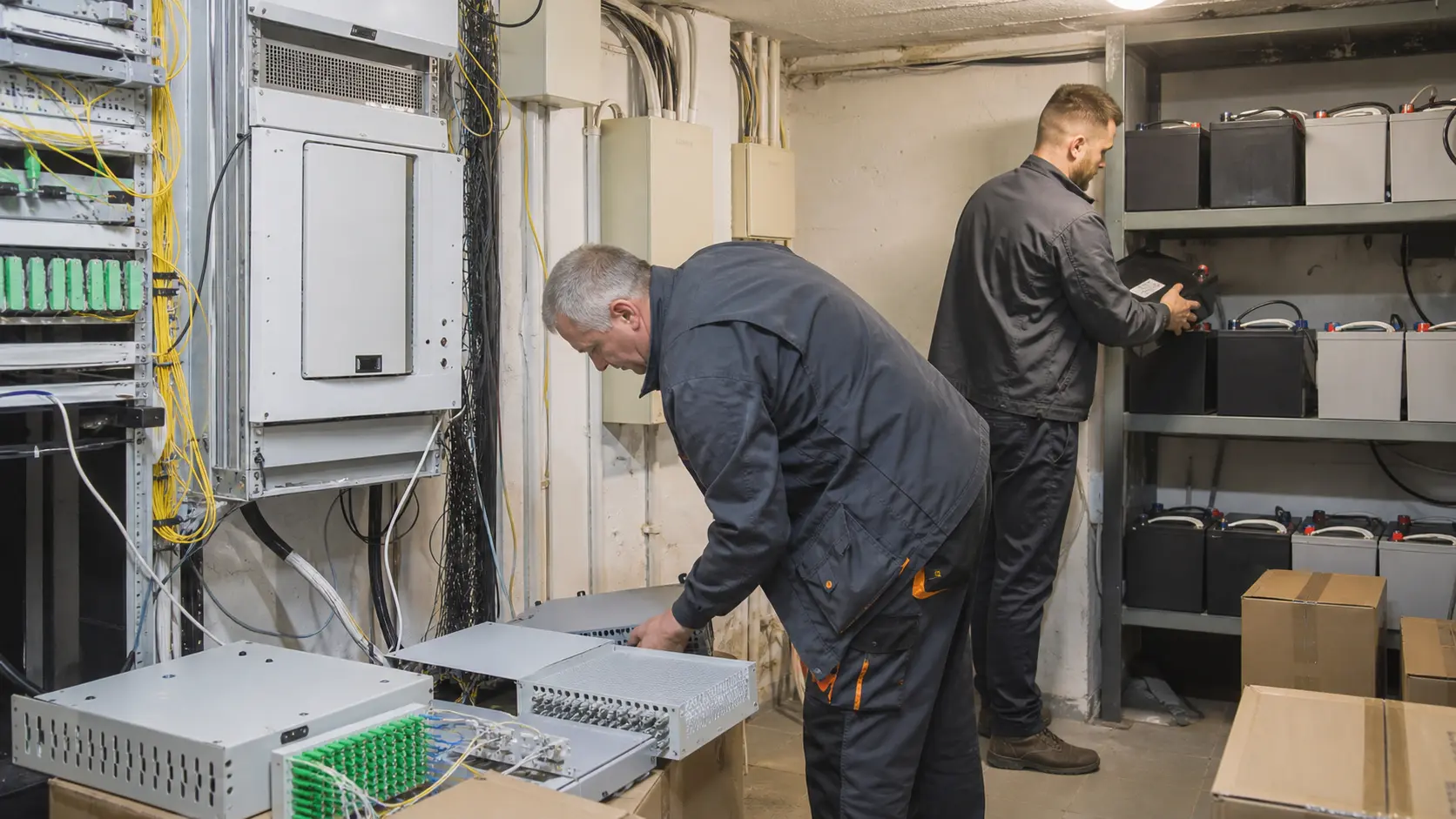
The cleanest way to read Linet is to start with one active broadband port in Zaporizhzhia and follow the money after the customer pays. The first claim on that monthly payment is not profit. It is the cash needed to keep upstream connectivity alive, support calls answered, last-mile faults repaired, power backup charged, network electronics replaced and collection systems working. In peacetime, a small regional ISP can survive on local density, low overhead and fast field response.
In wartime Ukraine, the same model has to carry extra redundancy, extra repairs and extra uncertainty, while subscribers still compare the bill against national and local alternatives.
The public record gives enough evidence to frame the unit economics, but not enough to close them. Linet controls AS34605, operates a visible IPv4 footprint and has been present in routing records since 2005. Ukrainian open-data sources show an operating company, TOV "LINET", with code 31852823, founded in 2002, small statutory capital and modest 2025 financial results. Consumer-payment, directory and review sources connect the business to local broadband service in Zaporizhzhia. Procurement mirrors show small institutional contracts for internet access, local-network functioning and repairs.
None of those sources disclose active subscribers, churn, real ARPU, gross margin, transit contracts, node-level power costs or equipment age.
That means the analytical question is contribution durability, not headline growth. If the average home customer pays around 180-300 UAH per month, and if a portion of the base takes business or institutional service at higher monthly rates, the operator can cover an eight-person organization only if the installed base is dense enough and field work is efficient. The accounting evidence does not show a distressed shell: reported 2025 revenue of 8.098 million UAH and net profit of 645,500 UAH imply a positive but thin margin.
At the National Bank of Ukraine's 2026-08-08 USD rate, those numbers are roughly USD 180,900 of revenue and USD 14,400 of profit. For a network that must buy equipment and often upstream capacity in currencies linked to dollars or euros while collecting from local customers in hryvnia, that profit cushion is not large.
The port-level test therefore asks four things. First, how much of each monthly access fee is left after upstream bandwidth, power and support labour? Second, how often does that port require a truck roll, cable repair, ONU replacement, battery replacement or switch-port intervention? Third, how quickly do customers churn when a national provider or another local operator offers comparable speed at a similar price?
Fourth, can Linet keep the network resilient enough during outages that customers value local response more than they value the brand scale of Kyivstar, Vodafone-linked alternatives, Ukrtelecom, Volia, Triolan or nearby Zaporizhzhia ISPs?
The public evidence leans toward a business that is real and locally embedded, but strategically narrow. Linet has enough routing footprint to matter within its service area. It does not have the visible scale, declared interconnection breadth or financial surplus to treat replacement capital as a background item. The local service revenue has to outrun wartime network replacement every month.
Identity And Control Boundary
The identity boundary is relatively clear. RIPE records identify AS34605 as LINET-AS for Limited Liability Company "Linet LTD". RIPE RDAP ties the autnum and organization handle ORG-LL365-RIPE to Linet, LTD in Zaporizhzhia. Ukrainian company aggregators tie TOV "LINET" to company code 31852823, founding date 2002-01-28, director Oryshchuk Oleksandr, 40,000 UAH of statutory capital and a primary activity in data processing, hosting and related services. The same public-data cluster appears across OpenDataBot, YouControl and UA-Region, although not every address string is consistent.
That inconsistency matters because small telecom operators often leave traces across registries, billing platforms, old local directories, technical registries and procurement portals. RIPE shows one address line. OpenDataBot shows another. UA-Region and older directories show still other Zaporizhzhia addresses, including legacy street names. The safer conclusion is not that control is broken. It is that the public record is messy and partially stale, which is normal for older local operators but still relevant for diligence.
Any lender, acquirer, wholesale partner or large institutional customer would want a current corporate extract, current tax status and proof that the RIPE, billing and Ukrainian legal identities are controlled by the same operating company.
The technical control boundary is stronger than the commercial disclosure. AS34605 is not an anonymous reseller record. It has a long RIPE history, recognized route objects, named maintainers, associated IPv4 resources and observable BGP origin activity. RIPEstat reports the AS as announced. Routing-status data shows first-seen origin evidence for 194.126.204.0/24 in 2005, so this is not a newly staged network. RIPE organization data ties Linet to the 178.218.64.0/20 block, the 194.126.204.0/24 block and the later 45.142.88.0/22 allocation.
Those resources are valuable control evidence because they show more than a web directory listing or a customer-facing phone number.
The control boundary also has a negative side: the public record does not show a broad corporate group, large balance sheet, parent-company guarantee or diverse asset base. Linet appears to be a small local network operator. That can be an advantage in customer service and field response, especially when outages are local and customers know the provider. It can also be a hard constraint when several capital needs arrive at once. A small LLC with modest profit does not have unlimited room to replace damaged access gear, pre-buy batteries, hold spare optical equipment and absorb slow-paying customers at the same time.
The article therefore treats Linet as a real operator with a narrow control perimeter. Its moat, if it has one, is local plant, existing customer relationships, installed drops, working BGP resources, municipal familiarity and the ability to repair faster than larger competitors in specific neighbourhoods. Its weakness is that those assets are local and exposed. They do not automatically convert into pricing power.
Network Evidence: Small, Visible, IPv4-Only
The network evidence is unusually useful because it gives a hard floor under the business story. RIPEstat, RIPE RDAP and third-party BGP mirrors all point in the same direction: AS34605 originates a small IPv4-only footprint. RIPEstat routing-status reports 19 IPv4 announced prefixes and 4,864 IPv4 addresses, with no IPv6 announced space. bgp.tools, IPinfo, IPGeolocation and IPIP corroborate the same broad count. RIPE RDAP associates Linet with 178.218.64.0/20, 194.126.204.0/24 and 45.142.88.0/22.
In observed announcements, that space appears as a set of /24s, including the 178.218.64.0/20 split into more specific routes, plus 45.142.88.0/24, 45.142.90.0/24 and 194.126.204.0/24.
For an access provider, 4,864 IPv4 addresses is neither trivial nor large. It is enough to support a meaningful local customer base, business users, NAT pools, public customer addresses and infrastructure. It is also small enough that every capital decision is visible in the economics. A national operator can average node costs across millions of accounts. Linet cannot. If a local segment requires battery replacement, switch replacement, fiber restoration or customer-premises equipment swaps, that cost has to be recovered from a limited monthly revenue pool.
The absence of visible IPv6 is a strategic signal. It does not mean the network cannot serve customers today; many access markets still run substantial IPv4 and NAT-heavy residential service. But zero announced IPv6 reduces future optionality. It can increase dependence on scarce IPv4 resources and translation policies. It may also matter for wholesale partners, business customers or technically demanding users that expect modern dual-stack service. In a small operator, delayed IPv6 can be rational because deployment consumes engineering time and customer-support attention.
The same delay can become a sign that scarce engineering resources are being spent on survival and repair rather than forward migration.
Routing resilience looks mixed rather than weak. RIPEstat reports full IPv4 RIS peer visibility at the reviewed point, and the AS has long-lived origin evidence. RPKI validation for 45.142.88.0/24 is valid, and bgp.tools presents the broader prefix table as RPKI-valid. That helps reduce one category of routing risk: the network is not visibly sloppy about origin authorization. The narrower concern is upstream concentration. RIPE whois route policy names AS12883, AS21497 and AS43633 as uplink/import-export counterparties and AS207123 as a customer.
Observed third-party views emphasize Vodafone Ukraine's AS21497 and Gigabit-Online's AS43633 as upstreams, with AS207123 as downstream. PeeringDB shows no listed IX presence and no listed facility presence.
That does not prove Linet has only two usable physical exits. PeeringDB is operator-maintained and can be incomplete. Registry policy can include historical or intended peers. BGP collector views can miss private arrangements. But the public evidence does not show a broad interconnection strategy. For a small wartime regional ISP, that matters because supplier resilience and commercial leverage are linked. If bought capacity is concentrated through a small number of upstreams, outages, pricing changes, fibre cuts or settlement changes can quickly affect customer experience and gross margin.
The network may be visible globally, but the economic control over that visibility may sit partly with suppliers.
The positive reading is that Linet has maintained stable visible routing across many years, holds recognized address space, maintains route-origin hygiene and continues to appear as an active Ukrainian eyeball ISP. The cautious reading is that this is an IPv4-only, low-neighbour-count access network with no public evidence of large-scale interconnection diversity. Both readings are true. The investment judgment depends on which one drives the next five years.
Revenue: Cash Ledger Before Subscriber Story
The best public financial anchor is OpenDataBot's 2025 company data: revenue of 8,098,100 UAH, net profit of 645,500 UAH, assets of 4,330,100 UAH, liabilities of 19,200 UAH and eight employees. UA-Region shows nine employees, so the public record should be rounded to about eight or nine workers rather than treated as a precise headcount. At the National Bank of Ukraine's official USD rate on 2026-08-08, the 2025 revenue converts to roughly USD 180,900, net profit to roughly USD 14,400 and assets to roughly USD 96,700. Those conversions are not purchasing-power analysis, but they show the order of magnitude.
The net margin implied by those OpenDataBot values is about 8.0%. That is not a broken business. It is also not a large reserve. A single year of positive profit can be consumed by a cluster of network electronics, customer-premises devices, fiber restoration, backup batteries, generator costs or delayed customer payments. The very low reported liabilities are encouraging if accurate, because they suggest little visible balance-sheet leverage. But low liabilities can also mean the business is funded from operating cash and owner discipline rather than access to major external capital. In wartime, that distinction matters.
A useful but limited proxy is revenue per IPv4 address. Dividing 8,098,100 UAH by 4,864 IPv4 addresses gives about 1,665 UAH per address per year, or roughly 139 UAH per address per month. That is not ARPU. IPv4 addresses can be shared through NAT, assigned to businesses, left idle, used for infrastructure or allocated differently across customer tiers. Still, the proxy is directionally helpful. It places Linet in a low-price access environment where each visible network resource has to support a small amount of monthly revenue.
Cloudflare Radar and other measurement platforms provide modelled user-population estimates, but these are not billing accounts. If one cautiously triangulates OpenDataBot revenue against a range around 3,900 to 6,200 modelled users, the implied monthly revenue per modelled user lands around 109 to 173 UAH. That overlaps the unofficial Linet price signals and local-market averages. The overlap is useful because it suggests the public data is internally plausible. It does not prove the actual subscriber count.
Visible public procurement does not look large enough to explain the business by itself. OpenDataBot reports 287,965 UAH of procurement sales in 2025, about 3.6% of reported 2025 revenue, and 1,482,391 UAH in 2024. The contract mirrors found in this research are small: 3,480 UAH for a 2026 internet-access services contract, 4,500 UAH for 2025 repair and modernization of an internet network, 46,900 UAH for 2025 local-network functioning services and 10,800 UAH for a 2022 internet-services contract. These contracts are useful because they show local institutional relationships and repair work.
They do not show a single anchor customer that explains revenue.
The revenue story is therefore likely retail-heavy with some business, institutional and repair-service income. Portmone's payment page supports a consumer-payment rail. Review and speed-test sites support local residential usage. Procurement mirrors support public-sector and small institutional work. None of the sources discloses customer concentration, but the visible evidence does not point to one public buyer controlling the 2025 revenue base. The risk is instead a long tail of low-ARPU customers whose willingness to pay depends on continuity, speed and local alternatives.
Contribution After Bought Capacity, Labour And Power
The assignment's one-port framing is useful because a gross revenue number can flatter a fixed-access network. A customer payment first has to cover traffic and backhaul, then the shared cost of keeping the access node alive, then field labour, then replacement and support. Only after that does the operator earn contribution. In Linet's case, the public evidence suggests each active port is exposed to at least four cost pools that can expand faster than tariff revenue: bought capacity, local repair labour, backup power and imported equipment.
Bought capacity is visible through routing relationships, even if contract prices are not. RIPE route policy and third-party BGP mirrors identify relationships involving AS21497, AS43633 and AS12883, with AS207123 as customer/downstream. Vodafone Ukraine and Gigabit-Online appear in observed upstream views. A small regional ISP can buy or exchange capacity efficiently if traffic is local, caching is effective and upstream pricing is stable. But limited upstream diversity reduces negotiating leverage.
If one supplier changes price, degrades service, loses a path or requires migration, Linet's customers still expect the monthly service to work.
Local repair labour is the second pool. OpenDataBot and UA-Region employee figures imply a very small staff. A small staff is economical when the network is stable and customer density is high. It becomes a constraint when outages arrive in clusters. Wartime damage, blackouts, equipment failures and customer-premises issues do not distribute themselves evenly across a spreadsheet. They arrive as queues. A local ISP can outperform a national competitor if its technicians know the buildings and routes.
It can underperform if the same technicians must handle fiber breaks, node batteries, customer complaints, public-institution tickets and equipment swaps with little slack.
Power is the third pool. Ukraine's energy system has been repeatedly attacked. IEA, OHCHR and UN Ukraine sources describe attacks on generation, transmission and distribution infrastructure, rolling power cuts and the need for businesses to use generators, batteries and power banks. Freedom House specifically connects blackouts to ISP generator use and network stress. None of those sources provides Linet's electricity bill or generator inventory. They do, however, change the normal economics of a neighbourhood broadband network.
A node that used to rely on grid power now may require batteries, charging cycles, replacement batteries, fuel logistics or customer communication during outages. Those costs are lumpy and operationally distracting.
Equipment replacement is the fourth pool. Broadband access networks depend on switches, routers, optical line terminals, ONUs, power supplies, fiber drops, patch panels, cabinets and spares. Much of that equipment is priced against global supply chains and currencies. Linet collects primarily in hryvnia from a local customer base. Its 2025 revenue and profit are in hryvnia. Its replacement exposure is partly imported or import-indexed. That creates currency mismatch. A weak local currency or sudden equipment need can turn an apparently tolerable margin into a thin one.
The NBU USD rate used for conversion is only a reference point, but it illustrates the scale: the company's reported 2025 profit was roughly the price range of a modest pool of professional network gear, not a deep capital buffer.
The result is an operator that may be contribution-positive in ordinary months but vulnerable in bad months. If churn is low, repairs are modest, upstream prices stay stable and power backup is already amortized, Linet's existing base can fund itself. If several nodes need replacement, a supplier raises price, blackouts increase generator runtime and customers migrate to a bundled national alternative, the economics tighten quickly. That is the central operating risk.
Suppliers, Routing Resilience And Replacement Timing
Supplier dependence is often hidden in small ISP accounts because the largest suppliers may not appear as trade creditors at year-end. In routing data, the shape is visible. Linet originates its own AS, but global reach comes through upstreams and counterparties. RIPE policy text lists AS12883, AS21497 and AS43633. Observed BGP mirrors emphasize AS21497 and AS43633. That is enough for a working access network, especially when one path is stable and local routing is clean. It is not enough to prove commercial independence.
For a local ISP, supplier dependence has three layers. The first is upstream capacity and transit. If wholesale cost per Mbps falls faster than retail prices, the business gains breathing room. If war, outages or path concentration raise the effective cost of reliable capacity, the business loses margin. The second layer is access equipment. A supplier of ONUs, switches, batteries or routers can become a hidden strategic dependency when replacement parts are scarce. The third layer is field infrastructure: poles, ducts, rooftops, basements, power feeds and access permissions.
Wartime legal changes around communications equipment on electricity infrastructure show that the state recognizes the special role of telecom continuity, but legal permission is not the same as cheap maintenance.
Replacement timing may be the hardest unseen variable. A network built steadily since the early 2000s can contain assets of many ages. Some parts may be recently upgraded, especially if the operator has been moving toward fiber access or resilient nodes. Other parts may be legacy and cheap to maintain until they fail. The public evidence does not show Linet's node count, last-mile technology mix, PON split ratios, battery age or fiber-route vulnerability. The article therefore cannot claim a capex cliff. It can say that the accounting surplus is small enough that any replacement cycle matters.
RPKI and route hygiene are positives. They suggest Linet has not neglected basic routing governance. Long-lived RIPE records and continued BGP visibility suggest continuity of technical control. The AS also appears as an eyeball ISP rather than a pure hosting shell. Hostname and IP intelligence sources show customer-like hostname patterns in Linet address space, supporting the access-provider reading. But route hygiene does not pay for truck rolls. It reduces one risk while leaving the economic risks intact.
The absence of declared PeeringDB IX or facility presence is a specific diligence question. It may be incomplete profile data. Many small networks do not maintain polished PeeringDB records. But if accurate, it implies Linet may rely more heavily on upstream-provided reach than on public exchange connectivity. That can be rational at small scale. It becomes less attractive if traffic grows, if upstreams are disrupted or if customers expect low-latency access to domestic and international services. A public IX or facility footprint would not solve wartime replacement costs, but it would improve the resilience story.
Customers And Concentration
The customer evidence is more fragmentary than the network evidence. Portmone's page shows a public payment route for Linet customers. Review and speed-test platforms show residential-style usage and user comments. Local directories list consumer-facing contacts and office hours. Procurement mirrors show small contracts with public institutions. Together, these point to a mixed local access business rather than a pure enterprise integrator or wholesale network.
What they do not show is concentration. No public source found in this run lists Linet's top customers, top buildings, active private business accounts, monthly recurring revenue by segment or exposure to a single estate, school district, municipality or enterprise. OpenDataBot's procurement sales give one partial view: visible public procurement was about 287,965 UAH in 2025, around 3.6% of reported revenue. That makes it unlikely that public procurement alone drove the company in 2025. It does not rule out private business concentration or a cluster of apartment buildings carrying a high share of contribution.
Apartment-building concentration can be powerful for a local ISP. Dense buildings reduce installation cost per customer, make repairs more efficient and create local word-of-mouth. They can also raise risk. If one building association changes access rules, if a rival installs better fiber, if a power arrangement fails or if a high-density node is damaged, churn and repair costs can move together. A national operator can offset that across many cities. A small Zaporizhzhia operator cannot.
Institutional customers have a different profile. They may value responsiveness and local repair. The procurement examples show Linet handling internet access, network functioning and repair/modernization tasks. Those jobs can reinforce relationships and generate service income, but the visible contract values are small. A 46,900 UAH local-network functioning contract can be useful work; it is not enough to transform the capital structure. A 4,500 UAH repair contract may cover a narrow job but not a strategic upgrade.
The open question is whether Linet's most profitable customers are residential, small business, public institutions or a few high-service accounts. The answer matters because each segment behaves differently under stress. Residential customers are price-sensitive and can switch when another provider offers faster service or better outage performance. Small businesses need continuity and may pay more, but they also punish downtime. Public institutions can provide stable contracts, but procurement values may be low and payment terms can add working-capital pressure. A balanced customer mix would help.
The public evidence cannot prove balance.
Competition And Switching Alternatives
Zaporizhzhia broadband pricing is not an empty field. National and local alternatives create a hard ceiling on Linet's ability to raise prices. Kyivstar publishes home-internet offers such as up to 300 Mbps at 350 UAH per month and up to 1 Gbps at 450 UAH per month, with promotional pricing. Xatanet lists residential tiers from 100 Mbps at 200 UAH to 500 Mbps at 400 UAH, and corporate tiers at higher prices. Telza advertises home 500 Mbps at 300 UAH and office fiber tiers at higher monthly charges.
Tariffa's marketplace view puts average home internet around 200 UAH per month and gigabit plans around 300-500 UAH per month in Zaporizhzhia.
Linet's own current tariff book was not available from a directly usable official source in this evidence set. Unofficial review signals on 2IP.ua include a 2026 reference to 100 Mbps at 180 UAH and guaranteed 500 Mbps service, along with high measured speeds. Older 2IP.ru market-memory entries include historical prices and service fees. Those are not official terms, but they place Linet within the same low-price local competitive band. The likely implication is that Linet cannot simply pass every new cost into customer bills without risking churn.
Switching behaviour during outages is especially important. Freedom House reports that Ukrainian subscribers shifted ISPs during blackout conditions and that many ISPs faced stress or near-bankruptcy. In such a market, resilience itself becomes a product feature. Customers may choose the provider whose building node stays alive longer, whose support line answers faster or whose technicians restore service after a strike or power failure. That creates opportunity for a local operator with strong field knowledge. It also creates a new benchmark. Cheap speed is no longer enough if the network fails when customers need it most.
National operators have scale advantages: procurement leverage, brand, mobile/fixed bundles, broader support systems and more capital options. Local operators have counter-advantages: building-level knowledge, faster informal communication, lower overhead and sometimes better relationships with local electricians, building managers and customers. Linet's strategic problem is to keep the local advantages visible while avoiding a capital race it cannot win. If customers see Linet as the neighbour who keeps service alive through outages, the operator has pricing tolerance and loyalty.
If customers see similar speed and better resilience from a larger rival, the installed base becomes vulnerable.
The local directory evidence shows a crowded competitive map, including named nearby providers and national brands. It does not quantify market share. The analytical conclusion is still firm: Linet operates in a switching market, not a captive one. Its contribution per active port depends on maintaining enough reliability and support quality that customers do not treat broadband as a pure commodity.
Wartime Regulation And Geopolitical Exposure
Ukraine's wartime infrastructure environment changes the risk model for every local telecom operator. The IEA describes repeated attacks on the energy system, loss of generation capacity and rolling cuts. OHCHR describes coordinated attacks on power generation, transmission and distribution and the civilian-service consequences. UN Ukraine documents large attacks that disrupted essential services. Freedom House links blackouts to telecom stress, generator usage and network disruption. These are country-level sources, not Linet-specific damage records, but Linet's region and business model make the context economically relevant.
The most direct channel is power. A fixed-access network depends on powered nodes, customer premises equipment and backhaul sites. If the grid is unreliable, the operator must decide where to place batteries, how much runtime to buy, which nodes receive generator support and how to communicate service limits to customers. Every extra hour of backup has a cost. Batteries age. Fuel logistics consume labour. Customers may blame the ISP even when the root cause is grid failure. In that environment, a small operator's brand can be strengthened by visible resilience or damaged by repeated outages.
The second channel is physical plant. Fiber can be cut by construction, shelling, debris, emergency works or power-infrastructure repair. Aerial segments, building entries and local cabinets may be cheap to deploy but exposed. Underground routes may be safer but harder and more expensive to repair. The public evidence does not show Linet's physical topology, so this article cannot rank its route vulnerability. It can state that replacement and restoration timing is a core diligence variable.
The third channel is regulation and tax. Ukrainian telecom regulation and wartime rules are moving targets. The legal source reviewed concerns access to electricity-infrastructure elements for electronic-communications equipment in specified wartime conditions. dev.ua's reporting on NCEC and small ISP tax pressure shows that regulatory and tax choices can affect provider economics. OpenDataBot says Linet has been on the third group single tax at 5% since 2023 and that its VAT certificate was annulled as of 2026-04-18. That combination requires careful follow-up.
It may be normal for the company's tax position, or it may affect input VAT recovery, contracting and equipment economics. The public evidence is not enough to make a legal conclusion.
The fourth channel is demand. War can reduce household income, displace customers, damage buildings and increase non-payment risk. It can also make internet access more essential and increase willingness to pay for reliability. These forces pull in opposite directions. Linet's reported 2025 profit suggests it was not overwhelmed in that year. The question is whether it can keep converting demand for connectivity into cash when repair and replacement needs remain elevated.
Unofficial Signals: Useful, But Not Proof
The unofficial market signals are helpful because Linet's official tariff and subscriber disclosures are limited. They must be handled carefully. 2IP.ua user-generated snippets from 2026 mention high measured speeds and one reference to 100 Mbps service at 180 UAH. Another comment refers to service working without electricity. 2IP.ru includes a long provider page, old reviews, historical price references and counts of speed measurements. Portmone shows that customers can pay Linet through a mainstream payment platform. Local directories show phones, office hours and nearby provider alternatives.
These signals support three cautious conclusions. First, Linet is not merely a registry object. There are consumer-facing traces around payments, reviews, phone numbers and broadband use. Second, customers evaluate the service on speed, price and continuity, the same dimensions that matter for contribution. Third, local memory is mixed and sometimes stale. Old reviews and directory pages cannot be treated as current operations.
The signals do not support stronger claims. They do not prove active subscriber count. They do not establish an official tariff book. They do not show churn. They do not show that Linet's nodes all have backup power. They do not prove customer satisfaction. They do not prove network coverage boundaries. For investment or credit judgment, they are early-warning and triangulation tools, not final evidence.
That distinction is important because local ISP research can easily become overconfident. A speed-test page can make the service look excellent, but speed-test participants are self-selected and often test working connections. A complaint page can make the service look bad, but reviews overrepresent frustration and may be old. A payment page can show billing continuity, but not total payments. A procurement award can show institutional trust, but not profitability. The responsible conclusion is to use unofficial signals to ask better questions.
For Linet, the better questions are specific. How many customers are on each tariff? How many buildings or neighbourhood nodes produce most revenue? How often do customers churn after outages? What is the average time to repair? What share of customers can receive service during grid outages, and for how many hours? What portion of revenue is collected through Portmone or other payment rails, and how much is late? Which competitors overlap each serving area? These questions determine whether the positive local signals translate into durable contribution.
What Would Change The Judgment
The strongest evidence that could improve the case is a verified active-port count matched to revenue. If Linet could show, for example, a stable or growing number of active paid connections, low churn, a clear tariff mix and a collection rate that holds during outages, the 2025 revenue and profit figures would look more durable. Without that, the analyst has to infer scale from IPv4 addresses, measurement estimates, payment traces and revenue proxies.
The second missing piece is cost per served port. A small ISP can look fragile from revenue alone but be efficient if it owns simple plant, has dense buildings and keeps field costs low. It can also look profitable until deferred maintenance arrives. A useful cost schedule would separate upstream capacity, electricity, backup power, rent/access, support labour, field labour, equipment replacement, customer-premises devices and spares. It would show which costs are fixed, which scale with customers and which spike during outages.
The third missing piece is replacement timing. An operator with recently replaced access equipment, adequate battery inventory and spare fiber supplies has a very different risk profile from one relying on aging switches and thin spares. The article cannot determine which Linet is. The public asset number, roughly 4.33 million UAH in 2025 according to OpenDataBot, is not enough. It does not break out cash, network assets, receivables or depreciation.
The fourth missing piece is routing and facility documentation. AS34605's public BGP evidence is real, and route-origin hygiene is a positive. But a current network map would be more persuasive if it showed independent upstreams, power-diverse sites, IX participation, private interconnects, backup paths and planned IPv6 deployment. PeeringDB's zero IX and facility counts should be treated as a question mark. If Linet has private or undeclared resilience, the public profile understates it. If it does not, supplier and path concentration deserve a discount.
The fifth missing piece is tax and regulatory treatment. OpenDataBot's single-tax and VAT-annulment fields may be benign, but they are economically relevant. Equipment purchases, institutional contracts and accounting treatment can all be affected by tax status. A current official extract and accountant explanation would help.
The sixth missing piece is competitive overlap at building level. Citywide tariff comparisons are useful, but broadband is sold at addresses. If Linet controls buildings where rivals have weak plant, its pricing power is stronger than market-wide price tables suggest. If Kyivstar, Xatanet, Telza, Ukrtelecom, Triolan or other local operators overlap most of its profitable buildings, Linet has less room to pass through costs. A building-level overlap map would change the judgment faster than another national market statistic.
Investment Conclusion
Linet should be read as a disciplined local access operator facing a hard operating equation. The public record supports existence, continuity and technical control. It shows AS34605 with long-running RIPE history, a modest but real IPv4 footprint, active BGP visibility, RPKI evidence, Ukrainian company records, a payment rail, local consumer signals and small procurement relationships. That is enough to reject a purely speculative view of the company. Linet appears to have an operating base that customers and institutions have used.
The same evidence does not support a broad-growth story. The revenue base is small in dollar terms. The net margin is positive but narrow. The staff count is small. The network is IPv4-only in public routing evidence. PeeringDB does not show declared IX or facility presence. Upstream evidence points to a limited set of counterparties. The local market prices broadband aggressively, with several alternatives advertising hundreds of megabits in the low hundreds of hryvnias. Ukraine's wartime energy and infrastructure conditions add repair and power-backup burdens that are not fully visible in accounts.
The company's strategic task is to convert local embeddedness into retention and modest pricing power. If Linet can keep nodes alive during outages, restore faults quickly, maintain customer trust and avoid large replacement shocks, its small scale may be sustainable. If replacement needs bunch together or a larger competitor matches its local reliability, the business has little public evidence of a cushion.
The most important point is that Linet's value is not captured by a single customer count or a single route table. It sits at the intersection of small-network control and local-service economics. The route table says the company controls a real network. The accounting record says the network generates modest profit. The tariff environment says customers have alternatives. The wartime context says replacement and power resilience are not optional. The unresolved diligence is whether each active port produces enough contribution after bought capacity, labour, backup power and replacement timing.
Until that is proven, Linet is investable only as a local resilience story, not as a scale story.
The operating priorities follow directly. Protect cash collection. Track contribution by node and building, not only by total revenue. Pre-price backup power and equipment replacement before a failure forces emergency buying. Keep upstream options live. Make routing hygiene and customer communication part of the product. Document outage performance against local competitors. And if capital is available, spend it on the assets that protect churn first: power, spares, route diversity, high-fault nodes and the customer groups that pay reliably. Linet does not need to look like a national operator to be valuable.
It needs to prove that its local network earns more than it consumes in the specific conditions of Zaporizhzhia.
Sources
- https://stat.ripe.net/data/whois/data.json?resource=AS34605
- https://rdap.db.ripe.net/autnum/34605
- https://rdap.db.ripe.net/entity/ORG-LL365-RIPE
- https://stat.ripe.net/data/as-overview/data.json?resource=AS34605
- https://stat.ripe.net/data/routing-status/data.json?resource=AS34605
- https://stat.ripe.net/data/announced-prefixes/data.json?resource=AS34605
- https://stat.ripe.net/data/rpki-validation/data.json?resource=34605&prefix=45.142.88.0/24
- https://www.peeringdb.com/api/net?asn=34605
- https://bgp.tools/as/34605
- https://ipinfo.io/AS34605
- https://ipgeolocation.io/browse/asn/AS34605
- https://whois.ipip.net/AS34605
- https://www.cidr-report.org/cgi-bin/as-report?as=AS34605&view=2.0
- https://radar.cloudflare.com/as34605
- https://radar.cloudflare.com/routing/as34605
- https://radar.cloudflare.com/quality/as34605
- https://stats.labs.apnic.net/cgi-bin/aspop?c=UA
- https://opendatabot.ua/c/31852823
- https://youcontrol.com.ua/catalog/company_details/31852823/
- https://www.ua-region.com.ua/31852823
- https://www.portmone.com.ua/r3/popovnyty-internet-linet-zaporizhzhya
- https://2ip.ua/ua/services/providers-rating?act=1&asid=34605&city=%D0%97%D0%B0%D0%BF%D0%BE%D1%80%D0%BE%D0%B6%D1%8C%D0%B5
- https://2ip.ru/isp/Linet%2BHome%2BNetwork/
- https://rubrikator.org/ukraine/zaporozhe/linet
- https://ipkiev.pp.net.ua/dir/85-1-0-686
- https://zp.vgorode.ua/reference/ynternet_provaidery/52911-lynet
- https://clarity-project.info/tender/14915cf55f1740618d35dc4b4ec50c16
- https://tender.uub.com.ua/tender/UA-2025-07-15-010748-a/
- https://tender.uub.com.ua/tender/UA-2025-03-13-010876-a/
- https://tendery-stran-mira.tenderguru.ru/tendery-ukraine/22379490
- https://freedomhouse.org/country/ukraine/freedom-net/2024
- https://nkek.gov.ua/news/kliuchovi-pokaznyky-ta-tendentsii-rynkiv-ek-i-posluh-pz-zvitnkek-2024
- https://www.iea.org/reports/ukraines-energy-security-and-the-coming-winter/ukraines-energy-system-under-attack
- https://ukraine.ohchr.org/en/Attacks-on-Ukraines-Energy-Infrastructure-Harm-to-the-Civilian-Population
- https://ukraine.un.org/en/286598-massive-attack-ukraine%E2%80%99s-energy-infrastructure-damages-and-disrupts-essential-services
- https://zpep.com.ua/rozdiltarifs/
- https://zakon.rada.gov.ua/laws/show/523-2025-%D0%BF
- https://dev.ua/news/nkek-internet-provaidery-1729232225
- https://blog.cloudflare.com/one-year-of-war-in-ukraine/
- https://kyivstar.ua/news/id301220251800
- https://www.telza.zp.ua/
- https://xatanet.zp.ua/tarifi/
- https://www.speedgeo.net/statistics/ukraine/zaporizhzhia
- https://tariffa.com.ua/providers/zaporyzhzhia
- https://bank.gov.ua/en/open-data/api-dev
- https://bank.gov.ua/NBUStatService/v1/statdirectory/exchange?valcode=USD&date=20260808&json
- https://ipinfo.io/AS34605/45.142.88.0/24
- https://ipinfo.io/AS34605/194.126.204.0/24
- https://www.bigdatacloud.com/network-lookup/178.218.74.0/24
- https://www.abuseipdb.com/check/178.218.74.38
Member Briefing
Deeper Profile Context
Sign in with the right membership level to unlock the full briefing and source notes.
Only for Strategic Circle
Strategic Circle
Open to all readers. Unlock profile briefings after joining and signing in.
Join Strategic CircleOnly for Leadership Alliance
Leadership Alliance
For qualified IP-asset owners and management; sign in to unlock alliance briefings.
Join Leadership Alliance