Summary
- The 22 October charter sets three years’ notice, local trials, coverage checks and quarterly reporting for the UK’s 2G retirement.
- Its hardest inventory job lands on users and equipment owners, many of whom may not be direct mobile customers.
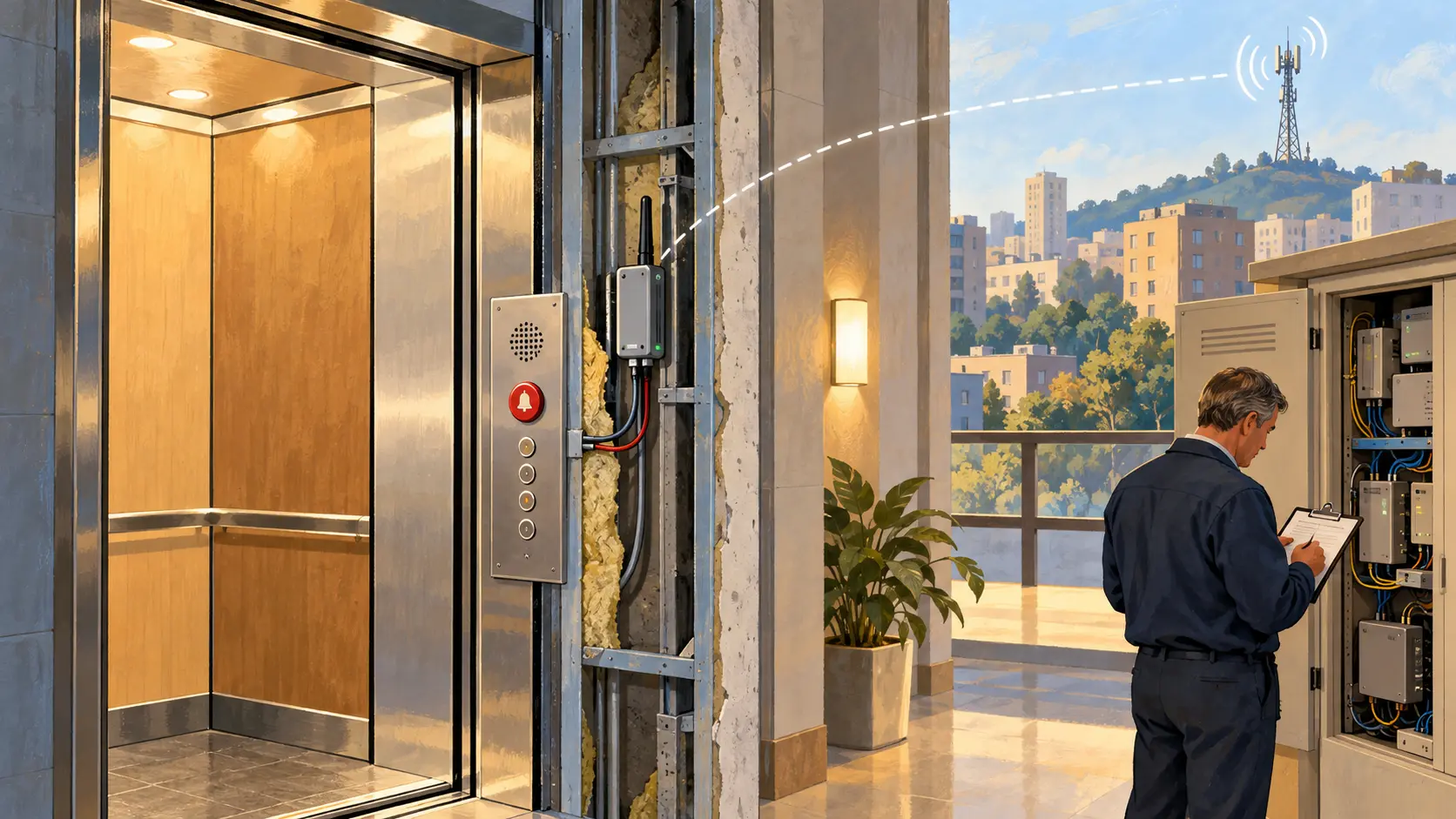
A lift alarm can be a mobile-network customer without anyone in the lift knowing which network it has hired. That is the awkward part of Britain’s 2G exit: the operator sees a SIM, a building manager sees an alarm panel, and the person relying on the alarm may see only a help button.
The government’s 2G switch-off guide names medical pendants, lift alarms and fire alarms among devices that can depend on 2G. The charter updated on 22 October gives mobile operators a detailed sequence: publish a shutdown date at least three years ahead, trial local closures, notify trial-area customers three months in advance, check replacement 4G or 5G coverage, and report indicators to the Department for Science, Innovation and Technology every quarter.
Then the charter draws a line around its own promise. It says the commitments do not cover affected users’ responsibility to identify and manage their services. The department expects 2G users to find the impact and take steps to keep connectivity. The reason supplied is practical: mobile operators and virtual operators often have no direct relationship with end users.
That is how a network transition becomes a building-management project. A mobile provider can message its billing customer. It may not know that the customer’s SIM sits inside a lift alarm bought years ago, installed by a contractor, monitored by a separate alarm centre and managed by a landlord. The chain has several owners and no obvious person holding the complete device list.
The charter does ask signatories to publish general guidance on identifying 2G devices and encourage suppliers and customers in their supply chains to upgrade or mitigate them. It calls for sector liaison where a confirmed loss is expected to have a non-negligible impact on life-critical services or critical infrastructure. Those are useful obligations. The trigger still begins with someone confirming the exposure, and the text does not define a numerical threshold for “non-negligible.”
Its coverage figure has a similar limit. The government says signatories cover around 95% of mobile customers. That describes the reach of participating providers; it is not a census of connected alarms, meters, payment terminals or industrial sensors. The charter lists quarterly indicators that could make the change measurable: remaining 2G devices, customers, calls, data, roaming, and places where 2G has no 4G or 5G counterpart. It requires reporting to government, but does not specify public release of those returns.
The official timetable names EE’s national retirement from May 2029, VodafoneThree’s spring 2030 shutdown and VMO2’s summer 2029 start. Each has a different clock. “The UK switch-off” is a convenient headline; equipment owners face several operator dates and local pilots.
The transition’s blind spot sits between the network account and the device’s real owner. A public register of affected sectors, published indicator totals and a clear escalation trigger would let building managers, care providers and local authorities plan before a trial reaches their street. The charter has built the reporting loop. Readers still cannot see the dashboard.
Primary records: 2G Switch-off Charter; Preparing for the 2G switch-off; Telecommunications Modernisation: Connectivity Timeline.
Member Briefing
Deeper Profile Context
Sign in with the right membership level to unlock the full briefing and source notes.
Only for Strategic Circle
Strategic Circle
Open to all readers. Unlock profile briefings after joining and signing in.
Join Strategic CircleOnly for Leadership Alliance
Leadership Alliance
For qualified IP-asset owners and management; sign in to unlock alliance briefings.
Join Leadership Alliance