
Intelligence
Latest Articles
Latest intelligence on infrastructure operators, policy decisions, market moves, and digital power shifts.

Number Resource Society
An ASN Transfer Needs a Routing-Identity Handover Ledger
An ASN Transfer Needs a Routing-Identity Handover Ledger intelligence summary explains the development, the public evidence available to readers, the organisations involved, the regional context, market exposure, and the infrastructure consequences that may follow. The Number…

History
The Acknowledgment That Waited for a Second Segment: TCP Delayed ACKs
TCP does not always answer one received data segment with one immediate acknowledgment. The receiver may wait briefly, but that silence is governed by a second-segment threshold, a timer, and exceptions that preserve loss evidence.

IETF
QNAME Minimisation Is a Query-Sequence Contract, Not a Privacy Switch
A resolver may advertise QNAME minimisation while exposing very different names, costs and failure modes from one lookup to the next. The feature matters only when operators can reconstruct the bounded sequence produced by delegation knowledge, cache state and negative proofs.

IETF
An SRv6 Locator Lease Makes DHCPv6 Part of the Routing Control Plane
An SRv6 locator is the address-space foundation from which a segment endpoint creates SIDs. RFC 10038 allows that foundation to arrive as a DHCPv6 lease. The convenience is real, but so is the transfer of authority: pool selection, lease renewal, route installation and withdrawal…

IETF
A Header Allowed Here Is Not Trusted Everywhere: RFC 9878 and SIP P-Header Scope
A call can fail at the trust boundary when a sender puts a P-Header in a SIP message that its receiver believes must not contain it. One implementation strips the field, another rejects the message, and a third accepts it. The disagreement can affect charging context…

CASE FILE
The Registrant Was Abroad; the Dot-Com Registry Was in Virginia: CNN v CNNews.com
The Registrant Was Abroad; the Dot-Com Registry Was in Virginia: CNN v CNNews.com intelligence summary explains the development, the public evidence available to readers, the organisations involved, the regional context, market exposure, and the infrastructure consequences that…

Global Cloud Services Trends
A QUIC Connection ID Is Not a Subscriber Identity
A QUIC connection can survive a change from Wi-Fi to mobile access. The identifier that helps packets find that connection is transport state, not proof of who holds the handset, which account is active, or whether an application action remains authorised.

IETF
The Link Is Not the Location: RFC 9877 and RDAP Geofeed Control
A geofeed link tells a client where to look; it does not turn every location claim in that file into verified truth. RFC 9877 makes RDAP a scoped discovery and authority signal, with controls that keep lookup scope, freshness, authenticity and privacy separate.

Number Resource Society
An IPv4 Transfer Pre-Approval Needs a Registration-and-Expiry Ledger
An IPv4 transfer pre-approval answers a narrow question: how much address space a recipient may qualify to receive during a defined period. It does not identify a source, complete a transfer or prove that the registry has changed.

History
The Window That Refused to Open One Byte at a Time: TCP Silly Window Syndrome Avoidance
A TCP receiver can have room for more data without advertising that room immediately. That deliberate silence prevents a small permission from becoming a self-repeating stream of small packets.

IETF
A Two-Byte Number Can Lie About the Payload: RFC 9876 and CoAP Registry Control
CoAP defines Content-Format as a small integer that identifies a payload's media type and any content coding. RFC 9876 makes the registration procedure behind that integer stricter, because the code point is meaningful only when its media type, parameters, coding and semantics…

BDNOG
bdNOG Publishes Who Oversees Its Executive Committee, Not How
bdNOG’s public governance pages draw a clean line: the Board is the highest authority, while the Executive Committee (EC) manages the community’s work. The Board page says it approves yearly activities and holds the EC accountable. The EC page names the operating committee and…

IETF
A Resolver Can Choose Encryption Before DNS Operators Coordinate
Encryption between a user and a recursive DNS resolver does not protect the next hop. The resolver may still send the resulting query in cleartext to an authoritative server, exposing another part of the path to passive observation. RFC 9539 proposes an experimental compromise…

History
The Window That Closed Without Ending the Connection: TCP Persist
When a TCP receiver says it has no room left, the sender stops sending ordinary data. The harder question is how either side escapes that pause if the one message announcing new room never arrives.

Global Cloud Services Trends
A Fast 0-RTT Handshake Is Not a Once-Only Transaction
TLS 1.3 and QUIC can remove a round trip from a resumed connection. That is a latency result, not a receipt that a state-changing request reached the application once, was committed once, and will never be replayed elsewhere.

IETF
One Header Can Invalidate a Whole Site Section: RFC 9875 and HTTP Cache Groups
A response can label related stored responses inside one cache and one URI origin, while a later unsafe request can name those labels for possible invalidation. The useful boundary is local coordination, not a promise of synchronization across caches, CDNs, or origins.

Story
AFRINIC Named Five Fellowship Recipients from a Pool Above 1,700. The Selection Record Is Not Public
AFRINIC’s announcement identifies five people and describes a highly competitive programme. It does not publish the exact applicant total, the scoring method, the assessors or the decision record, so the notice proves an outcome without making the selection reproducible.

IETF
Catalog Zones Turn a DNS Member List into Fleet-Wide Provisioning Authority
An empty file is usually absence. An empty DNS catalog can be an instruction. If a generator accidentally publishes a catalog without its members, every consumer that originally provisioned those zones from that catalog may begin removing them and their associated state. RFC 9432…
History
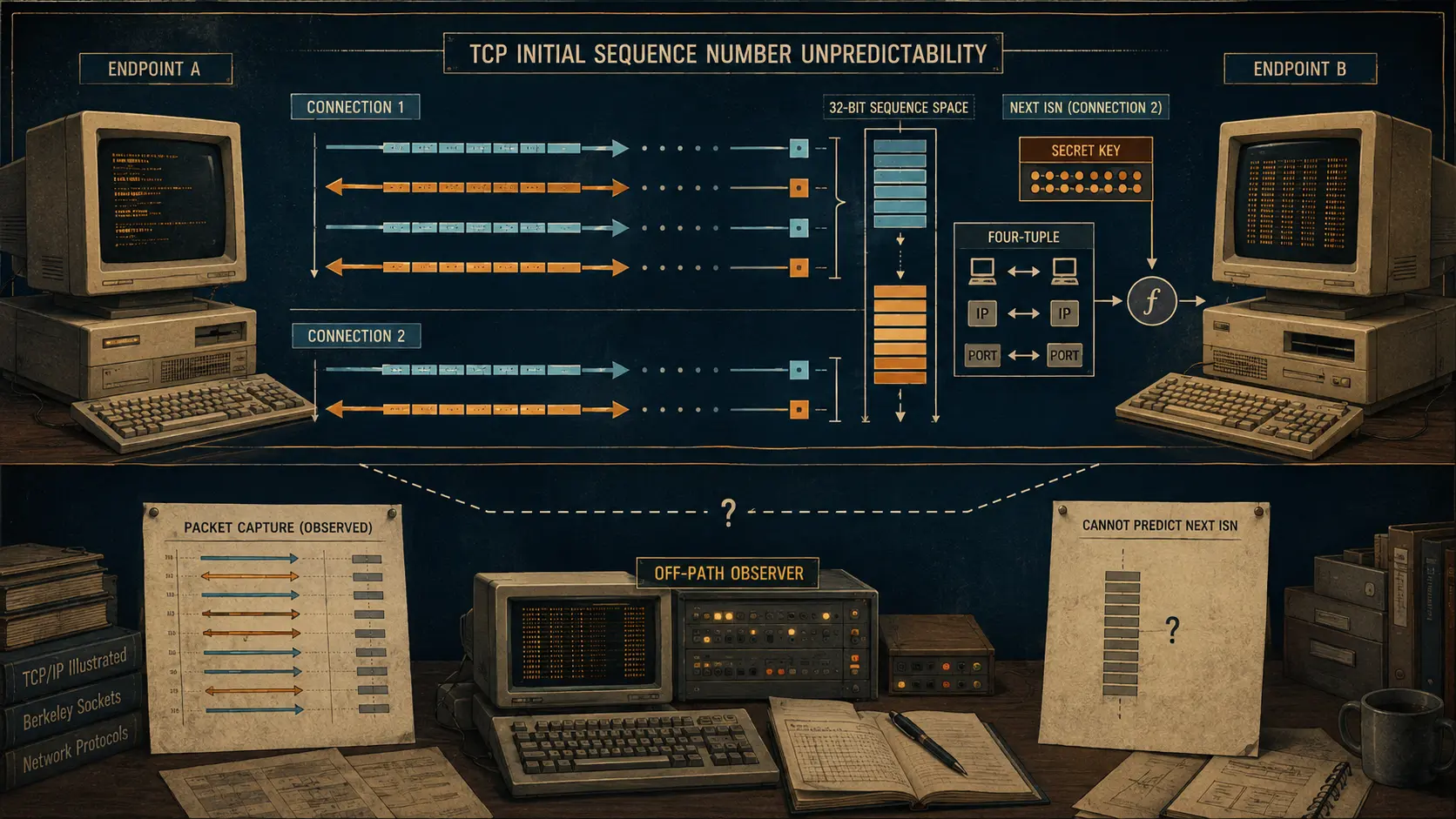
The Number Made Harder for an Off-Path Attacker to Predict: TCP Initial Sequence Numbers
A TCP connection begins by exchanging numbers. The security change was not to hide that exchange, but to stop one visible number from revealing the next connection's starting point.

Global Institutional Trends
A Valid Software Signature Is Not a Durable Authority Record
A green verification result can survive long after the authority that made a release legitimate has changed. The cryptography may still be sound. The missing evidence is organisational: who was permitted to sign, under which role, at what time, and what later revocation or…